
Training splits are defined as the deliberate division of your weekly workout volume across specific days, muscle groups, or movement patterns. After 40, they stop being a preference and become a necessity. Your body recovers more slowly, your joints carry more mileage, and your central nervous system (CNS) fatigues faster than it did at 25. Getting your split right is the difference between steady gains and a nagging shoulder injury that sidelines you for six weeks.
Why training splits matter after 40: the biology behind it
The core reason training splits matter after 40 is recovery. Recovery windows require 48–72 hours between intense sessions for the same muscle group in mature lifters. That window is not a suggestion. It reflects real changes in how your muscles, tendons, and nervous system repair themselves.
Here is what is actually happening inside your body:
- Collagen decline. Collagen synthesis drops roughly 1% per year after age 25. By 40, your joint and tendon structural integrity is approximately 15% lower than it was in your mid-20s. That is not a reason to stop lifting. It is a reason to stop hammering the same joints six days a week.
- Slower CNS recovery. Reduced deep sleep after 40 impairs overnight hormonal recovery, which means your nervous system carries residual fatigue into the next session. Back-to-back heavy days cost you more than they used to.
- Tendon lag. Tendons and ligaments adapt over 2–3 weeks, far longer than muscle tissue. Your quads might feel ready on day three. Your patellar tendon is not.
- Hormonal shifts. Testosterone and growth hormone decline gradually through your 40s. Both are critical for tissue repair. Less of them means your recovery budget shrinks, even if your training ambition does not.
The practical takeaway is blunt: the six-day body-part split that worked at 28 is now working against you. Spreading volume across fewer, smarter sessions is not a step back. It is the only way to keep moving forward.
Push-pull-legs vs. upper/lower vs. full-body: which split fits after 40?
Not all splits carry the same recovery cost. Here is a direct comparison of the three most common structures for lifters over 40.

| Split | Sessions per week | Recovery demand | Injury risk after 40 | Best for |
|---|---|---|---|---|
| 6-day push-pull-legs (PPL) | 6 | Very high | High | Younger lifters with fast recovery |
| 4-day upper/lower | 4 | Moderate | Moderate | Experienced lifters with stable sleep and low stress |
| 3-day full-body | 3 | Low to moderate | Low | Most lifters over 40, especially those managing joint issues |
| Modified 3-day PPL | 3 | Moderate | Low to moderate | Lifters who prefer PPL structure but need recovery buffer |
The numbers back the modified approach. A modified 3-day PPL split delivers roughly 90% of the muscle-building benefits of a standard 6-day split with approximately 50% less injury risk for lifters over 40. That trade-off is not a compromise. It is a win.
The 4-day upper/lower split sits in the middle. It works well when your sleep is consistent and your life stress is manageable. The problem is that life after 40 is rarely that predictable. Work deadlines, kids, poor sleep weeks. These all erode your recovery capacity without warning.
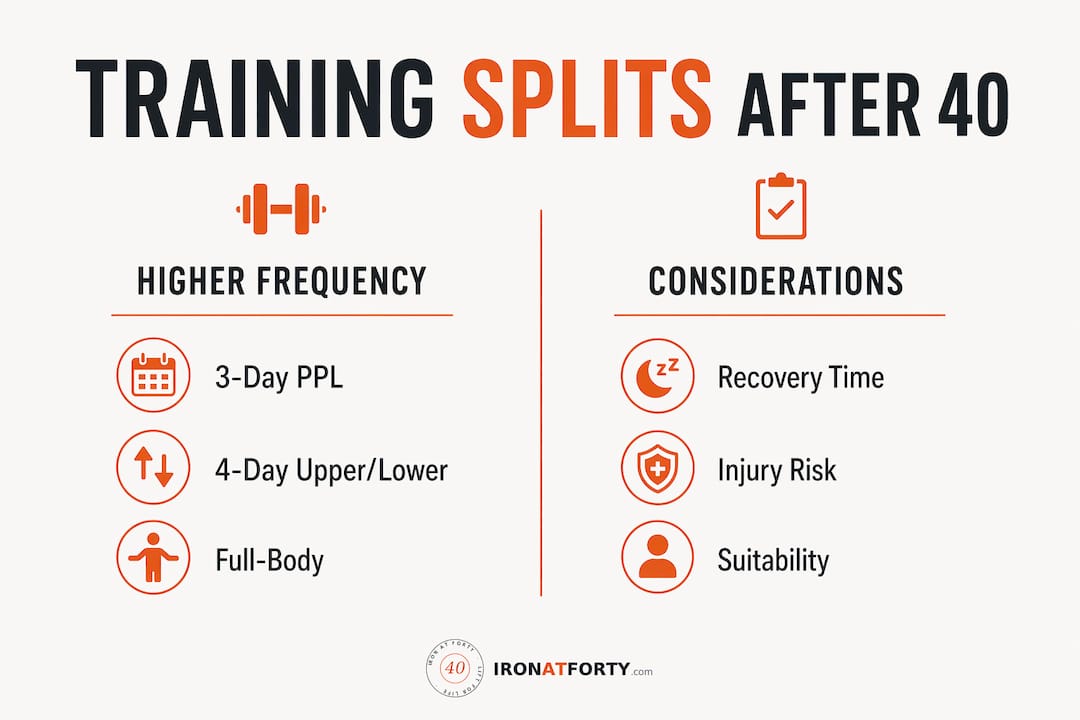
The 3-day full-body split is the most forgiving. Each session hits every major muscle group with moderate volume, then gives you 48 hours or more before the next session. That gap is exactly what your tendons and CNS need.
Pro Tip: If you are new to structured splits or returning after a break, start with a 3-day full-body routine for 8–12 weeks before considering a 4-day upper/lower. Build the recovery habit before adding frequency.
How to structure your split for maximum gains with minimum damage
Adjusting your split is not just about picking a template. It is about building a structure your body can actually absorb week after week.
-
Set your frequency floor at 3 days. Training 3–4 sessions per week is the sweet spot for most lifters over 40. Three days is your minimum viable dose. Four days is your ceiling in high-stress periods.
-
Distribute volume across shorter sessions. Four 45-minute sessions with 10–12 sets produce similar weekly volume to fewer, longer sessions but with a lower per-session recovery cost. Shorter sessions also protect your CNS from the kind of deep fatigue that bleeds into the next day.
-
Train at 70–85% of your one-rep max. Working at 70–85% 1RM with a controlled eccentric phase promotes hypertrophy and tendon health better than chasing max lifts. A 3-second lowering phase on squats, rows, and presses is not slow. It is smart.
-
Warm up like it is part of the workout. Skipping warm-ups increases injury rates significantly for mature lifters. A proper warm-up for heavy lifting takes 10–15 minutes and protects the joints you are about to load. This is not optional.
-
Build flexibility into your schedule. Dropping to 3 days in high-stress weeks and returning to 4 days when life stabilizes prevents burnout and keeps you consistent long-term. The all-or-nothing approach is what kills training careers after 40.
-
Monitor joint signals weekly. If a joint feels achy before a session, not just muscle soreness but actual joint discomfort, that is a signal to reduce load or swap the exercise. Tendons do not give you many warnings before they give out.
Pro Tip: Use a simple traffic light system. Green means train as planned. Yellow means reduce load by 20% and swap high-impact exercises for machine or cable alternatives. Red means rest or active recovery only. Check in with yourself before every session.
Common mistakes that wreck your split after 40
Most training problems after 40 are not about effort. They are about structure and ego.
- Rigid scheduling. Treating your training days as unmovable appointments sounds disciplined. When life hits, it becomes a trap. Missing one session should not derail your week. Build a split you can adapt without guilt.
- Ego-driven max attempts. Chasing a new one-rep max every few weeks is a young man's game. After 40, the cost of a failed max attempt goes up. A tweaked lower back or torn bicep tendon can cost you months. Train heavy, but train within your recovery capacity.
- Ignoring joint signals. Pushing through joint pain is not toughness. It is how a minor issue becomes a chronic one. Tendon adaptation takes 2–3 weeks. Overloading tendons that are not ready creates injuries that outlast any short-term strength gain.
- Excessive volume per session. More sets do not equal more growth if your recovery cannot absorb them. Ten to fifteen working sets per muscle group per week is a solid target. Cramming all of them into one session defeats the purpose of splitting at all.
- Skipping deload weeks. A planned deload every 4–6 weeks is not weakness. It is maintenance. Your tendons, joints, and CNS need a lower-stress week to consolidate adaptation. Skipping deloads is how overuse injuries sneak up on you.
Sustainability is the real goal. The best training splits over 40 are the ones you can run consistently for years, not the ones that look impressive on paper for six weeks. Check out Ironatforty's training frequency checklist to audit your current setup against these principles.
Key takeaways
Training splits after 40 are the single most controllable variable for building strength without accumulating injuries that compound over time.
| Point | Details |
|---|---|
| Recovery drives split choice | Mature lifters need 48–72 hours between intense sessions for the same muscle group. |
| Modified 3-day PPL is efficient | It delivers roughly 90% of muscle gains with about 50% less injury risk versus a 6-day split. |
| Frequency sweet spot is 3–4 days | Most lifters over 40 build best with 3–4 sessions per week, adjusted for life stress. |
| Tendons lag behind muscles | Tendon adaptation takes 2–3 weeks, so spacing load protects joints even when muscles feel ready. |
| Flexibility beats rigidity | Dropping to 3 days in hard weeks and returning to 4 in stable ones sustains long-term consistency. |
What I have learned from watching lifters over 40 get this wrong
I have seen the same pattern repeat itself. Someone in their mid-40s comes back to lifting after a few years off. They remember what they could do at 30. They jump straight into a 5-day split, go heavy from week one, and skip the warm-up because it feels like wasted time. Six weeks later, they are dealing with a rotator cuff issue or a flared-up knee. Not because they are old. Because they ignored the rules that apply to their body now.
The uncomfortable truth is that the biggest gains after 40 come from what you do not do. You do not train six days. You do not skip the eccentric phase. You do not ignore the ache in your elbow that has been there for two weeks. The lifters I have seen make the best progress past 40 are not the ones training the hardest. They are the ones training the most consistently, month after month, without the setbacks.
There is also a mindset shift that matters. Stop measuring success by your one-rep max and start measuring it by your training age. How many weeks in a row have you trained without missing a session due to injury? That number tells you more about your programming than any PR does. The goal is not to peak in six weeks. The goal is to still be under the bar at 55.
If you want a deeper look at how training consistency beats intensity for long-term results, that article lays it out plainly.
— Jeff
Build your split with the right tools
Ironatforty is built for lifters exactly like you. No recycled gym-bro advice, no programs designed for 22-year-olds with eight hours of sleep and no mortgage.

The Ironatforty training hub covers split programming, progressive overload, and recovery strategies written specifically for the over-40 body. If you want to dial in your nutrition to match your training split, the nutrition section covers fueling for recovery and body composition. And if you need a starting point for your calorie targets, the free TDEE calculator gives you a number you can actually build around. These tools exist because good programming should not require a personal coach budget.
FAQ
Why do training splits matter more after 40?
After 40, recovery slows, collagen declines, and CNS fatigue accumulates faster. Structured splits space your training volume to match your actual recovery capacity, which reduces injury risk and improves long-term consistency.
What is the best workout split for lifters over 40?
A modified 3-day full-body or push-pull-legs split works best for most lifters over 40. It delivers close to the same muscle-building stimulus as a 6-day split with significantly less injury risk.
How many days per week should you lift after 40?
Training 3–4 days per week is the most effective range for mature lifters. Three days is the minimum for consistent progress. Four days is sustainable when sleep and stress are well managed.
Should you still train heavy after 40?
Yes. The key is working at 70–85% of your one-rep max rather than chasing maximum singles. That intensity range builds both muscle and tendon strength without the injury cost of ego-driven max attempts.
How do you protect your joints when following a training split after 40?
Space sessions to allow 48–72 hours of recovery per muscle group, warm up thoroughly before every session, and use controlled eccentric tempos. Tendons adapt over 2–3 weeks, so gradual load progression is non-negotiable.