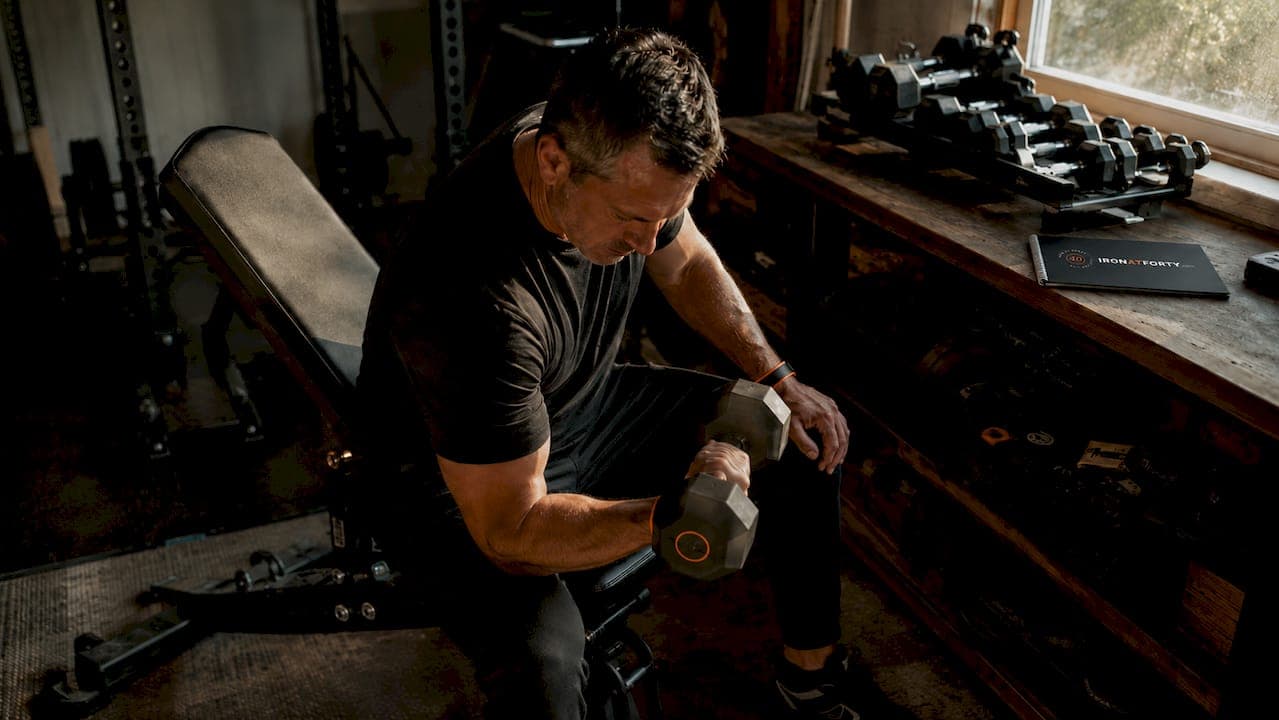
Training consistency is defined as the regular, repeatable effort you bring to the gym week after week, and it predicts long-term strength outcomes better than any single intense session ever will. If you're over 40 and still chasing that "epic" workout to feel like you're making progress, this article is going to challenge that instinct directly. The research is clear: consistency outperforms intensity across more than 30,000 participants in controlled trials. Stuart Phillips, PhD, one of the leading voices in resistance training science, puts it plainly: lower the friction, show up regularly, and the results follow. That's why training consistency beats intensity every time, especially for mature lifters.
What does science say about consistency vs. intensity?
The data on this is not subtle. Consistency predicts fitness outcomes more reliably than equipment choice or workout intensity, based on data from over 30,000 participants across multiple controlled trials. That finding alone should make you rethink how you structure your week.

The American College of Sports Medicine (ACSM) reinforced this in its most recent position stand. Training to failure and complex periodization do not consistently improve outcomes over simple, consistent training. That's a major institution telling you that the complicated stuff you read about on fitness forums is not the edge you think it is.
Here's what the baseline looks like for adults:
| Training Parameter | Recommended Minimum | Why It Matters |
|---|---|---|
| Moderate aerobic activity | 150 minutes per week | Supports cardiovascular and metabolic health |
| Strength training frequency | 2 sessions per week | Sufficient stimulus for muscle retention and growth |
| Session duration | 20–30 minutes | Manageable and sustainable for most schedules |
| Consistent program length | 12–24 months | Where meaningful physiological benefits emerge |
The Mayo Clinic recommends at least two strength sessions per week for adults, each lasting 20–30 minutes. That's not a massive time commitment. The problem is most people skip those sessions when life gets busy, then try to compensate with one brutal session on the weekend.
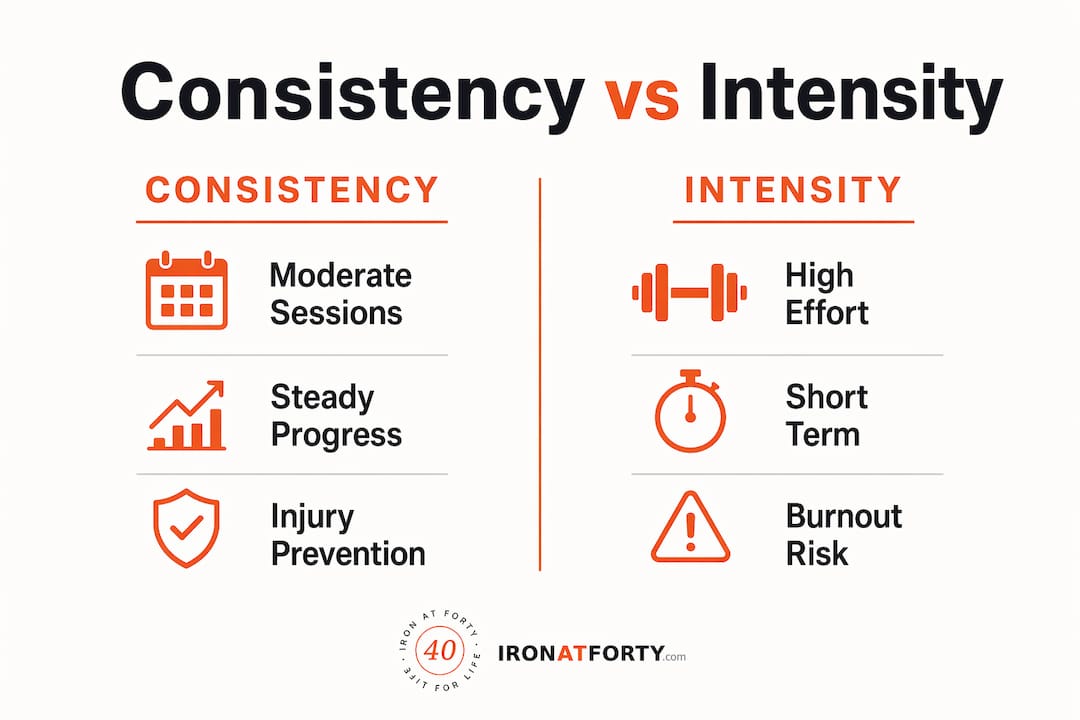
Training volume and frequency drive muscular and aerobic adaptations more than periodic intense sessions. Your body adapts to repeated, moderate stimulus. It does not adapt well to chaos.
Pro Tip: Track your training sessions on a simple calendar app or notebook. Seeing a streak of consistent weeks is a stronger motivator than any PR you'll chase in a single session.
Why consistency prevents injury and burnout after 40
About 50% of people drop out of new exercise programs within six months. High initial intensity is one of the top predictors of that dropout. That statistic is not a coincidence. It's a pattern.
When you go too hard too fast, you create a cycle that Ironatforty calls "feast or famine" training. Here's how it plays out:
- You crush a brutal leg day after two weeks off.
- You're so sore you can't train for four or five days.
- You feel guilty, so you go hard again when you return.
- The cycle repeats, and your body never gets a consistent stimulus.
The heroic session cycle of intense workouts followed by long rest periods resets your progress. Excessive soreness delays your next session, which means you're training less frequently than you think. Over time, this is worse than training moderately every single week.
For lifters over 40, this matters even more. Recovery slows with age. Connective tissue takes longer to adapt than muscle. Joints that get hammered with irregular, high-intensity loads accumulate wear without getting the steady adaptation signal they need to stay healthy. Gradual, consistent loading gives tendons, ligaments, and cartilage time to catch up with the demands you're placing on them.
Burnout is the other side of this coin. Psychological fatigue from dreading intense sessions is real. When training feels like punishment, adherence collapses. A sustainable program you actually look forward to will always outperform a "perfect" program you abandon after eight weeks.
Pro Tip: Set a floor, not a ceiling. Decide your minimum weekly training commitment, say two 25-minute sessions, and protect that floor no matter what. You can always do more. The floor keeps you in the game.
How to build a consistent strength routine over 40
Designing a sustainable plan is less about finding the perfect program and more about removing every reason you might skip a session. Here's how to do it:
-
Set a realistic frequency target. Two to three strength sessions per week is the sweet spot for most adults over 40. Training frequency matters more than session length when you're building a long-term habit.
-
Keep sessions short enough to be repeatable. A 30-minute full-body session you do twice a week beats a 90-minute session you do once every two weeks. Short and repeatable wins.
-
Apply progressive overload within a manageable range. Add one rep or a small amount of weight every one to two weeks. You don't need to push to failure every session. Steady progress compounds over months.
-
Reduce friction wherever possible. Stuart Phillips, PhD, advises lowering training friction as the primary lever for adherence. That means training at a gym close to home or work, keeping a set of dumbbells at home for backup sessions, and having a default workout you can do when motivation is low.
-
Track progress simply. A notebook or an app like Strong works fine. Seeing your numbers move over weeks and months is the feedback loop that keeps you consistent.
Here's a comparison of two common approaches for over-40 lifters:
| Approach | Frequency | Intensity | 6-Month Outcome |
|---|---|---|---|
| Consistent moderate training | 2–3x per week | Moderate, progressive | Steady strength gains, low injury risk |
| Sporadic high-intensity training | 1x per week or less | High, irregular | Frequent soreness, stalled progress, higher dropout |
The numbers are not close. A simple, sustainable program followed consistently for 12–24 months predicts better outcomes than any complex periodization scheme. You don't need a new program. You need to show up consistently.
Intensity vs. consistency: clearing up the biggest myths
Intensity is not the enemy. Let's be clear about that. The problem is treating intensity as the primary variable when it should be a secondary one.
Here are the myths worth calling out directly:
- Myth: More intense workouts produce faster results. The reality is that results compound from moderate, repeatable stimulus rather than sporadic high-intensity spikes that force long recovery breaks.
- Myth: You need to train to failure to build muscle. The ACSM's latest review shows that training to failure does not consistently outperform stopping short of failure when total volume is matched.
- Myth: Complex periodization is necessary for serious gains. For adults over 40, a simple program done consistently beats a sophisticated plan that creates confusion or overwhelm.
"Athletes who train steadily at moderate intensity without pushing into fatigue territory have better results and fewer injuries than those who rely on intense bursts." — Faster Skier, 2026
That quote applies directly to strength training. The slow-burn adaptation theory holds that metabolic and stress regulation benefits require 12–24 months of consistent training to fully materialize. You cannot shortcut that timeline with intensity. You can only honor it with regularity.
The right balance looks like this: train at a level that challenges you without wrecking you. Leave one to two reps in the tank. Come back in two days and do it again. That's the formula.
Key takeaways
Consistent, moderate training is the single most reliable path to long-term strength and health gains for adults over 40, outperforming intensity every time.
| Point | Details |
|---|---|
| Consistency predicts outcomes | Data from 30,000+ participants shows consistency beats intensity and equipment as a fitness predictor. |
| Dropout risk is real | 50% of exercisers quit within six months, with high initial intensity as a leading cause. |
| Minimum effective dose | Two strength sessions per week at 20–30 minutes each meets the baseline for meaningful adaptation. |
| Long-term timeline required | Profound physiological benefits emerge after 12–24 months of consistent training, not weeks. |
| Reduce friction first | Lowering barriers to showing up, like shorter sessions and convenient locations, drives adherence more than motivation. |
The honest truth about chasing intensity after 40
I've watched a lot of lifters over 40 make the same mistake. They come back to training after a gap, feel that old competitive fire, and immediately try to train like they did at 28. Two weeks later, they're nursing a tweaked shoulder or a cranky knee, and they're off for another month.
The mindset shift that actually changes things is this: stop measuring your workouts by how destroyed you feel afterward. Start measuring them by how many you complete in a row. A session that leaves you at 80% effort but lets you train again in 48 hours is worth ten times more than a session that wrecks you for a week.
I've also seen the flip side. Lifters who commit to two or three modest sessions per week, track their numbers, and stay patient. After six months, they're stronger than they've been in years. After 12 months, their body composition has shifted in ways they didn't expect. The training progress you can see over a year of consistency is genuinely transformative.
The uncomfortable truth is that most people over 40 don't have a training problem. They have an adherence problem. The program is rarely the issue. Showing up is. Once you accept that, everything gets simpler. You stop chasing the perfect plan and start protecting your schedule.
Build the habit first. The intensity can come later, when your body is ready for it.
— Jeff
Start building your consistent training foundation with Ironatforty
Ironatforty exists for lifters over 40 who want real guidance, not recycled gym bro advice. If this article resonated with you, the site has the tools and resources to help you put it into practice right now.
Use the free TDEE Calculator to dial in your caloric needs so your nutrition supports your training, not fights it. Browse the full library of training and nutrition tools built specifically for mature lifters. And if you want a deeper look at the physiology behind why training after 40 requires a different approach, Ironatforty covers it all. No coach required. Just honest, science-backed content that respects your time and your intelligence.
FAQ
Why does consistency beat intensity in strength training?
Consistency provides a repeated, moderate stimulus that drives steady adaptation in muscle, connective tissue, and metabolism. Intensity without consistency forces long recovery gaps that reset progress and increase injury risk.
How often should adults over 40 strength train?
The Mayo Clinic recommends at least two strength sessions per week for adults, each lasting 20–30 minutes. That frequency is sufficient for muscle retention, strength gains, and metabolic health.
How long before consistent training produces real results?
Meaningful physiological and metabolic benefits emerge after 12–24 months of consistent training. Short-term programs rarely produce the deep adaptations that sustained effort creates over time.
Is high-intensity training ever appropriate after 40?
Yes, but only as a secondary variable layered onto a consistent foundation. The ACSM's latest guidelines show that effort and consistency outperform complex intensity strategies for most adults.
What is the biggest barrier to training consistency?
High initial intensity is one of the top predictors of dropout, with approximately 50% of new exercisers quitting within six months. Lowering session intensity and reducing logistical friction are the most effective fixes for long-term adherence.