A balance of HIIT sessions alongside progressive resistance training sessions is the recommended approach. If you're over 40 and still lifting, concurrent training research is clear: keep strength as the structural base, and layer conditioning on top, not the other way around.
The quick version:
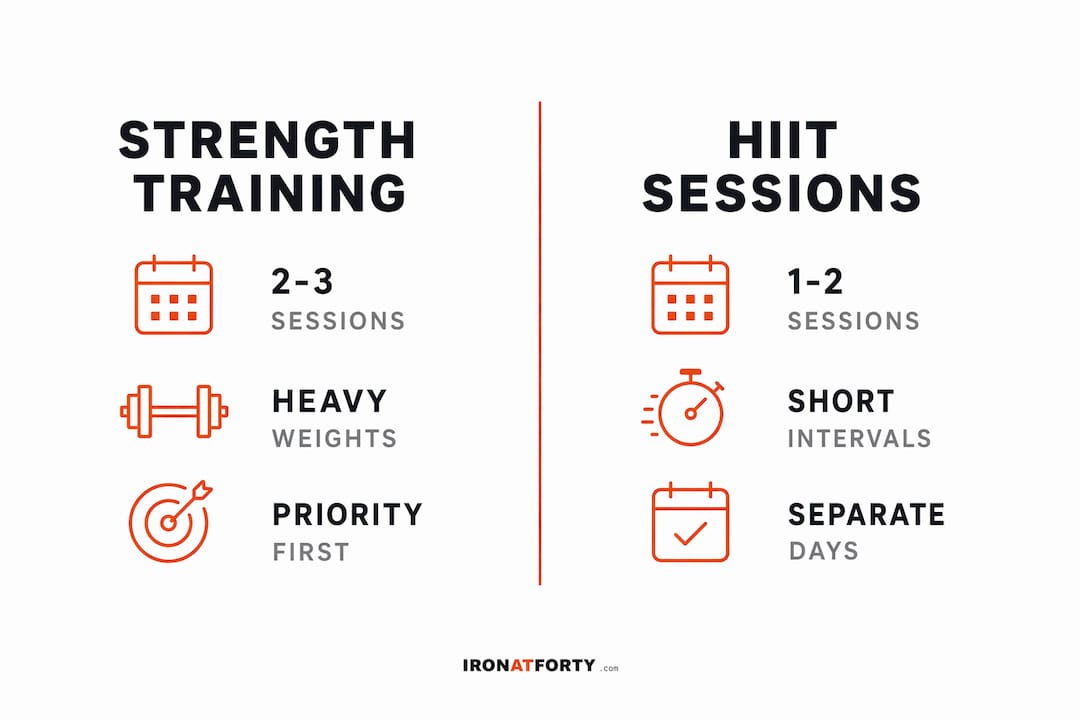
- Resistance training: 2–3 sessions per week, progressive load, non-negotiable
- HIIT: 1–2 sessions per week, 15–25 minutes, on non-lifting days or well-separated from heavy work
- Session length: Cap HIIT at 15–25 minutes; longer is not better here
- When to skip HIIT: After a heavy lower-body session, when sleep is poor, or when your lifts are stalling
Your next 48 hours: look at your training calendar and slot HIIT on days that sit at least 24 hours away from your heaviest compound lifts.
Table of Contents
- Why does HIIT actually matter after 40?
- How should you schedule HIIT around strength training?
- What does a safe HIIT session look like for men over 40?
- What does a 4-week sample plan look like?
- How do you track fatigue and know when to back off?
- What if you have joint pain, hypertension, or back problems?
- Quick programming rules for men over 40
- Key Takeaways
- The strength-first case, stated plainly
- Ironatforty tools that help you run this plan
- Useful sources
- FAQ
Why does HIIT actually matter after 40?
HIIT isn't just cardio rebranded. For aging lifters specifically, it targets something resistance training alone can't fully address: VO2peak and cardiorespiratory function. A meta-analysis of 11 studies found significant improvements in VO2peak, 6-minute walk distance, and quality of life in older adults following HIIT interventions.
Here's what that means for you in practical terms:
- VO2max preservation slows the aerobic decline that accelerates after 40 and affects work capacity under the bar
- Fast-twitch fiber recruitment stays sharper when you train near-maximal efforts, even briefly
- Metabolic health improves, including insulin sensitivity, which matters if you're managing body composition without a caloric crash
What HIIT won't do: build meaningful muscle or protect bone density the way progressive resistance does. A sweaty HIIT class is not a complete program. Think of HIIT as the topping, not the cake. The cake is your squat, your deadlift, your press, loaded progressively over time.
How should you schedule HIIT around strength training?
Strength sessions get priority in the schedule. Always. Concurrent training research consistently shows that programs maintaining 2–3 weekly resistance sessions with progressive load preserve or improve maximal strength even when HIIT is added, provided the sequencing protects mechanical tension.
The practical rule: place HIIT on non-lifting days, or separate it from heavy resistance work by several hours if you must train both on the same day. Never do high-volume intervals the day before a heavy lower-body session.
| Weekly Split | Resistance Sessions | HIIT Sessions | Best For |
|---|---|---|---|
| 2 strength + 1 HIIT | Mon, Thu | Wed | Beginners or high-stress weeks |
| 3 strength + 1 HIIT | Mon, Wed, Fri | Sat | Most lifters 40+; solid default |
| 3 strength + 2 HIIT | Mon, Wed, Fri | Tue, Thu | Well-recovered, experienced lifters |
A concrete example: if Monday is heavy squats and deadlifts, Tuesday HIIT is fine. Wednesday upper-body strength, Thursday rest or light activity. Friday lower-body accessory work, Saturday a short HIIT session. That 48–72 hour buffer between heavy lower-body days and interval work is your interference insurance. For smart training frequency over 40, that buffer is non-negotiable.
What does a safe HIIT session look like for men over 40?
Format: 15–25 minutes total, work:rest ratio of 1:2 (e.g., 20 seconds on, 40 seconds off), targeting RPE 8–9 on the modified Borg scale (0–10) during work intervals.
Warm-up checklist (8–10 minutes)
- 3–4 minutes of low-intensity movement: walking, light cycling, or rowing
- Hip circles, leg swings, shoulder rotations (joint prep, not static stretching)
- 2 rounds of bodyweight squats, glute bridges, and band pull-aparts
- 2 progressive build-up intervals at 50–60% effort to prime the system
For a detailed warm-up protocol built for older lifters, the warm-up guide for heavy lifting covers the full movement prep sequence.
Three sample sessions
Session A: Low-impact bike intervals Stationary bike, 8–10 rounds of 20 seconds hard (RPE 8–9) / 40 seconds easy. Total work time: 16–20 minutes. Target HR during work: 80–95% max. Good for knee or hip issues.
Session B: Mixed strength-interval Alternating kettlebell swings (15 reps) and box step-ups (10 reps each leg), 4–5 rounds, 45 seconds rest between rounds. Concurrent programs that pair power-oriented resistance movements with interval structure improve both VO2peak and functional strength simultaneously.
Session C: Treadmill incline intervals 6–8 rounds of 30 seconds at 8–10% incline, fast walk or jog (RPE 8), 60 seconds flat walk recovery. No joint pounding, high cardiovascular demand.
Scaling for joint issues: Swap running for cycling or swimming. Reduce work intervals to 15 seconds if needed. Harvard Health guidance confirms low-impact HIIT formats deliver comparable cardiorespiratory benefits for older adults.
Pro Tip: Don't chase speed or absolute load in HIIT. Use RPE 8–9 as your intensity anchor. If you hit that number on a 6% incline walk, that's your near-max. Small increases in incline or resistance over weeks are how you progress, not by matching a 30-year-old's pace.
What does a 4-week sample plan look like?
Objective: Raise or maintain VO2peak while preserving strength gains. Weeks progress by adding one interval round or slightly shortening rest, not by adding sessions.
| Week | Mon | Tue | Wed | Thu | Fri | Sat | Sun |
|---|---|---|---|---|---|---|---|
| 1 | Strength A | Rest | Strength B | HIIT (6 rounds) | Rest | Strength C | Rest |
| 2 | Strength A | Rest | Strength B | HIIT (7 rounds) | Rest | Strength C | Rest |
| 3 | Strength A | HIIT (6 rounds) | Strength B | Rest | Strength C | HIIT (7 rounds) | Rest |
| 4 | Strength A | HIIT (7 rounds) | Strength B | Rest | Strength C | HIIT (8 rounds) | Rest |
Deload signal: if your strength numbers drop in week 3 or 4, repeat week 2 before progressing. The 4-week block structure works because it builds load incrementally while keeping recovery intact. For effective training programs built around this structure, Ironatforty covers the full framework.
How do you track fatigue and know when to back off?
Monitor session RPE and your lift performance numbers. If your strength is declining, reduce HIIT volume first, not intensity. That's the rule.
Monitoring checklist:
- Session RPE after each workout (target: HIIT sessions feel hard but not wrecked)
- Morning resting heart rate (optional but useful: a rise of 5–7 bpm above baseline is a recovery flag)
- Sleep quality: less than 6 hours consistently will undermine adaptation faster than any training error
- Lift performance: track your top working sets weekly; stagnation over 2 weeks is a signal
Nutrition: Protein at 0.8–1 gram per pound of bodyweight supports muscle retention during concurrent training blocks. Use the TDEE calculator to confirm you're eating enough to support both strength and interval work. For detailed protein guidance, the protein intake guide for over 40 breaks down timing and targets.
Red flags that require reducing HIIT:
- Persistent strength loss across 2+ consecutive sessions
- Resting HR elevated by more than 7 bpm above your normal baseline
- Joint inflammation or unusual soreness that doesn't resolve in 48 hours
- Sleep quality crashing despite no lifestyle changes
What if you have joint pain, hypertension, or back problems?
Get medical clearance before starting if you have cardiovascular risk factors, uncontrolled hypertension, or a history of cardiac events. One sentence, non-negotiable.
For common issues, here are the immediate modifications:
- Knee pain: Replace running and jumping with cycling, rowing, or incline walking. Keep RPE targets the same, change the modality.
- Lower back problems: Avoid loaded carries and high-impact jumping. Bike intervals or swimming are your floor. Reduce work interval duration to 15–20 seconds.
- Hypertension (controlled): Use conservative RPE targets of 6–7 rather than 8–9. Monitor blood pressure before and after sessions. Some medications (beta-blockers) blunt heart rate response, so RPE becomes your primary intensity guide, not HR percentage.
- Osteoarthritis: Low-impact formats only. Prioritize joint-friendly modifications and monitor pain during and 24 hours after sessions. Pain above a 3/10 during exercise is a stop signal.
Harvard Health notes that HIIT requires careful individualization for older adults with comorbidities. Supervision matters here. If you're managing multiple conditions, work with a clinician before running any interval protocol unsupervised.
Quick programming rules for men over 40
- Strength comes first. Schedule resistance sessions before you schedule HIIT. Never sacrifice a progressive lift for a conditioning session.
- Cap HIIT at 2 sessions per week. More is not more. Two well-placed sessions deliver the cardiorespiratory benefit without the interference risk.
- Keep sessions short. 15–25 minutes of actual interval work is enough. Longer sessions increase fatigue without proportional benefit.
- Prefer near-maximal short efforts. 15–60 second bouts at 90–95% effort are time-efficient and compatible with strength preservation.
- Use RPE, not pace. Your 8/10 effort is your 8/10. Comparing your speed to a younger athlete is irrelevant and counterproductive.
- Progress by one variable at a time. Add one interval round, or reduce rest by 10 seconds, or increase incline by 1–2%. Never change all three in the same week.
- Deload when strength stalls. Two consecutive sessions with declining performance means reduce HIIT volume, not push harder.
- Consistency beats heroics. Training consistency over months outperforms any single brutal session.
RPE quick reference:
| RPE (0–10) | How It Feels | Use For |
|---|---|---|
| 5–6 | Conversational, moderate effort | Warm-up, recovery intervals |
| 7–8 | Hard, breathing heavy, can't hold a conversation | Work intervals (standard) |
| 9–10 | Near-maximal, unsustainable beyond 30–60 seconds | Short sprint efforts |
Key Takeaways
For lifters over 40, the most effective HIIT routine combines 2–3 progressive resistance sessions with 1–2 short HIIT sessions per week, with strength always scheduled first.
| Point | Details |
|---|---|
| Weekly session split | Use 2–3 resistance sessions plus 1–2 HIIT sessions; never let intervals crowd out progressive lifting. |
| Sequencing rule | Place HIIT on non-lifting days or 24+ hours away from heavy compound work to protect strength gains. |
| Session length | Cap HIIT at 15–25 minutes; short near-maximal efforts of 15–60 seconds are most compatible with strength training. |
| Red flag response | If strength declines across two sessions, reduce HIIT volume first before adjusting anything else. |
| Ironatforty tools | Use the 1RM calculator and TDEE calculator to set training intensities and calorie targets for this plan. |
The strength-first case, stated plainly
The fitness industry keeps selling HIIT as the answer for men over 40 who want to lose fat, get fit, and feel younger. It's not wrong, exactly. HIIT does improve VO2peak, metabolic health, and fast-twitch function. But the framing is almost always backwards.
Most men over 40 who walk into a HIIT class are already under-muscled and under-loaded. Adding more interval work to that base doesn't fix the problem. It accelerates it. Muscle is the organ of longevity. Bone density follows load. Neither responds meaningfully to a 45-minute bootcamp. What they respond to is progressive mechanical tension, week after week, year after year.
HIIT earns its place in this program as a precise tool: 1–2 short sessions that sharpen your aerobic engine without touching the structural work. That's the version worth doing. The version that treats intervals as the whole program is the one that leaves you tired, stalled, and wondering why you're not making progress.
Ironatforty tools that help you run this plan
The plan above works. It works even better when the numbers are dialed to your body. Ironatforty's free training and nutrition tools let you personalize the key variables without guessing.
Start with the TDEE calculator to confirm your calorie target supports both strength work and interval sessions. Then use the 1RM calculator to set accurate training intensities for your resistance sessions. Both tools are free, no sign-up required. For nutrition support during concurrent training blocks, the nutrition hub covers protein targets, meal timing, and recovery eating in detail. Run the numbers, then run the plan.
Useful sources
- HIIT for Muscle Strength and Sarcopenia Prevention in Older Adults — Systematic review (PMC, 2024) examining HIIT's effects on muscle strength, body composition, and sarcopenia prevention; foundational for understanding HIIT's role in aging lifters.
- Concurrent HIIT and Resistance Training: Musculoskeletal Adaptations — Systematic review of 18 trials; core evidence for sequencing rules, weekly split recommendations, and interference effect guidance.
- HIIT for Cardiometabolic Health in Older Adults: Meta-Analysis — Meta-analysis of 11 studies; primary source for VO2peak, 6MWT, and quality-of-life benefit claims.
- Concurrent Strength and Endurance Training in Middle-Aged and Older Adults — Meta-analysis of 15 studies (566 participants); supports session duration and frequency recommendations.
- HIIT Combined with Strength or Power Training in Older Men: 16-Week RCT — Randomized controlled trial; evidence for mixed strength-interval session design and VO2peak outcomes.
- HIIT for Body Composition and Muscle Strength in Middle-Aged and Older Adults — Systematic review of 8 RCTs; supports body composition and strength claims across age groups.
- Harvard Health: HIIT for Older Adults — Practical guidance on low-impact formats, intensity adaptation, and safety for older exercisers.
- RT and HIIT in Older Women with Cardiometabolic Risk: RCT — 8-week RCT; supports individualization, adaptation timelines, and the value of monitoring non-responders.
FAQ
How many HIIT sessions per week should men over 40 do?
One to two sessions per week is the evidence-backed ceiling for most lifters over 40. More sessions increase interference with strength adaptations without proportional cardiorespiratory benefit.
Should you do HIIT before or after strength training?
Do strength training first. Research shows that placing resistance work before endurance work in the same session produces larger strength gains. If sessions are separate, keep at least several hours between them.
Can HIIT replace strength training for men over 40?
No. HIIT improves VO2peak and metabolic health but produces only modest gains in maximal strength or muscle mass. Progressive resistance training remains the structural base for muscle retention and bone density after 40.
What's the best HIIT workout for men with bad knees?
Stationary bike intervals or incline walking are the most joint-friendly options. Use the same RPE 8–9 intensity target with a low-impact modality, and monitor pain during and 24 hours after each session.
How long should a HIIT session be for men over 40?
15–25 minutes of actual interval work is enough. Longer sessions add fatigue without meaningful additional benefit and increase the risk of interfering with strength recovery.