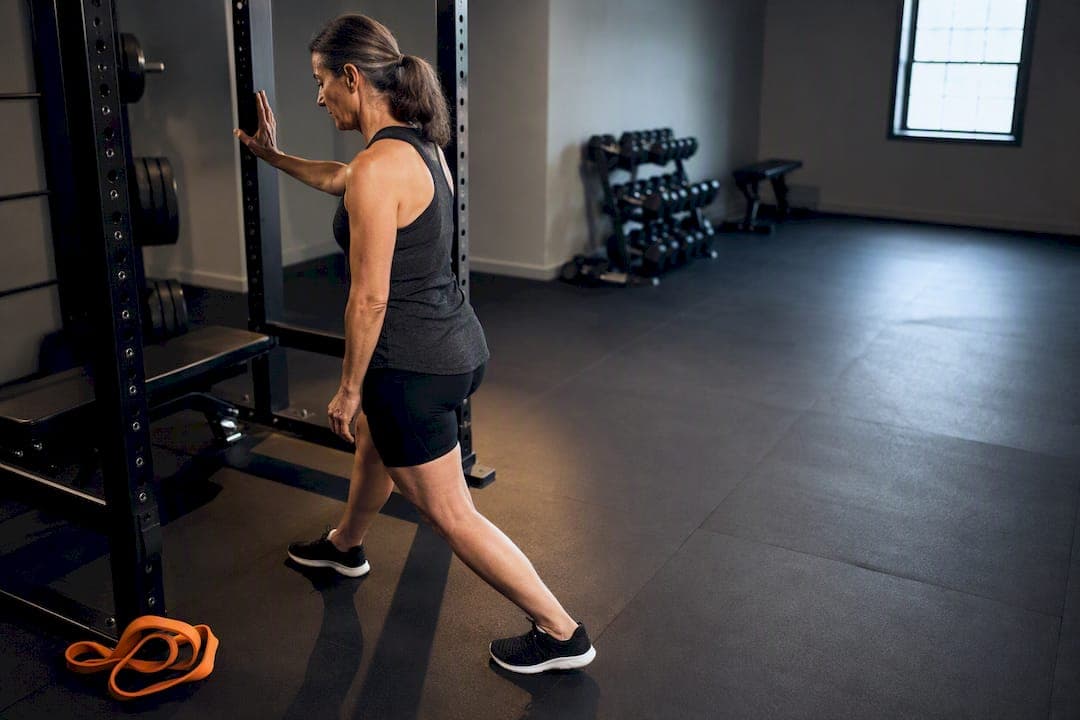
Start with a full-body strength routine, 2–3 sessions per week, hitting squat, hinge, press, pull, and core every session. Keep each workout between 30 and 60 minutes. Leave 1–2 reps in the tank on most sets. Do that consistently for several weeks and you will be stronger, leaner, and more confident under the bar than most guys who walked in before you.

That's the whole game. Everything below is the detail that makes it stick.
Your first-week checklist:
- Pick one of the three plans in Section 4 (2-day, 3-day, or 4-day).
- Schedule your sessions like appointments — Monday/Wednesday/Friday works for most beginners.
- Do a 5–8 minute dynamic warmup before every session (see Section 3).
- Log every set: weight, reps, and how hard it felt.
- Aim for a sufficient protein intake daily to support muscle maintenance and growth.
- Sleep 7–9 hours. Non-negotiable.
Pro Tip: Use the Ironatforty TDEE Calculator on day one to get a real calorie target. Most beginners either eat too little to recover or too much to lose fat — knowing your number removes the guesswork.
Table of Contents
- Why a beginner workout plan for men actually works
- Gym basics: how to warm up and move safely
- What do the best beginner workout plans for men look like?
- How do you actually make progress week after week?
- What mistakes do most beginners make in the gym?
- Nutrition and recovery: the basics that actually move the needle
- Starting after 40: what you need to change and what stays the same
- What should your first week and first month look like?
- Key Takeaways
- The honest truth about starting in the gym
- Free tools from Ironatforty to personalize your plan
- Useful sources and further reading
- FAQ
Why a beginner workout plan for men actually works
Most guys walk into a gym, copy what the biggest person in the room is doing, and quit within six weeks. Not because they lack willpower. Because random effort without a repeatable structure produces random results, and random results kill motivation fast.
A simple, structured plan solves this. Harvard Health's guidance on starting a strength training program is clear: the single biggest mistake beginners make is inconsistency, not program choice. Repeat a basic program consistently over a period of weeks and you capture what coaches call "newbie gains" — a window of rapid neurological adaptation where your nervous system learns to recruit muscle fibers more efficiently. Strength goes up fast. Technique improves. The habit forms.
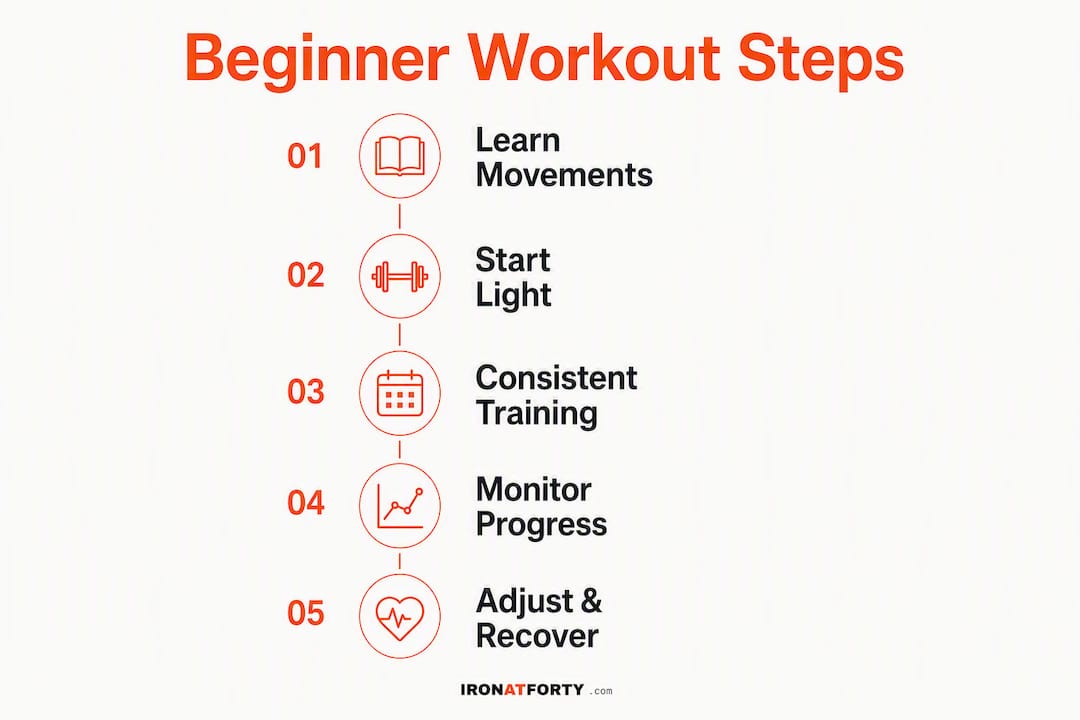
The American College of Sports Medicine notes that shorter, frequent sessions lower the barrier to starting and are effective for building strength. Two sessions per week is enough to make real progress. Three is better. More sessions may risk impairing recovery if managed poorly.
What to expect on a realistic timeline:
- Weeks 1–4: Strength increases are mostly neurological. You're not building much new muscle yet — your brain is learning to use what you already have. Technique improves quickly. Some soreness, especially after leg days.
- Weeks 5–8: Visible changes begin. Clothes fit differently. Weights that felt heavy in week 1 feel manageable. Sleep and energy often improve noticeably.
- Weeks 9–12: Measurable muscle gain and fat loss (if calories are dialed in). You have a training habit. The program feels like part of your week, not an interruption.
Strength training also does something most cardio-focused plans don't: it preserves and builds muscle mass, which directly supports metabolic health. Research published in PMC shows strength training improves insulin sensitivity — a benefit that compounds over years, not just weeks.
Gym basics: how to warm up and move safely
Skipping the warmup is the fastest route to a pulled muscle and a two-week setback. Five to eight minutes of movement prep before your first working set is not optional.
Dynamic warmup sequence (do this before every session):
- Hip hinge drill: Stand with feet hip-width apart, push hips back with a soft knee bend, feel the hamstrings load. 10 reps.
- Bodyweight squat: Slow descent, 3-second hold at the bottom, drive through the whole foot. 10 reps.
- Banded pull-aparts: Hold a light resistance band at chest height, pull it apart to shoulder width. 15 reps.
- Scap pull-downs: Hang from a bar or cable, depress your shoulder blades without bending your elbows. 10 reps.
- Arm circles and thoracic rotations: 30 seconds each to open the upper back and shoulders.
For a more detailed warmup progression built specifically for older lifters, this guide on warming up for heavy lifting covers mobility drills that carry over directly to compound movements.
Form cues for the five foundational patterns
Squat: Sit back and down, not just down. Knees track over the second toe. Chest stays tall. Drive the floor away on the way up.
Hinge (deadlift): Soft knees, bar stays close to the shins, hips push back before they drop. Think "proud chest" to keep the spine neutral.
Press (bench or overhead): Set your shoulder blades before you unrack. Brace your core like you're about to take a punch. Lower the bar with control — don't let it drop.
Pull (row or lat pulldown): Lead with your elbows, not your hands. Chest up, scapulae retract at the top. Avoid shrugging your traps into the movement.
Core: Neutral spine, not a flat back or an arch. Brace by breathing into your belly and tightening your midsection. Most core work is about resisting movement, not creating it.
Gym etiquette basics: Wipe down equipment after use. Re-rack weights to where you found them. Don't sit on a machine scrolling your phone between sets during peak hours. If you're unsure how a machine works, ask a staff member — that's literally what they're there for.
Pro Tip: Film one set per exercise from the side on your phone. You'll spot form errors in 10 seconds that you'd never feel from the inside. One session with a certified personal trainer to review your footage is worth more than six months of guessing.
What do the best beginner workout plans for men look like?
Three templates. Pick the one that fits your schedule and stick with it. Don't mix and match until you've run one plan for at least 8 weeks.
2-day full-body (best for very busy beginners)
Two sessions per week, 45–60 minutes each. Hit every major pattern both days with slightly different exercises to avoid monotony.
| Exercise | Sets x Reps | Rest | Notes |
|---|---|---|---|
| Goblet squat | 3 x 8–10 | 90 sec | DB or kettlebell; focus on depth |
| Romanian deadlift | 3 x 8–10 | 90 sec | Hinge pattern; bar or dumbbells |
| Dumbbell bench press | 3 x 8–10 | 90 sec | Neutral grip option if shoulders are tight |
| Seated cable row | 3 x 10–12 | 60 sec | Chest up, elbows drive back |
| Plank | 3 x 20–30 sec | 45 sec | Brace hard; quality over duration |
Progression rule: Add 1 rep per set each session until you hit the top of the range across all sets. Then add 5 lb (lower body) or 2.5 lb (upper body) and reset to the bottom of the rep range.
3-day full-body (best balance for most beginners)
Monday, Wednesday, Friday. Each session is 45–55 minutes. This is the 3-day-a-week program structure that produces the most consistent results for men starting out.
| Exercise | Sets x Reps | Rest | Notes |
|---|---|---|---|
| Barbell back squat (or goblet squat) | 3 x 6–8 | 2 min | Start light; bar only is fine |
| Conventional deadlift (or trap bar) | 3 x 5 | 2 min | One heavy hinge per session |
| Barbell bench press | 3 x 6–8 | 90 sec | Spot or use dumbbells solo |
| Bent-over barbell row | 3 x 8–10 | 90 sec | Hinge slightly forward, pull to navel |
| Overhead press | 2 x 8–10 | 90 sec | Standing or seated |
| Ab wheel rollout (or dead bug) | 3 x 8–10 | 45 sec | Core anti-extension |
Session length estimate: 50 minutes including warmup.
4-day upper/lower split (for faster recoverers or more volume)
Upper days: press and pull. Lower days: squat and hinge. Run this only after 6–8 weeks on a full-body plan, or if you genuinely recover fast and want more weekly volume. See training split options for a full breakdown of when to make the switch.
Upper A: Bench press 4x6, barbell row 4x6, overhead press 3x8, lat pulldown 3x10, face pulls 3x15. Lower A: Squat 4x6, Romanian deadlift 3x8, leg press 3x10, walking lunges 2x12, plank 3x20 sec. Upper B / Lower B: Rotate exercise variations (incline press, cable row, front squat, trap bar deadlift).
Equipment substitutions: No barbell? Swap every barbell lift for a dumbbell equivalent. No cable machine? Use resistance bands for rows and pull-aparts. The pattern matters more than the tool.
Pro Tip: Double progression is the simplest system that works: add reps until you hit the top of your range across all sets, then add weight. Don't add weight until you've earned it with reps.
How do you actually make progress week after week?
Progress isn't random. It follows a hierarchy, and beginners who skip steps are the ones who plateau at week 6 and blame the program.
The progression hierarchy:
- Rep quality first. Full range of motion, controlled tempo, no grinding reps. If form breaks down, the set is over.
- Volume second. Add reps within your target range before you add weight.
- Load last. Once you've hit the top of your rep range with clean form across all sets, add weight.
Practical numbers: add 2.5–5 lb on upper body lifts and 5–10 lb on lower body lifts when you're ready to progress. Those increments feel small. Over 12 weeks they add up to real strength.
Frequency tradeoffs:
- 2x/week: Lower total volume, but very sustainable. Good for beginners with demanding jobs, limited sleep, or joint sensitivity.
- 3x/week: The sweet spot for most men. Hits each muscle group 2–3 times per week, which evidence supports as optimal for muscle protein synthesis.
- Moving from 2x to 3x: do it after 4–8 weeks once you've confirmed your recovery is solid (no persistent soreness, performance is trending up).
Reps in reserve (RIR): Finish most sets with 1–2 reps left in the tank. Not 5 reps left (too easy), not 0 reps left (too taxing for a beginner's recovery). The 6-3 Strength Framework covers six movement patterns across three weekly sessions and recommends exactly this approach for sustainable progress.
Deloads: Every 4–8 weeks, cut your volume by roughly 30–40% for one week. Drop sets, not weight. If you're feeling beat up, your performance is stalling, or soreness is accumulating, that's the signal. Deloads aren't weakness — they're how you keep training for years instead of months.
What to log every session:
- Exercise name
- Weight used
- Sets and reps completed
- RPE (rate of perceived exertion, 1–10) or RIR (reps in reserve)
That log is your progress proof. When motivation dips, open it and look at week 1 versus week 8.
What mistakes do most beginners make in the gym?
Most beginner mistakes aren't about exercise selection. They're about habits and mindset.
The most common errors and their fixes:
- Chasing novelty. Switching programs every 2–3 weeks because something new looks better online. Fix: commit to one plan for a minimum of 8 weeks before evaluating it.
- Training to failure every set. Feels productive. Destroys recovery and increases injury risk. Fix: use 1–2 RIR on all working sets except occasional final sets.
- Skipping warmups. The 5 minutes you save will cost you 2 weeks when something pulls. Fix: treat the warmup as the first part of the workout, not optional prep.
- Ignoring protein. You can't build or preserve muscle without adequate protein. Fix: hit your daily target before worrying about meal timing or supplements.
- Inconsistent scheduling. Training when you "feel like it" means training 1–2x per week on average. Fix: put sessions in your calendar like meetings. Same days, same time.
- Ego loading. Adding weight before you've earned it with reps and clean form. Fix: follow double progression and trust the process.
Being a good gym member matters too. Wipe down benches and machines. Don't occupy two pieces of equipment simultaneously during busy hours. Ask before working in on someone's station. These habits make the gym a better place for everyone and, practically, make staff more willing to help you when you need it.
Pro Tip: If you're unsure whether you're recovering properly, check your sleep first. Poor sleep is the most underrated performance killer in the gym. Seven hours minimum — eight is better.
Nutrition and recovery: the basics that actually move the needle
Training is the stimulus. Nutrition and sleep are where the adaptation happens. Get the training right and ignore these two and you'll leave most of your results on the table.
Protein target: Aim for 1.6–2.2 grams of protein per kilogram of bodyweight daily (roughly 0.7–1 gram per pound). Spread it across 3–4 meals rather than loading it all at one sitting. Post-workout protein is helpful, but total daily intake matters far more than timing. For a deeper breakdown of practical food choices and targets, this protein guide for lifters over 40 covers exactly what to eat and how much.
Calorie basics: Use the Ironatforty TDEE Calculator to estimate your daily energy needs. From there:
- Building muscle: eat 200–300 calories above TDEE.
- Losing fat while maintaining muscle: eat 300–500 calories below TDEE.
- Body recomposition (beginners can do this): eat at or near TDEE with high protein.
Recovery checklist:
- Sleep 7–9 hours per night. This is where muscle is built and hormones reset.
- Walk daily. Even 20–30 minutes of low-intensity movement improves recovery and reduces soreness.
- Plan your deloads (every 4–8 weeks, as covered above).
- Address joint pain early. Persistent joint pain is not normal soreness. See a physical therapist before it becomes a real problem.
Visible changes from nutrition adjustments typically appear in the same 4–12 week window as training adaptations. The two compound together — you won't see the full effect of your training without the nutrition to support it.
Starting after 40: what you need to change and what stays the same
The fundamentals don't change after 40. Squat, hinge, press, pull, core. Compound movements. Progressive overload. Protein and sleep. What changes is the margin for error.
Recovery takes longer. Joints need more warmup time. Tendons and connective tissue adapt more slowly than muscle. That's not a reason to train less — it's a reason to train smarter.
Program modifications for men 40+:
| Variable | Standard Beginner | Beginner 40+ |
|---|---|---|
| Weekly frequency | 3x full-body | 2–3x full-body or upper/lower (aim for each major muscle group 2–3 times per week) |
| Squat variation | Barbell back squat | Goblet squat or hex bar squat |
| Deadlift variation | Conventional deadlift | Trap bar deadlift or Romanian deadlift |
| Rep range | 5–8 (strength focus) | 8–12 (joint-friendly range) |
| Intensity | 1–2 RIR | 2–3 RIR early on |
| Deload frequency | Every 6–8 weeks | Every 4–6 weeks |
| Protein target | 1.6 g/kg/day | sufficient protein intake daily |
The trap bar deadlift deserves special mention. It places the load closer to your center of gravity, reduces shear force on the lumbar spine, and is significantly easier to learn than the conventional deadlift. For most men over 40 starting out, it's the better default choice.
Hitting major muscle groups 2–3 times per week remains the evidence-based recommendation for older beginners. Once-a-week bodybuilding splits don't provide enough stimulus frequency for muscle protein synthesis to stay elevated.
Pro Tip: Movement quality over load, always. A goblet squat with 35 lb done through full range of motion builds more functional strength than a half-rep barbell squat with 135 lb. Your joints will thank you in year two.
For joint-specific guidance and exercise modifications, Ironatforty's joints resource covers pain management and recovery strategies built for lifters over 40.
What should your first week and first month look like?
Decision fatigue is real. Here's exactly what to do, day by day.
Week 1 schedule (3-day full-body example):
- Monday: Dynamic warmup (8 min) + Session A from the 3-day plan above. Log everything.
- Tuesday: Rest or 20–30 min walk. Light stretching if sore.
- Wednesday: Dynamic warmup (8 min) + Session A again (same exercises, same weights). Focus on form.
- Thursday: Rest or walk.
- Friday: Dynamic warmup (8 min) + Session A. Try to add 1 rep somewhere compared to Monday.
- Saturday/Sunday: Rest, walk, or light mobility work.
Week 1 is not about pushing hard. It's about learning the movements, establishing the habit, and arriving at week 2 healthy.
4-week progression plan:
- Week 1: Learn the movements. Use light weight. Focus on form and full range of motion.
- Week 2: Add 1 rep per set where possible. Increase weight on any lift where all sets felt easy (1–2 RIR felt like 4–5 RIR).
- Week 3: Continue double progression. Log every session. Note which lifts are progressing and which feel stuck.
- Week 4: Attempt a small weight increase on your strongest lifts. If you've been consistent, you'll hit numbers in week 4 that felt impossible in week 1.
Starter checklist — what to pack and prepare:
- Water bottle (at least 20 oz)
- Training log (notebook or phone app — Strong and Hevy are both free)
- Gym shoes with a flat sole (not running shoes for lifting)
- Towel for wiping equipment
- Resistance band for warmup pull-aparts
When to book a trainer session: If your form on squat or deadlift feels uncertain after two weeks, book one session with a certified personal trainer. One hour of feedback is worth more than six weeks of guessing. Ask the gym's front desk — most facilities have trainers available for single-session consultations.
Key Takeaways
A repeatable full-body strength plan done 2–3 times per week, with consistent protein intake and 7–9 hours of sleep, will produce measurable beginner gains within 8–12 weeks.
| Point | Details |
|---|---|
| Start with full-body, 2–3x/week | Hit squat, hinge, press, pull, and core every session for maximum early adaptation. |
| Use double progression | Add reps first, then weight; progress 2.5–5 lb upper body and 5–10 lb lower body when ready. |
| Protein and sleep are non-negotiable | Target 1.6–2.2 g/kg of protein daily and sleep 7–9 hours to support recovery and muscle growth. |
| Deload every 4–8 weeks | Cut volume by 30–40% for one week when soreness accumulates or performance stalls. |
| Ironatforty tools personalize your plan | Use the free TDEE and 1RM calculators at Ironatforty to dial in calories and track load progression. |
The honest truth about starting in the gym
Here's what most beginner guides won't tell you: the program matters far less than you think. The difference between a good beginner program and a great one is maybe 10% of your results. The other 90% is whether you show up consistently, eat enough protein, and sleep.
The fitness industry profits from complexity. New splits, new protocols, new supplements — all of it is designed to make you feel like you're missing something. You're not. A barbell, a bench, a pull-up bar, and a simple plan repeated for 12 weeks will outperform any elaborate system you abandon after three weeks.
What I'd push back on hardest is the idea that you need to "find the right program" before you start. You don't. You need to start. The right program is the one you'll actually do. Pick the 3-day full-body template above, run it for 8 weeks, and then evaluate. By that point you'll know your body well enough to make intelligent adjustments.
For men over 40 specifically: the modifications in Section 8 are not about going easier. They're about going smarter. Trap bar deadlifts and goblet squats aren't beginner exercises — they're intelligent choices that protect your joints while building real strength. The guys who train consistently into their 50s and 60s are the ones who treated recovery as seriously as training from day one.
Free tools from Ironatforty to personalize your plan
Most beginner guides hand you a template and leave you to figure out the calories and loads yourself. Ironatforty built free tools specifically to close that gap.

The Ironatforty TDEE Calculator gives you a personalized daily calorie target based on your weight, age, activity level, and goal — whether that's building muscle, losing fat, or both. Pair it with the 1RM Calculator on the free tools page to estimate your working weights before you ever touch a barbell. That means you walk into your first session knowing exactly what to load, not guessing and hoping.
The tools are free, no sign-up required. Use the TDEE number to set your protein floor, use the 1RM estimate to pick your starting weights, and use the training resources at Ironatforty's training hub when you're ready to progress beyond the beginner templates. That's a complete personalization system at zero cost.
Useful sources and further reading
- Guide to starting a strength training program — Harvard Health
- Strength Training and Insulin Resistance: The Mediating Role of Body Composition — PMC
- Ironatforty free training tools
- Ironatforty training hub
- Ironatforty joints and recovery resource
FAQ
How do I start the gym as a beginner male?
Pick a 2 or 3-day full-body strength plan, learn the five foundational movements (squat, hinge, press, pull, core), and commit to it for 8–12 weeks. Start light, focus on form, and add reps or weight only when you can complete all sets cleanly.
What is the 3-3-3 rule in the gym?
The 3-3-3 rule is an informal beginner guideline: 3 exercises, 3 sets each, 3 days per week. It's a reasonable starting structure, though most evidence-based beginner plans expand this to 5–6 exercises covering all major movement patterns.
What is the most beginner-friendly gym setup?
A gym with barbells, dumbbells, a cable machine, and a squat rack covers everything a beginner needs. For men starting out, a full-body routine using those four pieces of equipment is more effective than any machine-only circuit.
What is the 2-2-2 rule in the gym?
The 2-2-2 rule typically refers to a progression method: add 2 reps per set over 2 consecutive sessions before increasing weight by 2 increments. It's a conservative double-progression approach that works well for beginners who want to avoid jumping weight too quickly.