
Training frequency is defined as how many times per week you train each muscle group, and it is one of the most misunderstood variables in strength programming for adults over 40. Why training frequency matters explained simply: it determines whether you accumulate enough weekly volume to drive strength and muscle growth, while spacing sessions to allow real recovery. The ACSM 2026 Position Stand, which synthesized 137 systematic reviews, confirms that training each muscle group at least twice per week produces measurable strength improvements. Get frequency wrong and you leave gains on the table, or worse, you dig a recovery hole you can't climb out of.
Why training frequency matters for strength gains
The science here is cleaner than most gym conversations suggest. Programs training each muscle group at least twice weekly produce significantly better strength outcomes than once-a-week approaches. That finding comes from the ACSM's most comprehensive resistance training review to date, covering decades of research across thousands of subjects.

A 2018 meta-analysis published in Sports Medicine added an important nuance: when total weekly volume is matched, frequency alone does not significantly change strength outcomes. That means the advantage of training twice a week over once a week is not magic. It is the fact that two sessions make it easier to accumulate enough total sets and reps at quality intensity.
There is a motor learning angle here that most people ignore. More frequent practice of movement patterns accelerates skill acquisition in compound lifts like the squat, deadlift, and bench press. You get better at the movement faster, which translates directly into load progression. For lifters over 40 who may have spent years away from the bar, this matters more than it does for a 25-year-old who has been squatting since high school.
Stuart M. Phillips, PhD, co-author of the ACSM 2026 position stand, put it plainly: training all major muscle groups at least twice weekly is more important than chasing a complex or perfect program. Consistency and coverage beat optimization every time.
Frequency is not the hero of your program. Volume is. Frequency is the vehicle that gets you to your volume target without wrecking your joints or your sleep.
Pro Tip: If you are currently training each muscle group once per week, do not double your sessions overnight. Add one extra session per muscle group per week for four weeks and monitor how your recovery responds before adding more.
How frequency drives hypertrophy without burning you out
Muscle hypertrophy responds primarily to weekly training volume, not to frequency alone. The ACSM 2026 review confirmed that hypertrophy links more strongly to volume than to how many days per week you train. The practical target most research supports is roughly 10 or more sets per muscle group per week to drive meaningful growth.
Here is where frequency becomes the tool, not the goal. If you need 12 sets per week for your quads, cramming all 12 into one session is brutal and counterproductive. Your form breaks down, your fatigue spikes, and the last four sets produce almost nothing useful. Splitting those 12 sets across two sessions of six each keeps quality high across every rep.
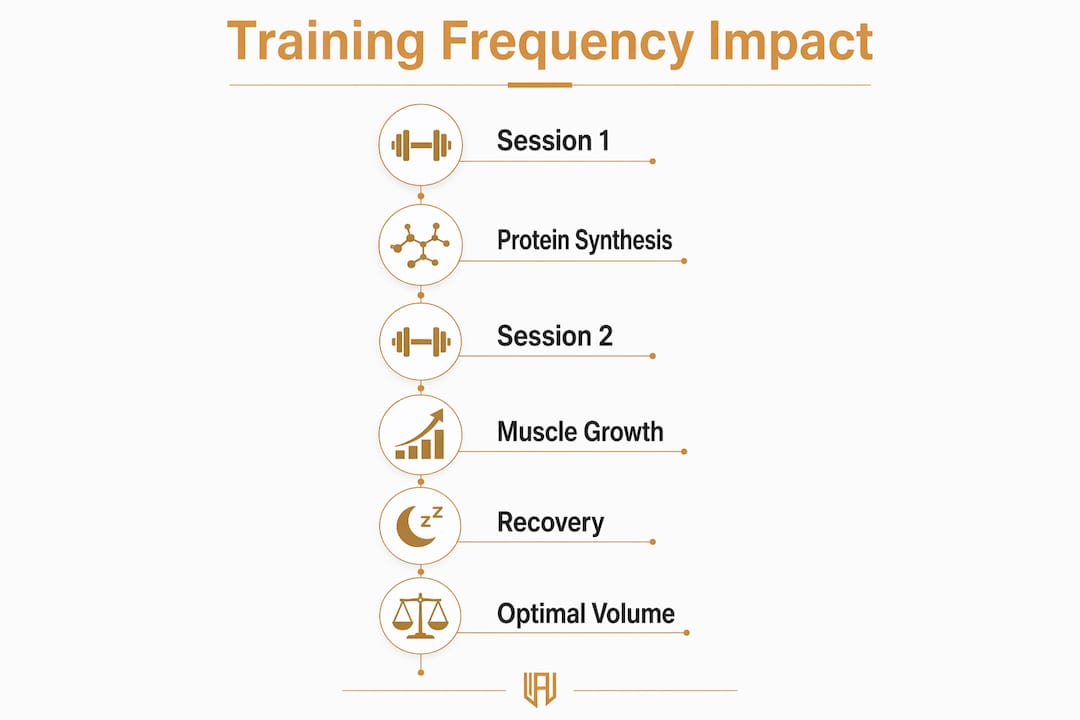
Muscle protein synthesis remains elevated for 24–48 hours after a training session. Training a muscle twice per week means you spend more total time in an elevated growth state compared to once-a-week training. That is the mechanistic reason two sessions per muscle group outperforms one, assuming volume is adequate.
The table below shows how frequency affects your ability to hit weekly volume targets without sacrificing per-session quality.
| Weekly Frequency | Sets Per Session | Total Weekly Sets | Quality Risk |
|---|---|---|---|
| 1x per muscle group | 12 | 12 | High (fatigue accumulates fast) |
| 2x per muscle group | 6 | 12 | Low (manageable per session) |
| 3x per muscle group | 4 | 12 | Very low (fresh each session) |
| 4x per muscle group | 3 | 12 | Minimal (but scheduling is harder) |
Pro Tip: Do not spread sets so thin that no single session creates enough stimulus. Three sets per session across four days can feel like a lot of gym time for very little training effect. Two sessions of five to six sets per muscle group is the sweet spot for most lifters over 40.
How often should you train after 40?
Recovery is the variable that changes most dramatically after 40. Your muscles can still adapt. Your connective tissue, hormonal recovery, and sleep quality take longer to bounce back. That reality shapes how you apply frequency, not whether you apply it.
The ACSM recommends spacing sessions for the same muscle group approximately 48 hours apart. For a 45-year-old training Monday and Thursday, that spacing is built in naturally. For someone trying to train chest on Monday, Wednesday, and Friday, the 48-hour window still works. The problem comes when people add a fourth or fifth session without tracking how they actually feel under load.
Recovery ability declines with age, which means frequency must be individualized. What works for your 32-year-old training partner may leave you grinding through sessions on empty. Here are the recovery markers worth tracking before you increase frequency:
- Resting heart rate: A spike of five or more beats above your baseline on a training morning is a yellow flag.
- Sleep quality: Waking up at 3 a.m. consistently after hard sessions signals your nervous system is under stress.
- Bar speed: If your warm-up sets feel slow and heavy two sessions in a row, you have not recovered from the previous session.
- Joint soreness: Muscle soreness is expected. Joint aches that persist more than 72 hours are a sign to back off.
If you have dealt with injury-related recovery challenges, the Ironatforty article on SI joint recovery covers how to manage training around structural limitations without losing momentum.
Which training frequency split actually works best?
There is no universally optimal split. There is only the split you will actually do consistently, that hits your weekly volume targets, and that you can recover from. That said, the research and real-world experience point to some clear patterns.
| Split Type | Frequency Per Muscle | Strength Benefit | Hypertrophy Benefit | Recovery Demand |
|---|---|---|---|---|
| Full body 3x/week | 3x | Strong | Strong | Moderate |
| Upper/lower 4x/week | 2x | Strong | Strong | Moderate to high |
| Push/pull/legs 6x/week | 2x | Strong | Strong | High |
| Bro split (1x/week) | 1x | Weak | Weak to moderate | Low |
The bro split, one muscle group per day, is the least effective approach for adults over 40 who want real results. You train chest on Monday and do not touch it again until the following Monday. That is seven days between stimuli, which is too long to maintain consistent motor learning momentum or keep muscle protein synthesis elevated.
Full body training three times per week is the most practical starting point for most lifters over 40. You hit every major muscle group three times weekly, each session stays manageable in length, and the 48-hour recovery window fits naturally into a Monday, Wednesday, Friday schedule. If you want to understand how training after 40 differs from your earlier years, Ironatforty covers the full picture.
The upper/lower split four days per week works well once you have built a base and want to add volume without making sessions longer. Each muscle group gets two quality exposures per week, and you can load the upper body and lower body sessions differently based on how you feel.
Key takeaways
Training frequency is the delivery mechanism for your weekly volume, and two sessions per muscle group per week is the evidence-based floor for adults over 40 who want consistent strength and hypertrophy results.
| Point | Details |
|---|---|
| Minimum effective frequency | Train each muscle group at least twice per week to drive strength and growth. |
| Volume drives hypertrophy | Aim for 10 or more sets per muscle per week; frequency helps you spread that load. |
| Recovery window matters | Space sessions for the same muscle group at least 48 hours apart to maximize adaptation. |
| Age changes recovery, not potential | Older adults need individualized frequency based on real recovery markers, not guesswork. |
| Consistency beats complexity | A simple full body or upper/lower split done consistently outperforms any perfect program done sporadically. |
What i have learned about frequency after years under the bar
Here is my honest take: most lifters over 40 are not training too frequently. They are training inconsistently and calling it recovery. I have seen it repeatedly. Someone trains hard Monday, skips Wednesday because life happened, does a half-hearted session Friday, and then wonders why they are not progressing. The problem is not frequency. It is the absence of a reliable floor.
The research from the ACSM and the Sports Medicine meta-analysis tells you the minimum: twice per week per muscle group. What the research cannot tell you is how to build a schedule that actually survives contact with your real life. That part requires honesty about your recovery, your sleep, your stress load, and your schedule.
I spent two years overcomplicating my own frequency. I chased six-day push/pull/legs splits because the numbers looked impressive on paper. My joints disagreed. Dropping to a four-day upper/lower split and focusing on hitting my weekly set targets with better intensity produced more progress in six months than the previous two years of volume theater.
The principle I keep coming back to is this: frequency is a consistency threshold, not a performance ceiling. It ensures you show up often enough to keep the stimulus regular. Once you have that floor locked in, you can experiment with adding a third session per muscle group and see how your body responds. But do not skip the floor-setting step. Without it, you are just training randomly and hoping for results.
If you want a framework for showing up consistently rather than chasing the next program, the Ironatforty piece on why you do not need a new program is worth your time.
— Jeff
Build your frequency plan with ironatforty's free tools
You now know the science behind training frequency. The next step is applying it to your actual numbers.
Ironatforty's free training and nutrition tools are built specifically for lifters over 40 who want to train smarter without hiring a coach. Use the 1RM Calculator to set load targets that match your current strength level, so every session you add to your frequency plan is working at the right intensity. Pair that with the TDEE Calculator to make sure your nutrition supports the recovery demands of training twice or more per week. No guesswork. No recycled gym bro advice. Just the numbers you need to build a plan that actually holds up.
FAQ
What is the minimum training frequency for strength gains?
Training each muscle group at least twice per week is the evidence-based minimum for consistent strength improvements, according to the ACSM 2026 Position Stand. Once-a-week training produces weaker results, especially for adults over 40.
Does training more often always build more muscle?
Not automatically. Increasing frequency without increasing volume does not enhance strength or hypertrophy. More sessions only help if they allow you to accumulate more total weekly sets at quality intensity.
How long should i rest between sessions for the same muscle?
The ACSM recommends at least 48 hours between sessions targeting the same muscle group. This spacing allows adequate recovery and maximizes the quality of your next training stimulus.
Is a full body split better than a bro split after 40?
Full body training three times per week outperforms a once-a-week bro split for both strength and hypertrophy. It hits each muscle group more frequently, supports motor learning, and fits the 48-hour recovery window naturally.
How do i know if i am training too frequently?
Persistent joint soreness beyond 72 hours, declining bar speed on warm-up sets, and disrupted sleep are reliable signs your frequency exceeds your recovery capacity. Reduce sessions by one per week and reassess over two to three weeks.