
Warming up for heavy lifting is the deliberate process of raising muscle temperature, priming your nervous system, and rehearsing movement patterns through progressive loading to maximize performance and minimize injury risk. Skip it at 25 and you might get away with it. Skip it at 45 and you pay for it. The good news: a structured pre-lift warm up routine does not need to take forever. The RAMP protocol, which stands for Raise, Activate/Mobilize, and Potentiate, gives you a repeatable framework that works whether you are squatting, deadlifting, or pressing. This guide covers the exact structure, the best warm up exercises for mature lifters, and the mistakes that quietly kill your working sets before they start.
How long should warming up for heavy lifting actually take?
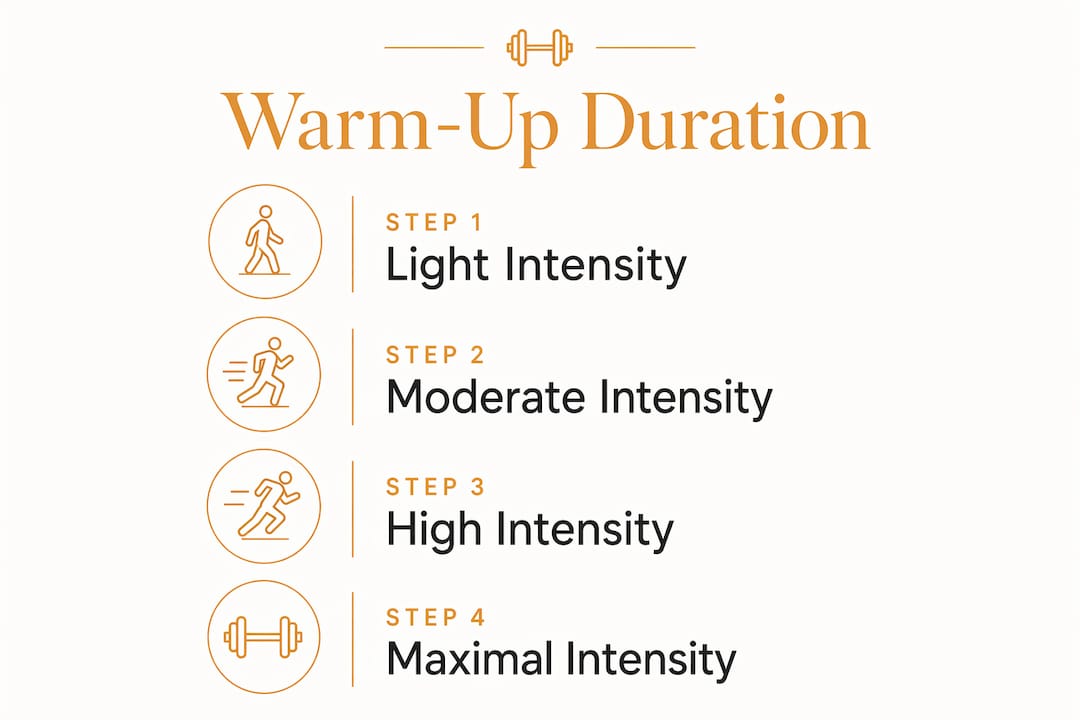
The answer depends on how heavy you are going. Warm-up duration scales with intensity: 70–80% of your one rep max requires 10–12 minutes, 85–90% requires 13–16 minutes, and anything above 90% requires 16–20 minutes. That is a meaningful range. A lifter hitting a moderate training day does not need the same ramp as someone chasing a near-max squat.
The RAMP structure organizes those minutes into three phases:
- Raise (3–5 minutes): General movement to increase heart rate and blood flow. Think light rowing, cycling, or a brisk walk. The goal is to get your body temperature up, not to tire yourself out.
- Activate/Mobilize (5–8 minutes): Dynamic mobility drills targeting the joints and muscles you are about to load. Leg swings, hip circles, T-spine rotations, and the world's greatest stretch all belong here.
- Potentiate (5–10 minutes): Lift-specific ramp-up sets starting with the empty bar and building progressively to your working weight.
Here is how warm-up time maps to training intensity:
| Training Intensity | Recommended Warm-Up Time | Primary Focus |
|---|---|---|
| 70–80% 1RM | 10–12 minutes | General movement + light ramp sets |
| 85–90% 1RM | 13–16 minutes | Full RAMP with moderate ramp sets |
| 90%+ 1RM | 16–20 minutes | Full RAMP with extended potentiation |
One hard rule: warm-ups beyond 25 minutes deplete your ATP-PCr stores, which are the same energy reserves you need for maximal lifts. Going longer does not make you more prepared. It makes you pre-fatigued.
Which dynamic stretches best prepare you for heavy lifts?
Static stretching before lifting is a mistake. Static stretching reduces maximal strength by 3–5% and belongs in your post-workout cooldown, not your warm-up. For lifters over 40, this matters even more because you are already managing reduced joint mobility and longer recovery windows.
Dynamic stretching for lifting works because it takes your joints through full ranges of motion under controlled movement, not passive holds. Here are the drills that deliver the most return for mature lifters:
- Leg swings (front-to-back and lateral): Opens the hip flexors and adductors before squats and deadlifts.
- Hip circles: Lubricates the hip joint and addresses the stiffness that builds up from sitting.
- T-spine rotations: Unlocks thoracic mobility for bench press and overhead work. Most lifters over 40 are chronically stiff here.
- World's greatest stretch: A single drill that hits the hip flexor, thoracic spine, and ankle simultaneously. Do 5 reps per side.
- Glute bridges: Activates the posterior chain before any lower body compound lift.
- Band pull-aparts: Wakes up the rear delts and rotator cuff before pressing.
- Bodyweight squats: Rehearses the squat pattern and identifies any mobility restrictions before you load the bar.
Pro Tip: Do not run through a generic list. Identify your personal sticking points first. If your hips are your weak link, spend more time on hip circles and leg swings. If your thoracic spine locks up, prioritize T-spine rotations. A mobility assessment after injury can help you pinpoint exactly where to focus your pre-lift work.
The world's greatest stretch earns its name because it addresses three common mobility restrictions in one movement. Pair it with T-spine rotations and you have covered the two biggest problem areas for most lifters over 40.

How to structure ramp-up sets without burning out
Ramp-up sets are the Potentiate phase of your warm-up. They are not a workout. They are movement rehearsals. Start with the empty bar and increase load gradually, reducing reps as the weight climbs.
Here is a practical ramp-up scheme for a 225-pound working set squat:
- Empty bar x 10 reps
- 95 lbs x 8 reps
- 135 lbs x 5 reps
- 165 lbs x 3 reps
- 185 lbs x 2 reps
- 205 lbs x 1 rep
- Working set: 225 lbs
The key rule: never jump more than 50–60 lbs once you pass 70% of your one rep max. Large jumps force your nervous system to adapt too quickly and increase injury risk at the exact moment you are approaching peak load.
Compare two common approaches:
| Approach | Load Jumps | Rep Scheme | Result |
|---|---|---|---|
| Correct ramp-up | Small, consistent increments | 8–10 down to 1–2 reps | Primed, not fatigued |
| Common mistake | Large jumps, skipping weights | Same reps throughout | Underprepared or pre-exhausted |
Rest between ramp-up sets matters more than most lifters realize. Near 90% 1RM sets require 3+ minutes of rest to replenish your ATP-PCr stores. Rushing this rest turns your warm-up into an endurance session, which is the opposite of what you need before a max effort.
Pro Tip: Treat every ramp-up set as a technical rehearsal. Focus on bar path, bracing, and foot position. If a set at 70% feels slow or grindy, that is data. Reduce your working weight rather than pushing through.
What are the most common warm-up mistakes over 40?
Most warm-up problems fall into a short list of repeatable errors. Knowing them in advance saves you from learning them the hard way under a heavy bar.
- Static stretching before lifting: Reduces strength output by 3–5% and does nothing to prepare your nervous system for heavy loading.
- Warming up too long: Going past 25 minutes depletes the energy systems you need for your working sets. Longer is not better.
- Skipping rest between ramp sets: Rushing from set to set turns your potentiation phase into cardio. Your ATP-PCr stores need time to recover.
- Treating ramp-up sets as max effort: Overspending energy during warm-up is the most common mistake that leads to fatigue before working sets. Every rep should feel controlled and well within your capacity.
- Ignoring bar velocity as a readiness signal: If your bar speed is noticeably slower than usual during a ramp-up set, your body is telling you something. Do not override it.
- Using a one-size-fits-all routine: Your warm-up should match your lift, your mobility limitations, and your readiness on that specific day.
If a warm-up set at 70% 1RM is more than 5% slower than your baseline velocity, reduce your working load by 5–10% that session. Velocity does not lie.
When you are running multiple heavy compound lifts in one session, you do not need to repeat a full general warm-up before each one. A brief, lift-specific transition phase focusing on movement pattern rehearsal is enough. Going from squats to deadlifts, for example, requires only a targeted hip hinge warm-up, not another 15-minute full protocol.
How do warm-up needs change after 40?
Training after 40 is physiologically different, and your warm-up needs to reflect that. This is not pessimism. It is just how the body works, and understanding those changes is the first step toward training smarter.
Here is what shifts as you age and what to do about it:
- Increased joint stiffness: Joints take longer to lubricate and mobilize. Add 2–3 extra minutes to your Activate/Mobilize phase and prioritize the specific joints involved in your main lift.
- Slower nervous system activation: Your neuromuscular system needs more rehearsal reps to reach peak firing efficiency. Do not skip the lower-intensity ramp sets.
- Longer recovery between ramp sets: Joint stiffness and longer recovery times mean you need conservative load increments and more rest between sets near your working weight.
- Reduced tolerance for high-volume warm-ups: More warm-up volume does not equal better preparation after 40. It equals more fatigue. Keep total ramp-up reps under 30 across all sets.
- Greater value of velocity monitoring: Velocity-based monitoring during ramp-up sets gives you an objective readiness signal that perceived effort alone cannot provide. A device like a GymAware or PUSH band makes this practical.
Raising muscle temperature by 1 to 2 degrees Celsius increases anaerobic power by 4–6%. That is a meaningful performance gain from a 5-minute general movement phase. For lifters over 40, that physiological priming is not optional. It is the difference between a productive session and an injury.
You can also track your warm-up performance over time to spot patterns in your readiness. If your ramp-up sets consistently feel heavy on Mondays, that is a recovery signal worth acting on.
Key takeaways
A structured pre-lift warm up routine using the RAMP protocol is the most effective way for lifters over 40 to protect joints, prime the nervous system, and maximize working set performance.
| Point | Details |
|---|---|
| Use the RAMP protocol | Structure every warm-up into Raise, Activate/Mobilize, and Potentiate phases. |
| Match duration to intensity | Warm up 10–12 minutes at 70–80% 1RM and 16–20 minutes at 90%+ 1RM. |
| Drop static stretching | Dynamic mobility preserves strength output; static stretching cuts it by 3–5%. |
| Respect rest between ramp sets | Take 3+ minutes after heavy ramp sets to restore ATP-PCr stores before working sets. |
| Use bar speed as a readiness check | If velocity drops more than 5% below baseline, reduce your working load that day. |
The warm-up truth nobody told me at 42
I spent the first two years of lifting after 40 treating warm-ups like a formality. A few arm circles, a couple of empty bar sets, and I was under the bar. I paid for it with a nagging hip flexor issue that took three months to resolve and cost me a full training cycle.
What changed my approach was not a new program. It was accepting that my body at 42 needed a different contract than it did at 28. The RAMP structure was not a revelation in theory. The revelation was actually doing it consistently and watching my working set performance improve, not despite the longer warm-up, but because of it.
The part most lifters over 40 resist is the rest between ramp sets. Three minutes feels like wasted time when you are standing around watching the clock. But that rest is not passive. It is your ATP-PCr system refueling. Rushing it is like trying to sprint on a half-empty tank.
The other thing I have learned: your warm-up is the most honest feedback you will get about your readiness that day. If your 70% set feels like 85%, your body is telling you something. The lifters who get hurt are the ones who override that signal. The ones who stay in the game long-term are the ones who listen to it and adjust. That is not weakness. That is training intelligently after 40.
— Jeff
Ironatforty has the tools to back your warm-up
You now have the framework. The next step is applying it with the right numbers behind you.
Ironatforty is built for lifters over 40 who want real guidance without the recycled gym bro content. Use the 1RM Calculator to calculate your exact working weights so your ramp-up sets are based on accurate percentages, not guesswork. Pair that with the full suite of free training tools to monitor your readiness and track progress over time. Everything on Ironatforty is designed for the lifter who takes the long view, because staying under the bar at 50 and 60 starts with the decisions you make right now.
FAQ
How long should a warm-up be before heavy lifting?
Warm-up duration scales with training intensity. Aim for 10–12 minutes at 70–80% of your one rep max and 16–20 minutes at 90% or above.
Should you stretch before heavy lifting?
Avoid static stretching before lifting. It reduces maximal strength output by 3–5%. Use dynamic mobility drills like leg swings, hip circles, and T-spine rotations instead.
How many warm-up sets should i do before a heavy lift?
Most lifters need 5–7 ramp-up sets starting with the empty bar and building to their working weight. Reduce reps as load increases, from 8–10 reps at light weights down to 1–2 reps near 90% of your one rep max.
What is the RAMP warm-up method?
RAMP stands for Raise, Activate/Mobilize, and Potentiate. It organizes your warm-up into general movement, dynamic mobility, and lift-specific ramp-up sets for a complete heavy lifting preparation protocol.
Does warming up change after age 40?
Yes. Joint stiffness increases and recovery slows after 40, requiring longer rest between ramp sets, more focused dynamic mobility work, and conservative load increments to protect joints and preserve energy for working sets.