
For most active adults, a compound-focused full-body 3 day a week workout program is the single most efficient path to strength and muscle gains. Three sessions per week hits the frequency sweet spot for reducing low muscle mass risk while leaving enough recovery time to actually grow. Start with Day 1 today.
TL;DR:
- Session length: Around 45 to 60 minutes per workout
- Weekly volume target: Moderate weekly sets per major muscle group spread across sessions
- Rep ranges: Low reps for strength, moderate to higher reps for hypertrophy; mixing rep ranges can be effective
- Progression cue: Add repetitions before increasing weight once you reach the upper end of your rep range for consecutive sessions
- First action: Use the 1RM calculator to set your starting loads before Day 1, then hit the full-body template in Section 5
Table of Contents
- What is a 3-day workout split and what should you expect?
- Who actually benefits from a 3-day program?
- Which 3-day split fits your goal?
- Sample workouts for every popular 3-day split
- How to design your program for steady progress
- How to schedule your week, manage recovery, and add cardio
- Your ready-to-run 8-week program
- What the research says and how to apply it for lifters over 40
- Key Takeaways
- The real mistakes people make on a 3-day plan
- Ironatforty has the tools to back your 3-day program
- Useful sources and further reading
- FAQ
What is a 3-day workout split and what should you expect?
A 3-day split means you train three non-consecutive days per week, hitting every major muscle group across those sessions. The four most common formats are full-body (all major muscles each session), push/pull/legs (PPL, each session has a distinct movement focus), upper/lower variant (alternating upper and lower body emphasis), and the bodybuilder or "bro" split (chest/shoulders/triceps, back/biceps, legs on separate days).
Total weekly time commitment runs roughly 2.5–3 hours of actual training, not counting travel. That's a realistic floor for meaningful progress.
Pros:
- Sufficient frequency to stimulate each muscle group 2–3 times per week on a full-body template
- Built-in recovery days reduce cumulative fatigue, especially relevant for lifters over 40
- Flexible scheduling fits most work and family schedules
- Evidence shows weekly volume matters more than frequency, so 3 days can match 5-day results when sets are matched
Cons:
- Each session carries more volume than a 5-day split, so fatigue management matters
- PPL and bro splits only hit each muscle group once per week, which is suboptimal for beginners
- Less room for specialization if you want to prioritize one muscle group heavily
The key trade-off: full-body templates distribute volume more evenly and keep each muscle group stimulated more frequently. Splits concentrate volume but reduce per-muscle frequency. For most people reading this, full-body wins on both efficiency and recovery.
Who actually benefits from a 3-day program?
Three days per week suits a wide range of lifters, but not all of them equally.
Beginners get the most out of it. You're still in the phase where almost any consistent stimulus drives progress, and three sessions give you enough practice with movement patterns without grinding your joints into the floor. A full-body template with 2–3 sets per exercise is plenty.
Early intermediates (6 months to 2 years of consistent training) can push volume higher and start using more advanced techniques like RPE-based loading or rep-range progression. A full-body or upper/lower variant works well here.
Advanced lifters often need more frequency or specialization than 3 days allows. If you've been training seriously for 3-plus years and have stalled, a 4-day upper/lower or push/pull split may serve you better.
Lifters over 40 are where 3 days per week really shines. Recovery windows lengthen with age. Muscle protein synthesis (MPS) stays elevated longer after a session in older lifters, which means you actually benefit from slightly longer gaps between training the same muscle group. Research on masters athletes confirms that recovery from muscle-damaging exercise takes longer as you age, making the built-in rest days of a 3-day plan a feature, not a limitation.
Practical signposts that 3 days is right for you:
- You have 3–5 hours per week available for training
- You're sleeping 6–8 hours but still feeling beat up after 4-day programs
- You're a beginner or returning after a break
- You're over 40 and noticing that soreness lingers longer than it used to
Pro Tip: If you're over 40 and choosing between full-body and a split, default to full-body. You'll hit each muscle group more often, and the lower per-session volume per muscle group means less damage per session and faster recovery.
Which 3-day split fits your goal?
Your goal should drive your template choice. Here's how to match them:
Strength (chasing heavier lifts, lower rep work): Use a full-body or upper/lower variant. Keep reps in the 3–6 range on your main compound lifts, rest 3–5 minutes between heavy sets, and keep accessory volume moderate. Think: squat, bench, deadlift as the anchors.
Hypertrophy (building muscle size): Full-body or PPL both work. Push rep ranges to 8–15 on most exercises, rest 60–90 seconds, and prioritize time under tension. PPL lets you stack more volume per muscle group in one session, which some intermediate lifters prefer.
Fat loss (maintaining muscle while in a calorie deficit): Full-body with added conditioning. Keep the compound lifts, add a 10-minute conditioning finisher (sled push, kettlebell swings, or rowing), and use your TDEE calculator to set a modest calorie deficit. Don't slash volume; you need the stimulus to hold muscle.
Time-limited schedules (under 45 minutes per session): Compound-only full-body. Three exercises per session: one leg press movement, one upper-body push, one upper-body pull. That's it. Supersets can roughly halve gym time while maintaining volume, so pair your push and pull movements back-to-back.
Quick goal-to-split reference:
| Goal | Best Split | Rep Range | Rest |
|---|---|---|---|
| Strength | Full-body or upper/lower | 3–6 | 3–5 min |
| Hypertrophy | Full-body or PPL | 8–15 | 60–90 sec |
| Fat loss | Full-body + conditioning | 8–12 | 45–75 sec |
| Time-limited | Compound-only full-body | 6–12 | 60–90 sec |
When you want both strength and size, prioritize strength work early in the session (heavy compounds first) and hypertrophy work after (higher-rep accessories). You don't have to choose one exclusively.
Sample workouts for every popular 3-day split
Full-body intermediate program (Day 1/2/3)
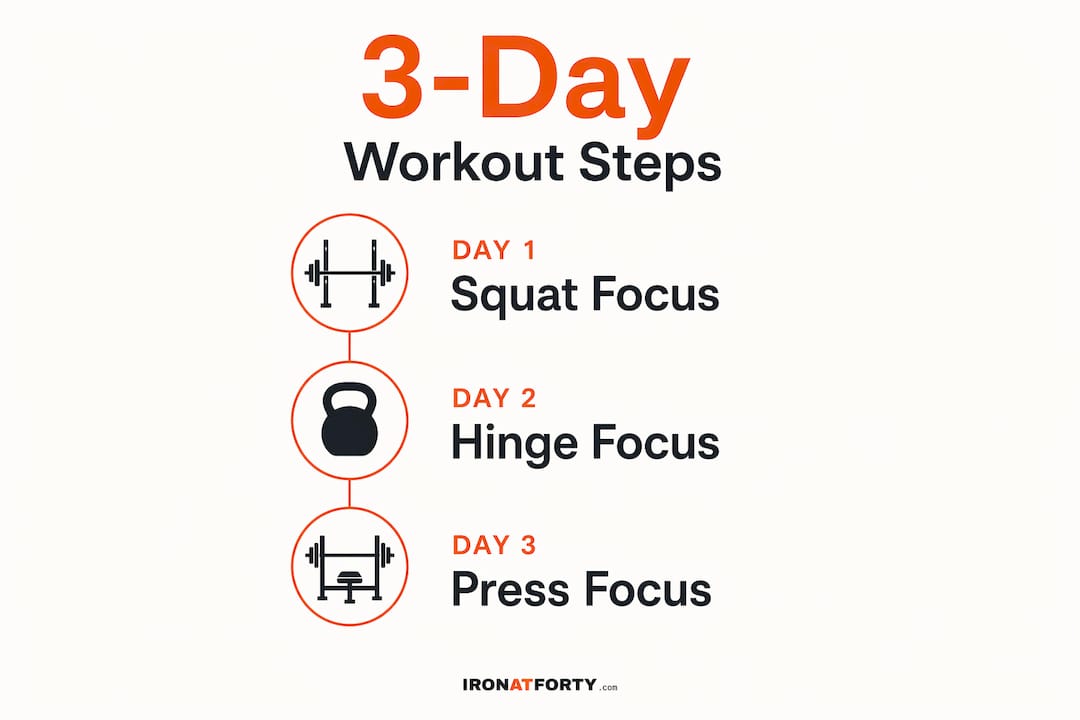
Day 1 — Squat focus
| Exercise | Sets | Reps | Rest |
|---|---|---|---|
| Barbell back squat | 4 | 5–6 | 3 min |
| Barbell bench press | 3 | 8–10 | 90 sec |
| Barbell row | 3 | 8–10 | 90 sec |
| Romanian deadlift | 3 | 10–12 | 90 sec |
| Overhead press | 2 | 10–12 | 60 sec |

Day 2 — Hinge focus
| Exercise | Sets | Reps | Rest |
|---|---|---|---|
| Conventional deadlift | 4 | 4–5 | 3–4 min |
| Incline dumbbell press | 3 | 10–12 | 90 sec |
| Pull-up or lat pulldown | 3 | 8–10 | 90 sec |
| Goblet squat | 3 | 12–15 | 60 sec |
| Dumbbell lateral raise | 2 | 12–15 | 60 sec |
Day 3 — Press focus
| Exercise | Sets | Reps | Rest |
|---|---|---|---|
| Overhead press | 4 | 6–8 | 2–3 min |
| Front squat or leg press | 3 | 10–12 | 90 sec |
| Weighted pull-up or cable row | 3 | 8–10 | 90 sec |
| Hip thrust | 3 | 12–15 | 60 sec |
| Dumbbell curl + tricep pushdown (superset) | 2 | 12 each | 60 sec |
Full-body beginner variant
Cut to 2 sets per exercise, use the same movement patterns, and drop the isolation work entirely. Three exercises per session: squat pattern, push, pull. Add sets every 2–3 weeks as you adapt. A minimum of 4 weekly sets per muscle group is the evidence-backed floor for hypertrophy, so even a beginner hitting 2 sets per session across 3 days clears that threshold.
Push/Pull/Legs (3-day PPL)
Day 1 — Push: Bench press, overhead press, incline dumbbell press, tricep dips, lateral raises Day 2 — Pull: Deadlift, barbell row, lat pulldown, face pulls, dumbbell curl Day 3 — Legs: Squat, Romanian deadlift, leg press, leg curl, calf raise

Sets: 3–4 per exercise, 8–12 reps. The limitation with 3-day PPL is that each muscle group only gets hit once per week. That's fine for intermediates with solid technique, but beginners should stick to full-body instead.
Beginner PPL modification: Drop to 2 sets per exercise and cut one accessory per day. Focus on technique over load.
Upper/lower variant and bodybuilder split
The upper/lower variant on 3 days alternates: Upper A (press focus), Lower A (squat focus), Upper B (pull focus). You rotate through the sequence each week, so over two weeks every pattern gets hit roughly twice. It's a solid middle ground between full-body frequency and split specialization.
The bodybuilder split (chest/shoulders/triceps, back/biceps, legs) concentrates the most volume per muscle group per session. It suits intermediates who want to feel a specific muscle working hard. The trade-off: each muscle group gets only one session per week, which is less than ideal for beginners or anyone prioritizing strength over aesthetics.
Weekly sets per muscle group by template
| Template | Chest | Back | Quads | Hamstrings | Shoulders |
|---|---|---|---|---|---|
| Full-body (intermediate) | 9–12 | 9–12 | 9–12 | 6–9 | 6–8 |
| Full-body (beginner) | 6 | 6 | 6 | 6 | 4–6 |
| 3-day PPL | 9–12 | 9–12 | 9–12 | 9–12 | 6–9 |
| Upper/lower variant | 8–10 | 8–10 | 8–10 | 6–8 | 6–8 |
| Bodybuilder split | 12–16 | 12–16 | 12–16 | 12–16 | 10–12 |
Exercise substitutions
Pro Tip: Equipment limitations are not a reason to skip a session. Every major movement pattern has a workable substitute.
- Barbell bench press → push-up variations (feet elevated, weighted vest, or banded)
- Barbell squat → goblet squat, leg press, or Bulgarian split squat
- Pull-ups → dumbbell or cable rows, resistance band pull-aparts
- Barbell deadlift → trap bar deadlift, dumbbell Romanian deadlift, or cable pull-through
- Overhead press → seated dumbbell press, landmine press (joint-friendly for shoulder issues)
How to design your program for steady progress
Volume, rep ranges, and session structure
Research supports a minimum of 4 weekly sets per muscle group for hypertrophy, with 10 or more sets per week producing better results when recovery allows. For a 3-day program, that means distributing roughly 3–5 sets per muscle group per session on a full-body template.
Rep ranges by goal:
- Strength: 3–6 reps at 80–90% of your 1RM, long rest periods
- Hypertrophy: 6–15 reps, moderate load, shorter rest
- Endurance/conditioning: 15–30 reps, lighter load, minimal rest
Structure each session compounds-first. One leg pressing movement, one upper-body push, one upper-body pull. That's your backbone. Accessories come after. Never bury your squat or deadlift at the end of a session when you're already fatigued.
Progression methods
- Linear load progression: Add 5 lbs to lower-body lifts and 2.5 lbs to upper-body lifts each week. Works well for beginners for the first 8–12 weeks.
- Rep-based progression: Stay at the same weight until you hit the top of your rep range for two consecutive sessions, then increase load. More sustainable for intermediates.
- RPE-based progression: Train to a target Rate of Perceived Exertion (RPE 7–8 for most working sets). Adjust load based on how hard the set felt, not a fixed percentage.
- Microloading: Use 1.25 lb or 2.5 lb fractional plates when standard 5 lb jumps stall your progress. Especially useful on overhead press and bench.
Volume adjustments by level:
- Beginners: 6–10 weekly sets per muscle group, 2–3 sets per exercise
- Intermediates: 10–16 weekly sets per muscle group, 3–4 sets per exercise
- Reduce volume by 30–40% during deload weeks, keep intensity similar
For a deeper look at how to structure multi-week blocks, the periodization guide for lifters over 40 covers wave loading and block periodization in detail.
How to schedule your week, manage recovery, and add cardio
Weekly schedule options
- Monday/Wednesday/Friday: The classic. Two full rest days between sessions, weekend free. Works for most schedules.
- Tuesday/Thursday/Saturday: Shifts the window if Monday is always chaotic. Still gives 48-hour gaps.
- Friday/Saturday/Tuesday: Useful if your weekend is the only time you can train back-to-back. Not ideal, but the Friday/Saturday pairing is manageable if Saturday is lower intensity.
The non-negotiable: at least 48 hours between sessions targeting the same muscle groups. For lifters over 40 doing heavy compound work, 72 hours is a better target.
Deload rules
Every 4–8 weeks, take a deload week. Reduce your working sets by 40–50% and drop load by 10–15%. Keep the same exercises and movement patterns. Deloads aren't optional; they're when adaptation actually consolidates. Signs you need one sooner: persistent joint soreness, stalled lifts for two weeks straight, or sleep quality dropping. Check the overtraining warning signs guide if you're unsure.
Nutrition and sleep bullets
- Daily protein: Aim for 1.2–1.6 g per kg of body weight per day, distributed across 3–4 meals. Research on master athletes supports moderate protein doses of roughly 0.25–0.4 g/kg per meal to maximize muscle protein remodeling.
- Calorie target: Use the TDEE calculator to set your maintenance or surplus. A modest 200–300 calorie surplus supports muscle gain without excessive fat accumulation.
- Sleep: 7–9 hours is the target. For lifters over 40, sleep quality directly affects cortisol and recovery. Cutting sleep to add a fourth training day is a losing trade.
- Meal timing: Eat a protein-containing meal within 2 hours post-workout. Timing matters less than total daily intake, but post-workout protein is a simple habit worth keeping.
Cardio placement
Pro Tip: Place cardio on rest days or after strength sessions, never before. A 20-minute brisk walk or cycling session on off days supports recovery without eating into strength adaptations.
- Low-intensity steady-state (LISS) cardio: any rest day, 20–40 minutes
- Moderate cardio (cycling, rowing): after strength sessions, 15–20 minutes max
- High-intensity intervals: treat them like a strength session; don't stack them on the same day as heavy lower-body work
Your ready-to-run 8-week program
This is a full-body, compound-focused block. Use the intermediate Day 1/2/3 template from Section 5. Session time: 45–60 minutes.
- Weeks 1–2 (Introduction): 3 sets per compound, 2 sets per accessory. Focus on technique and establishing baseline loads. Log every set. Rep target: hit the middle of your rep range on all working sets.
- Weeks 3–4 (Build phase A): Add one set to each compound movement. Push to the top of your rep range on the last set. If you hit the top of the range for two sessions in a row, add weight next session.
- Weeks 5–6 (Build phase B): Increase load by 5 lbs on lower-body compounds and 2.5 lbs on upper-body lifts where you've hit the rep ceiling. Add one accessory set if recovery is good.
- Week 7 (Intensity peak): Keep volume from weeks 5–6. Push working sets to RPE 8–9 on compounds. This is your hardest week. Don't add new exercises.
- Week 8 (Deload): Drop to 2 sets per compound, reduce load by 10–15%. Same exercises, same movement patterns, half the effort. Let your body consolidate the gains.
Progression tracking: Log your reps and load every session. A simple notebook or phone note works. You're looking for an upward trend over 8 weeks, not a perfect line. Stalled for two consecutive sessions? Check sleep and protein before adding volume.
Beginner scaling: Start with weeks 1–2 protocol for the full 4 weeks before progressing. Technique is the ceiling for beginners, not load. If a compound lift feels unstable, drop to a regression (goblet squat instead of barbell squat) until the pattern is solid.
Session time management: If you're consistently over 60 minutes, superset your accessory work. Pair bicep curls with tricep pushdowns, or lateral raises with face pulls. Building time-efficient routines from the ground up helps you identify which exercises to keep and which to cut.
What the research says and how to apply it for lifters over 40
The evidence on training frequency is clear: when weekly volume is matched, training a muscle group 2–3 times per week produces similar gains to higher frequencies. A 12-week study in sarcopenic older women found that 2 and 3 sessions per week produced nearly identical improvements in muscular strength (+20.4% vs +21.0%), skeletal muscle mass, and muscle quality. Three days per week is not a compromise. It's a legitimate, evidence-backed choice.
Key finding: Resistance training 3–4 days per week is associated with reduced risk of low muscle mass in large population data, confirming that this frequency is sufficient for long-term muscle preservation, not just short-term gains.
For lifters over 40, the practical adjustments are specific:
- Space heavy sessions 48–72+ hours apart. Muscle-damaging eccentric work (deadlifts, Romanian deadlifts, squats) needs more recovery time as you age. Masters athlete recovery data supports longer MPS elevation windows and longer required recovery periods compared to younger lifters.
- Prioritize intensity over volume. A hard set of 5 at 85% of your 1RM does more for you than three sloppy sets at 60%. Quality beats quantity, especially when recovery is the limiting factor.
- Hit your protein target every day, not just on training days. Muscle remodeling happens continuously, not just in the post-workout window.
- Monitor hormonal context. Changes in testosterone, estrogen, and cortisol after 40 affect both training capacity and recovery. The hormones resource at Ironatforty covers this in depth.
Use the 1RM calculator to set accurate starting loads before beginning the 8-week block. Guessing your working weight is one of the most common mistakes; it leads to either wasted sessions or unnecessary injury risk. For a broader look at how training physiology shifts with age, the training after 40 overview is worth reading before you start.
Key Takeaways
A compound-focused full-body 3-day-a-week workout program, built on at least 4 weekly sets per muscle group and progressive overload, is the most time-efficient path to strength and muscle for most active adults.
| Point | Details |
|---|---|
| Best split for most readers | Full-body, compound-focused; targets each muscle group 2–3 times per week with manageable per-session volume. |
| Minimum effective volume | At least 4 weekly sets per muscle group; 10–16 sets per week for meaningful hypertrophy. |
| Rep ranges | 3–6 for strength, 8–15 for hypertrophy; mix both within the same week for best results. |
| Recovery for lifters 40+ | Allow 48–72 hours between sessions; prioritize sleep, daily protein at 1.2–1.6 g/kg, and scheduled deloads every 4–8 weeks. |
| Ironatforty tools | Use the free 1RM and TDEE calculators at Ironatforty to set starting loads and calorie targets before Day 1. |
The real mistakes people make on a 3-day plan
Most people who fail on a three-day-per-week program don't fail because the program is wrong. They fail because they treat the three days as three separate opportunities to chase fatigue instead of three coordinated sessions building toward a goal.
The most common mistake: skipping the compound lifts when you're short on time and filling the session with curls and cable work. Accessories feel productive. They're not the engine. The squat, deadlift, bench, and row are the engine. If you only have 30 minutes, do the compounds and go home. The 30–45 minute session approach is genuinely viable when you're ruthless about exercise selection.
The second mistake: chasing tiny weight jumps every single session. Linear progression works for beginners for a few months, then it stops. When it stops, most people either panic and add volume, or they keep grinding the same weights for weeks. The fix is rep-based progression: stay at the same load until you own the top of your rep range, then move up. Slower on paper, faster in practice.
For joint health specifically, tempo control matters more than most people realize. A 3-second eccentric (lowering phase) on squats and bench press reduces peak joint stress and builds more muscle than bouncing the weight. It also keeps you training when you're 50, 55, and beyond. Microloading with fractional plates is the other underused tool. A 2.5 lb jump is still progress. Don't let ego demand 10 lb jumps that wreck your shoulder.
When should you move from 3 days to more frequency? When you've run 2–3 full 8-week blocks, your technique is solid, and you're consistently hitting the top of your rep ranges within the first few weeks of a new block. That's the signal. Not boredom. Not a YouTube video telling you that 3 days isn't enough.
Ironatforty has the tools to back your 3-day program
Knowing the right program is step one. Executing it with accurate numbers is where most people leave gains on the table.

Ironatforty's free 1RM calculator takes the guesswork out of starting loads. Enter a recent lift and rep count, and it gives you the working percentages you need for every set in the 8-week block above. The TDEE calculator does the same for calories: input your stats and activity level, and you get a daily calorie target for muscle gain, maintenance, or fat loss. Both tools are free, no signup required. For the nutrition side, the training, recovery, and nutrition hub covers protein targets, meal timing, and meal prep strategies built specifically for lifters over 40. Start with the calculators, then use the nutrition guide to build the eating plan that supports your three days under the bar.
Useful sources and further reading
The following primary sources and Ironatforty resources were used to build this guide:
- Time-efficient resistance training review (PMC): Core evidence for minimum weekly sets (4+), rep ranges (6–15), and the role of compound movements and supersets in time-efficient programming.
- Resistance training frequency and muscle mass (European Review of Aging and Physical Activity, 2024): Population-level data supporting 3–4 days per week as sufficient for long-term muscle preservation.
- Sarcopenic older women frequency study (PubMed, 2024): 12-week RCT showing 2 and 3 sessions per week produce comparable strength and muscle gains when volume is equated.
- Protein requirements for master athletes (Sports Medicine): Daily protein targets (1.2–1.6 g/kg/day) and meal distribution guidance for active older adults.
- Masters triathlete recovery study: Evidence for mode-dependent recovery differences and longer recovery windows in older athletes.
- Ironatforty free tools: TDEE and 1RM calculators for load and calorie planning.
- Protein intake for muscle over 40 (Ironatforty): Practical protein guidance for lifters over 40.
- Effective training programs for adults over 40 (Ironatforty): Broader program design context for the 40+ audience.
FAQ
Can you build real muscle on only 3 days a week?
Yes. Research confirms that weekly volume matters more than frequency, and 3 sessions per week is sufficient to hit the minimum 4 weekly sets per muscle group needed for hypertrophy.
What is the best 3-day split for beginners?
A full-body compound program is the best beginner workout program: one squat pattern, one push, one pull per session, 2–3 sets each. It builds technique across all movement patterns while keeping volume manageable.
How long should each workout be on a 3-day plan?
Aim for 45–60 minutes per session. Supersets on accessory work keep sessions tight without cutting volume.
Is a 3-day workout program enough for lifters over 40?
Three days per week is often the optimal frequency for lifters over 40. Comparative data shows 2 and 3 sessions per week produce nearly identical strength and muscle gains in older adults, and the longer recovery windows between sessions align with the slower MPS recovery rates that come with age.
How do you progress on a 3-day program without stalling?
Use rep-based progression: stay at the same load until you hit the top of your rep range for two consecutive sessions, then add weight. When standard plate jumps stall you, switch to microloading with 1.25–2.5 lb fractional plates.