
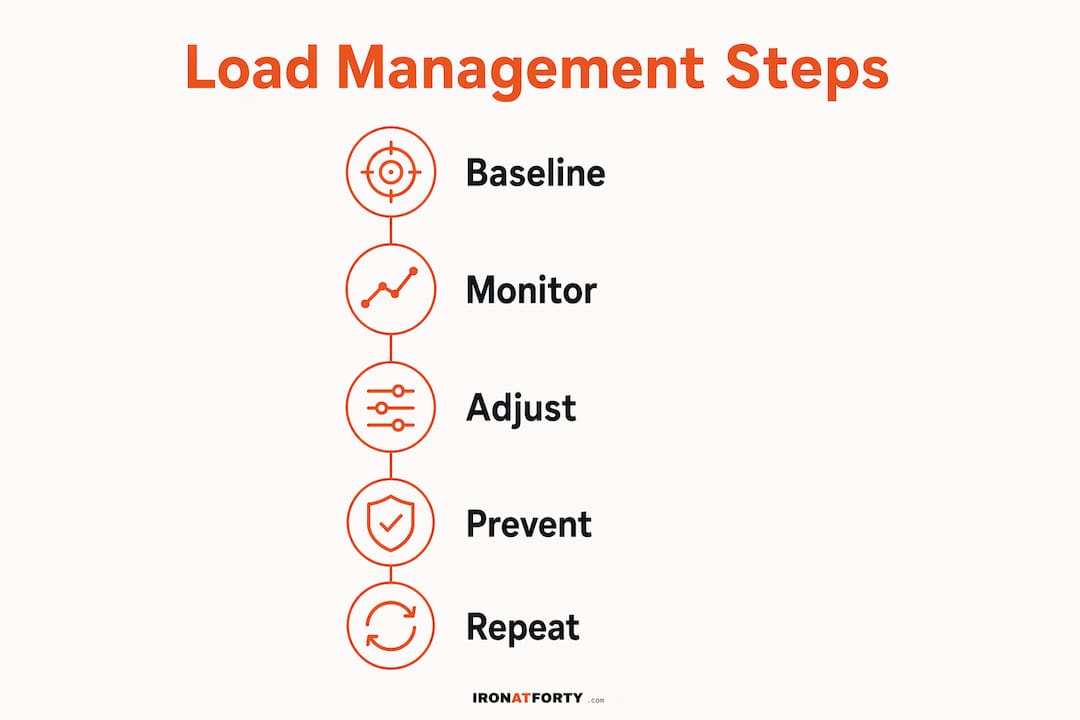
Load management is the deliberate prescription, monitoring, and adjustment of training and non-training stressors over time to maximize adaptation while minimizing injury risk. That's the IOC consensus definition, and it's the only one worth using. The practical payoff: when you manage load well, you get fitter, stay healthier, and show up consistently instead of cycling through hard weeks and forced rest.
Three moving parts make it work:
- Prescription — plan what you're going to do before you do it
- Monitoring — measure what you actually did and how your body responded
- Adjustment — change next week's plan based on what the data and your body are telling you
That's it. No black box. No proprietary system. Just a feedback loop you run on yourself.
Table of Contents
- What do "external load" and "internal load" actually mean?
- Why does load management matter for performance and injury prevention?
- What are the core principles behind managing training load?
- How is training load measured in practice?
- How do you manage load week to week?
- Why doesn't the same training plan work for everyone?
- What does load management look like for lifters specifically?
- How do you know if your load is too high or too low?
- What are the real controversies around load management?
- What does the research actually say?
- Key Takeaways
- The IronAtForty take on load management
- Useful sources for further reading
- FAQ
What do "external load" and "internal load" actually mean?
Before the rest of this guide makes sense, you need two vocabulary words nailed down.
External load is the objective work you put into a session: sets, reps, weight, distance, speed, time. A 5×5 back squat at 225 lb is external load. It doesn't care how you felt that day.
Internal load is your body's physiological and psychological response to that work. Two athletes can do the same 5×5 and have completely different internal responses depending on fitness level, sleep, and stress. Session-RPE is the most practical internal measure: you rate the session's difficulty on a 1–10 scale after it's done.
Two more terms you'll see constantly:
- Acute load — what you've done in the past week or so (short-term fatigue)
- Chronic load — your rolling average over the past three to four weeks (fitness baseline)
The rate of change between those two numbers is where injury risk lives. A sudden spike in acute load relative to your chronic baseline is the warning sign, not the total amount of work itself. Life stress counts too: a brutal work week, a red-eye flight, or a sick kid at home all add to your internal load even when your training log looks clean.
Why does load management matter for performance and injury prevention?
The blunt answer: poor load management creates peaks and valleys in training that directly raises injury risk and tanks performance availability. You can't get stronger from sessions you miss because you're hurt.
The benefits of getting it right stack up fast:
- Better adaptation — consistent, progressive stress drives structural and metabolic changes that improve performance
- Fewer injuries — avoiding rapid spikes keeps tissue stress within what your body can absorb
- More availability — you show up for the sessions that matter, including competitions and peak training blocks
- Long-term consistency — training consistency beats intensity for lifters over 40, and load management is the mechanism that makes consistency possible
Two research-backed rules anchor this: limit weekly load increases to less than 10% when possible, and keep your acute:chronic workload ratio (ACWR) within roughly 0.8–1.3 to stay in the adaptation zone. Both are guidelines, not laws, but they give you a starting reference.
What are the core principles behind managing training load?
Progressive overload: raising the floor, not just the ceiling
Progressive overload is the engine. Training stress must exceed your current capacity to drive adaptation, but the increase has to be measured. Think of it as a floor and a ceiling: your floor is the minimum load your tissues can handle without losing capacity; your ceiling is the maximum they can absorb without breaking down. Raising the floor gradually is how you expand the ceiling safely. Time is often the limiting factor between where you are and where you want to be. For a deeper look at how to structure those increases, the progressive overload guide for lifters over 40 covers the mechanics in detail.
Spikes are the real enemy
A load spike is a rapid increase in training volume or intensity relative to what you've been doing. Big spikes, not high load per se, are the main injury driver. The same logic applies in reverse: a sudden drop in load followed by a rapid return is equally risky. Planned deloads are fine; unplanned crashes followed by aggressive restarts are not.
Periodization and autoregulation
Periodization is the macro-level plan: organizing training into phases (accumulation, intensification, deload) so load rises and falls in a structured way across weeks and months. Autoregulation is the micro-level adjustment: reading how you feel on a given day and modifying the session accordingly, usually by adjusting RPE targets or volume.

| Concept | Time horizon | How you use it |
|---|---|---|
| Progressive overload | Session to session | Add weight, reps, or sets in small increments |
| Periodization | Weeks to months | Plan loading and deload phases in advance |
| Autoregulation | Day of session | Adjust intensity or volume based on readiness |
| Spike avoidance | Week to week | Cap increases; flag sudden jumps in the log |
Pro Tip: Periodize your macrocycles (plan the big blocks in advance) but autoregulate your microcycles (adjust day-to-day based on sleep, soreness, and stress). The plan is the map; autoregulation is the steering wheel.
How is training load measured in practice?
You don't need a sports science lab. Here are the practical options, from simplest to most sophisticated.
Session-RPE (sRPE)
Multiply your post-session RPE (rated 1–10 using the Borg CR-10 scale) by session duration in minutes. A 60-minute session rated RPE 7 produces a load score of 420 arbitrary units. This method is free, validated, and takes 10 seconds. It's the best starting point for most gym-goers.
Volume and tonnage
For resistance training, tonnage = sets × reps × weight. A session with 5 sets of 5 reps at 225 lb = 5,625 lb of tonnage. Track it weekly and you have a concrete external load number to trend over time. Pair it with sRPE and you've covered both sides of the equation. The training volume guide for lifters over 40 breaks down how to use these numbers to drive adaptation without overdoing it.
Acute:Chronic Workload Ratio (ACWR)
ACWR divides your acute load (last 7 days) by your chronic load (rolling 28-day average). A ratio near 1.0 means you're training at your baseline. Ratios above 1.3 signal a spike worth paying attention to. Use it as a conversation starter, not a hard rule. Context always matters more than the number alone.
GPS and accelerometry
Field sport athletes use GPS units and accelerometers to capture total distance, high-speed running distance, and player load. These are external load tools. Useful for team sports; overkill for most gym-based lifters unless you're also doing conditioning work.
Wellness questionnaires and wearables
Simple daily check-ins covering sleep quality, mood, fatigue, muscle soreness, and stress take under two minutes. Wearables like Whoop or Garmin devices add resting heart rate and heart rate variability (HRV) data. The IOC consensus recommends combining external and internal measures alongside athlete well-being monitoring because no single marker reliably detects maladaptation.
Practical monitoring stack for most lifters:
- Daily wellness check-in (sleep, soreness, mood — rated 1–5)
- sRPE logged after every session
- Weekly tonnage tracked per movement pattern
- ACWR calculated monthly or when something feels off
How do you manage load week to week?
Start with a baseline
Before you can manage load, you need to know what your current load actually is. Spend two to three weeks logging sessions honestly: duration, RPE, tonnage. That's your baseline.

Set progression limits and monitor frequently
Cap weekly load increases at less than 10% unless you have a strong reason to push faster. The IOC recommends daily or weekly self-administered monitoring, balanced against keeping the process simple enough that you actually do it. A training log or a basic spreadsheet works fine.
Sample weekly microcycle (intermediate lifter)
| Day | Session type | Relative intensity | Volume target |
|---|---|---|---|
| Monday | Lower body strength | High (RPE 7–8) | Moderate |
| Tuesday | Upper body strength | High (RPE 7–8) | Moderate |
| Wednesday | Active recovery / conditioning | Low (RPE 4–5) | Low |
| Thursday | Lower body accessory | Moderate (RPE 6–7) | Moderate |
| Friday | Upper body accessory | Moderate (RPE 6–7) | Moderate |
| Saturday | Optional skill / sport | Variable | Low–moderate |
| Sunday | Full rest | — | — |
Pro Tip: When your wellness scores drop two days in a row (sleep below 3/5, fatigue above 4/5), treat that as a signal to cut volume by 20–30% that day, not to push through. Subjective data is often faster than objective metrics at catching a problem early.
Red flags that warrant an immediate reduction in load: resting heart rate elevated more than 5–7 beats above your norm, performance dropping across two consecutive sessions, soreness that hasn't cleared after 72 hours, or any sharp joint pain. Back off volume first, then intensity.
Why doesn't the same training plan work for everyone?
Two athletes can follow identical programs and have completely different outcomes. Training history, age, sleep quality, life stress, and genetics all shape how much load a person can absorb. Load management applies across populations, from elite athletes to military personnel to masters lifters, because the underlying principle is the same: match the dose to the individual's current capacity.
Higher-risk situations that need modified load:
- Beginners — tissue tolerance is low; even moderate loads can spike relative to baseline
- Masters athletes (40+) — recovery takes longer; training after 40 is physiologically different and demands more conservative progression timelines
- Return from injury — a 6-week layoff means your chronic load baseline has dropped significantly; restart at 50–60% of pre-injury volume and rebuild over 4–6 weeks, not 1–2
- Congested competition schedules — high-frequency competition compresses recovery windows; volume must drop to compensate
- High life stress — cortisol and recovery are directly linked; a brutal work month is a load event even if the gym log looks normal
The practical fix in all these cases is the same: lower volume first, use autoregulation to adjust intensity daily, prioritize sleep and nutrition, and lengthen your progression timeline. Patience isn't weakness. It's math.
What does load management look like for lifters specifically?
For resistance training, the key external load variables are session tonnage, proximity to failure (how many reps you leave in reserve), and training frequency. Velocity-based training adds another layer if you have the equipment, but it's optional.
A simple 4-week loading block for an intermediate lifter might look like this:
- Week 1: Moderate volume, RPE 6–7 (3 reps in reserve), establish baseline tonnage
- Week 2: Add 5–10% volume, RPE 7–8 (2 reps in reserve)
- Week 3: Maintain or slightly reduce volume, RPE 8–9 (1 rep in reserve), peak intensity
- Week 4: Deload — cut volume by 40–50%, RPE 5–6, let tissue recover and supercompensate
The deload isn't optional. It's where adaptation consolidates. Skipping it to chase more volume is how you end up grinding through a plateau for months.
Pro Tip: If you're over 40 or dealing with joint issues, keep most of your working sets 2–3 reps from failure rather than 0–1. You get nearly the same stimulus with a fraction of the recovery cost. Use your 1RM calculator to set intensity zones so you're not guessing at proximity to failure.
How do you know if your load is too high or too low?
Signs of overloading
- Persistent performance drop across two or more consecutive sessions
- Mood changes: irritability, low motivation, apathy toward training
- Sleep quality declining despite normal bedtime habits
- Resting heart rate elevated above your personal norm
- Soreness that lingers beyond 72 hours
- Small nagging injuries that won't resolve
Signs of underloading
- Stalled progress despite consistent attendance
- Sudden loss of strength or endurance with no obvious cause
- Recurrent technical failures that stem from being underprepared for the demand
- Feeling chronically under-stimulated or bored in sessions
Immediate actions when you detect overloading: reduce volume by 20–40% for one week, add an extra recovery day, review the past two to three weeks of your log for spikes, and consult a sports medicine clinician or physical therapist if pain is present. Don't wait for an injury to force the conversation.
What are the real controversies around load management?
ACWR isn't a decision machine
The ACWR is useful as a rough guide, but research on workload ratios shows it can produce false signals when used without context. Athlete history, sleep, psychological state, and life stress all affect how a given ratio translates to actual risk. A ratio of 1.4 for a well-rested, experienced athlete in a controlled training block is very different from the same number for a sleep-deprived athlete returning from travel.
"Load management" doesn't mean benching players
In professional sports, "load management" became a media shorthand for sitting healthy players to rest them. That's a misuse of the term. Tim Gabbett's research is clear: spikes in load are the main injury driver, not load itself. The goal is to build athletes who can handle high loads consistently, not to protect them from training. Rest-only management reduces capacity over time.
Metrics inform; they don't decide
Load models are tools to support the coach-athlete conversation, not replace it. Automated rules that ignore subjective well-being, life context, and athlete history are a liability. The IOC consensus explicitly recommends combining objective data with frequent subjective check-ins for exactly this reason.
Practical safeguard: use your metrics to open a conversation with yourself (or your coach) about what the data suggests, then apply judgment. A number that contradicts how you feel deserves investigation, not blind obedience.
What does the research actually say?
The IOC consensus statement defines load management as the deliberate prescription, monitoring, and adjustment of sport and non-sport burden applied to an individual over time. It recommends monitoring at least weekly using a combination of external load, internal load, and athlete well-being measures, and it's explicit that no single marker is sufficient.
Tim Gabbett's core contribution, published in the same PMC review, is the distinction between load and load spikes. High chronic load, built gradually, is associated with better injury resilience. Rapid spikes in acute load relative to that chronic baseline are where injuries cluster. The practical implication: raise the floor before you raise the ceiling.
| Research source | Core finding | Application |
|---|---|---|
| IOC consensus (BJSM) | Combine external + internal + well-being monitoring | Use a multi-metric stack; monitor weekly |
| Gabbett (PMC) | Spikes drive injury risk; load per se does not | Cap weekly increases; build chronic fitness first |
| JOSPT (Gabbett) | Raise the floor gradually; time limits progression | Don't rush return-to-load after breaks |
Key application note: start with sRPE and weekly tonnage. Add wellness scores. Review ACWR monthly. That three-metric stack covers the IOC's core recommendations without turning monitoring into a second job.
Key Takeaways
Load management works because it matches training stress to your current capacity through deliberate planning, consistent measurement, and honest adjustment.
| Point | Details |
|---|---|
| Spikes cause injuries, not load | Rapid weekly increases raise injury risk; build chronic fitness gradually before pushing intensity. |
| Measure something every session | Log sRPE and tonnage at minimum; add wellness scores for a complete picture. |
| Deloads are mandatory | A planned 40–50% volume reduction every 3–4 weeks is where adaptation consolidates. |
| Individualize for your situation | Masters athletes, beginners, and those returning from injury need longer timelines and lower starting volumes. |
| Metrics inform; judgment decides | No single ratio or score replaces context, athlete history, and how you actually feel. |
The IronAtForty take on load management
Here's the honest truth about load management for lifters over 40: the concept isn't complicated, but the discipline to follow it is. Most of us didn't grow up tracking RPE or calculating tonnage. We trained hard, recovered when we had to, and figured the body would sort itself out. That works until it doesn't, and after 40, it stops working faster than you'd like.
What I've seen consistently in the research and in the real-world experience of older lifters is this: the biggest mistake isn't training too hard. It's training inconsistently, spiking load after a layoff, and then spending three weeks nursing a shoulder or a knee. The injury didn't come from the heavy session. It came from the heavy session after two weeks of doing nothing.
The floor-and-ceiling model is the most useful mental frame I know for this age group. Your floor is the minimum you need to maintain capacity. Your ceiling is what you're chasing. Raise the floor first. Always. A lifter who trains at 70% of max consistently for 12 months will outperform one who hits 100% for six weeks and then gets hurt, every single time. That's not a theory. That's just math applied to biology.
For joint health specifically, the longevity practices for aging athletes are worth your time. And if something hurts for more than two weeks, stop guessing and see a sports medicine doctor or physical therapist. Load management is a training tool, not a substitute for clinical judgment.
Pro Tip: Keep most sets 2–3 reps from failure, not 0–1. You'll recover faster, train more frequently, and accumulate more total volume over a month than you would grinding to the edge every session.
Useful sources for further reading
- IOC consensus statement on load in sport and risk of injury — the primary definition of load management and the evidence base for monitoring frequency and multi-metric approaches.
- Load Management: What It Is and What It Is Not (PMC) — Tim Gabbett's review clarifying the spike-versus-load distinction and correcting the rest-only misconception.
- How Much? How Fast? How Soon? (JOSPT) — practical guidance on progression rates, the floor/ceiling framework, and return-to-load timelines.
- Limitations of workload ratios (PMC) — research on why ACWR and similar metrics need contextual interpretation and can produce false signals in isolation.
- AIS position statement on training load — practitioner-focused guidance on reloading after planned and unplanned breaks, with interdisciplinary monitoring frameworks.
FAQ
What does load management mean in training?
Load management is the deliberate prescription, monitoring, and adjustment of training and non-training stressors over time to maximize adaptation and performance while minimizing injury risk. It's a feedback loop, not a rest protocol.
What is the purpose of load management?
The purpose is to keep training stress within the range where your body adapts positively, avoiding both the underload that stalls progress and the overload spikes that cause injury. Consistent availability is the outcome.
Why is load management controversial?
In professional sports, the term became associated with sitting healthy players as a precaution, which critics argue reduces athlete fitness and shortchanges fans. Researchers like Tim Gabbett argue that true load management builds athletes who can handle high loads, not protect them from training.
What is load management in lifting?
For lifters, load management means tracking session tonnage, proximity to failure, and weekly volume, then planning loading and deload phases so intensity and volume rise and fall in a structured way. A 4-week block with a planned deload in week 4 is a basic example.
How do I start monitoring my training load?
Start with two metrics: log your sRPE (RPE × session duration in minutes) after every session, and track weekly tonnage for your main lifts. Add a simple daily wellness score for sleep and fatigue. That three-data-point stack covers the core of what the IOC recommends without overcomplicating your routine.