
Training volume is defined as the total work performed in a training session, calculated as sets multiplied by reps multiplied by load. It is the single most important variable determining how much muscle you build and how your strength progresses over time. If you have ever wondered why training volume matters explained through actual science rather than gym folklore, the answer comes down to one principle: your body adapts to the total stimulus you give it, not just the effort you feel in the moment. Get the volume right and you grow. Get it wrong in either direction and you stall.
Why does training volume matter for muscle growth?
The relationship between volume and hypertrophy is a dose-response curve. More sets produce more muscle growth, up to a point. Optimal hypertrophy volume sits at roughly 10–20 sets per muscle group per week, with benefits flattening near 20 sets and negative effects appearing above 30 sets due to recovery limitations.
That range matters because not all sets are equal in what they cost you. Early sets yield the biggest returns; sets 11–20 still produce growth but demand more recovery per gain; sets above 20 require significantly more volume for smaller increments. Think of it like compound interest in reverse. The first deposits pay the best rate. After a certain point, you are paying fees to earn almost nothing.
One detail most lifters miss is fractional set counting. Indirect muscle work from compound exercises contributes approximately half a set toward the training volume of secondary muscles. A set of barbell rows counts as one direct set for your back and roughly 0.5 sets for your biceps. Ignoring this inflates your perceived volume and pushes you toward overtraining faster than you realize.
Pro Tip: Track your sets using fractional counting. Log compound lifts as 1.0 for the primary muscle and 0.5 for secondary muscles. Your actual volume is probably higher than your spreadsheet shows.
| Weekly sets per muscle | Hypertrophy outcome | Recovery cost |
|---|---|---|
| Below 10 sets | Suboptimal stimulus, slow growth | Low |
| 10–20 sets | Strong growth response | Moderate |
| 20–30 sets | Diminishing returns | High |
| Above 30 sets | Risk of negative adaptation | Very high |
How does volume affect strength gains differently?
Strength and hypertrophy respond to volume in different ways. This is one of the most misunderstood concepts in the gym. Strength gains plateau around 4 sets per week per movement, meaning piling on more sets does not keep driving your one-rep max up the way it drives muscle size.
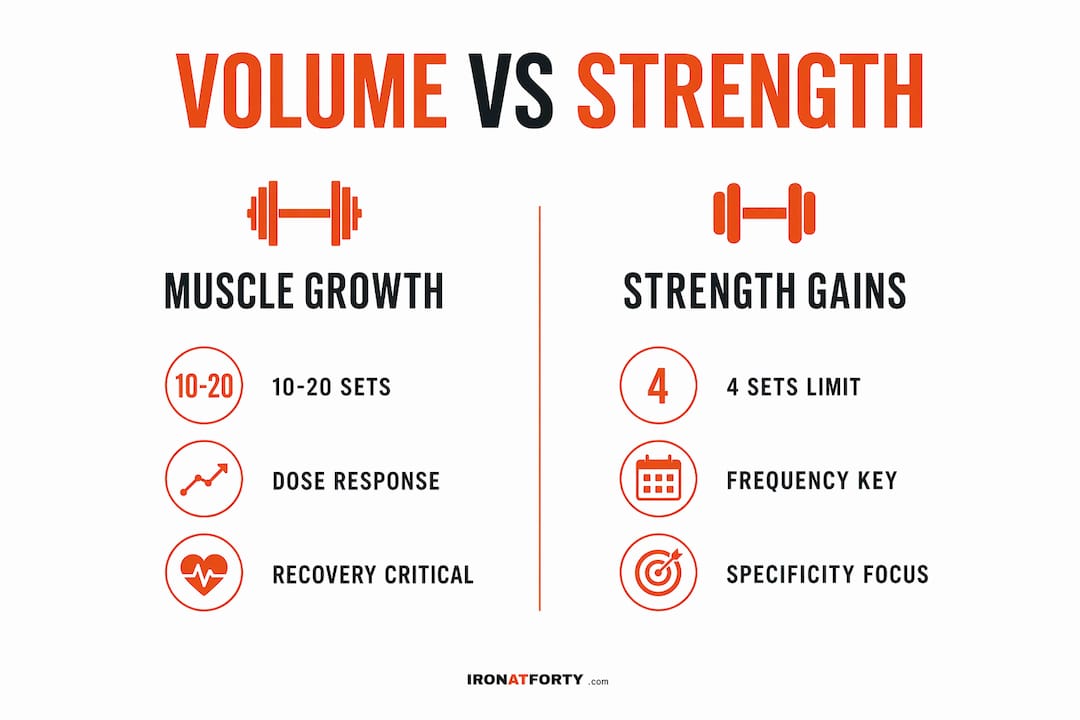
What actually moves the needle for strength is training frequency and movement specificity. Frequency improves strength through better movement coordination and neural adaptations, with each additional weekly session producing measurable strength gains. Squatting twice a week beats squatting once a week with double the sets in that single session.
Load intensity also plays a defining role. The ACSM recommends loads above 80% of your 1RM for strength development. That means your training load, not just your total sets, determines whether you get stronger. You can use Ironatforty's 1RM calculator to pin down your working weights accurately before you plan your sets.
Key differences between volume for strength versus hypertrophy:
- Strength plateaus at roughly 4 sets per movement per week; hypertrophy benefits extend to 20 sets per muscle per week.
- Strength responds strongly to training frequency; hypertrophy responds primarily to total weekly volume.
- Strength requires loads above 80% 1RM; hypertrophy can occur across a broader load range.
- Movement specificity drives strength; muscle tension and metabolic stress drive hypertrophy.
- For adults over 40, splitting strength work across more frequent, shorter sessions reduces joint stress while preserving the neural stimulus.
How do frequency and recovery shape your volume tolerance?
Volume without recovery is just fatigue. This is where most lifters over 40 get into trouble. They add sets, feel the burn, and assume progress is coming. It is not. Not without the recovery infrastructure to support it.

The ACSM recommends at least two training sessions per week per muscle group, with 2–3 sets per exercise as a baseline for adults over 30. Spreading your weekly volume across multiple sessions keeps performance quality high and fatigue manageable. One brutal session per week is not the same as two focused ones, even if the total sets match.
Recovery fundamentals are non-negotiable. Seven or more hours of sleep, protein intake at 1.6g per kilogram of bodyweight, and sufficient total calories are the floor, not the ceiling, for high-volume training. Without those three, your volume advantages disappear and gains stall or reverse. For a 180-pound lifter, that protein target is roughly 130 grams per day minimum.
Here is a practical recovery checklist for lifters aged 30–50:
- Sleep 7+ hours per night. Muscle protein synthesis peaks during deep sleep. Cutting this short cuts your gains short.
- Hit 1.6g of protein per kilogram of bodyweight daily. Spread it across 3–4 meals for better absorption.
- Eat at or above your maintenance calories when volume is high. A calorie deficit during a high-volume block is a recovery killer.
- Monitor your performance session to session. A drop in reps or load at the same effort level signals accumulated fatigue, not weakness.
- Build deload weeks into your program every 4–6 weeks. Reduce volume by 40–50% for one week to let your body catch up.
Pro Tip: If your performance drops two sessions in a row at the same weight, that is a recovery signal, not a motivation problem. Eat more, sleep more, or reduce volume before adding sets.
Training after 40 changes the recovery equation in real ways. Hormonal shifts slow recovery, connective tissue takes longer to adapt, and the cost of each hard session is higher. That does not mean training less. It means training smarter with volume you can actually absorb.
How to apply optimal training volume for lasting gains
The biggest mistake lifters make with volume is starting too high. Start at minimum effective volume and increase incrementally based on recovery and progress. Beginners should start at 8–12 sets per muscle per week. Intermediate lifters can add 2 sets every 4–6 weeks when progress stalls.
This approach works because optimal volume is not about maxing out your weekly sets. It is about finding the lowest volume that produces consistent progress and only adding more when that volume stops working. More is not better. Enough is better.
Practical volume application for adults aged 30–50:
- Start with 10 sets per muscle group per week and track results for 4–6 weeks before changing anything.
- Use compound lifts as your volume backbone. Deadlifts, squats, rows, and presses cover multiple muscle groups efficiently.
- Apply fractional counting to avoid underestimating your actual workload. Count indirect sets at 0.5 per compound movement.
- Split your weekly volume across at least two sessions per muscle group. Three sessions is better for most people in this age range.
- Adjust volume based on recovery signals, not a fixed schedule. If you are sleeping poorly or performance is dropping, reduce sets before adding them.
The table below shows how to structure weekly volume progression across training experience levels:
| Experience level | Starting volume | Progression rate | Upper limit |
|---|---|---|---|
| Beginner (under 1 year) | 8–10 sets per muscle per week | Add 2 sets every 6 weeks | 15 sets |
| Intermediate (1–3 years) | 10–15 sets per muscle per week | Add 2 sets every 4–6 weeks | 20 sets |
| Advanced (3+ years) | 15–20 sets per muscle per week | Add 1–2 sets when progress stalls | 25 sets |
For effective training programs built around these principles, the structure matters as much as the numbers. Splitting volume across exercises and sessions, rather than cramming it into one workout, keeps quality high and injury risk low. That is especially true for the 30–50 age group where connective tissue recovery lags behind muscle recovery.
Key Takeaways
Training volume drives muscle growth and strength through a dose-response relationship, but recovery capacity sets the ceiling on how much volume you can productively absorb.
| Point | Details |
|---|---|
| Optimal hypertrophy volume | Aim for 10–20 sets per muscle per week; benefits flatten above 20 sets. |
| Strength needs frequency, not just volume | Strength plateaus around 4 sets per movement; add sessions, not just sets. |
| Fractional counting matters | Count indirect sets at 0.5 to avoid underestimating your actual workload. |
| Recovery is the real ceiling | Sleep 7+ hours and hit 1.6g protein per kilogram or high volume backfires. |
| Progress incrementally | Start at minimum effective volume and add 2 sets every 4–6 weeks when gains stall. |
Volume is not the problem. Recovery is.
Here is the uncomfortable truth I have seen play out repeatedly with lifters in their 30s and 40s: the volume is rarely the issue. The recovery is. People read that 20 sets per muscle per week is the target and immediately try to hit that number, ignoring the fact that they are sleeping six hours a night, eating at a deficit, and working a stressful job. Then they wonder why they feel beat up and their lifts are going backward.
The marginal difference between optimal and adequate volume is often small. If you are making steady progress at 12 sets per week, adding more sets is not going to accelerate that. It is going to cost you recovery resources you do not have to spare. I have watched lifters make better gains by cutting volume and fixing sleep than by adding sets and grinding through fatigue.
The real skill is reading your own data. Track your performance week to week. If your reps are climbing and your recovery feels solid, you have room to add volume. If performance is flat or declining, the answer is almost never more sets. It is better sleep, more food, or a deload. Ignoring recovery metrics is the most common failure point I see, and it is entirely avoidable.
For lifters over 40, I always recommend starting with minimum effective dose training before chasing higher volume. Build the recovery habits first. Then add the sets.
— Iron@40 Staff
Tools and resources to manage your volume at Ironatforty
Knowing the right volume targets is one thing. Applying them to your actual life, with your actual schedule and recovery capacity, is another. Ironatforty publishes science-backed guidance built specifically for lifters aged 30 and older, covering training and nutrition after 40 with the kind of specificity that generic fitness content never delivers.
The free TDEE calculator helps you confirm you are eating enough to support your training volume. Calorie sufficiency is not optional when volume is high. The nutrition guidance at Ironatforty covers protein targets, meal timing, and recovery nutrition tailored to adults over 40. Use these tools together to build a volume plan your body can actually absorb and grow from.
FAQ
What is training volume and why does it matter?
Training volume is the total work performed, calculated as sets multiplied by reps multiplied by load. It matters because it determines the size of the training stimulus your muscles receive, which directly drives hypertrophy and strength adaptation.
How many sets per week do I need for muscle growth?
Research supports 10–20 sets per muscle group per week for hypertrophy, with the strongest returns in the first 10 sets. Benefits flatten near 20 sets and negative effects appear above 30 sets.
Does more volume always mean more muscle?
No. Volume and hypertrophy show diminishing returns, and volume above your recovery capacity produces stagnation or regression rather than growth. Adequate recovery is what converts volume into muscle.
How does training volume differ for strength versus muscle growth?
Strength gains plateau around 4 sets per movement per week and respond more to training frequency and load intensity above 80% 1RM. Muscle growth responds to higher total weekly volume spread across multiple sessions.
How should lifters over 40 approach training volume?
Adults over 40 should start at 8–12 sets per muscle per week, prioritize recovery fundamentals including 7+ hours of sleep and 1.6g of protein per kilogram of bodyweight, and increase volume by 2 sets every 4–6 weeks only when progress stalls.