Core longevity practices for the aging athlete are defined as the integrated combination of structured training, targeted nutrition, and deliberate recovery that preserves strength, aerobic capacity, and joint health past 40. After 40, your body faces real physiological shifts: VO2max begins declining, anabolic resistance increases, and connective tissue recovers more slowly than muscle. These are not excuses. They are variables you can manage. The athletes who stay competitive and pain-free into their 50s and 60s are not the ones training hardest. They are the ones training smartest, with protocols built around adaptation rather than punishment.
What are the core longevity practices for the aging athlete?
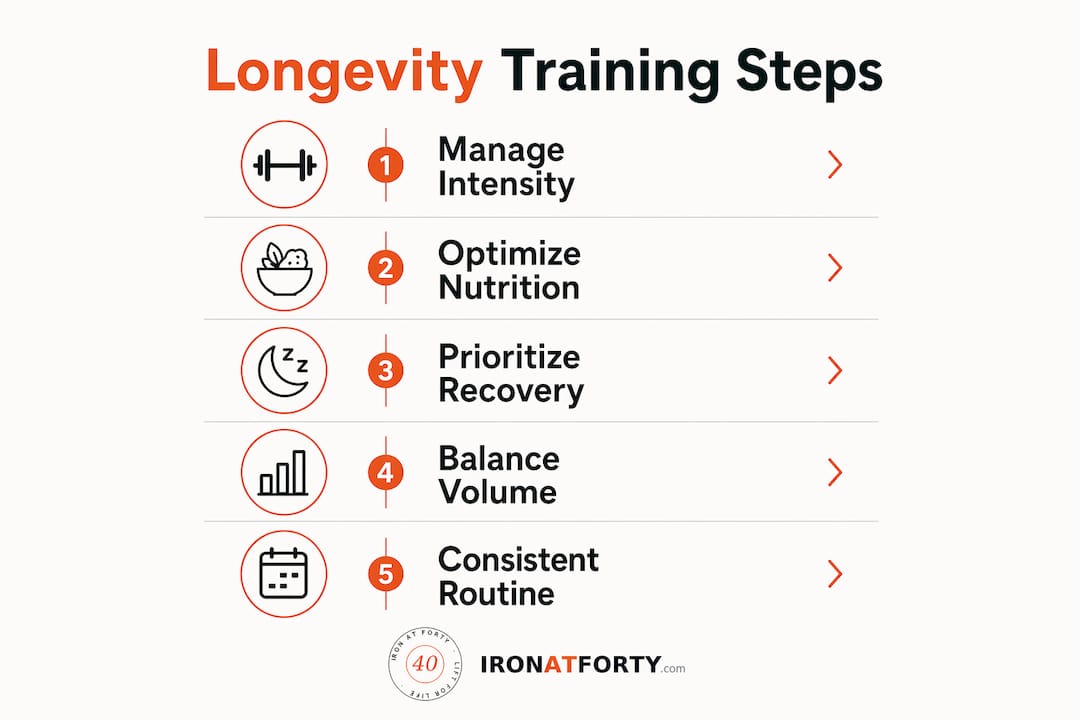
The foundation sits on three pillars: training intensity management, nutrition precision, and recovery discipline. Get all three right and you slow the clock. Ignore one and the other two cannot compensate.
Aging athletes face a specific challenge called anabolic resistance, where muscle tissue becomes less responsive to the same training stimulus that worked at 25. This means you need more protein, smarter programming, and better sleep, not just more volume. The physiological changes after 40 are real, but they are manageable with the right framework.
The research is clear on one point: consistency beats intensity every time. An athlete who trains at 75% capacity for 10 years outperforms one who trains at 100% for 3 years before breaking down. Build your program around that truth.
How should training intensity and volume be structured after 40?
The 80/20 training split is the most evidence-backed intensity model for aging athletes. That means 80% of your weekly training volume stays at low to moderate intensity, and only 20% pushes into high-intensity territory. This is not a soft approach. It is the structure that keeps you training for decades.
High-intensity sessions should be capped at 1–2 per week, with 48–72 hours of recovery between sessions targeting the same muscle group. Violate that window consistently and you accumulate fatigue faster than you can clear it. That is how overtraining starts.
Consistent endurance training at Zone 2 pace, which means you can hold a conversation, reduces VO2max decline by approximately 50% with 3–5 hours per week. That number matters because VO2max is one of the strongest predictors of long-term health and athletic capacity. Protecting it is not optional.
Key training structure guidelines for athletes over 40:
- Keep 80% of weekly sessions at conversational, aerobic intensity
- Limit high-intensity work to 1–2 sessions per week
- Allow 48–72 hours between hard sessions targeting the same muscles
- Monitor heart rate variability to track recovery status and avoid overtraining
- Adjust volume down before intensity when fatigue accumulates
Pro Tip: If your HRV is trending down for three or more consecutive days, replace your next hard session with a Zone 2 walk or easy bike ride. Your nervous system is telling you something. Listen.
Periodization matters here too. A structured periodization approach cycles training stress and recovery over weeks and months, which is far more effective than grinding the same program indefinitely.
What nutrition strategies support muscle preservation for aging athletes?
Protein is the non-negotiable. Athletes over 40 need 1.2 to 1.8 grams of protein per kilogram of body weight daily, distributed across 3–4 meals. Spreading intake matters because muscle protein synthesis has a ceiling per meal. Eating 60 grams at dinner and skipping breakfast does not work the same way as 30 grams four times a day.

Leucine-rich protein sources trigger muscle protein synthesis most effectively. Eggs, chicken, Greek yogurt, cottage cheese, and whey protein all qualify. Aim for at least 2.5–3 grams of leucine per meal to hit the synthesis threshold, especially after training.
Carbohydrate timing around workouts supports glycogen replenishment and reduces cortisol spikes post-training. A meal or snack with both protein and carbohydrates within 60–90 minutes after a hard session accelerates recovery. This is not complicated sports science. It is basic fuel management.
Nutrition priorities for aging athletes:
- Hit 1.2–1.8 g/kg of body weight in protein daily
- Distribute protein across 3–4 meals, not front or back-loaded
- Prioritize leucine-rich sources: eggs, chicken, whey, cottage cheese
- Time carbohydrates around training for glycogen recovery
- Monitor vitamin D and iron levels, as deficiencies directly impair performance and recovery
Pro Tip: Use Ironatforty's TDEE calculator to nail your daily calorie target before worrying about macro ratios. You cannot optimize protein intake if total calories are too low.
Which recovery practices are essential for joint health and training capacity?
Sleep is the most underrated performance variable in fitness. Adults over 50 need 7–9 hours of quality sleep for adequate tissue repair and growth hormone output. After 50, sleep architecture becomes more fragmented, meaning you spend less time in deep, restorative stages. That fragmentation directly reduces recovery capacity.
Practical sleep interventions that work:
- Minimize evening light exposure starting 90 minutes before bed. Blue light suppresses melatonin and delays sleep onset.
- Cool your bedroom to between 65–68°F. Core body temperature must drop to initiate deep sleep.
- Set a consistent wake time seven days a week. Consistency anchors your circadian rhythm better than any supplement.
- Avoid alcohol within 3 hours of sleep. It fragments REM sleep even when it feels like it helps you fall asleep faster.
- Schedule deload weeks every 3–4 weeks. Proactive deloading protects connective tissues that recover slower than muscle. Tendons and ligaments do not bounce back in 48 hours. They need weeks.
Recovery modalities like sauna and cold therapy add value when used consistently. Sauna exposure post-training supports cardiovascular adaptation and reduces muscle soreness. Cold immersion reduces acute inflammation but should not be used immediately after strength training, as it can blunt the adaptation signal.
Pro Tip: Treat your deload week like a planned pit stop, not a sign of weakness. The athletes who skip deloads are the ones posting about their injuries six months later.
Mobility work and structured yoga belong in your weekly program, not as extras but as training sessions. Mobility and recovery are foundational, not optional. They preserve movement quality, protect joints, and reduce the recovery burden on your central nervous system.
What exercises best preserve function and prevent decline with age?
Functional strength is the best exercises for aging athletes to prioritize. Squats, deadlifts, hip hinges, rows, overhead presses, and loaded carries train the movement patterns your body uses in sport and daily life. Strength training twice per week focusing on legs, back, and core with 3 sets of 8–12 reps per exercise is both time-efficient and highly effective for joint protection and muscle retention.
Balance training is a longevity tool that most athletes ignore until they need it. Single-leg work, such as Bulgarian split squats, single-leg Romanian deadlifts, and step-ups, builds neuromuscular coordination that pure bilateral lifting cannot replicate. Grip strength and balance are early warning signs of decline. Treat them as vital signs, not afterthoughts.
Bone density deserves specific attention. Pure resistance training alone does not fully maintain bone mineral density without a high-impact stimulus. Grip strength and high-impact activities like jumping and drop landings, targeting 40–50 reps per week, preserve bone health in ways that machines and cables cannot.
| Movement category | Primary benefit for aging athletes |
|---|---|
| Compound lifts (squat, deadlift, press) | Muscle mass retention and joint stability |
| Unilateral movements (split squat, single-leg RDL) | Balance, coordination, and injury prevention |
| Loaded carries (farmer's carry, suitcase carry) | Grip strength, core stability, and gait quality |
| High-impact drills (box jumps, drop landings) | Bone mineral density preservation |
| Mobility and yoga flows | Joint range of motion and movement quality |
Movement quality is non-negotiable. A heavy squat with poor mechanics does more damage than good. If your form breaks down under load, reduce the weight and rebuild the pattern. Sustainable performance requires that you move well before you move heavy.
- Prioritize compound movements over isolation exercises
- Add unilateral work to every lower body session
- Include 40–50 high-impact reps per week for bone health
- Train grip strength directly with carries and dead hangs
- Use your 1RM calculator to set load targets that challenge without exceeding safe thresholds
Key Takeaways
The most effective longevity strategy for aging athletes combines the 80/20 intensity split, 1.2–1.8 g/kg daily protein, 7–9 hours of sleep, proactive deloading every 3–4 weeks, and functional movement that includes high-impact bone-loading work.
| Point | Details |
|---|---|
| Train with the 80/20 split | Keep 80% of sessions at low intensity and cap high-intensity work at 1–2 sessions per week. |
| Hit your protein target daily | Eat 1.2–1.8 g/kg of body weight in protein spread across 3–4 meals to counter anabolic resistance. |
| Protect sleep as a training variable | Aim for 7–9 hours with consistent timing and a cool, dark environment to maximize tissue repair. |
| Deload every 3–4 weeks | Planned deload weeks protect connective tissue and extend long-term training consistency. |
| Load bone with impact work | Include 40–50 high-impact reps weekly through jumping and drop landings to preserve bone density. |
What I've learned from training through my 40s
The hardest mindset shift is moving from "how hard can I go" to "what does my body need to adapt from." I resisted that shift for longer than I should have. The result was a string of nagging injuries that cost me more training time than any deload week ever would.
The athletes I respect most are not the ones grinding at maximum volume every week. They are the ones who show up consistently, adjust when their body signals fatigue, and protect their connective tissue like it is their most valuable asset. Because it is.
HRV monitoring changed how I program my own training. When my numbers drop, I pull back. Not because I am soft, but because I know that one extra hard session on a depleted nervous system costs me a week of quality training. That math never works out in favor of pushing through.
The uncomfortable truth is that most athletes over 40 are not undertrained. They are under-recovered. More volume is rarely the answer. Better recovery, smarter intensity distribution, and consistent nutrition are. If you want to stay competitive and pain-free for the next 20 years, build your program around avoiding overtraining before it becomes a problem, not after.
— Jeff
Ironatforty's resources for training and nutrition after 40
Ironatforty publishes science-backed guidance built specifically for athletes over 40 who lift weights and want real answers, not recycled gym advice.
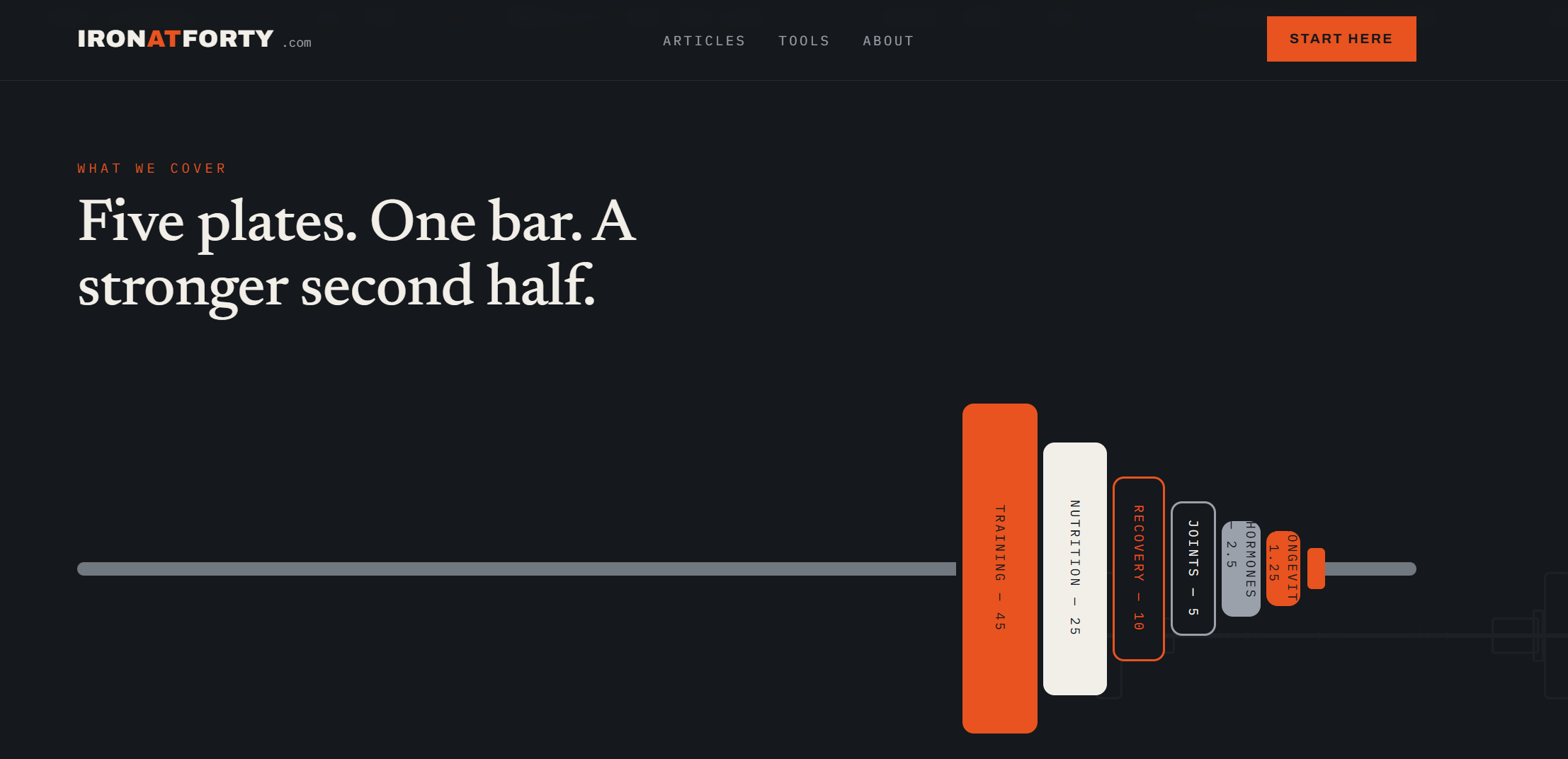
The nutrition hub covers protein targets, meal timing, and recovery nutrition with the same specificity you read here. The training section goes deep on program design, periodization, and how to structure your week for both performance and longevity. If you want to protect your joints while staying strong, the joint health resources address exactly that. Every article is written for athletes who train seriously and need guidance that respects their experience level.
FAQ
What is the best training split for athletes over 40?
The 80/20 split works best: 80% of weekly volume at low to moderate intensity and 20% at high intensity. Limit hard sessions to 1–2 per week with 48–72 hours of recovery between them.
How much protein do aging athletes actually need?
Athletes over 40 need 1.2 to 1.8 grams of protein per kilogram of body weight daily, spread across 3–4 meals. This range counteracts anabolic resistance and supports muscle protein synthesis throughout the day.
How often should aging athletes take a deload week?
Deload every 3–4 weeks as a standard practice. Connective tissues recover slower than muscle, and proactive deloading prevents the cumulative damage that leads to injury.
Does sleep really affect athletic performance after 40?
Sleep directly affects growth hormone output, tissue repair, and recovery capacity. Adults over 50 need 7–9 hours of quality sleep, and disrupted sleep architecture after 50 makes sleep hygiene interventions a critical training variable.
What exercises preserve bone density as you age?
High-impact activities like jumping and drop landings, targeting 40–50 reps per week, preserve bone mineral density alongside compound strength work. Resistance training alone is not sufficient to maintain bone health without that impact stimulus.