
Caloric periodization is the planned, deliberate manipulation of your calorie and macronutrient intake across training sessions, weeks, and months to match what your body actually needs to adapt, recover, and perform. It is not eating the same 2,200 calories every single day regardless of whether you squatted heavy or took a rest day. It is matching fuel to demand.
Three things to know before you go further:
- It works both directions. You can use caloric periodization to push performance up during a hard training block or to lose fat without tanking your lifts, depending on how you sequence the changes.
- It is session-aware, not just calendar-aware. The best version of this adjusts food around your actual workout, not just your week.
- It has a floor. Push the deficit too hard, too often, and you risk low energy availability, a state where your body starts sacrificing hormones, bone density, and recovery to make up the energy gap. That is not a hypothetical. It is the single most common way well-intentioned lifters wreck their own progress.
If you have ever eaten the exact same meal plan on a heavy deadlift day and a rest day and wondered why one felt fine and the other felt like wading through wet cement, you already understand the problem caloric periodization solves.
Key Takeaways
Caloric periodization works because it matches food intake to training demand instead of forcing one flat number to cover every day of the week.
| Point | Details |
|---|---|
| Definition | Caloric periodization is the planned manipulation of calories and macros across sessions and cycles to match training demands. |
| Protein stays stable | Hold protein at 1.3 to 1.8 g/kg daily, rising toward 1.8 to 2.4 g/kg during a deficit, while carbohydrate does most of the cycling. |
| Match fuel to the session | Add 200 to 500 calories on hard training days and pull back a similar amount on easy or rest days. |
| Watch for red flags | Persistent fatigue, declining strength, and menstrual irregularity signal low energy availability and warrant a pause or professional input. |
| Test before committing | Run a 4-week trial using Ironatforty's TDEE calculator as your baseline before locking in a longer periodization plan. |
Table of Contents
- What Is Caloric Periodization, Really?
- How Do Macro, Meso, and Microcycles Work?
- What Strategies Fall Under Caloric Periodization?
- How Do You Set Up a Caloric Periodization Plan?
- How Do You Track Progress and Avoid Getting Hurt?
- What Does the Research Actually Support?
- How Do You Run a 4-Week Caloric Periodization Test?
- What Myths About Caloric Periodization Should You Ignore?
- What Should Athletes Over 40 Prioritize First?
- Sources
- FAQ
What Is Caloric Periodization, Really?
Caloric periodization means nutrition stops being a fixed, static number and starts acting like part of your training program. Researchers describe periodized nutrition as the planned, purposeful, and strategic manipulation of energy, carbohydrate, protein, and micronutrient intake across your training cycles, tied directly to specific adaptations you're chasing rather than a diet you picked off a magazine cover.
The framing that matters most here is one experts sometimes call "fuel for the work required." Instead of asking "how many calories should I eat today," you ask "what is today's training asking of my body, and how do I fuel that specifically?" The UCI Sports Nutrition Project frames this directly: carbohydrate availability, meaning your glycogen stores plus what you eat around a session, should scale with the intensity and volume of the work in front of you. A 6 mile easy jog and a set of hill repeats at threshold pace are not the same fueling event, even if they take the same amount of time.
Here's the part that surprises most lifters: nutrition doesn't create adaptation on its own. It amplifies or blunts the adaptation your training already triggers. Train hard with too little carbohydrate around the session and you can blunt the quality of the work itself, which then blunts the signal your muscles get to grow, recover, or adapt. Train with proper fueling and the same session produces a stronger training stimulus with better recovery on the back end.
"Periodized nutrition" makes nutrition subservient to training goals, not a parallel diet plan running on its own schedule.
Three scenarios show why this matters in practice. An off-season hypertrophy block calls for a caloric surplus or maintenance level with steady carbohydrate to support volume and recovery. A base-building endurance phase calls for higher carbohydrate around long sessions to build the aerobic engine without under-fueling. Taper week before a competition calls for something entirely different: lower training volume but often maintained or even increased carbohydrate to top off glycogen stores.
The practical payoff comes down to three things:
- You retain performance during a deficit instead of watching your numbers on the bar collapse the moment you cut calories.
- You recover faster between hard sessions because the body has the raw material to repair, not just survive.
- You manage body composition with less chronic restriction, cycling calories up and down instead of grinding through months at the same low number.
That last point is the one most 40 plus lifters get wrong. Grinding a flat deficit for 12 weeks straight is a slower, harder path to fat loss than most people realize, and it's exactly the kind of approach caloric periodization is built to replace.
How Do Macro, Meso, and Microcycles Work?
Three timescales, three levels of decision-making. Get comfortable with these terms because every serious periodization plan, whether it's your lifting program or your nutrition, is built on them.
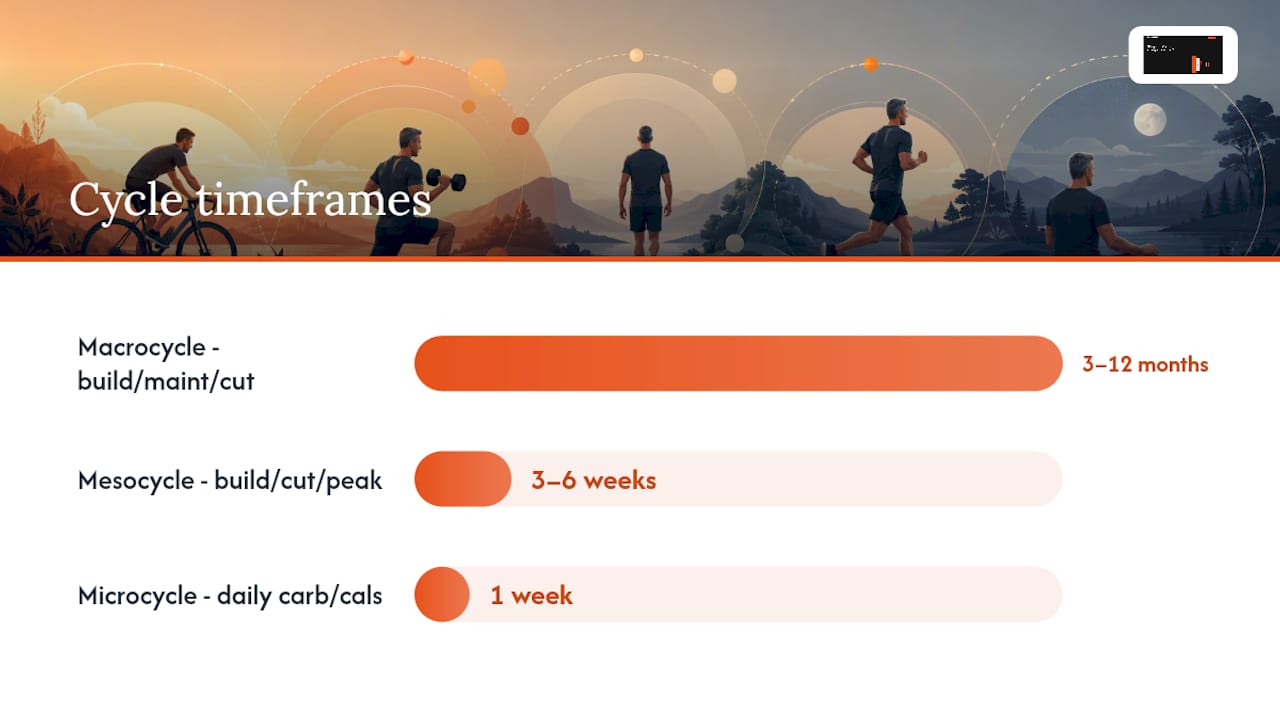
A macrocycle is your big picture, usually months to a full year. Think a full off-season into a competition season, or a 16 week body recomposition project. At this level, caloric periodization means choosing the overall trajectory: are you building, maintaining, or cutting for this entire block?
A mesocycle is a chunk inside that, typically 3 to 6 weeks. This is where you set a specific nutritional theme: a hypertrophy mesocycle eating at maintenance or slight surplus, a fat-loss mesocycle running a moderate deficit, a peaking mesocycle prioritizing carbohydrate for performance.
A microcycle is your week, and inside it, your individual training days. This is where "fuel for the work required" gets literal. A heavy squat day gets more carbohydrate around the session than a mobility and light cardio day, even within the same week, even within the same overall caloric target.
| Cycle level | Typical timeframe | Nutrition action |
|---|---|---|
| Macrocycle | 3 to 12 months | Set overall direction: surplus for lean mass, deficit for fat loss, maintenance for skill or performance focus |
| Mesocycle | 3 to 6 weeks | Assign a nutritional theme (build, cut, peak) tied to the training block's goal |
| Microcycle | 1 week, with daily variation | Cycle carbohydrate and total calories around session intensity, with higher intake on hard days and lower on rest or easy days |
A lifter chasing seasonal lean mass might run a macrocycle at a modest surplus for four months, broken into mesocycles that alternate volume-accumulation weeks (slightly higher calories) with deload weeks (calories trimmed back toward maintenance). Inside each week, the microcycle still flexes: more carbohydrate around the two heaviest lifting days, less on the two lower-intensity days.

Compare that to competition fuel-up, where the macrocycle goal shifts entirely toward performance. Calories may hold steady or even rise slightly in the final microcycle before an event, prioritizing glycogen storage over any body composition goal. This is where a lot of people sabotage themselves: they try to cut weight the same week they need peak output, and the two goals fight each other.
What Strategies Fall Under Caloric Periodization?
Several distinct approaches live under the caloric periodization umbrella, and they are not interchangeable. Picking the wrong one for your goal wastes months.
- Train-high, fuel-high: eating adequate carbohydrate before and during your hardest sessions so you can hit the intensity or volume the session demands. Best for strength and power work where output quality is the whole point. Evidence here is the strongest of any strategy on this list, because performance during the session is directly observable.
- Train-low: deliberately doing certain sessions with lower carbohydrate availability, usually easy aerobic work, to enhance cellular signaling for endurance adaptations. The signaling research is real, but the performance carryover is inconsistent, and doing this on a session that actually requires intensity backfires by degrading the work itself.
- Sessional carbohydrate periodization: matching daily carbohydrate to the day's training load rather than eating a flat amount, useful for endurance athletes managing a mixed week of easy and hard sessions.
- Planned refeeds: scheduled higher-calorie days during an extended deficit, mainly to support training performance and psychological adherence during a cut. Practical and well-tolerated, though the direct performance benefit is more anecdotal than rigorously proven.
- Calorie cycling: alternating higher and lower calorie days across the week tied to training load, common for body recomposition goals in strength athletes.
- Gut training: practicing carbohydrate intake during training at the volumes you plan to use in competition, so your gut tolerates it. Strong practical value for endurance athletes doing long events; largely irrelevant for pure strength training.
- Low-carbohydrate, high-fat (LCHF) macrocycles: extended blocks emphasizing fat as the primary fuel source. The evidence for enhanced endurance performance from LCHF blocks is mixed at best, and it tends to compromise the ability to train at high intensity, which is a real cost for most lifters.
The common thread across all of them: none work in isolation from your actual training. A train-low session that turns into a low-quality session because you couldn't hit the required pace or load isn't a clever adaptation strategy. It's just a wasted workout.
How Do You Set Up a Caloric Periodization Plan?
Getting this right starts with a number you probably don't know precisely, which is your actual daily energy need. Skipping this step is the most common reason caloric periodization plans fail before they even start.
- Establish your baseline. Run your numbers through a TDEE calculator to get a starting estimate of your total daily energy expenditure. This is your anchor point, the number everything else moves around. If you're 40 plus, treat this as an estimate to be refined over two to three weeks of real-world tracking, not a fixed truth, since metabolic estimates get noisier with age-related shifts in muscle mass and activity patterns.
- Set your protein floor and hold it steady. Somewhere in the 1.3 to 1.8 g/kg per day range covers most training goals, with the higher end of that range, closer to 1.8 to 2.4 g/kg, making more sense during a deficit phase when you're actively trying to preserve muscle. Protein is the macro you don't cycle much. It stays high and stable while carbohydrate and total calories do the moving.
- Decide your macrocycle direction. Building, cutting, or maintaining, chosen based on what your current training block is actually built to accomplish, not what you feel like doing this week.
- Apply session-based carbohydrate and calorie rules. This is where "fuel for the work required" becomes an actual number. On your highest-volume or highest-intensity training days, add roughly 200 to 500 calories above your baseline, weighted toward carbohydrate. On lighter or rest days, pull back by a similar 200 to 500 calorie margin. Carbohydrate itself can range from roughly 3 g/kg on low-demand days up to 12 g/kg for the heaviest endurance training days, a wide window that reflects how differently a rest day and a three hour ride demand fuel.
- Test it inside a real training week before locking it in. Adjust based on how sessions actually feel and perform, not based on the spreadsheet.
Pro Tip: Don't guess your way through step one. A TDEE calculation that's off by 300 calories in either direction will quietly sabotage weeks of careful periodization before you ever notice something's wrong.
Four day-level examples make this concrete:
Heavy resistance day. Baseline calories plus 300 to 400, with an extra 30 to 50 grams of carbohydrate concentrated in the two hours before training and the hour after, when your muscles are primed to restock glycogen and protein synthesis is elevated.
Long aerobic day. Baseline plus 400 to 500 calories, most of it carbohydrate, with some taken during the session itself if it runs past 90 minutes, since exogenous carbohydrate during long efforts extends the point at which you run out of fuel.
Recovery or rest day. Baseline minus 200 to 300 calories, protein held at your full target, carbohydrate trimmed the most since glycogen demand is low. This is not a punishment meal plan. It's simply less fuel because less work is happening.
Competition or high-stakes performance day. Calories at or slightly above baseline, carbohydrate front-loaded in the 24 to 48 hours prior, timing built entirely around the event rather than around any body composition goal that week.
If you're pairing this with a structured lifting cycle, our guide on periodization training for strength after 40 walks through how to build the training side of this equation, and our piece on meal prep for strength athletes over 40 covers how to actually execute the higher and lower calorie days without living in the kitchen.
How Do You Track Progress and Avoid Getting Hurt?
Caloric periodization only works if you're watching the right signals and willing to adjust when they say something's wrong.
Track these on a rolling basis:
- Training performance: loads lifted, reps completed, pace or times on conditioning work. This is your most honest feedback loop.
- Subjective recovery: how sessions feel, whether soreness is lingering longer than usual, whether motivation to train is dropping.
- Body composition trends: weight and, ideally, a simple measurement or photo check every two to four weeks, not daily obsessive weigh-ins.
- Menstrual function, for women, since irregularity is one of the earliest and most reliable signals of inadequate energy intake.
- Resting heart rate, sleep quality, and hunger levels, all of which drift in a bad direction when energy availability drops too low for too long.
A reasonable cadence: log training performance weekly, check weight and strength benchmarks every two weeks, and do a fuller body composition check monthly. Faster than that and you're reacting to noise. Slower and you miss problems until they're entrenched.
Watch for the red flags of low energy availability, sometimes grouped under the label RED-S (Relative Energy Deficiency in Sport): persistent fatigue that doesn't improve with a rest day, declining strength despite consistent training, missed or irregular periods, frequent illness, and mood changes like irritability or flatness that don't track with anything else in your life. Any combination of these means the deficit has gone too far or lasted too long, and it's time to bring in a doctor or registered dietitian rather than push harder.
Part of why small mismatches matter is that both your TDEE estimate and your actual food tracking carry error. A calculator estimate can be off by hundreds of calories, and most people underreport what they eat by a similar margin. Compounded daily over months, a consistent 150 calorie miss in either direction becomes a meaningfully different outcome than the one you planned for.

What Does the Research Actually Support?
The strongest, most consistent evidence backs one specific idea: matching carbohydrate availability to session demand helps you sustain training intensity and finish long or hard sessions in better shape. That part of caloric periodization isn't theoretical. It shows up reliably across endurance and mixed-modality training studies.
The weaker ground is anything claiming a guaranteed long-term performance edge from strategies like train-low. The signaling research, meaning the cellular and hormonal responses tied to endurance adaptation, is genuinely well documented. What's far less settled is whether that signaling reliably converts into a faster race time or a bigger strength gain months later. Some studies show a benefit. Others show no meaningful difference, or even a performance cost when the low-fuel sessions degrade training quality.
Nutrition periodization can amplify or diminish the very training adaptations it's paired with. The signal is not the same thing as the outcome, and mistaking one for the other is where a lot of well-meaning athletes go wrong.
The practical takeaway is to treat every strategy as a hypothesis you test on yourself, not a guarantee you inherit from a study. Prioritize keeping your hardest sessions genuinely hard. And regardless of the strategy, chronic low energy availability isn't a shortcut. It's a liability that erases whatever adaptation benefit you were chasing in the first place.
How Do You Run a 4-Week Caloric Periodization Test?
You don't need a coach to run a legitimate test of this. You need four weeks and a willingness to actually track what happens.
- Week 1, baseline and test. Use the TDEE calculator to establish your starting point, then eat at that level for seven days while logging training performance, hunger, and sleep. This week is diagnostic, not a change week.
- Week 2, introduce session-based carbohydrate. Keep total weekly calories close to baseline but start shifting carbohydrate higher around your two or three hardest sessions and lower on easy or rest days. Notice whether hard sessions feel different.
- Week 3, apply your target block. If the goal is fat loss, drop total weekly calories by roughly 200 to 500 on average while keeping the session-based carbohydrate cycling intact. If the goal is lean mass, add a similar range instead.
- Week 4, reassess and taper the change. Compare training numbers, body weight trend, and how you feel against week 1. Decide whether to extend the block, adjust the numbers, or pull back if any red flags from the monitoring checklist above showed up.
For lifters over 40, keep the swings conservative. A 300 to 400 calorie shift up or down tends to be plenty; the aggressive 800 plus calorie deficits sometimes recommended for younger athletes carry a higher risk of joint and recovery problems when paired with the naturally slower recovery curve that comes with age. Keep protein at the top of your range throughout, since preserving muscle mass gets harder, not easier, as you get older.
| Week | Nutrition focus | What to track |
|---|---|---|
| Week 1 | Eat at baseline TDEE | Training numbers, hunger, sleep quality |
| Week 2 | Add session-based carbohydrate cycling | How hard sessions feel and perform |
| Week 3 | Apply target caloric shift (up or down 200 to 500) | Weight trend, strength maintenance |
| Week 4 | Reassess and adjust or taper | Compare against week 1 baseline, check red flags |
Run the test for at least four weeks before drawing conclusions. Anything shorter and you're reacting to water weight and normal day-to-day fluctuation, not a real trend. If you want the training side mapped out alongside this, our load management guide covers how to keep training stress and nutrition changes from stacking up against each other in the same week.
What Myths About Caloric Periodization Should You Ignore?
Myth: you have to eat the exact same calories every day to see results. Reality: matching intake to training demand, not to a flat daily number, is the entire premise of caloric periodization, and it's better supported by the fueling research than rigid daily consistency.
Myth: train-low always makes you a better endurance athlete. Reality: the signaling benefits are real, but performance carryover is inconsistent, and a train-low session that compromises the actual quality of your work can do more harm than good.
Myth: caloric cycling is just yo-yo dieting with better branding. Reality: yo-yo dieting is uncontrolled, reactive, and usually driven by frustration. Caloric cycling is planned, tied to specific training days, and built around a defined block with a clear endpoint. The difference is intention and structure, not the fact that calories go up and down.
Myth: any carbohydrate cut will speed fat loss. Reality: cutting carbohydrate on your hardest training days tends to backfire by degrading the session, which then reduces the total training stimulus driving the fat loss and muscle retention you actually want.
What Should Athletes Over 40 Prioritize First?
The biggest mistake we see lifters over 40 make with caloric periodization isn't the concept. It's the execution: they apply the aggressive swings recommended in studies of 25 year old athletes and wonder why their joints, sleep, and hormones start protesting by week three.
Three adjustments matter more here than anywhere else. First, protein does more heavy lifting as you age, so keep it toward the higher end of the range consistently rather than treating it as flexible. Second, keep your calorie swings conservative. A 300 to 400 calorie shift on hard days accomplishes almost everything an 800 calorie swing would, with a fraction of the recovery cost. Third, lean on session-based carbohydrate cycling specifically to protect training intensity. Preserving your heaviest lifts matters more for long-term strength retention after 40 than any short-term body composition goal.
Recovery deserves equal billing with the nutrition side of this. Sleep quality, joint load, and mobility work all interact with how well your body tolerates the deficit and surplus phases baked into a periodization plan. Our piece on cortisol and recovery after 40 covers this in more depth, and it's worth reading before you commit to an aggressive cutting mesocycle.
One last thing: if you're chasing a significant body composition change, or if any of the red-flag signs from the monitoring section above show up, that's the point to bring in a coach or registered dietitian rather than push through on your own. Self-directed experimentation is fine for the moderate adjustments described here. It's not the right approach for aggressive, extended deficits.
Where to start if you're new to this
There are other ways to get a caloric periodization plan built for you, from hiring a sports dietitian to working with a private coach, and either can be worth the cost if your goals are complex or you've dealt with RED-S before. But most lifters over 40 don't need that level of intervention to get started. They need an accurate baseline number and a simple structure to test against it.
That's exactly what Ironatforty's free tools are built for. The TDEE calculator gives you the baseline number this entire framework depends on, without a signup wall or an upsell attached to it. From there, the nutrition section has the meal prep and macro guidance to fill in the details, and the broader tools landing page includes the 1RM calculator if you want to track strength alongside the caloric changes described in the four-week test above. Run your numbers, build your first microcycle, and adjust from there. Start with the TDEE calculator today and you'll have your baseline in under five minutes.
Sources
- Periodized Nutrition for Athletes - PMC
- Fuelling gold medals: developing a ‘periodised nutrition system’ for elite athletes and applying it in practice
This article is general information, not a substitute for advice from a qualified doctor. Consult a qualified healthcare professional about your own circumstances before acting on anything here.
FAQ
What Is Caloric Periodization in Simple Terms?
It's adjusting your calories and carbohydrate up or down based on how hard you're training that day or week, instead of eating the same amount every single day regardless of workload.
What Are the Four Phases of Periodization?
Training periodization typically moves through preparatory, build, competition, and recovery phases, and caloric periodization mirrors this by shifting calories and carbohydrate to match each phase's demands, from higher fueling during build and competition to a lighter, recovery-focused intake during the off phase.
What Is the 3-3-3 Rule to Lose Weight?
Definitions of this rule vary across fitness sources and it isn't part of the peer-reviewed periodization research covered in this guide, so it's not something we can validate as an evidence-based fat-loss method here.
What Is the 30/30/30 Rule for Weight Loss?
This popular rule, eating 30 grams of protein within 30 minutes of waking followed by 30 minutes of low-intensity exercise, is a general fat-loss habit rather than a caloric periodization strategy, and it isn't backed by the training-adaptation research this article draws on.
How Do I Know If I'm in Low Energy Availability?
Watch for persistent fatigue that doesn't resolve with rest, declining strength despite consistent training, irregular or missed periods in women, and frequent illness. Any combination of these warrants scaling back a deficit or consulting a clinician.