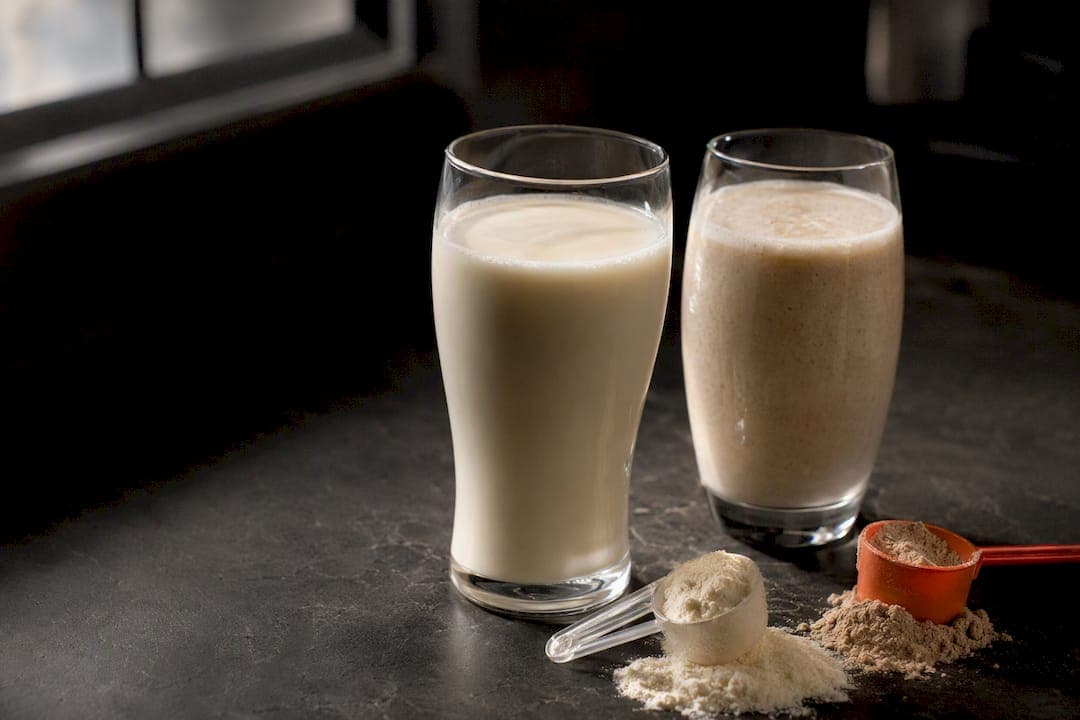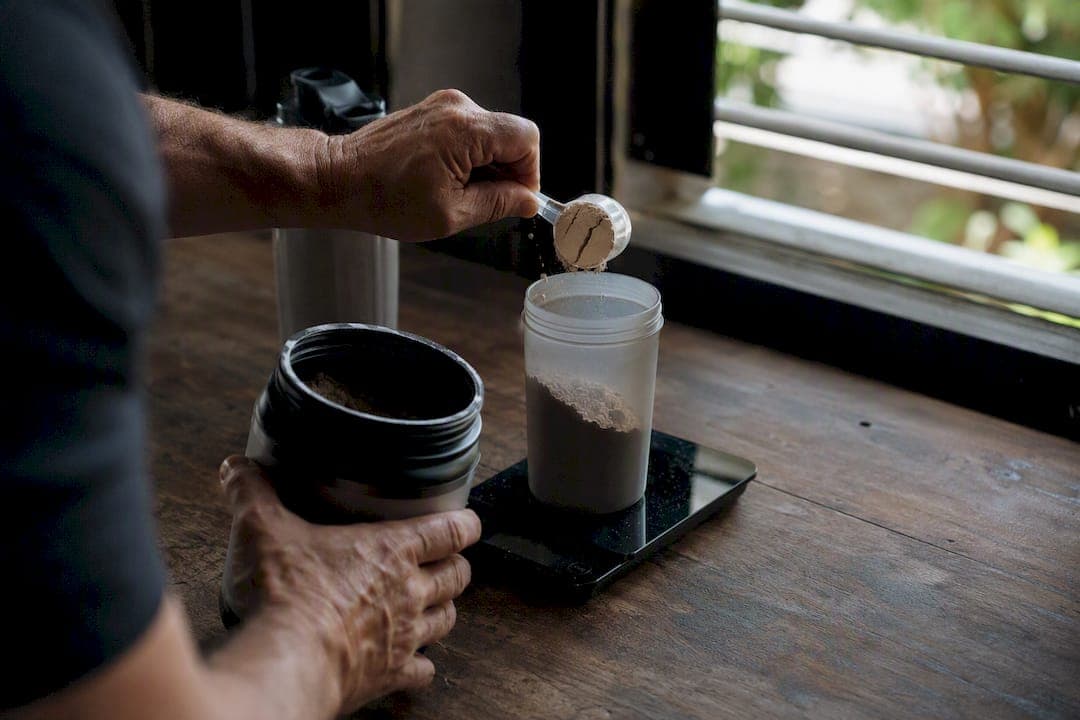
Aim for roughly 0.4 grams per kilogram of body weight per meal, or about 30 to 45 grams, if you're over 40 and training for muscle. Younger lifters can get by on 20 to 30 grams per feeding. Your total daily protein target matters more than hitting a perfect per-meal number, but each meal should still deliver sufficient leucine to trigger muscle protein synthesis.
TL;DR:
- Consuming about 0.4 grams of protein per kilogram of body weight per meal supports muscle building, with older adults needing 30 to 45 grams per meal to overcome anabolic resistance.
- Spreading protein intake evenly across three to four meals enhances 24-hour muscle protein synthesis more effectively than skewed schedules, especially if daily protein intake is below 1.6 g/kg.
- To trigger muscle growth, each meal should contain approximately 2.5 to 2.8 grams of leucine, obtainable from foods like whey, eggs, lean meats, or combined plant sources.
- Total daily protein intake remains the primary factor for muscle gain, while meal distribution and timing are secondary and most beneficial when daily intake is insufficient.
- High-protein diets are safe for healthy adults, but individuals with kidney disease should consult a doctor before increasing protein consumption significantly.
Table of Contents
- What's the Right Amount of Protein Per Meal?
- What Does the Research Actually Show?
- Does Meal Timing Matter More Than Total Intake?
- How Much Leucine Do You Need to Trigger Muscle Growth?
- What Meals Actually Hit These Targets?
- How Do You Calculate Your Own Protein Per Meal?
- Should You Worry About Protein Timing Around Workouts?
- Is High Protein Intake Safe for Your Kidneys?
- Iron@40 Perspective: Making This Work After 40
- Turn These Numbers Into a Weekly Plan
- Sources
- FAQ
What's the Right Amount of Protein Per Meal?
The research settles into a workable range once you strip away the gym-forum noise. For most adults chasing muscle, 0.4 g/kg per meal is the practical target recommended in the Schoenfeld et al. synthesis of single-meal protein research, spread across roughly four meals to reach 1.6 g/kg per day. That's the number worth writing on your fridge, not the vague "eat more protein" advice that got you here.
Here's where it gets specific to age. Older adults face anabolic resistance, meaning muscle tissue responds more sluggishly to a given protein dose than it did at 25. The PROT-AGE Study Group recommends per-meal intakes of 30 to 45 grams for older adults specifically to overcome that blunted response. That's not a suggestion to eat more for the sake of eating more. It's a correction for biology that changes whether you like it or not.
Maintenance eaters (not actively training for size) can generally hit their goals with 20 to 25 grams per meal and 1.2 to 1.6 g/kg daily, per the ranges outlined in the Dietary Guidelines for Americans. Hypertrophy-focused lifters need more: 1.6 to 2.2 g/kg daily, split into meals landing between 0.4 and 0.55 g/kg each.
Let's put real bodies on these numbers.
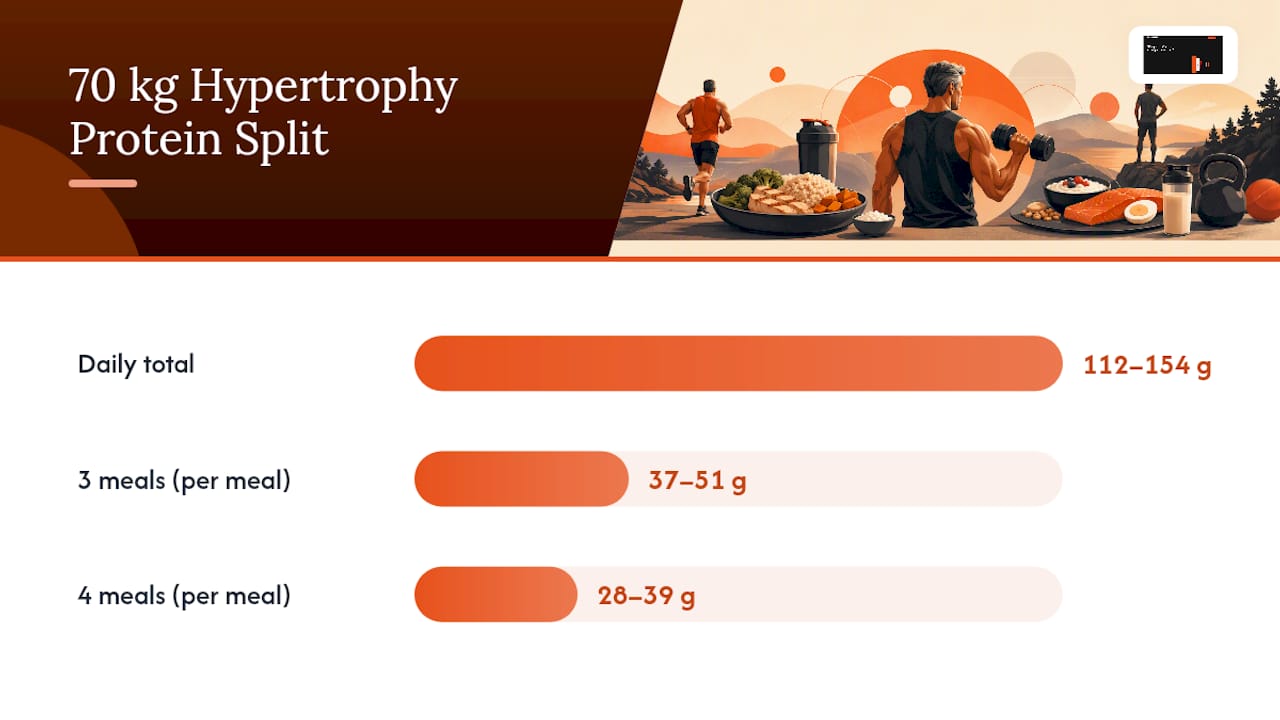
A 70 kg (154 lb) lifter chasing hypertrophy needs roughly 112 to 154 grams of protein daily (1.6 to 2.2 g/kg). Split across four meals, that's 28 to 39 grams per feeding. Split across three, you're looking at 37 to 51 grams per meal, which starts crowding the upper end of what a single sitting can meaningfully use.
An 85 kg (187 lb) lifter with the same goal needs 136 to 187 grams daily. Over four meals, that lands at 34 to 47 grams each. Over three meals, it climbs to 45 to 62 grams per sitting, still usable, just less efficient than spreading it out.
Quick reference for where you likely land:
- Maintenance, any age: 20 to 25 g per meal, 1.2 to 1.6 g/kg/day total
- Hypertrophy, under 40: 25 to 39 g per meal, 1.6 to 2.2 g/kg/day total
- Hypertrophy or maintenance, 40+: 30 to 45 g per meal, prioritizing even spread across 3 to 4 meals
- Any age, appetite-limited days: lean on liquid or semi-liquid protein sources to hit the floor without forcing volume
Your actual number depends on your weight, your training age, and how many meals you realistically eat. But these ranges cover the vast majority of readers walking into this article looking for a plan, not a lecture.
What Does the Research Actually Show?
Three separate lines of evidence point to the same conclusion, which is rare enough in nutrition science that it's worth paying attention.
Acute muscle protein synthesis studies identify a per-meal intake around 0.24 g/kg in young adults—about 20 to 30 grams—above which the muscle-building response starts to plateau. Higher doses provide amino acids used for other physiological purposes.
The second line of evidence comes from a metabolic crossover study that's more relevant to your actual eating pattern than any single-meal tracer test. Researchers compared an EVEN distribution of protein (roughly 30 grams per meal, three meals) against a SKEW pattern (most protein loaded onto dinner) using identical total daily intake. The even pattern raised 24-hour mixed muscle protein synthesis by about 25 percent compared with skewed intake. Same total grams, different result, just from timing where those grams land.
The third line, and arguably the most convincing for anyone actually training, comes from a 12-week resistance training trial. Researchers increased breakfast protein to roughly 0.33 g/kg in one group while a comparison group kept a low-breakfast, skewed pattern. Both groups matched on total daily protein. The higher-breakfast group produced greater resistance-training-induced hypertrophy over the 12 weeks. That's not a lab tracer result measured in hours. That's real muscle growth measured in weeks, and it happened because of when protein showed up, not how much showed up overall.
Here's the part that keeps this from turning into distribution obsession: the same body of research, including the original single-meal synthesis paper, concludes that total daily protein intake remains the primary driver of hypertrophy. Distribution is a secondary lever. A useful one, especially for people who eat two meals a day and wonder why their gains stalled, but secondary all the same.
Quick summary of what each study type tells you:
- Acute tracer studies: identify a rough per-meal ceiling (~20 to 30 g) for maximizing single-meal MPS response
- 24-hour metabolic crossover trials: show even distribution beats skewed intake by roughly 25 percent for daily MPS
- 12-week training trials: confirm that even distribution translates into measurably more muscle over time, not just better lab numbers
- Meta-analytic reviews: consistently rank total daily protein above distribution as the dominant variable
None of these studies contradict each other. They're answering different questions at different timescales, and together they build a coherent case for a specific eating pattern rather than a vague directive to "eat more protein."
Does Meal Timing Matter More Than Total Intake?
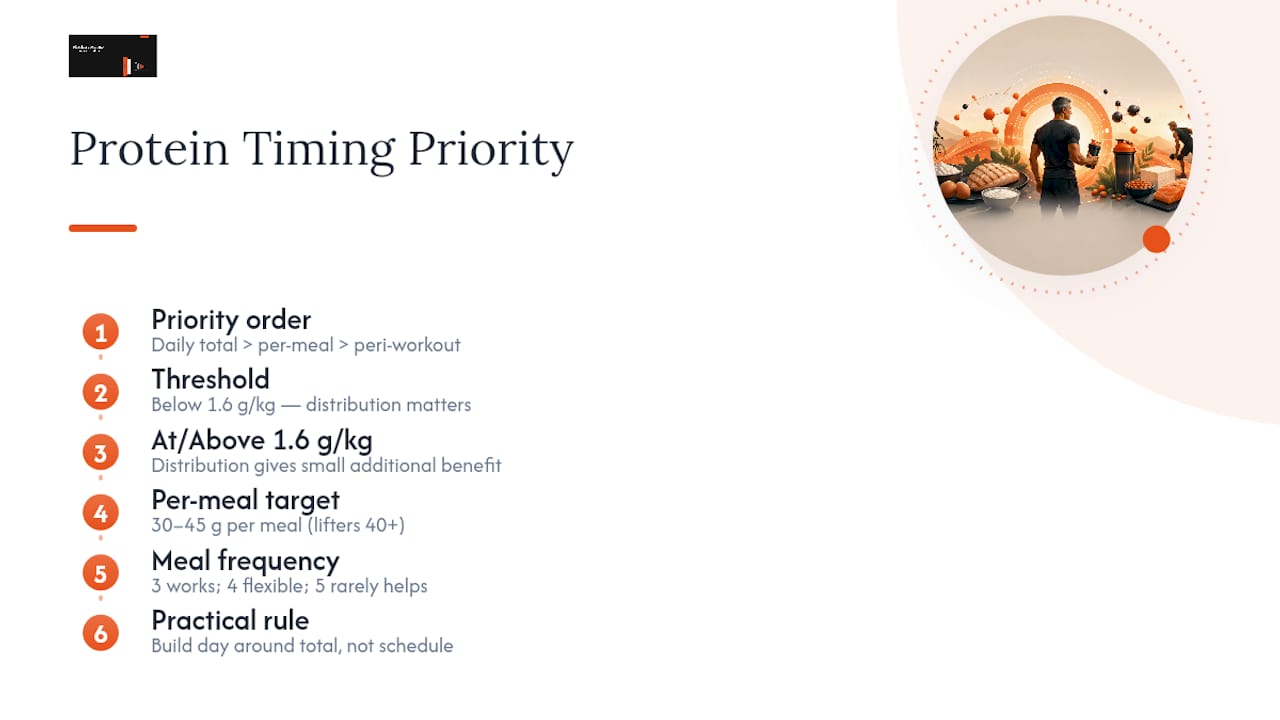
No, and this is where a lot of well-meaning advice goes sideways. The hierarchy looks like this: total daily protein comes first, per-meal distribution comes second, and precise peri-workout timing comes a distant third. If you remember nothing else from this article, remember that order.
Here's the practical threshold. If you're eating below 1.6 g/kg per day, distribution matters quite a bit, because you need every meal pulling its weight to reach enough anabolic episodes across the day. A review on protein distribution and its implications notes that people already hitting high total daily protein see a much smaller benefit from strict even distribution. In other words, distribution is a rescue strategy for people under-eating, not a mandatory ritual for people already doing the work.
If you're already at or above 1.6 g/kg daily, spread across a reasonable number of meals, you've likely captured most of the available benefit. Obsessing over exact grams at exact hours past that point is chasing a rounding error, not a result.
So how many meals should you actually eat? Three meals works fine if each one lands in the 30 to 45 gram zone recommended for lifters 40 and older. Four meals gives you more flexibility and slightly easier per-meal math, especially if your appetite runs smaller in the morning. Five meals rarely adds benefit once your first four are dialed in. It mostly adds dishes to wash.
The real-world takeaway: don't build your day around a feeding schedule. Build it around hitting your daily total, then use three or four meals to spread that total in a way that doesn't leave you starving by 3 p.m. or stuffed at 9 p.m. Our guide to protein timing for lifters over 40 breaks this down further if you want the deeper mechanics.
How Much Leucine Do You Need to Trigger Muscle Growth?
Every gram of protein isn't equal at the meal level. What actually flips the muscle-building switch is leucine, a specific amino acid that acts as the trigger for muscle protein synthesis. The threshold sits around 2.5 to 2.8 grams of leucine per meal, based on leucine-trigger research summarized in a review on protein supplementation in older adults. That threshold matters even more after 40, when anabolic resistance means your body needs a bigger signal to respond at all.
Hitting that number is easier than it sounds if you know which foods carry the load:
- Whey protein: roughly 25 to 30 grams delivers about 2.5 to 3 g leucine
- Eggs: 4 to 5 whole eggs gets you into range, though volume becomes an issue for some people
- Lean beef or chicken: 4 to 6 ounces cooked typically covers the leucine threshold alongside 25 to 35 g of total protein
- Greek yogurt or cottage cheese: a large serving (1 to 1.5 cups) usually clears the bar
- Plant proteins: single servings often fall short on leucine density, so combining sources (like rice and beans, or a pea protein blend) matters more than it does with animal protein
That last point deserves attention. If you're leaning plant-forward, check out our breakdown on matching leucine content with plant protein combinations before assuming a single serving of lentils covers what a chicken breast would.
Pro Tip: If a meal is running short on protein or leucine, don't force down more chicken you don't want. Add a scoop of whey to oatmeal, stir Greek yogurt into a smoothie, or top a salad with cottage cheese. Small additions close the gap without forcing a second entrée.
What Meals Actually Hit These Targets?
Theory is easy. Tuesday morning, half-awake, trying to figure out what to eat before work is harder. Here's what actually works across a real day.
- Breakfast option A: A bowl with 1.5 cups Greek yogurt, a tablespoon of peanut butter, and berries delivers roughly 30 to 35 grams of protein with a solid leucine load, no cooking required.
- Breakfast option B: Three whole eggs plus half a cup of cottage cheese scrambled together gets you close to 30 grams and covers the leucine threshold comfortably.
- Breakfast option C: A protein smoothie with one scoop of whey, a cup of milk, and a banana lands around 30 grams and takes under three minutes to make, useful on mornings when appetite is the real obstacle.
- Lunch or dinner: A 5 to 6 ounce cooked chicken breast or lean beef portion delivers 35 to 45 grams. For plant-based meals, a tofu stir-fry with a cup of cooked tofu plus a side of quinoa or lentils gets you into a comparable range once combined properly.
- Snack for low-appetite days: A single whey shake or a high-protein yogurt cup (look for 20+ grams per serving on the label) fills a gap without requiring you to sit down to a full plate.
The common thread across all of these: none require unusual ingredients or a kitchen scale obsession. They require picking a protein-dense anchor for each meal and building the rest around it. Our meal-prep guide for strength athletes over 40 has a full week of these built out if you'd rather not improvise daily.
How Do You Calculate Your Own Protein Per Meal?
The math is simpler than most calculators make it look. Take your body weight in kilograms, multiply by your target g/kg per meal, and that's your number.
- 70 kg lifter, maintenance: 70 x 0.3 g/kg average = about 21 grams per meal across four meals
- 70 kg lifter, hypertrophy: 70 x 0.4 g/kg = 28 grams per meal across four meals, or roughly 37 grams across three
- 85 kg lifter, hypertrophy: 85 x 0.4 g/kg = 34 grams per meal across four meals, or roughly 45 grams across three
If your appetite limits you to two meals on some days, don't panic. Just push each meal toward the higher end of your range rather than trying to force a third meal you don't want. Pounds in your pocket don't work here, only kilograms, so convert first if you're used to thinking in pounds (divide pounds by 2.2).
Energy budgeting matters too, since higher protein often means adjusting calories elsewhere. Our TDEE calculator helps you figure out your daily calorie target so added protein doesn't accidentally turn into unwanted weight gain.
Should You Worry About Protein Timing Around Workouts?
Not as much as supplement marketing wants you to believe. Meta-analytic evidence consistently shows total daily protein matters far more than the exact minute you eat relative to training, a point echoed in independent analysis on protein timing. The old "anabolic window" of 30 minutes post-workout has been stretched into a much wider, more forgiving zone by the actual data.
The practical rule: try to land one protein-containing meal within roughly two to three hours before or after training. If you're short on time, a quick option like a whey shake or a handful of jerky and cheese covers the gap without requiring a full sit-down meal.
Is High Protein Intake Safe for Your Kidneys?
Healthy adults tolerate high-protein diets well within the ranges studied in the research covered above, including intakes up to and beyond 2.2 g/kg per day. The "protein damages healthy kidneys" claim doesn't hold up against the evidence at these levels.
What does happen at very high intakes is increased amino acid oxidation, meaning your body burns off the excess rather than storing it as some mythical "wasted" nutrient. That protein still serves other physiological functions even when it's not building muscle. This isn't medical advice for existing conditions: if you have diagnosed kidney disease or another chronic condition affecting protein metabolism, talk to your doctor before making significant changes to your intake, and never adjust or stop any prescribed medication or dietary restriction without their guidance.
Iron@40 Perspective: Making This Work After 40
We translate these numbers into real meals for readers who don't have three hours to meal-prep or a gym bag full of supplements. That usually means fortifying breakfast first, since it's the meal most people shortchange, and treating whey or Greek yogurt as backup insurance on rough days rather than a crutch. Progress here is gradual: add protein to one meal at a time, recheck how you feel, and loop in your doctor if you're managing kidney issues, diabetes, or other conditions that intake changes could affect.
— Iron@40 Staff
Turn These Numbers Into a Weekly Plan
Knowing your per-meal target is one thing. Building a week of meals around it without spending every evening doing math is another. That's where our free tools do the heavy lifting instead of a coach charging by the hour.
Start with the TDEE calculator to nail down your daily calorie budget before you start adding protein on top of it. From there, our nutrition hub has deeper breakdowns on distribution, meal timing, and food swaps specific to lifters over 40, and the meal-prep guide turns the gram targets in this article into an actual shopping list and weekly rotation. No subscriptions, no upsells buried in the fine print. Pick one tool, run your numbers tonight, and adjust next week's meals based on what actually comes out.
Sources
- How much protein can the body use in a single meal for muscle-building? Implications for daily protein distribution — Schoenfeld et al., 2018
- Dietary Guidelines for Americans 2020-2025
FAQ
Is 70 Grams of Protein Too Much for One Meal?
It's not harmful, but it's more than most people need in a single sitting. Amino acid oxidation increases as intake climbs past roughly 40 grams per meal, so spreading protein across meals typically produces a better anabolic return.
How Much Protein Should You Eat Per Meal?
Most adults do well with 20 to 30 grams per meal, while adults over 40 or those training for hypertrophy should aim for 30 to 45 grams to overcome anabolic resistance and hit the leucine threshold, according to PROT-AGE.
Is 100 Grams of Protein Per Meal Too Much?
Yes, for most purposes it exceeds what a single meal can meaningfully use for muscle building. It's not dangerous for healthy adults, but splitting large protein intakes into two smaller meals of about 30 to 45 grams each will generally produce better results than one oversized serving.
Do You Really Need 30 Grams of Protein Per Meal?
Not always. Younger adults can trigger a strong muscle protein synthesis response with as little as 20 to 25 grams, but adults over 40 typically need closer to 30 to 45 grams per meal to reach the same anabolic effect, per PROT-AGE guidance.