TDEE is the total number of calories your body burns in a day, and you get a working estimate by multiplying your basal metabolic rate (BMR) by an activity multiplier. The Mifflin-St Jeor equation is the most reliable starting formula for most adults, and the Katch-McArdle equation works better if you know your body-fat percentage. Neither one is precise for you personally. Treat the number as a first draft, then spend two to four weeks tracking intake and weight to calibrate it into something real.
TL;DR:
- The most reliable formulas for estimating TDEE are Mifflin-St Jeor for most adults and Katch-McArdle when body-fat percentage is accurate, but both are only initial estimates requiring calibration.
- Units conversion errors and overestimations from activity multipliers are common mistakes that can significantly skew TDEE calculations, especially in heavily muscled lifters.
- NEAT accounts for the largest unexplained variation in daily energy expenditure and can be most effectively influenced by increasing daily steps and movement outside formal workouts.
- Calibrating your TDEE with a 2-4 week tracking period of food intake and weight loss provides a personalized and more accurate figure than formula estimates alone.
- Fitness trackers tend to misestimate calorie burn and should be used for trend tracking, not for precise calorie counting, reinforcing the need for calibration and manual adjustments.
Table of Contents
- How Do You Calculate TDEE Step by Step?
- What Makes Up Your TDEE?
- Which BMR Formula and Activity Multiplier Should You Use?
- How Accurate Are TDEE Calculators, Really?
- Calibrate Your TDEE With a 2-4 Week Protocol
- Stop Chasing the Perfect Number
- Put the Calculator to Work
- Sources
- FAQ
How Do You Calculate TDEE Step by Step?
Start by gathering six inputs: age, assigned sex, weight, height, activity level, and (optional) body-fat percentage. Ironatforty's TDEE calculator runs these through the math automatically, but knowing the manual process matters when you need to sanity-check the output or adjust it later.
Use Mifflin-St Jeor if you don't know your body-fat percentage. It's the default for good reason: it's validated across a broad population. Use Katch-McArdle (a version of the Cunningham equation built on lean mass) if you have a trustworthy body-fat reading, since it accounts for muscle mass rather than treating all body weight the same.
Conversions trip up more people than the formulas themselves:
- Pounds to kilograms: divide by 2.2046.
- Feet and inches to centimeters: multiply total inches by 2.54.
- Multiply your BMR result by your activity multiplier to get TDEE.
Worked example: a 45-year-old man, 190 lb (86.2 kg), 5'10" (177.8 cm), moderately active.
Mifflin-St Jeor: (10 × 86.2) + (6.25 × 177.8) − (5 × 45) + 5 = 862 + 1,111.25 − 225 + 5 = 1,753 calories BMR. Multiply by a 1.55 activity multiplier and you land around 2,717 calories TDEE.
Common mistakes: mixing units mid-calculation, rounding height before converting, and picking an activity level based on how you feel rather than what your week actually looks like.
What Makes Up Your TDEE?
TDEE breaks into four pieces, and understanding them tells you what a calculator is actually estimating.
BMR/REE is the energy your body burns at rest just keeping organs running, breathing, and maintaining temperature. It typically accounts for a majority portion of total daily burn, which is why getting the formula right matters more than obsessing over workout calories.
TEF (thermic effect of food) is the energy cost of digesting what you eat, roughly 10% of intake, and it shifts slightly depending on macronutrient mix (protein costs more to digest than fat).
EAT (exercise activity thermogenesis) covers your deliberate training sessions: the lifting, the runs, the class you paid for.
NEAT (non-exercise activity thermogenesis) is everything else: fidgeting, walking to your car, standing at your desk, taking the stairs. This is where the real surprises live.
Research shows NEAT is the single largest source of unexplained variation in daily energy expenditure between two people of similar size, according to research summarized by Stanford Medicine. Two lifters with identical stats can burn hundreds of calories apart just from how much they move outside the gym.
Practical levers for each piece:
- Push protein toward 0.8 to 1 gram per pound of body weight to raise TEF slightly and preserve muscle during a deficit.
- Keep resistance training consistent to protect BMR as you age, since lean mass is metabolically active tissue.
- Track daily steps or standing time, since NEAT is the piece you can influence most without adding formal "cardio."
Which BMR Formula and Activity Multiplier Should You Use?
Default to Mifflin-St Jeor. It's the equation validated by Frankenfield and colleagues as accurate within 10% for the majority of non-obese adults, which makes it the safest starting point if you don't have a reliable body-fat number. Switch to Katch-McArdle only when you trust your body-fat measurement, since a bad input there produces a worse estimate than skipping it entirely.
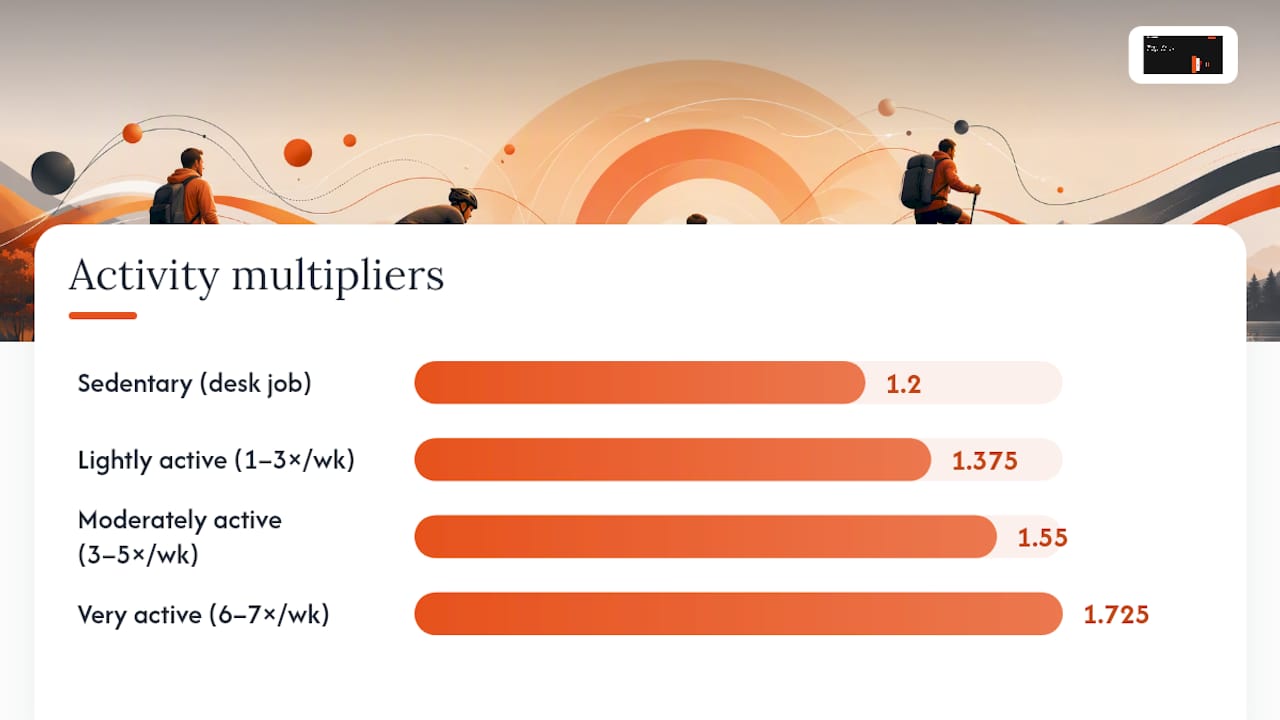
Activity multipliers cause more overestimation than the BMR formula itself:
- Sedentary (1.2): desk job, minimal intentional movement, maybe a walk on weekends.
- Lightly active (1.375): light exercise one to three days a week, or a job that has you on your feet part of the day.
- Moderately active (1.55): structured training three to five days a week, plus normal daily movement.
- Very active (1.725): hard training six to seven days a week or a physically demanding job on top of lifting.
Most people round up. Pick the level that matches your actual week, not your best week.
Pro Tip: If you wear a fitness tracker and log its "calories burned" for your workout on top of an activity multiplier that already assumes exercise, you're double-counting. Pick one system and stick with it.
For heavily muscled lifters, a lean-mass-based formula like Katch-McArdle can outperform Mifflin-St Jeor, but only when the body-fat percentage feeding it is accurate. A consumer-grade scale that's off by five points will introduce more error than the formula fixes.
How Accurate Are TDEE Calculators, Really?
Mifflin-St Jeor lands within about 10% of measured resting metabolic rate for roughly 82% of non-obese adults, but that accuracy drops to around 67% in people with obesity and 71% in trained athletes, according to Frankenfield et al. That's a solid hit rate for a formula built off population averages, and a clear signal that outliers exist.
Fitness trackers make the accuracy problem worse, not better. Stanford Medicine's review found devices measure heart rate reliably but consistently misestimate calories burned, which means leaning on your watch to fine-tune a calorie target adds noise rather than precision.
Two quick diagnostic checks:
- If you've eaten at your "TDEE minus 500" for three straight weeks and the scale hasn't budged, your real TDEE is lower than the formula said.
- If you're dropping weight faster than expected on a modest deficit, your real TDEE is likely higher.
Lab methods like indirect calorimetry and doubly labeled water are the gold standard for measuring true energy expenditure, and research using these techniques confirms formulas can diverge meaningfully from measured values in some populations. Most people don't need a lab. Calibration gets you most of the way there for free.
Calibrate Your TDEE With a 2-4 Week Protocol
This is the step that turns a formula guess into a number you can actually trust. Adaptive calibration using tracked intake and weight data outperforms equations alone, and it only takes a few weeks of discipline.
- Pick a starting target. Use your calculator's TDEE result as day one. Log every gram of food with a kitchen scale, not eyeballed portions, for the full period.
- Weigh daily, under the same conditions. Morning, after using the bathroom, before eating. Average your first week and your last week to smooth out daily noise.
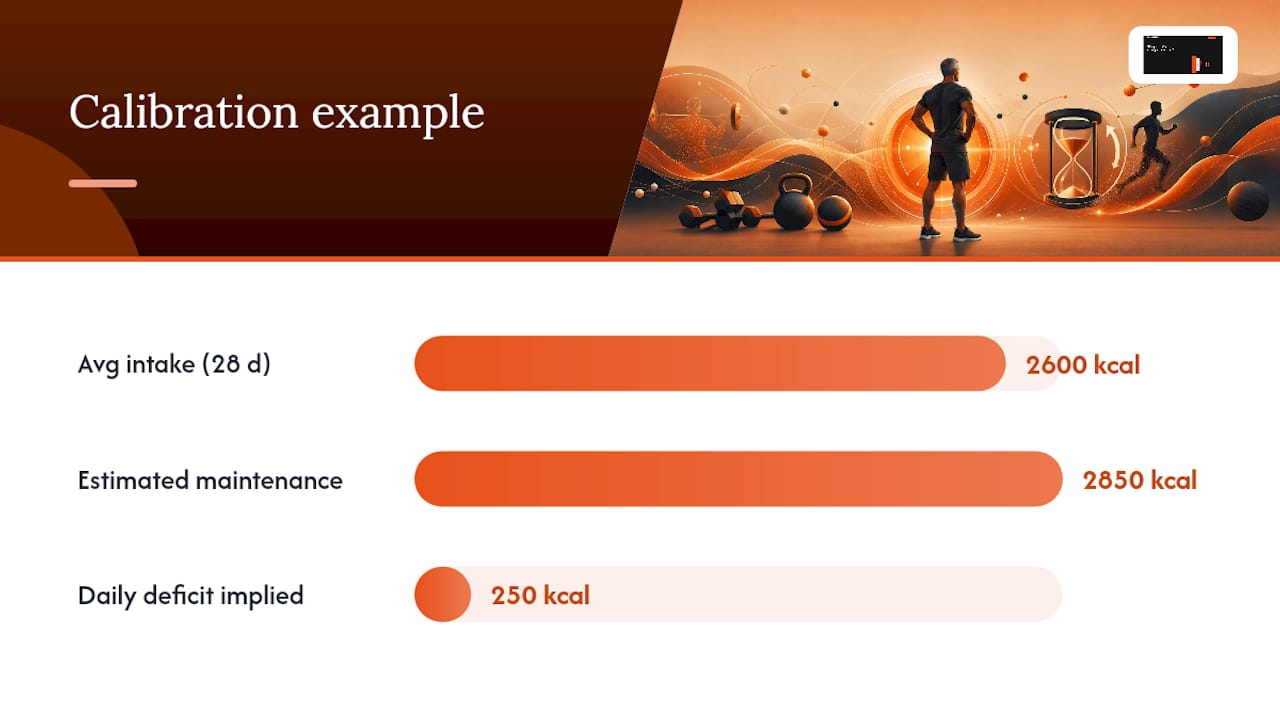
- Reverse-calculate your real TDEE. One pound of body fat is roughly 3,500 calories. If you averaged 2,600 calories a day for 28 days and lost 2 pounds, that's 7,000 calories below maintenance over 28 days, or 250 calories a day. Your real TDEE is closer to 2,850, not whatever the formula said.
- Adjust in small steps. Move intake by 100 to 200 calories based on the trend, then recheck every 4 to 6 weeks or after a change of more than 10 pounds.
Pro Tip: Ignore single-day weight swings entirely. Water retention from sodium, carbs, or a hard training session can mask fat loss for days. Trust the weekly average, not the daily number. A step-by-step calibration approach built around this same two-to-four-week tracking window is standard practice in weight-management guidance for exactly this reason.
If your data looks noisy, check for logging gaps, a missed weigh-in, or a menstrual cycle affecting water weight before you assume the formula failed. Give it the full window before making a call.
Stop Chasing the Perfect Number
Calculators are a starting point, not a verdict. The formula gets you in the right neighborhood; your body's actual response over a few weeks is the only authority that matters after that.
We see this go wrong most often in lifters over 40 who chase an aggressive deficit number a calculator spit out, then wonder why recovery tanks and lifts stall. Chronic underfueling doesn't announce itself. It shows up as nagging joint pain, flat strength numbers, and sleep that doesn't fix anything. If that's you, the math didn't fail, the target was probably too aggressive for someone your age still trying to train hard. Pair your TDEE number with a real training plan, like caloric periodization or a minimum-effective-dose approach, so the calories you eat actually support the work you're doing under the bar.
— Iron@40 Staff
Put the Calculator to Work
Reading about the math is one thing. Running your own numbers is what actually moves the needle. Ironatforty's TDEE calculator handles the Mifflin-St Jeor and Katch-McArdle math automatically, no unit-conversion errors, no rounding mistakes, so you can spend your energy on the part that actually determines accuracy: the two-to-four-week tracking window covered above.

Once you've got a starting number, the calibration protocol is what turns it into something trustworthy. Log your food, weigh in daily, and revisit the tools hub if you want to pair TDEE with a 1RM calculator to track strength alongside body composition. For deeper reading on eating to support training rather than just chasing a deficit, the nutrition section covers meal timing, protein targets, and the tradeoffs lifters over 40 face that generic calorie advice ignores. Run your numbers now and give the protocol its full four weeks before you judge the result.
Sources
Key sources behind this guide: Frankenfield et al.'s validation of Mifflin-St Jeor, Stanford Medicine on tracker calorie accuracy, doubly labeled water and indirect calorimetry findings, and CDC guidance on safe weight loss.
This article is general information, not a substitute for advice from a qualified doctor. Consult a qualified healthcare professional about your own circumstances before acting on anything here.
- Frankenfield et al. (2005) — validation of Mifflin‑St Jeor
- Stanford Medicine — fitness tracker accuracy
- DLW and RMR measurement study (PMC6392078)
- FitnessVolt — TDEE calculator accuracy and adaptive calibration
FAQ
What Is TDEE and How Is It Different From BMR?
TDEE is your total daily calorie burn, including exercise and daily movement. BMR is just the calories your body burns at rest, and it typically makes up 60 to 75% of your TDEE.
What Formula Should I Use to Find My TDEE?
Use Mifflin-St Jeor as your default, since it's validated as accurate within 10% for most non-obese adults. Switch to Katch-McArdle only if you have a reliable body-fat percentage reading.
How Long Should I Track Data to Calibrate My TDEE?
Two to four weeks of consistent food logging and daily weigh-ins is enough to reverse-calculate your real TDEE using the weight-change math covered above.
Can I Trust My Fitness Tracker's Calorie Burn Number?
Not for precise accounting. Trackers measure heart rate reliably but commonly misestimate calories burned, so use them for trend data, not exact totals.
How Do I Use TDEE for Weight Loss or Muscle Gain?
Subtract a moderate calorie deficit from your calibrated TDEE for steady fat loss, or add calories to support lean muscle gain, then reassess every 4 to 6 weeks with Ironatforty's TDEE calculator.