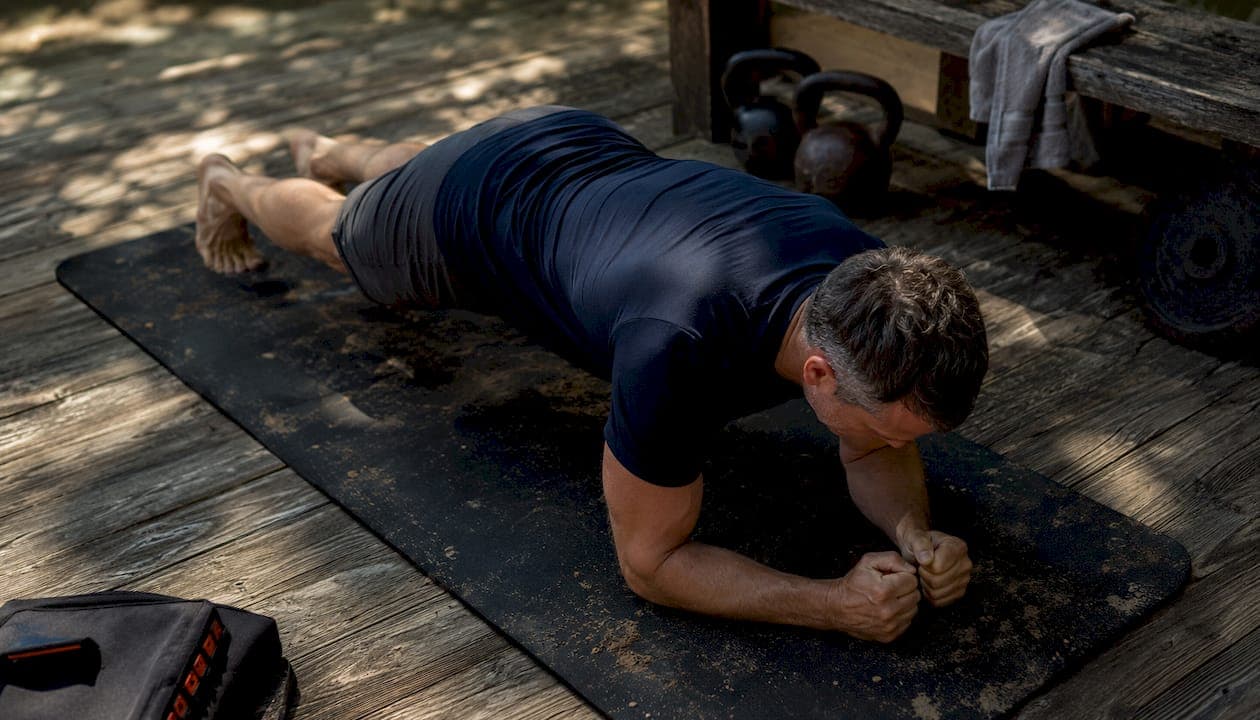
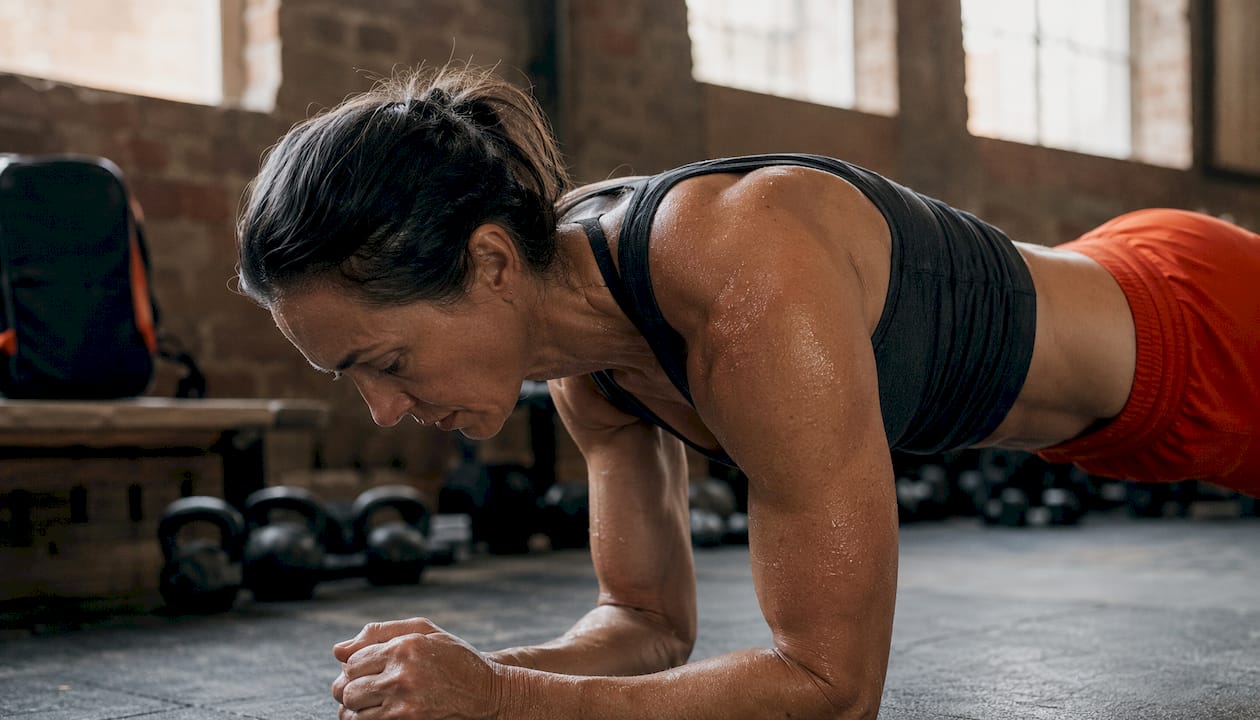
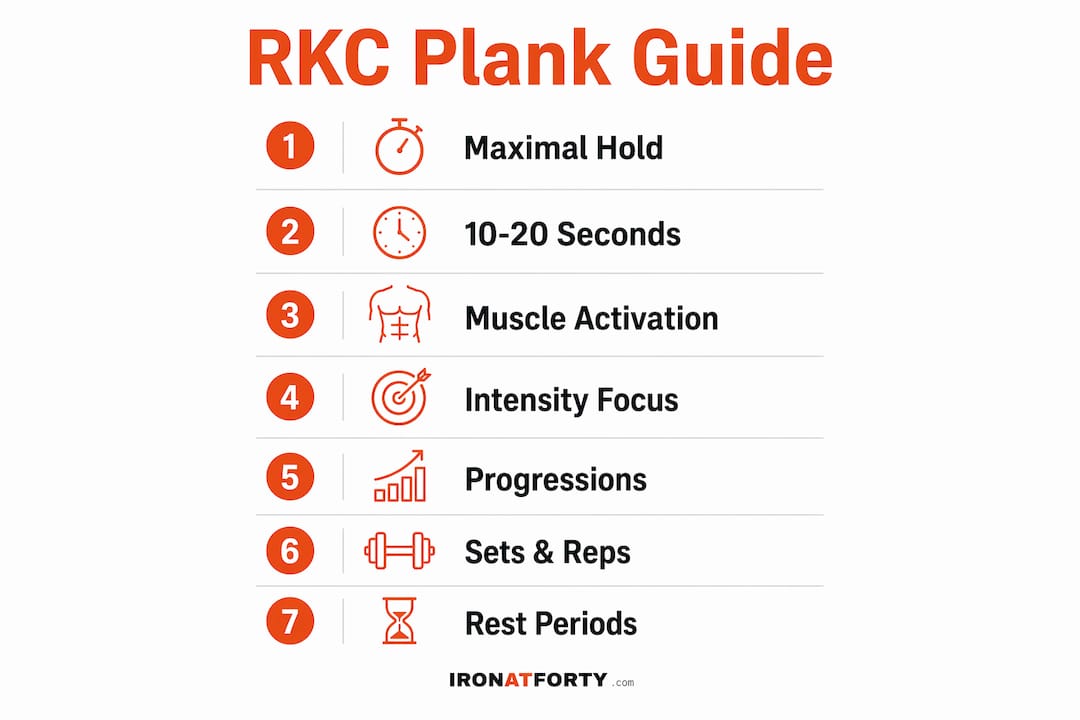
The RKC plank (Russian Kettlebell Challenge plank) is a short, maximal-tension forearm plank in which you squeeze every muscle in your body simultaneously for 10–20 seconds. That's the whole drill. No endurance contest, no two-minute holds. Coaches like Bret Contreras and Dr. John Rusin recommend it as either a neuromuscular activator before heavy lifts or a high-intensity finisher after your session. Holds are purposefully short: 10–20 seconds of maximal tension per set. If you can hold it longer than 30 seconds without shaking, you're not squeezing hard enough.
Why it matters for lifters:
- Builds the same full-body brace you need under a heavy bar
- Activates glutes and posterior pelvic tilt to protect your lower back during hip-extension movements
- Trains the nervous system, not just endurance
- Takes under five minutes to program into any session
Hold window: 10–20 seconds per set. Shorter than you think. Harder than it sounds.
Table of Contents
- How to do the RKC plank with perfect tension
- Why the RKC plank trains your core differently than a standard plank
- How to program the RKC plank: sets, holds, and progressions
- Ready-to-use RKC plank protocols for every session type
- Common RKC plank mistakes and how to fix them fast
- Who should modify or avoid the RKC plank
- What the research and coaching consensus actually say
- Key Takeaways
- The Ironatforty take on the RKC plank for lifters over 40
- Useful sources and further reading
- FAQ
How to do the RKC plank with perfect tension
Getting the position right takes about 60 seconds to learn. Getting the tension right takes a few sessions. Here's the exact setup:
Step-by-step setup
- Get into a forearm plank. Elbows directly under your shoulders, forearms flat on the floor, toes shoulder-width apart.
- Walk your elbows forward 2–3 inches. This lengthens the lever and immediately increases difficulty. Your elbows should end up roughly at nose level.
- Make tight fists. Grip the floor hard. This triggers irradiation up through your forearms and into your lats.
- Squeeze your quads. Lock your knees out like you're trying to straighten your legs against resistance. Your thighs should lift slightly off the floor.
- Crush your glutes. Hard. Both cheeks, maximum contraction.
- Tilt your pelvis posteriorly. Think "pull your pubic bone toward your belly button" or "tuck your tailbone toward your heels." This is the single most important cue. It flattens your lower back and closes the SI joint.
- Pull elbows toward toes and toes toward elbows simultaneously. Neither moves, but the isometric tension this creates lights up your entire anterior core.
- Breathe short and controlled. Short belly breaths without releasing the brace. Don't hold your breath.
Form checkpoints
- Hips level with your shoulders, not sagging or piked
- Neck neutral, eyes looking at the floor 6–8 inches in front of your hands
- No lumbar arch, no full spinal rounding
- Shaking is expected and correct at true maximal effort
Pro Tip: If you can hold the position for more than 30 seconds without shaking, your tension is too low. The RKC plank is an intensity drill, not an endurance test. Reset, squeeze harder, and go again.
Why the RKC plank trains your core differently than a standard plank
The standard plank is an endurance exercise. You hold it for 30–90 seconds, fatigue sets in gradually, and the training stimulus is primarily muscular endurance. Nothing wrong with that, especially for beginners or rehab contexts.
The RKC plank flips that logic. You hold it for 10–20 seconds at absolute maximum tension. The goal is nervous system recruitment, not time under load. Think of it like the difference between a 10-rep set at 60% and a 3-rep set at 90%. Same movement pattern, completely different training effect.
Primary muscles trained
- Rectus abdominis (upper and lower)
- Transverse abdominis (deep stabilizer)
- External and internal obliques
Secondary drivers that make it functional
- Glutes (maximal contraction closes the SI joint)
- Quadriceps (isometric knee extension cue)
- Lats (fist-grip irradiation)
- Forearms and hip flexors
The mechanism is called irradiation: squeezing your fists, quads, and glutes hard enough creates a neurological overflow that dramatically increases core activation. A peer-reviewed EMG study by Schoenfeld and Contreras confirmed that the long-lever posterior-tilt plank produces significantly greater activation of the upper rectus abdominis, lower abdominal stabilizers, and external oblique compared to the traditional prone plank. The long-lever component drove most of that difference.
Bret Contreras notes that the posterior pelvic tilt and glute contraction in this drill directly reduce lumbar hyperextension during hip-extension movements like deadlifts and hip thrusts. That's the functional carryover. You're not just building abs. You're teaching your body the exact brace pattern it needs when the bar gets heavy.
How to program the RKC plank: sets, holds, and progressions
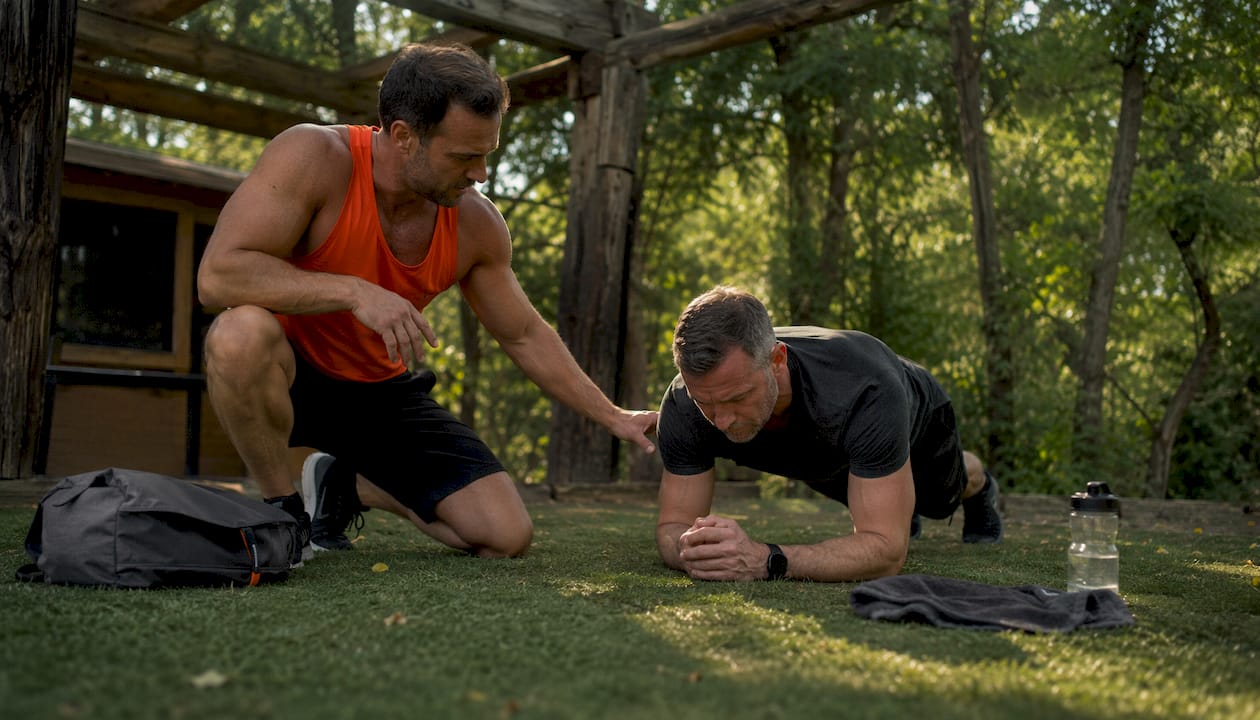
The core programming rule is simple: favor intensity over duration. Dr. John Rusin recommends two primary uses: a neuromuscular activator before heavy lifts, or a metabolic finisher after your session. The sets and rest differ significantly between the two.
| Role | Sets | Hold Time | Rest | When to Use |
|---|---|---|---|---|
| Neuromuscular activator | 2–4 | 10s | 60–90s | Before squats, deadlifts, or heavy pressing |
| Metabolic finisher | 6–10 | 10–20s | 30–60s | End of session, after main lifts |
| Beginner baseline | 2–3 | 10s | 90s | Learning the tension cue |
Frequency: 2–3 times per week. Heavy core work needs recovery. Don't stack RKC finishers on back-to-back days.
Progressions (once 10–20s feels controlled)
- Long-lever RKC: Walk elbows further forward. More lever length, more demand. Do this before adding weight.
- Narrower foot base: Bring feet together to reduce stability.
- Band resistance: Loop a resistance band around your hips with a partner holding it down to add horizontal load.
- Weighted plate: A 10–25 lb plate on the upper back once the pattern is solid.
Regressions (if tension cues aren't landing)
- Standard forearm plank to build baseline endurance first
- Box-supported RKC with hands elevated to reduce lever length
- Reduce hold time to 5–8 seconds and focus purely on the pelvic tilt cue
Track effort, not time. A useful cue: the last 2–3 seconds of each hold should feel maximal. If they don't, you eased off too early.
Pairing RKC planks with traditional endurance planks in a periodized approach covers both high-threshold bracing and reflexive endurance. You need both, especially if you're training for longevity.
Ready-to-use RKC plank protocols for every session type
These protocols are ready to drop into your current program. Pick the one that matches your goal for that session.
| Protocol | Sets | Hold | Rest | Purpose |
|---|---|---|---|---|
| Warm-up activator | 2–3 | 10s | 60–90s | Prime bracing before heavy lifts |
| Post-lift finisher | 6–10 | 10–20s | 30–60s | Metabolic stress, repeated max tension |
| 4-week bracing cycle | 3–4 | 10–15s | 60s | Progressive tension overload |
| Beginner scaling | 2–3 | 10s | 90s | Learn the cue, build confidence |
How to sequence within a session:
- Activator: Place it after your general warm-up, immediately before your first heavy set. Two to three sets of 10 seconds is enough. You want the nervous system primed, not fatigued.
- Finisher: Place it at the very end of your session. Six to ten sets with short rest. This is where you accumulate volume and metabolic stress.
- 4-week cycle: Start at 3 sets of 10 seconds in week one. Add one set per week. In week four, extend holds to 15 seconds. Then reset and progress intensity (lever length or load).
Pro Tip: Log effort, not just time. After each set, ask yourself: "Were the last 2–3 seconds truly maximal?" If the answer is no, shorten the hold and squeeze harder next time. Chasing longer holds is the wrong game.
For lifters over 40 thinking about recovery between sessions, pairing high-intensity finishers with a solid cool-down and recovery routine makes a real difference in how you feel the next day.
Common RKC plank mistakes and how to fix them fast
Most people get the position right and the tension wrong. Here's what falls apart and how to reset it.
- Sagging hips: You've lost the posterior pelvic tilt. Re-cue: "pull tailbone toward heels." Squeeze glutes first, then re-engage quads.
- Piking hips too high: Usually a sign you're avoiding the hard part. Drop hips to level, re-establish the body line.
- Breath holding: Common under high tension. Take short, sharp belly breaths. Holding your breath spikes blood pressure and kills the set.
- Gripping too hard and losing form: Fist tension should feed into lat activation, not cause your shoulders to shrug. Keep shoulders packed down and back.
- Neck strain: You're probably looking up. Eyes down, chin slightly tucked, neck in line with your spine.
- Shaking: This is correct. Involuntary shaking at maximal contraction is a sign you're doing it right, not a sign of weakness.
When shaking becomes uncontrolled wobbling across your whole body, that's a different signal. It usually means you've lost the pelvic tilt and your hips are compensating. Stop, reset, and start a fresh set.
Pro Tip: Treat each set as a single maximal effort with full recovery between reps. One perfect 10-second hold beats three sloppy 20-second holds every time.
Who should modify or avoid the RKC plank
The high-tension nature of this drill makes it powerful. It also makes it the wrong starting point for certain situations.
Modify or get clearance first if you have:
- Acute low-back injury or active disc herniation
- Uncontrolled hypertension (the Valsalva-adjacent tension can spike blood pressure)
- Recent abdominal surgery or unrepaired hernia
- Severe osteoporosis affecting the spine
- Active SI joint dysfunction that worsens with posterior pelvic tilt
Practical modifications:
- Shorten holds to 5–6 seconds and reduce total sets
- Regress to a standard forearm plank until baseline stability is established
- Use a box or bench to elevate your hands and reduce spinal load
- Focus on the breathing cue first before adding full-body tension
The good news for most lifters over 40: the RKC plank is actually joint-friendlier than many core exercises because it avoids spinal flexion. With proper regressions and a gradual progression, the majority of experienced lifters can work into it safely. Ironatforty's joint health resources cover modification strategies in more depth for those dealing with chronic issues.
This article is general fitness information, not medical advice. If you have a spinal condition or cardiovascular concern, confirm the suitability of high-tension isometric work with your physician or physical therapist before starting.
What the research and coaching consensus actually say
The coaching consensus on the RKC plank is unusually tight. Across Dr. John Rusin, Bret Contreras, and Roy Pumphrey, the recommendations land in the same place: short maximal holds (10–20 seconds), 3–6 sets, rest 30–90 seconds, and progress via intensity rather than time.
The EMG evidence backs this up. The Schoenfeld and Contreras study showed that the long-lever posterior-tilt plank produced significantly greater activation of the upper rectus abdominis, lower abdominal stabilizers, and external oblique versus the traditional prone plank. Critically, the long-lever component drove more of that increase than the posterior tilt alone, which is why walking your elbows forward is the first progression coaches recommend.
Bret Contreras specifically highlights the glute activation and posterior pelvic tilt as the mechanism that reduces lumbar hyperextension during hip-extension lifts. For deadlift and squat athletes, that's not a minor benefit. Lumbar hyperextension under load is one of the most common technical breakdowns in lifters over 40, and the RKC plank directly addresses the neuromuscular pattern that prevents it.
| Claim | Source | Application |
|---|---|---|
| Short maximal holds (10–20s) outperform long endurance holds for bracing | Dr. John Rusin | Programming all RKC sets |
| Long-lever posterior-tilt plank significantly increases RA and oblique activation vs. standard plank | Schoenfeld & Contreras EMG study | Justifies the elbow-forward cue |
| Posterior pelvic tilt + glute squeeze reduces lumbar hyperextension in hip-extension lifts | Bret Contreras | Carryover to deadlift and squat |
| Irradiation (fist/quad/glute squeeze) boosts core activation | Roy Pumphrey / Gym Navigator | Justifies full-body tension cues |
Key Takeaways
The RKC plank builds functional bracing in 10–20 second maximal holds, making it one of the most time-efficient core drills for strength athletes.
| Point | Details |
|---|---|
| Tension beats time | Hold 10–20 seconds at maximum effort; if you exceed 30 seconds without shaking, squeeze harder. |
| Two programming roles | Use 2–4 sets of 10s as a warm-up activator or 6–10 sets of 10–20s as a post-lift finisher. Beginner protocols use 2–3 sets of 10s to learn the cue. |
| Key cues | Posterior pelvic tilt, hard glute and quad squeeze, fists tight, pull elbows toward toes. |
| Progress lever first | Walk elbows forward before adding weight or a resistance band. |
| Safety note | Stop for pain (not fatigue); those with acute back injury or uncontrolled hypertension should modify or get clearance first. |
The Ironatforty take on the RKC plank for lifters over 40
Here's the honest truth: most lifters over 40 are already doing too much volume and not enough quality. The RKC plank fits that reality perfectly. Two to three sets of 10 seconds before your heavy work costs you under two minutes and pays dividends in bracing quality for every squat and deadlift that follows.
Where I'd push back on the mainstream advice is the finisher protocol. Six to ten sets sounds great on paper, but if you're already training four days a week and managing recovery carefully, stacking a 10-set RKC finisher on top of heavy pulls is a recovery tax you may not be able to afford. Start with the activator role. Get the pattern dialed in. Add the finisher protocol only when your recovery is genuinely solid, and keep an eye on your training stress balance to make sure you're not digging a hole.
The other thing nobody talks about: the RKC plank is a skill. The first few sessions, you'll think you're squeezing hard and you won't be. It takes 3–4 sessions before the posterior pelvic tilt cue clicks and you feel what true maximal tension actually means. Don't judge the exercise in week one.
For lifters building a complete program around longevity, the RKC plank pairs well with unilateral work and mobility. Ironatforty's free training tools can help you map out where it fits in your weekly structure. And if you want to think about the recovery side of high-intensity finishers, the nutrition guidance on the site covers post-session fueling for lifters over 40.
The bottom line: this is one of the few core exercises where doing less, harder, is genuinely the right answer. Trust the short holds. Squeeze like you mean it.
Useful sources and further reading
The sources below back the claims in this article. Use them to verify technique, programming, and activation evidence.
| Source | Best Used For |
|---|---|
| Dr. John Rusin | Programming templates, set/rep/rest schemes, nervous-system rationale |
| Bret Contreras | Glute activation, SI joint mechanics, carryover to hip-extension lifts |
| Schoenfeld & Contreras EMG Study | Peer-reviewed activation data for long-lever posterior-tilt plank |
| Gym Navigator | Exercise guide, irradiation concept, common mistakes |
| Roy Pumphrey | Short-duration rationale, shaking as correct effort signal |
| BulkAndStrength | Progressions, regressions, lever and load adjustments |
| Muscle & Fitness | Step-by-step cues, breathing guidance, common form errors |
Ironatforty internal reading:
- Core longevity practices for aging athletes for long-term core strategy
- Effective training programs for adults over 40 for placing RKC in weekly splits
- Specificity principle training for understanding why RKC transfers to heavy lifts
FAQ
What is the RKC plank?
The RKC plank is a forearm plank variation from the Russian Kettlebell Challenge system where you create maximal full-body tension for 10–20 seconds by simultaneously squeezing your fists, quads, glutes, and lats while holding a posterior pelvic tilt.
What's the difference between a regular plank and the RKC plank?
A standard plank is an endurance hold (30–90+ seconds at moderate effort); the RKC plank is a maximal-tension drill held for 10–20 seconds, training the nervous system's bracing pattern rather than muscular endurance.
What are the main benefits of the RKC plank?
The primary benefits are significantly greater activation of the rectus abdominis and external obliques compared to a standard plank, improved full-body bracing for heavy lifts, and reduced lumbar hyperextension risk during hip-extension movements like deadlifts.
Is the RKC plank the hardest plank variation?
It's among the most demanding because it requires true maximal voluntary contraction across the whole body simultaneously. Coaches note that if you can hold it beyond 30 seconds without shaking, your intensity is too low, which means the ceiling for difficulty is self-regulated by effort.
How do you progress the RKC plank once 10–20 seconds feels manageable?
Walk your elbows further forward to increase lever length before adding any external load. After that, narrow your foot base, then add a resistance band or a light plate on your upper back once the long-lever pattern is solid.