
Training Stress Balance (TSB) is the modeled difference between your long-term fitness and your short-term fatigue: TSB = CTL − ATL. Chronic Training Load (CTL) uses a 42-day average; Acute Training Load (ATL) uses a 7-day average. A negative TSB means recent training has outpaced your longer-term base. A positive TSB means fatigue has cleared. For lifters over 40, the single most important thing to know: treat TSB as a trend signal, not a target number. Volatility across three weeks tells you more than any single day's score.
Table of Contents
- What is training stress balance and where did it come from?
- How to calculate CTL, ATL, and TSB step by step
- How to use TSB safely when you lift weights and are over 40
- What should you track alongside TSB?
- Common TSB mistakes and red flags to watch for
- Your weekly TSB checklist for lifters over 40
- Key Takeaways
- The Ironatforty take on training stress balance
- Useful sources
- FAQ
What is training stress balance and where did it come from?
TSB grew out of Eric Banister's impulse–response model from the 1970s, which described athletic performance as the net result of a fitness component building slowly over weeks and a fatigue component accumulating quickly over days. The Banister model was built on endurance athletes. TSB is a simplified extension: subtract ATL from CTL and you get a number that reflects whether your recent load is above or below your longer-term training base.
The 42-day CTL window smooths out weekly variation to approximate fitness. The 7-day ATL window captures the fatigue spike from a hard training block. Both are moving averages, and the window lengths you choose change how responsive the model feels. Shorter windows react faster, while longer windows are more stable.
Here is the critical limitation for strength athletes: no consistent relationship was found between a single day's TSB value and competition-day performance in elite weightlifters. The model was designed for aerobic load, where a Training Stress Score (TSS) can be calculated from power output or pace. Resistance training produces internal stress that depends heavily on exercise selection, rest intervals, and proximity to failure — two sessions with identical nominal load inputs can demand very different recovery. TSB is a load-relationship metric. It does not measure injury risk, health, or psychological state.
How to calculate CTL, ATL, and TSB step by step
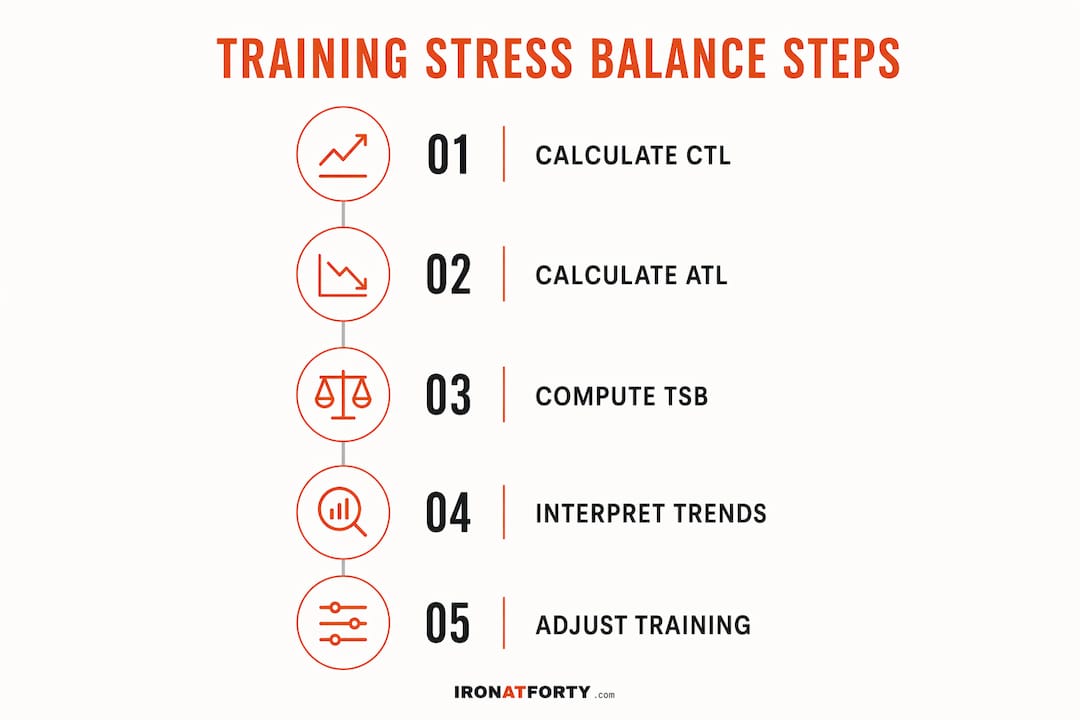
Step-by-step calculation
- Assign a daily load score. Multiply session RPE (1–10 scale) by session duration in minutes. A 60-minute squat session at RPE 7 = 420 load units. Use the same method every session.
- Calculate ATL (7-day average). Sum the last 7 days of load scores and divide by 7. This is your acute load.
- Calculate CTL (42-day average). Sum the last 42 days of load scores and divide by 42. This is your chronic load.
- Calculate TSB. TSB = CTL − ATL.
Worked example
| Metric | Value | What it means |
|---|---|---|
| CTL (42-day avg) | 420 load units | Solid, consistent base |
| ATL (7-day avg) | 420 load units | Hard week, fatigue elevated |
| TSB | −50 | Significant fatigue; not a day to test maxes |
A TSB of −50 after a tough training week is expected. The question is whether it stays that deep for two or three weeks running. That sustained negative trend is the warning sign, not the single number.
Common TSB threshold ranges published in the literature come from endurance practice and should be taken as rough orientation points rather than strict rules. For strength athletes, these thresholds vary depending on exercise selection and training history.
Pro Tip: A simple spreadsheet with two rolling-average columns handles this calculation cleanly. Use Ironatforty's free training tools to log sessions and track load trends without needing dedicated endurance software. Simple moving averages tend to explain strength performance better than exponentially weighted averages for multi-week strength cycles.
How to use TSB safely when you lift weights and are over 40

Conservative application is the right call. Here is why: the consequences of chronic overuse compound faster after 40. Connective tissue recovery slows, hormonal buffers shrink, and a two-week overreach that a 25-year-old shakes off can sideline a 45-year-old for a month. Pair TSB monitoring with the overtraining red flags Ironatforty covers in depth.
Practical rules for lifters over 40:
- Keep TSB modestly negative during a build phase. Deep or prolonged negative readings are a signal to pull back, not push through.
- Monitor 21-day volatility before any heavy test session or peak week. Less variation in that window generally correlates with better readiness for strength athletes.
- Deload proactively when subjective markers deteriorate, even if the model looks acceptable. Persistent soreness, disrupted sleep, or a rising resting heart rate outweigh a "good" TSB number.
- Prioritize top-set quality over volume. One strong working set tells you more about readiness than five grinding sets at reduced load.
- Allocate extra recovery days after lower-body or eccentric-heavy sessions. High volume and training to failure lengthen recovery demands, especially for large-muscle compound lifts.
- Limit training to failure on high-skill lifts (deadlifts, Olympic variations) when TSB is trending deeply negative.
For a deeper look at how periodization frameworks map onto load management, that resource is worth bookmarking alongside your TSB log.
What should you track alongside TSB?
TSB is best used as a trend indicator; its value comes from direction and volatility, not a one-off number. Pair it with these markers:
- Session RPE and duration — your primary load input; log these every session without exception.
- Top-set performance — load × reps on your key lift. A declining top set across two weeks is a harder signal than any model output.
- Sleep quality — rate it 1–5 each morning. Chronic poor sleep is both a recovery marker and a stressor that TSB cannot capture.
- Soreness rating — a simple 1–5 score for the muscle groups trained two days prior.
- Resting heart rate or HRV — optional but useful; a consistently elevated resting HR often precedes a TSB crash.
- Perceived recovery scale — a brief "how recovered do I feel today?" score (1–10) before training.
- Training-quality notes — one sentence: did technique hold up? Did the session feel harder than the numbers suggest?
Simple daily log entry: Date / Load input (RPE × minutes) / ATL snapshot / CTL snapshot / TSB / Subjective score (1–10) / One-line note.
Eccentric-heavy work is a particular blind spot for TSB. Two sessions with the same RPE × duration score can produce very different creatine kinase responses depending on how much eccentric stress was involved. Resistance-specific load tools are emerging to address this, but until they are mainstream, your soreness rating and top-set performance are the best proxies.
Common TSB mistakes and red flags to watch for
- Treating TSB as a single-number truth. The model is an estimate built on your load inputs. Garbage in, garbage out. If you skip logging two sessions, your CTL and ATL are wrong.
- Ignoring exercise-specific stress. A heavy Romanian deadlift session and a machine-based upper-body session can produce the same RPE × duration score but wildly different recovery demands.
- Using endurance TSS inputs unchanged for resistance work. Power-based TSS from a cycling session is not equivalent to a strength session's load. Keep activity types coded separately.
- Reacting too late to a falling TSB. If TSB has been trending below −25 for ten days and you are still adding volume, you are behind the curve.
When red flags appear:
- Drop total volume by 30–40% for the next week.
- Swap high-skill, high-fatigue lifts for technical or lighter variations.
- Add one active recovery session (walking, light mobility work).
- Reassess CTL and ATL inputs at the end of that week before resuming normal programming.
Never make injury or medical decisions from TSB alone. Use it alongside recovery markers and consult a professional if pain or dysfunction is present. The cortisol and recovery dynamics that change after 40 mean the model's blind spots are wider for this age group.
Your weekly TSB checklist for lifters over 40
Keep this simple. Weekly checks, monthly reviews.
- Log load consistently. Every session, same method: RPE × minutes. No exceptions.
- Review 21-day volatility once a week. Is TSB swinging wildly or holding a steady trend? Write one sentence in your log: "Stable and productive" or "Volatile — reduce intensity next week."
- Let subjective markers override the model. If your body says no and TSB says go, trust your body.
Monthly, zoom out on your CTL trend. Is it rising steadily? Flat? Declining? A slowly rising CTL over 8–12 weeks with manageable ATL spikes is the pattern you want. That consistency, as Ironatforty argues in why consistency beats intensity, is the actual driver of long-term strength gains after 40.
Key Takeaways
TSB = CTL − ATL is a trend tool, not a readiness verdict; for lifters over 40, 21-day volatility and subjective markers matter more than any single target number.
| Point | Details |
|---|---|
| Formula and windows | TSB = CTL (42-day avg) minus ATL (7-day avg); negative means recent load exceeds your base. |
| Volatility over targets | 21-day TSB volatility before peak sessions is more informative than a single-day score. |
| Endurance model limits | No consistent day-of-performance association was found in elite weightlifters; adapt thresholds for strength work. |
| Pair with subjective data | Log session RPE, top-set performance, sleep, and soreness alongside every TSB reading. |
| Conservative is correct | For lifters over 40, proactive deloads and modest negative TSB during builds reduce overuse risk. |
The Ironatforty take on training stress balance
Most lifters over 40 who find TSB make the same mistake: they treat it like a speedometer. Hit the right number and you are good to go. That is not how it works, and honestly, that framing is borrowed wholesale from triathlon coaching where power meters make TSS inputs precise and repeatable. Your squat session does not have a power meter.
What TSB actually gives you is a mirror for your training habits over time. If your CTL is rising slowly and your ATL spikes are controlled, you are building something real. If your TSB is crashing every third week, you are not training hard, you are just accumulating debt. There is a difference, and it shows up in your top sets before it shows up in any model.
The conservative approach is not timid. It is the only approach that keeps you under the bar consistently at 45, 50, and beyond. Use Ironatforty's free tools to log your load and track CTL and ATL trends. Check the training resources for program templates built around these principles.
Useful sources
- Relationships between internal training load in a taper with elite weightlifting performance — Primary research on TSB, ACWR, and moving average methods in elite weightlifters. Start here for the evidence on volatility and performance.
- Trainingload.ai — TSB documentation — Clear technical explanation of CTL, ATL, and TSB defaults. Best for understanding what the model does and does not measure.
- PMC review — Recovery in resistance training microcycle construction — Narrative review of 24 studies on recovery demands. Use this to understand why eccentric and high-volume work requires extra recovery time.
- SportRxiv — Resistance-specific load quantification — Preprint on emerging resistance-specific load tools. Useful context for why generic TSS inputs underestimate strength training stress.
- Vitruve — TSB thresholds and interpretation — Practical threshold table; read alongside the limitations discussion above.
- CMES — Optimal control and Banister model feasibility — Academic context on individualized load modeling extending Banister's original framework.
- Training periodization for athletes — Accessible primer on periodization theory and how training windows connect to load models.
FAQ
What does a negative TSB mean for a strength lifter?
A negative TSB means your recent 7-day load exceeds your 42-day average, so you are carrying more fatigue than your base fitness can easily absorb. A modest negative TSB during a build phase is normal; a sustained negative trend is a signal to reduce volume.
How is TSB different from the Acute:Chronic Workload Ratio?
TSB uses the difference between CTL and ATL; ACWR uses the ratio. Both track the relationship between short-term and long-term load, but TSB gives you a signed number (positive or negative) that is easier to interpret directionally for programming decisions.
Should lifters over 40 aim for a specific TSB target number?
No. Research on elite weightlifters found no consistent association between a single-day TSB value and performance. Focus on keeping TSB volatility low across the 21 days before any peak session, and let subjective markers guide daily decisions.
What is the simplest way to start tracking TSB?
Log RPE × session duration after every workout. After 7 days you can calculate ATL; after 42 days you have a CTL. A basic spreadsheet handles both calculations. Ironatforty's free tools page offers calculators that simplify the process.
Can TSB predict injury risk?
No. TSB models load relationships from your input data; it does not measure health, tissue stress, or injury risk directly. Use it alongside soreness ratings, resting heart rate trends, and professional assessment when pain is present.