The specificity principle of training is defined as the rule that your body adapts precisely to the type of stress you impose on it. Known formally as the SAID principle (Specific Adaptations to Imposed Demands), it means that training adaptations are specific to the exact demands you place on your muscles, joints, and nervous system. If you want to get stronger, you must train for strength. If you want to build muscle, you must train for hypertrophy. Generic exercise produces generic results. For lifters over 40, understanding what is specificity principle training is not an academic exercise. It is the difference between a program that actually moves the needle and one that just burns calories.
What is specificity principle training and why does it matter?
The SAID principle is the scientific foundation behind every effective training program. Your body does not adapt to exercise in general. It adapts to the specific forces, velocities, and movement patterns you repeatedly expose it to. Jog three miles a day and your aerobic system improves. Squat heavy twice a week and your lower body strength increases. The two adaptations do not cross over in any meaningful way.
The Merck Manual confirms that exercise adaptations depend on type, intensity, duration, and frequency. That is not a minor detail. It means every variable in your program either points toward your goal or away from it. There is no neutral.
Here is what the specificity principle governs in practice:
- Exercise type: Squats build squat strength. Leg press builds leg press strength. The overlap exists but is not complete.
- Load and intensity: Heavier loads build maximal strength. Moderate loads with higher volume build muscle size. Light loads to failure build endurance.
- Frequency: How often you train a movement determines how fast the nervous system adapts to it.
- Duration and volume: Total sets and reps per session drive hypertrophy more than any other single variable.
Pro Tip: If your goal is a stronger deadlift, the majority of your lower body training should involve hip hinge patterns under load. Leg extensions and calf raises do not transfer.
The ACSM's position on resistance training confirms that lifting heavier loads enhances strength while volume drives hypertrophy and different loading schemes affect power output. These are not interchangeable. Choosing the wrong variable for your goal is the most common reason lifters over 40 plateau.
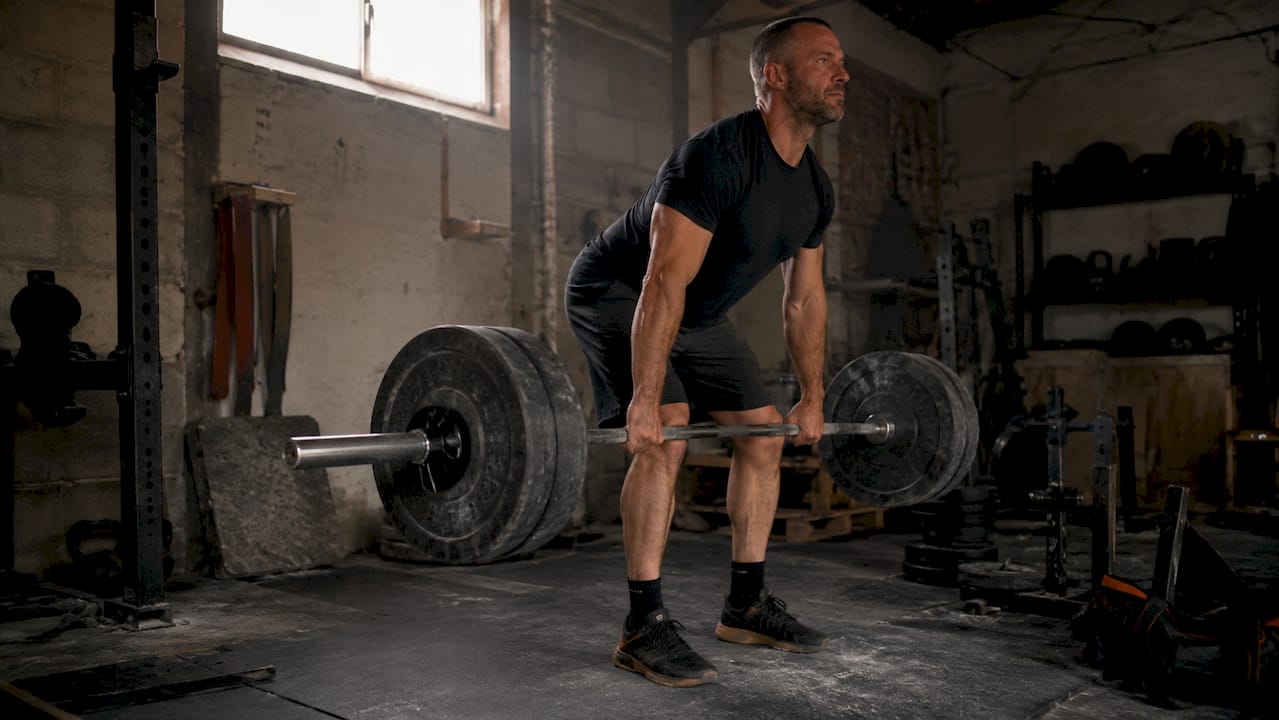
Does exercise specificity mean copying movements exactly?
No. This is one of the most persistent misconceptions in strength training. Specificity is not about visual similarity. It is about matching the functional demands of the target activity.
Omni Athlete's analysis of exercise specificity makes this clear: functional demands matter more than positions. Two exercises can look identical from the outside and produce completely different adaptations based on load, velocity, and intent. A slow Romanian deadlift and an explosive trap bar deadlift both involve hip hinge mechanics. The adaptations they produce are not the same.
"Specificity is determined by the forces, velocities, and coordination patterns involved — not by whether the exercise resembles the target movement from a distance." — Omni Athlete
Sprint coaches learned this the hard way. Exercises that mimic the visual appearance of sprinting (high knees, butt kicks) do not produce the same neuromuscular demand as actual sprinting. The velocity, ground reaction force, and coordination timing are completely different. The same logic applies to strength training.
Pro Tip: Ask yourself: does this exercise match the load, speed, and movement pattern of my goal? If the answer is no, it belongs in your warm-up, not your main block.
The NSCA's work on velocity-based training reinforces this point. Altering load and velocity parameters shifts adaptations from strength to power to endurance, even within the same exercise. A back squat performed explosively with 60% of your one rep max trains a different quality than the same squat performed slowly with 85%. Same movement. Different specificity.
How to apply the specificity principle after 40
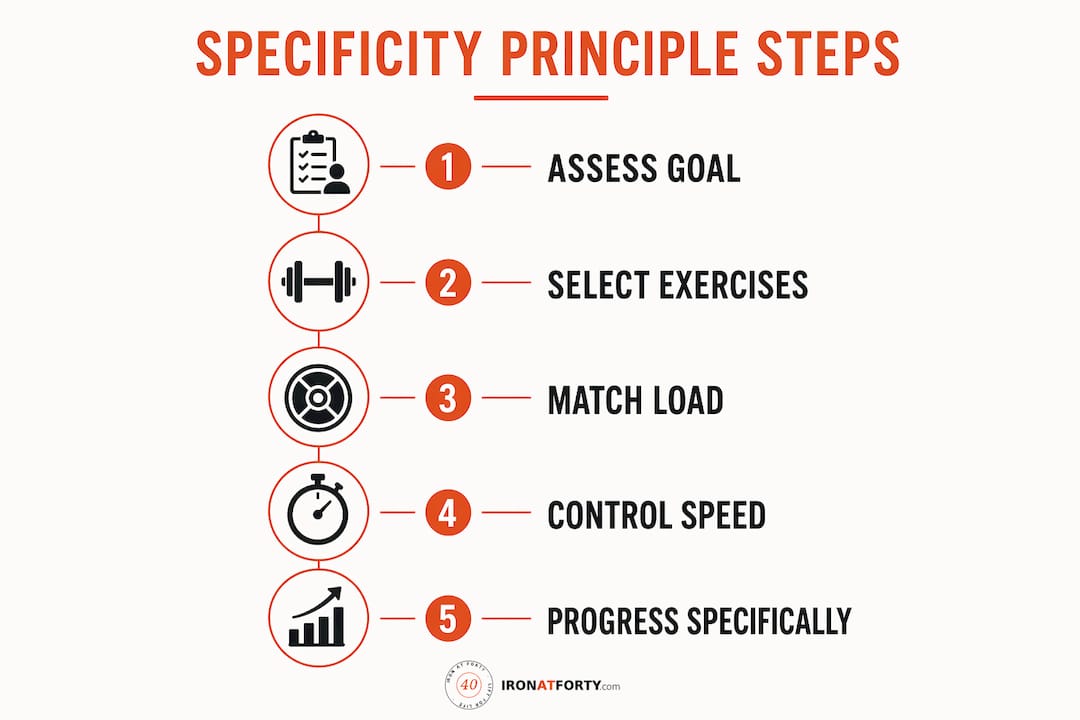
Applying the principle of specificity in training after 40 requires one honest question: what is the actual goal? Not a vague goal. A specific one. "Get stronger" is a vibe. "Increase my deadlift by 20 pounds over 12 weeks" is a target.
Once the goal is clear, program backward from it. The Merck Manual outlines that programming should match movement pattern, load quality, and frequency to the desired adaptation. Here is how that looks in practice for lifters over 40:
- Define the target adaptation. Maximal strength requires loads above 80% of your one rep max for low reps (1–5). Hypertrophy responds best to moderate loads (60–80%) for higher volume. Power needs explosive intent with submaximal loads.
- Select exercises that match the demand. For maximal strength, compound barbell movements (squat, deadlift, bench press, overhead press) are the most direct path. Machines and isolation work supplement but do not replace them.
- Set training frequency by recovery capacity. After 40, recovery takes longer. Two to three sessions per week per movement pattern is realistic for most lifters. Training frequency after 40 follows the same specificity logic: more frequency builds skill and neural efficiency, but only if recovery is adequate.
- Progress load, not just effort. Specificity requires progressive overload. Feeling tired after a session is not the same as applying a specific enough stimulus to force adaptation.
- Protect joint integrity. Specificity does not mean grinding through pain. Modify exercise selection to match the demand while protecting vulnerable joints. A trap bar deadlift delivers nearly identical posterior chain specificity to a conventional deadlift with far less lumbar stress.
A few additional points worth keeping in mind:
- Training consistency matters more than any single session. Specificity compounds over weeks, not days.
- General conditioning (walking, mobility work, low-intensity cardio) supports recovery without competing with your specific adaptation goal.
- Use Ironatforty's 1RM Calculator to set accurate load targets. Training at the right percentage of your max is how you apply specificity precisely.
What are the most common mistakes with the specificity principle?
The biggest mistake is treating specificity as an excuse to do only one thing. Narrow training focus without a general strength base leads to stagnation and injury. Coach Dale Hansford's work on transfer of training confirms that beginners respond broadly while advanced athletes need precise specificity. You cannot skip the general phase.
Here are the most common errors and how to fix them:
- Mimicking movement appearance instead of matching demands. Fix: ask what force, velocity, and coordination the goal requires, then train those qualities directly.
- Abandoning general strength too early. Fix: keep foundational compound lifts in your program year-round. They are the base everything else builds on.
- Ignoring load and volume variables. Fix: if your goal is strength, your program must include heavy sets. If your goal is hypertrophy, volume must be sufficient. Doing moderate weight for moderate reps forever produces moderate results.
- Applying specificity at the exercise level instead of the program level. A single exercise cannot carry a program. Specificity must operate at the program level across weeks and months to produce meaningful adaptation.
- Neglecting recovery as part of the specific demand. After 40, the adaptation happens during recovery, not during the session. Undereating, poor sleep, and chronic stress all blunt the specific adaptations you are training for.
The general-to-specific continuum is real. Start with a broad base. Add specificity as your goal sharpens and your body adapts. Remove general work too fast and performance drops. This is not theory. It is what the research consistently shows.
Key Takeaways
The specificity principle means your body adapts to the exact demands you train, so every program variable must align with your specific goal to produce real results.
| Point | Details |
|---|---|
| SAID principle is the foundation | Your body adapts specifically to the type, load, and frequency of training you impose. |
| Functional demands beat visual similarity | Match force, velocity, and coordination to your goal, not just the shape of the movement. |
| Program variables must align with goals | Heavy loads build strength; volume builds muscle; explosive intent builds power. |
| General base comes before specificity | Build foundational strength before narrowing your training focus, especially after 40. |
| Specificity works at the program level | One exercise cannot deliver specificity. The entire program must point toward the target adaptation. |
What I have learned about specificity after years under the bar
Here is the uncomfortable truth I had to accept in my mid-40s: I was training hard but not training specifically. I was doing a bit of everything, feeling worked, and wondering why my deadlift had not moved in six months. The answer was right there in the SAID principle. My program was not specific enough to the adaptation I actually wanted.
The shift that changed everything was simple. I stopped asking "did I work hard today?" and started asking "did I apply the right stimulus for my goal today?" Those are very different questions. Hard work without specificity is just fatigue management.
One thing I see constantly at Ironatforty is lifters over 40 who are afraid to go heavy. They default to high-rep, light-load training because it feels safer. I understand the instinct. But if your goal is strength, that approach violates the specificity principle at the most basic level. You cannot train for endurance and expect strength gains. The body does not work that way.
The balance I have found is this: keep two to three heavy, specific sessions per week. Fill the rest with general conditioning, mobility, and recovery work. Do not confuse the two categories. The heavy sessions are where specificity lives. The rest is support work.
If you are over 40 and serious about getting stronger, understanding the principle of specificity in training is the single biggest upgrade you can make to your programming. Not a new supplement. Not a new split. Just a clear answer to the question: what exactly am I training for, and does my program actually reflect that?
— Jeff
Ironatforty has the tools to train with real specificity
Knowing the principle is step one. Applying it with the right numbers is step two.
Ironatforty is built for lifters over 40 who want science-backed guidance without the noise. The free training and nutrition tools include a 1RM Calculator to set accurate load targets and a TDEE Calculator to support your nutrition. The blog covers training splits, recovery, hormones, and joint health, all written with the specificity principle baked in. No recycled gym bro advice. No generic plans. Just real guidance for serious lifters who are playing the long game. Visit Ironatforty and put your program to work.
FAQ
What is the SAID principle in strength training?
SAID stands for Specific Adaptations to Imposed Demands. It means your body adapts precisely to the type of training stress you apply, not to exercise in general.
Does the specificity principle mean I should only do one type of exercise?
No. Specificity requires a general strength base before narrowing focus. Removing foundational work too early causes performance to drop, not improve.
How does specificity apply differently for lifters over 40?
For lifters over 40, specificity helps tailor intensity, exercise selection, and volume to match both performance goals and recovery capacity, which changes with age.
Can I apply the specificity principle without heavy lifting?
Only partially. If your goal is maximal strength, the ACSM confirms that heavier loads are required to produce that specific adaptation. Light loads build endurance, not strength.
How long does it take to see results from specific training?
Neural adaptations from specific training begin within two to four weeks. Structural changes like muscle growth take longer, typically six to twelve weeks of consistent, targeted work.