
Effective training programs for adults over 40 are defined by three non-negotiable pillars: progressive heavy compound lifts, structured recovery, and age-adjusted nutrition. The mainstream fitness world still pushes light weights and high reps for anyone past 40. That advice is wrong. Meta-analyses of 13 RCTs covering 546 participants show that 3 weekly sessions of heavy resistance training optimize grip strength and gait speed within 12 weeks. The examples of effective training programs below are built on that evidence, not gym-floor mythology. Ironatforty covers each component with the specificity you need to actually get stronger, protect your joints, and recover like an athlete.
1. Examples of effective training programs: strength-first splits
The most proven structure for adults over 40 is a 3-day-per-week full-body or modified Push-Pull-Legs split built around heavy compound movements. Heavy progressive resistance at 80% or more of your one-rep max is what maintains Type II muscle fibers and bone density. Light weight, high-rep schemes simply do not do that job. Your training split design matters more than most lifters realize.
A well-structured 3-day week looks like this:
- Day 1 (Full Body A): Trap bar deadlift, incline dumbbell press, seated cable row, goblet squat
- Day 2 (Full Body B): Barbell squat or safety bar squat, dumbbell overhead press, chest-supported row, Romanian deadlift
- Day 3 (Full Body C): Hex bar or conventional deadlift variation, dip or close-grip press, pull-up or lat pulldown, single-leg Romanian deadlift
Double progression drives the loading. You pick a rep range, say 4–6 reps. Once you hit the top of that range across all sets, you add weight next session. This method produces consistent strength gains without the neural fatigue that comes from chasing daily maxes.
Pro Tip: Track your top set weight and reps every session. If you are not hitting a new number every 2–3 weeks, your recovery or nutrition is the problem, not your program.
2. Modified Push-Pull-Legs for joint-conscious lifters
A modified Push-Pull-Legs split works well for lifters who need more volume but cannot tolerate the joint stress of a traditional bodybuilding PPL. The key word is modified. You swap barbell bench for dumbbell or cable variations. You replace conventional deadlifts with trap bar pulls on pull days. You cut isolation work that loads tendons without adding meaningful strength.

Training frequency for adults over 40 should hit each muscle group at least twice per week. A 3-day PPL running Monday, Wednesday, Friday accomplishes that with one rest day between every session. Each session stays under 60 minutes. Volume is moderate, intensity is high, and recovery is protected.
3. Joint health and recovery-focused program design
Joint pain in adults over 40 most often comes from poor technique or muscular imbalance, not from lifting heavy. Trap bar deadlifts and goblet squats reduce spinal shear and hip impingement while still allowing heavy loading. Single-leg work like Bulgarian split squats or step-ups exposes and corrects left-right asymmetry before it becomes inflammation.
A joint-conscious program includes these elements:
- Exercise swaps: Trap bar deadlift over conventional, goblet squat over barbell back squat, dumbbell press over barbell bench
- Mobility work: 10 minutes of hip flexor, thoracic, and ankle mobility before every session
- Range-of-motion checks: Assess single-leg squat depth monthly to catch asymmetry early
- Session spacing: 72-hour recovery windows between sessions targeting the same muscle groups protect tendons and connective tissue
- Active recovery: Zone 2 cardio at 60–70% max heart rate on off days supports blood flow without taxing the central nervous system
Pro Tip: A proper warm-up is not optional. A structured warm-up protocol before heavy lifting reduces injury risk and improves your first working set by a measurable margin.
4. Nutrition strategies built into the program
Nutrition is not separate from your training program. It is part of it. Adults over 40 face anabolic resistance, meaning the muscle-building signal from protein is blunted compared to younger lifters. The fix is higher protein intake and smarter distribution across the day.
Daily protein targets for adults over 40 sit at 1.6–2.4g per kilogram of body weight. That is roughly 0.7–1.1g per pound. Spread that across 3–4 meals, with each meal hitting 30–40g of high-quality protein to clear the leucine threshold that triggers muscle protein synthesis.
Practical protein sources that hit the leucine threshold:
- Chicken breast (31g protein per 100g cooked)
- Eggs and egg whites combined
- Greek yogurt with added whey protein
- Salmon or tuna
- Lean beef or bison
Consuming 25–30g of leucine-rich protein within 30 minutes after training is the most evidence-backed timing strategy for adults over 40. Creatine monohydrate at 3–5g daily supports strength output and has a strong safety record across decades of research. Your meal prep approach determines whether you actually hit these targets consistently.
5. Recovery and auto-regulation methods
Recovery is where adaptation happens. Skipping it does not make you tougher. It makes you slower to progress and faster to get hurt. Chronic 6-hour sleep cycles elevate cortisol and block protein synthesis even when protein intake is adequate. Seven to nine hours of sleep is a training variable, not a lifestyle preference.
Separating resistance training from high-intensity cardio protects testosterone levels. Zone 2 cardio on non-lifting days reduces injury rates by approximately 40% compared to mixing high-intensity cardio with heavy lifting in the same sessions. That is a significant number. It means your cardio choice directly affects how often you get hurt.
Auto-regulation tools worth using:
- Velocity-based training (VBT): Inertial measurement units (IMUs) track bar speed and flag central nervous system fatigue before it becomes overtraining
- Deload weeks: Every 4–6 weeks, reduce volume by 40–50% while keeping intensity. This is not optional for adults over 40
- Rate of perceived exertion (RPE): Use an RPE scale of 1–10 to adjust daily loads based on how you actually feel, not what the spreadsheet says
- Overtraining signals: Learn to recognize signs of overtraining before they derail a full training block
Power declines at roughly double the rate of strength decline after 40. That means auto-regulation is not a luxury for elite athletes. It is a practical necessity for anyone training seriously past 40.
6. Program comparison: key features at a glance
Different program structures suit different goals and recovery capacities. This table gives you a direct reference.
| Program type | Weekly sessions | Joint impact | Recovery demand | Nutrition focus |
|---|---|---|---|---|
| Full-body 3-day | 3 | Low to moderate | Moderate | High protein, creatine |
| Modified PPL 3-day | 3 | Low (with swaps) | Moderate | High protein, leucine timing |
| Master athlete power | 2–3 | Moderate | High, needs deload | High protein, biomarker tracking |
| Minimum effective dose | 2 | Low | Low to moderate | Protein floor, calorie maintenance |
The full-body 3-day program suits most adults over 40 starting or restarting serious training. The modified PPL works better for lifters with more training history who need higher weekly volume. Training age is the deciding factor between these two approaches. The master athlete power program applies to competitive athletes who need velocity tracking and formal periodization. Periodization principles apply across all program types but become critical at higher intensities.
Key takeaways
The most effective training programs for adults over 40 combine heavy compound lifts at least 3 days per week, joint-friendly exercise selection, protein intake of 1.6–2.4g per kilogram daily, and structured recovery including sleep and deload weeks.
| Point | Details |
|---|---|
| Heavy compound lifts are non-negotiable | Three sessions per week at 80%+ of 1RM drives hypertrophy and bone density after 40. |
| Joint-friendly swaps protect longevity | Trap bar deadlifts and goblet squats allow heavy loading with less joint stress. |
| Protein distribution beats total intake alone | Hit 30–40g per meal across 3–4 feedings to clear the leucine threshold for muscle synthesis. |
| Sleep is a training variable | Chronic under-sleep raises cortisol and blocks protein synthesis regardless of diet quality. |
| Auto-regulation prevents overtraining | Deload weeks every 4–6 weeks and RPE tracking keep progress consistent without injury. |
What I actually think about training programs after 40
Most lifters over 40 fail not because they train too little. They fail because they train without a system. They pick a program, run it hard for three weeks, get sore or tweaked, take two weeks off, and repeat the cycle. That is not training. That is just showing up.
The programs that work are boring on paper. Three days a week. The same compound movements. Small weight increases every few sessions. Protein at every meal. Eight hours of sleep. That is it. The lifters I have seen make the best progress past 40 are the ones who commit to consistency over intensity. They do not chase PRs every session. They set a floor, not a ceiling, and they show up every week without fail.
The one thing most articles will not tell you: your recovery capacity is the actual ceiling on your progress. You can write the perfect program, but if you are sleeping six hours, skipping deloads, and running sprints the day after squats, you will not progress. Fix the recovery first. Then add volume.
The minimum effective dose approach is underrated for adults over 40. More is not better. The right amount, done consistently, beats the aggressive program you abandon in week four. Ironatforty is built on that exact philosophy.
— Jeff
Ironatforty's training and nutrition resources for over 40
Ironatforty publishes science-backed training programs, nutrition guides, and free tools built specifically for adults over 40 who lift. No recycled gym-bro content. No advice written for 22-year-olds.
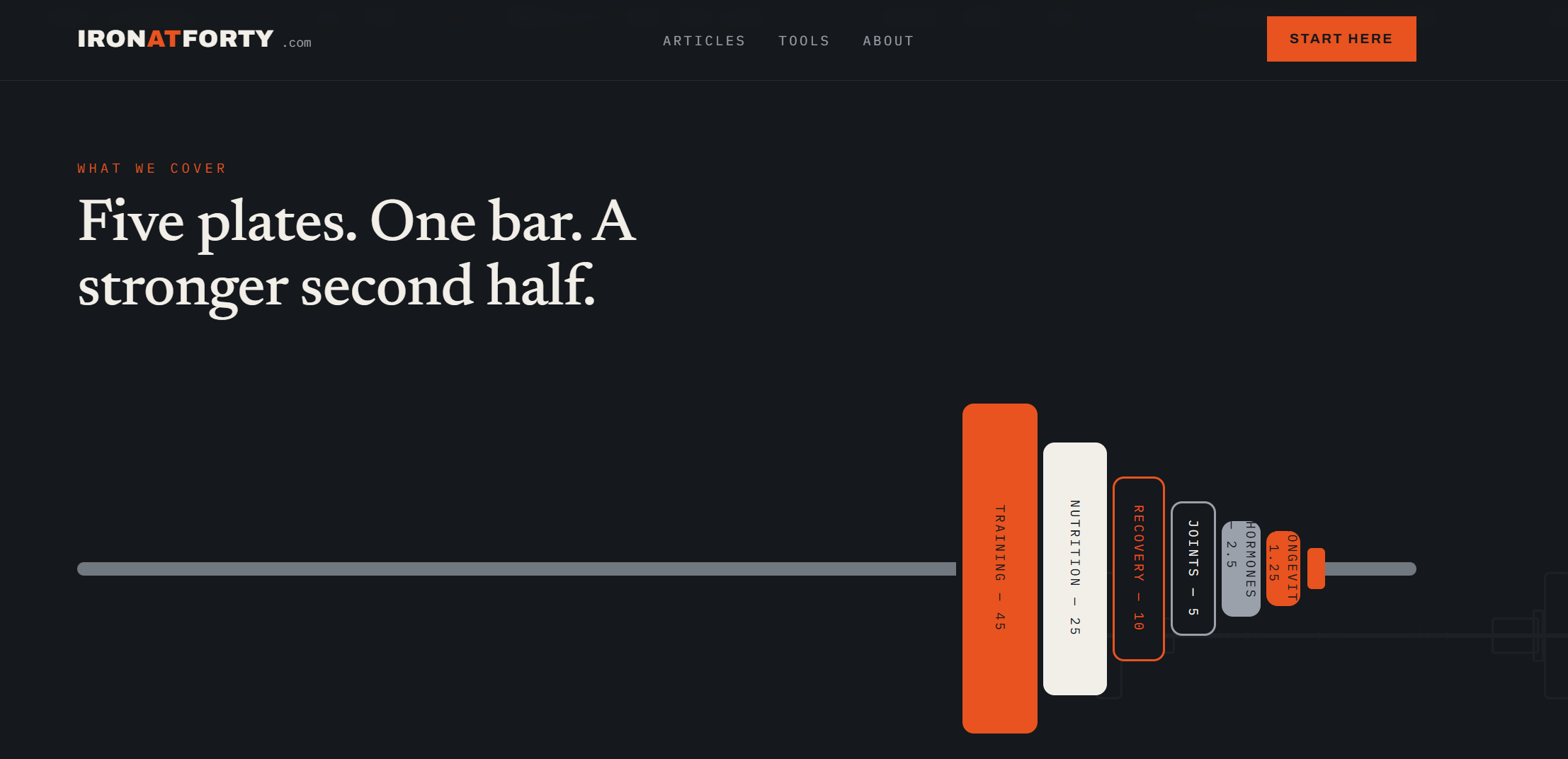
The training section at Ironatforty covers program design, periodization, and recovery protocols with the depth you need to make real decisions. The nutrition resources address protein distribution, meal prep, and insulin resistance for lifters in their 40s and 50s. Free tools including a TDEE Calculator and 1RM Calculator are available at Ironatforty tools. If you are serious about training after 40, Ironatforty is built for you.
FAQ
What are effective training programs for adults over 40?
Effective training programs for adults over 40 prioritize heavy compound movements 3 days per week, joint-friendly exercise selection, and structured recovery. Meta-analyses confirm that 3 weekly sessions optimize strength and functional fitness within 12 weeks.
How much protein do adults over 40 need for muscle growth?
Adults over 40 need 1.6–2.4g of protein per kilogram of body weight daily, distributed across 3–4 meals with 30–40g per meal to overcome anabolic resistance.
Why is light-weight, high-rep training ineffective after 40?
Light training fails to maintain lean mass or bone density because it does not adequately stimulate Type II muscle fibers, which decline with age and require heavy loading to stay active.
How often should adults over 40 take deload weeks?
A deload week every 4–6 weeks, reducing volume by 40–50% while keeping intensity, protects tendons and prevents central nervous system fatigue in adults over 40.
Does cardio hurt strength training progress after 40?
High-intensity cardio mixed with heavy lifting suppresses testosterone. Zone 2 cardio on non-lifting days supports recovery and reduces injury risk by approximately 40%.