
Cardio does not kill gains for the vast majority of lifters. The idea that "cardio kills gains" holds up only at extremes: elite endurance volumes, chronic under eating, or stacking hard cardio right before a lift with zero recovery buffer. For everyone else, moderate cardio and resistance training coexist just fine. The real skill is sequencing, dosing, and eating enough to support both.
TL;DR:
- Moderate cardio of two to three sessions per week generally does not hinder muscle growth or strength for most lifters, except at extreme endurance volumes.
- Sequencing resistance training before cardio optimizes strength gains, and separating sessions by at least three hours further reduces interference risks.
- High-impact cardio like running increases local muscle damage more than cycling or rowing, especially when performed frequently alongside heavy lifting.
- For lifters over 40, keeping calories and protein intake on point and choosing joint-friendly modalities are crucial to prevent long-term losses.
- Using free tools to track calorie needs and strength progress helps prevent the false belief that cardio inevitably wrecks gains.
Table of Contents
- Cardio Kills Gains? What the Research Actually Shows
- Mechanisms: How and Why Cardio Can Interfere (or Not)
- Practical Rules for Adding Cardio Without Losing Gains (Priorities for Lifters 40+)
- Two 4-Week Micro-Programs: Cutting and Bulking With Cardio
- What Is the Interference Effect, and When Does It Actually Show Up?
- Does Cardio Hurt Gains Over Months and Years, Not Just Weeks?
- How Cardio Affects Recovery Markers and Hormones Tied to Muscle Growth
- The Psychology of Combining Cardio With Strength Training
- IronAtForty Perspective: What Lifters 40+ Should Prioritize
- Free Tools to Manage Calories and Progress While Adding Cardio
- Sources
- FAQ
Cardio Kills Gains? What the Research Actually Shows
The phrase "cardio kills gains" oversells what's called the interference effect, a real but narrow phenomenon that shows up mainly when endurance volume gets extreme. Researchers have been testing concurrent training (doing both cardio and lifting) for decades, and the consensus from recent systematic reviews is more forgiving than gym folklore suggests.
A systematic review and meta-analysis on concurrent training found that moderate concurrent training usually does not significantly compromise whole-muscle hypertrophy or maximal strength compared to lifting alone in healthy adults. Interference shows up mainly at extreme endurance volumes, think marathon-block mileage, not a couple of 30-minute bike rides a week.
Sequencing matters more than most lifters realize. A meta-analysis on exercise order in concurrent training found that doing resistance work before endurance work improved lower-body dynamic strength gains compared to the reverse order, with a weighted mean difference favoring resistance before endurance for lower-body dynamic strength. Sequence had no measurable effect on hypertrophy either way.
Modality and intensity also change the picture. A 2023 systematic review in the Journal of Strength and Conditioning Research found no significant difference in whole-muscle hypertrophy between concurrent training and resistance-only training, but some concurrent programs that included HIIT showed smaller fiber-level hypertrophy gains in some subgroup analyses. That's a nuance worth sitting with: steady cardio and high-intensity intervals do not behave identically inside a concurrent program.
Training status changes your risk profile too. Well-trained lifters, especially those stacking endurance and resistance work in the same session, are more likely to show interference than untrained or recreationally active people, according to a Sports Medicine meta-analysis on concurrent training. If you're deep into your lifting career with years of accumulated strength, your margin for sloppy programming shrinks a bit.
What the evidence supports:
- Moderate cardio (a few sessions a week, sensible duration) rarely blunts hypertrophy or strength in most lifters.
- Sequencing resistance before endurance protects strength gains better than the reverse.
- HIIT inside a concurrent program may modestly reduce fiber-level growth compared to resistance training alone.
- Well-trained, same-session combos carry more real interference risk than casual, separated sessions.
Evidence quality check: these are systematic reviews and meta-analyses pooling dozens of studies, which is about as solid as exercise science gets. The uncertainty that remains centers on exact volume thresholds (nobody has nailed down a precise "this many minutes triggers interference" number) and how results generalize to lifters over 40, since most trial populations skew younger.
Mechanisms: How and Why Cardio Can Interfere (or Not)
The classic explanation for interference is a molecular tug-of-war between two signaling pathways: AMPK, activated by endurance exercise, and mTOR, the pathway that drives muscle protein synthesis after resistance training. The theory goes that AMPK activation can blunt mTOR signaling, dampening the hypertrophic response.
That mechanism is real at the cellular level, but its practical weight gets overstated. A 2025 study on long-interval HIIT combined with resistance training found molecular markers related to hypertrophy stayed intact after concurrent training when the interval structure and recovery were managed well. Biology isn't destiny here. Programming variables like timing, volume, and recovery decide whether the interference pathway actually shows up in muscle tissue.
Mechanical stress differs by modality too. Running involves repeated eccentric loading on the same muscle groups you train in the gym (quads, hamstrings, calves), which adds to your total damage and recovery burden. Cycling and rowing produce far less eccentric stress, which is why they're the better cardio choice when hypertrophy is the priority and your legs are already carrying a squat or deadlift session that week.
Energy availability might be the biggest hidden mediator. Adding cardio without adjusting calories creates a bigger deficit than you intended, and an unmanaged deficit is a much stronger threat to muscle than the cardio itself. Training status raises the stakes further: well-trained lifters sit closer to their genetic ceiling for hypertrophy, so any added stress, whether from HIIT, high mileage, or poor recovery, eats into a smaller margin than it would for someone newer to lifting.
- AMPK/mTOR crosstalk is real but modifiable through programming.
- Running creates more local muscle damage than cycling or rowing.
- Calorie and protein shortfalls do more damage than the cardio itself.
- Trained lifters and high-volume endurance athletes have the least room for error.
Pro Tip: If you're adding cardio to an already-heavy leg day, swap running for cycling or rowing that week. Your quads will thank you on squat day.
Practical Rules for Adding Cardio Without Losing Gains (Priorities for Lifters 40+)
Here's the part that actually matters: how to build cardio into your week without sabotaging the muscle and strength you've worked to keep after 40.
- Set a weekly volume ceiling. Two to three sessions of 20 to 40 minutes at a conversational pace (zone 2) is a reasonable starting range that rarely interferes with hypertrophy. Push much beyond that, especially with added intensity work, and you start eating into recovery capacity that resistance training needs.
- Sequence resistance first. When you're combining modalities in the same session, lift before you do cardio. That order protected strength gains in the exercise-sequence meta-analysis cited earlier, and it makes intuitive sense: you want your best energy and neural drive available for the heavier stimulus.
- Separate sessions when you can. If your schedule allows it, put three or more hours between a cardio session and a resistance session. Research on concurrent training timing shows that gap meaningfully reduces the acute interference seen when sessions are crammed within 20 minutes of each other.
- Choose modality by season. Cycling, rowing, or the elliptical are better choices when you're prioritizing hypertrophy and want to avoid extra eccentric damage on days you've already loaded your legs. Save running for lower-volume lifting phases or dedicated conditioning blocks.
- Eat like you mean it. If you're bulking, add calories to offset the extra energy cardio burns rather than letting it eat into your surplus unnoticed. If you're cutting, keep protein high enough to protect muscle during the deficit.
- Track protein deliberately. Aim for roughly 0.7 to 1 gram of protein per pound of body weight daily, a range consistently supported across hypertrophy nutrition research. Spread it across three or four meals, and don't skip the post-lifting meal.
- Watch your performance markers. If your lifts start stalling or your bar speed drops for two or more consecutive sessions, that's your body flagging a recovery deficit. Back off cardio volume before you touch your lifting program.
A few things make this easier than it sounds:
- Use a TDEE calculator to figure out your actual calorie needs once cardio enters the picture, rather than guessing.
- Review how training volume works so you're not accidentally overloading both systems at once.
None of this requires obsessive tracking. It requires paying attention to a handful of numbers that actually move the needle.
Two 4-Week Micro-Programs: Cutting and Bulking With Cardio
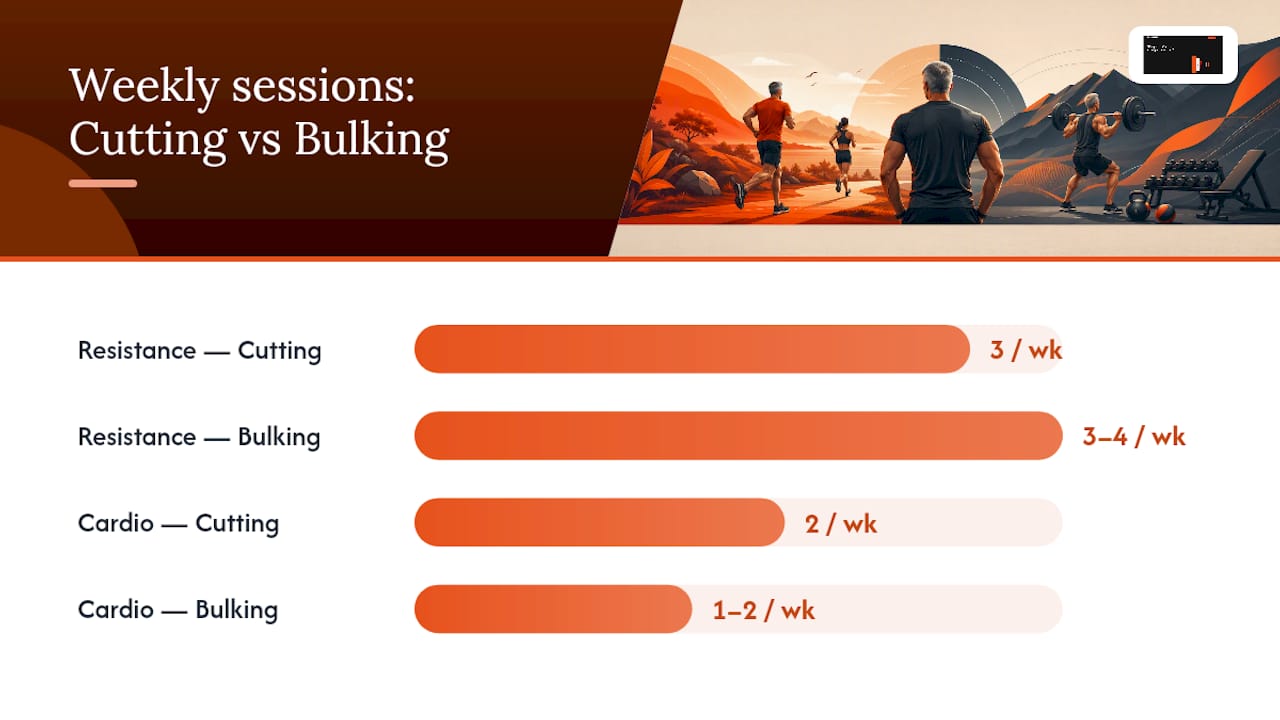
Templates make this concrete. Here are two simple four-week structures, one for a maintenance or cutting phase, one for a bulk, that let you add cardio without wrecking your lifting progress.
Cutting or maintenance micro-program:
- Three full-body or upper/lower resistance sessions weekly, focused on maintaining working weights rather than chasing new personal records.
- Two zone 2 cardio sessions weekly (cycling or brisk incline walking), starting at 20 minutes and building to 35 minutes by week four.
- Calorie target set at a modest deficit using a TDEE calculator, with protein held at 0.8 to 1 gram per pound of body weight to protect muscle during the deficit.
- Schedule cardio on non-lifting days where possible, or after lifting if same-day, never before a heavy session.
Bulking micro-program:
- Three to four resistance sessions weekly with progressive overload as the main driver, tracked against your current numbers.
- One to two short, low-volume cardio sessions weekly (15 to 25 minutes), positioned purely for cardiovascular health rather than fat loss.
- Calorie surplus increased slightly (roughly 100 to 150 calories) on cardio days to offset the added expenditure, calculated from your baseline TDEE.
- Protein held steady at 0.8 to 1 gram per pound daily, distributed evenly, with extra attention to the post-lifting meal since that session carries the bulk of your hypertrophy stimulus.
In both templates, cardio volume increases gradually across the four weeks rather than jumping in all at once. That progression lets you gauge how your recovery responds before committing to a permanent higher volume.
What Is the Interference Effect, and When Does It Actually Show Up?
The interference effect describes a measurable reduction in strength or hypertrophy gains when endurance and resistance training are combined, compared to doing resistance training alone. It's a documented phenomenon, not a myth, but it's also far more conditional than the gym-forum version of "cardio kills gains" suggests.
It shows up most reliably under three conditions: high endurance volume (think competitive distance running or cycling, not casual cardio), same-session training where cardio and lifting happen back to back with minimal separation, and in well-trained individuals who have less physiological slack to absorb competing adaptations. Modality plays a role too. High-impact, high-eccentric-load cardio like running tends to produce more interference than low-impact options like cycling or rowing, largely because it adds to the same muscle damage your lifting sessions are already generating.
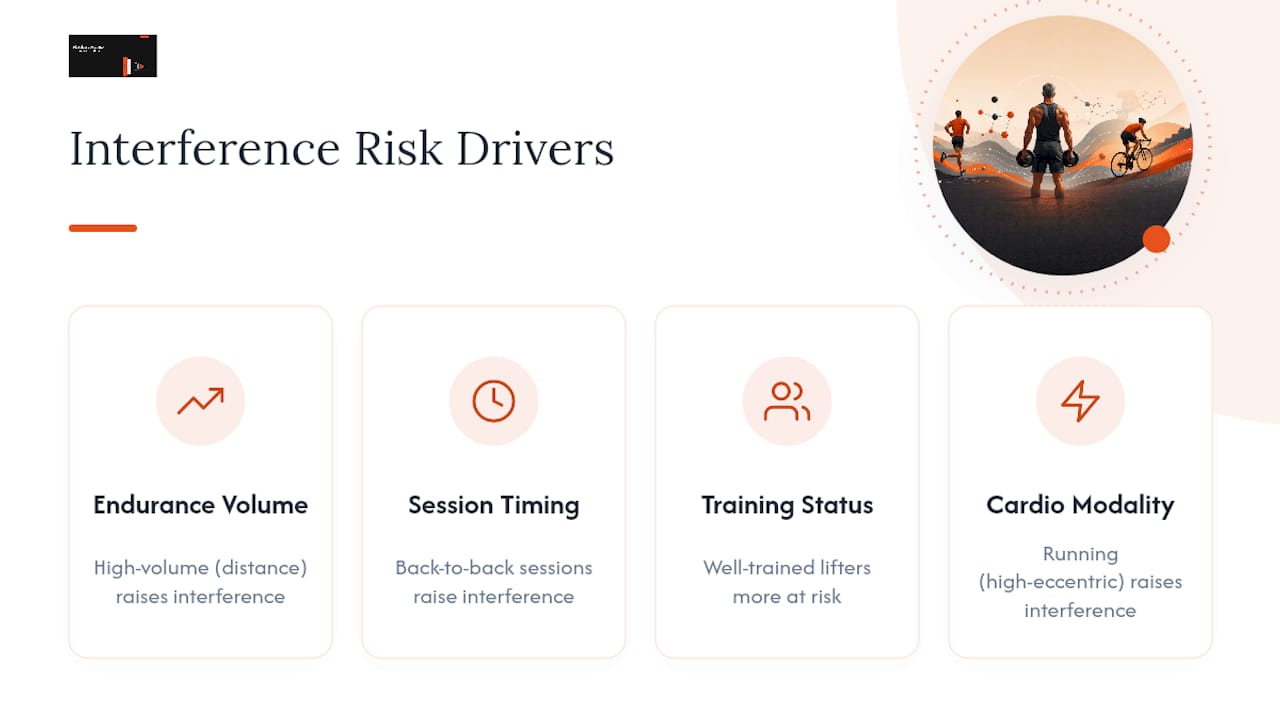
For a recreational lifter doing two or three moderate cardio sessions a week, separated from lifting by a few hours or a full day, the interference effect is unlikely to show up in any way that matters. It becomes a real concern mainly for endurance athletes layering serious mileage on top of a lifting program, or for lifters chronically under eating while doing both.
Does Cardio Hurt Gains Over Months and Years, Not Just Weeks?
Short-term studies tell you what happens over 8 to 12 weeks. What lifters over 40 actually care about is whether cardio compounds into a problem over a full year or more of training.
The available evidence doesn't point to cardio causing progressive, compounding muscle loss when it's dosed sensibly. The meta-analysis on concurrent training and hypertrophy found no significant long-run compromise to whole-muscle growth in most healthy adults doing moderate concurrent training, and there is no strong signal that this changes as training duration extends into months or years, provided volume and fueling stay reasonable.
What does change over time is your margin for error. A lifter in year one of training has enormous room to grow, so a slightly suboptimal cardio dose barely registers against that growth curve. A lifter with a decade of consistent training has a smaller window of untapped hypertrophy left, which means a chronic energy deficit or excessive endurance volume shows up faster and more visibly in stalled numbers.
For lifters over 40 specifically, the bigger long-term threat usually isn't cardio itself. It's the slow creep of under recovering, whether from accumulated joint stress, inadequate sleep, or protein intake that hasn't kept pace with age-related changes in muscle protein synthesis. Cardio done thoughtfully over years tends to support joint health and cardiovascular longevity, which protects your ability to keep lifting heavy at all.
How Cardio Affects Recovery Markers and Hormones Tied to Muscle Growth
Recovery capacity, not muscle fibers directly, is usually where cardio's real cost shows up. Adding volume to your week, in any form, adds to your total recovery demand. If sleep, calories, and protein don't scale to match, that's when performance markers start to slip.
Cortisol gets blamed constantly in gym culture, often without nuance. Cardio does raise cortisol acutely during the session, same as resistance training does, but that spike is a normal part of the stress-adaptation cycle, not a sign of muscle breakdown. The concern is chronic, poorly recovered training stacking session after session without enough downtime, which is a programming and lifestyle issue more than a cardio issue specifically.
On the positive side, aerobic training has documented hypertrophic potential in its own right. Research on aerobic exercise and skeletal muscle adaptation shows it can stimulate muscle protein synthesis and, in some populations including older adults, produce measurable hypertrophic responses. Cardio isn't purely a recovery tax; it can be a mild contributor to the same signaling pathways lifting relies on.
The practical marker to watch isn't a lab value most lifters can track anyway. It's performance. If your working weights, rep quality, or bar speed decline over consecutive sessions, that's your most reliable signal that recovery demand has outpaced supply, whatever the underlying hormonal picture looks like. Managing that tradeoff is covered in more depth in our piece on cortisol and recovery over 40.
The Psychology of Combining Cardio With Strength Training
Programming aside, cardio often fails for a reason that has nothing to do with physiology: people hate doing it, do it inconsistently, or swing between skipping it entirely and overdoing it out of guilt.
That inconsistency is arguably a bigger threat to your goals than any interference effect. A lifter who does zero cardio for months, then panics and adds five sessions a week, is far more likely to show real fatigue and performance drops than one who steadily does two moderate sessions every week without fail. Consistency beats intensity here, the same way it does in lifting itself.
Motivation also shifts with age and goals. Many lifters over 40 come to cardio not for aesthetics but for genuine health reasons, cardiovascular risk, joint mobility, longevity, and that shift in purpose tends to make the habit stick better than chasing a look ever did. The Physical Activity Guidelines frame regular aerobic activity as a core health behavior alongside strength training, not a competing priority, which is a useful reframe if you've been treating cardio as the enemy of your lifting goals.
Pick a cardio modality you don't dread. Rowing, cycling, incline walking, swimming, whatever you'll actually repeat week after week beats the theoretically optimal modality you'll quit in three weeks.
IronAtForty Perspective: What Lifters 40+ Should Prioritize
Cardio doesn't kill gains for most of you reading this. What kills gains is skipping protein, chasing every workout guilt-trip you saw on social media, and ignoring your joints until they force the issue. If you're over 40, your recovery capacity isn't what it was at 25, so the margin for sloppy programming is smaller, not because cardio is dangerous, but because your body doesn't forgive stacked mistakes the way it used to.
Prioritize joint-friendly modalities like cycling and rowing over pounding pavement, especially if your knees or hips have any history of complaint. Keep resistance training first in your priority stack, and let cardio support your heart and longevity rather than compete for recovery resources. Our TDEE calculator and 1RM calculator exist specifically so you're not guessing at either side of this equation.
— Iron@40 Staff
Free Tools to Manage Calories and Progress While Adding Cardio
Getting the cardio-and-lifting balance right comes down to two numbers most lifters never actually calculate: how many calories they need and whether their strength is actually holding steady. Guessing at either one is how "cardio kills gains" turns from myth into a self-fulfilling prophecy.

Free calculators are available to help lifters who want field-tested numbers instead of gym-forum guesswork. The TDEE calculator tells you exactly how many calories to add on cardio days so a surplus stays a surplus. The one rep max calculator flags a strength dip before it turns into a three-month plateau. Pair those with our nutrition hub for protein targets and meal timing built around lifters over 40, not 22-year-old influencers. Start by running your numbers through the full tools page and set your calorie and protein targets before you add a single cardio session this week.
Sources
- Systematic review/meta-analysis on concurrent training and hypertrophy (PMC8891239)
- Meta-analysis on exercise sequence and concurrent training (PMC5752732)
- Systematic review with meta-analysis on CT and muscle fiber hypertrophy (J Strength Cond Res, 2023)
FAQ
Does cardio ruin your muscle gains?
For most lifters doing moderate amounts, no. Research on concurrent training shows no significant compromise to whole-muscle hypertrophy or strength compared to lifting alone.
How much cardio actually kills gains?
There's no single universal threshold, but interference shows up mainly at extreme endurance volumes, competitive-level mileage, not two or three moderate sessions a week. A practical safe range is 2 to 3 sessions of 20 to 40 minutes weekly.
What kills muscle gains the most?
Chronic under eating and inadequate protein intake pose a bigger threat to muscle than cardio itself, since an unmanaged calorie deficit undermines the recovery both lifting and cardio depend on.
Will cardio on rest days kill gains?
No. Cardio on rest days, especially low-impact modalities like cycling, generally supports recovery and cardiovascular health without meaningfully interfering with hypertrophy, as long as total calories and protein stay on target. If you're managing any chronic condition or take prescribed medication, talk to your doctor before making major changes to your training volume or diet.