
Tendons adapt slower than muscles because they have far fewer living cells, a fraction of the blood supply, and a much lower baseline metabolism than the muscle sitting right next to them. Muscle responds fast to metabolic stress and mechanical load, often shifting in weeks. Tendon needs sustained, high-magnitude strain within a certain effective range of its resting length, and that kind of change takes months, not weeks.
If you've hit a wall where your muscles feel stronger but your elbow or Achilles still nags you, this is why. The tissue types are playing by different rules.
- Cell density: Tendon has far fewer cells per unit of tissue than muscle, so protein turnover moves slower.
- Blood flow: Tendons are poorly vascularized compared to muscle, which limits nutrient and immune cell delivery.
- Baseline metabolism: Lower metabolic activity means slower remodeling under any stimulus.
- Strain dependence: Tendon adaptation is triggered by high mechanical strain, not by the metabolic fatigue that drives muscle growth.
The practical takeaway: if your program treats tendons like they're on the same clock as muscle, you're setting yourself up for a plateau, or worse, an overuse injury.
Table of Contents
- Why Tendons Adapt Slower Than Muscles: The Physiology
- How Do Tendons Sense Load and Adapt to It?
- How Long Does It Take for Tendons to Adapt?
- What Strengthens Tendons the Most?
- Why Your Imaging Might Look Bad Even When You Feel Fine
- Keeping Muscle Growth From Outrunning Tendon Capacity
- Ironatforty's Take: Training Tendons After 40
- Why We Keep Repeating This to Every Lifter Who Asks
- Sources
- FAQ
Why Tendons Adapt Slower Than Muscles: The Physiology
Muscle and tendon share a job, transmitting force, but they're built from almost entirely different materials, and that difference explains most of the adaptation gap.
Muscle tissue is packed with cells. Tendon is not. Tenocytes, the primary cells inside tendon, are sparse relative to the surrounding matrix, and that low cell-to-mass ratio directly limits how fast the tissue can synthesize new proteins or clear out damaged ones. Muscle fibers are metabolically busy, loaded with mitochondria and a dense capillary network. Tendon is the opposite: a matrix-dominant tissue where cells are almost an afterthought structurally, even though they run the entire adaptation process.
That matrix is mostly type I collagen, tightly packed and cross-linked to handle tensile load without stretching much. It's a phenomenal design for transmitting force efficiently, but it's a poor setup for rapid turnover. Muscle is contractile tissue built to change quickly. Tendon is structural tissue built to stay put, and tendon biology research confirms that this compositional difference, low cellularity, collagen-dominant matrix, and reduced vascularity together, is what caps the tissue's remodeling speed.
Vascularization compounds the problem. Muscle gets a rich blood supply that delivers oxygen, nutrients, and repair signals fast. Tendon's blood supply is regional and comparatively sparse, especially in areas like the mid-Achilles or the rotator cuff insertion, which happen to be common injury sites for exactly this reason. Less blood flow means slower delivery of amino acids for collagen synthesis and slower clearance of the byproducts of tissue breakdown.
Here's the number that puts it in perspective:
Tendon collagen has a half-life measured in years in some regions of the body, while muscle protein turns over on a scale of days to weeks. That's not a minor gap. It's an entirely different biological clock, and it's the core reason a lifter can add 20 pounds to their bench press in eight weeks while their elbow tendons are still catching up six months later.
Put the three factors together and you get a tissue that is metabolically quiet by design:
- Fewer cells doing the remodeling work
- A dense, slow-turnover collagen matrix
- Restricted blood supply limiting delivery and clearance
None of this means tendon can't change. It means tendon changes on its own terms, and those terms involve a specific kind of mechanical signal that most training programs never intentionally provide. That signal is where the real story of tendon adaptation begins.
How Do Tendons Sense Load and Adapt to It?
Tendons don't respond to how tired your muscles feel or how much you sweat. They respond to strain, the actual mechanical deformation of the collagen fibers themselves, and that distinction changes how you should think about programming almost everything.

Here's the mechanism in plain terms. When a tendon stretches under load, the extracellular matrix deforms, and tenocytes embedded in that matrix physically sense the stretch. Mechanosensitive channels like PIEZO1 open in response to that deformation, triggering a cascade of intracellular signals. Those signals recruit growth factor pathways, including TGF-β and myostatin-related signaling, that regulate collagen synthesis and cross-linking over the following days. Research on TGF-β superfamily signaling shows that a single loading bout raises tendon collagen synthesis for about 2 to 3 days afterward, but the coordinated signaling that produces lasting material changes only builds up with repeated, sufficiently intense loading over weeks.
The word doing the heavy lifting here is "sufficiently." Not all loading counts.
Multiple exercise studies converge on a strain threshold for tendon: adaptation happens reliably when tendon strain reaches a certain effective magnitude relative to its resting length. Below that range, the mechano-metabolic evidence shows tendon response drops off sharply. This isn't a gradual dial. It behaves more like a switch that needs a minimum push before anything happens, which is a very different model from muscle hypertrophy, where volume and metabolic stress both contribute across a wider intensity range.
The tendon doesn't care that you're exhausted. It cares that the collagen fibers were stretched far enough, long enough, often enough. Fatigue is a muscle signal. Strain is a tendon signal, and conflating the two is probably the single biggest programming mistake lifters make when they assume "hard workout" automatically means "tendon-building workout."
That's why a high-rep, moderate-load accessory circuit that leaves your muscles burning can do almost nothing for tendon stiffness. You're fatiguing the contractile tissue without ever pushing the tendon into its adaptive strain range. Tendinopathy risk research backs this up directly: high-magnitude loading interventions produced significant stiffness gains, while low-intensity, high-volume protocols largely didn't move the needle.
- Tenocytes sense mechanical stretch through the matrix, not through blood lactate or breathlessness.
- PIEZO1 and related mechanosensors convert stretch into a biochemical signal within the cell.
- TGF-β and myostatin pathways translate repeated signaling into structural change over weeks.
- The strain threshold sits around 4.5% to 6.5%, and going lower mostly wastes training time as far as the tendon is concerned.
Pro Tip: If your accessory work leaves your muscles pumped but your joints feel unchanged after two months, you're probably training in the metabolic zone, not the strain zone. Swap in a heavy isometric hold, six seconds, near-maximal tension, and see if the joint starts responding differently within a few weeks.
How Long Does It Take for Tendons to Adapt?
Give it at least 12 weeks before expecting your tendons to show measurable change, and expect your muscles to respond in a fraction of that time.
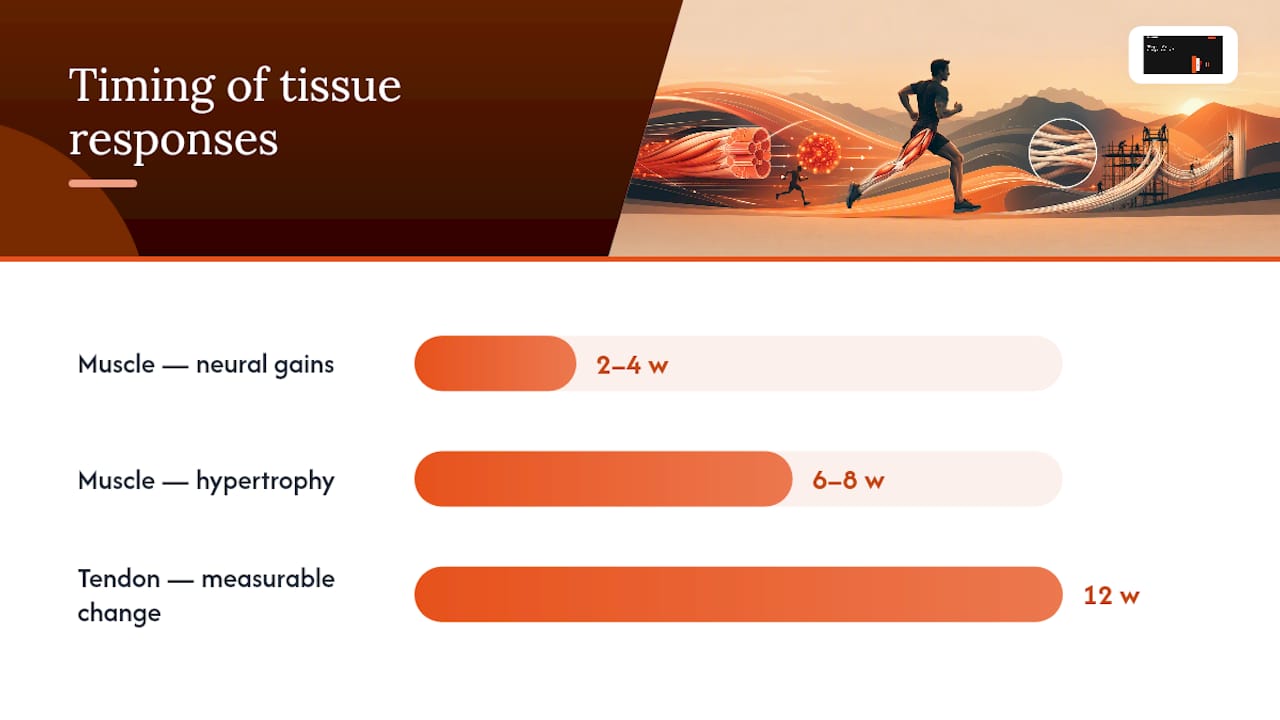
A systematic review and meta-analysis of exercise intervention studies found that programs lasting longer than 12 weeks were substantially more likely to produce measurable tendon stiffness and material property changes than shorter interventions. Shorter programs, four to eight weeks, mostly came back with null results on tendon outcomes, even when muscle strength gains in the same subjects were obvious and well documented.
That gap between muscle and tendon timelines isn't a footnote. It's the whole story. Muscle hypertrophy shows up on ultrasound or DEXA scans within 4 to 8 weeks of consistent resistance training in most cohorts. Strength gains, driven partly by neural adaptation, can appear within the first 2 to 3 weeks. Tendon cross-sectional area, when it changes at all, tends to lag well behind stiffness and modulus changes, sometimes requiring 6 months or more of consistent high-strain loading to register on imaging.
Here's roughly how the two tissues stack up across common training timeframes:
| Timeframe | Muscle response | Tendon response |
|---|---|---|
| 2–4 weeks | Neural strength gains, minimal size change | Little to no measurable change |
| 6–8 weeks | Visible hypertrophy in most trained individuals | Early signaling activity, no structural shift yet |
| 12 weeks | Continued hypertrophy and strength gains | First measurable stiffness and modulus changes in high-strain protocols |
| 6 months+ | Strength and size gains plateauing or continuing gradually | Cross-sectional area changes may begin appearing |
The intervention type matters as much as the duration. Studies using isometric holds, slow heavy concentric-eccentric work, and progressive eccentric loading have all produced tendon adaptation, provided the strain magnitude was high enough. According to research on strain and load magnitude, interventions using loads at or above roughly 70% of maximal voluntary contraction tended to show significant stiffness gains, though the same research flags a real caveat: percentage of 1RM is an imperfect proxy for actual tendon strain, since individual tendon stiffness, joint angle, and lever mechanics all change how much a given load actually deforms the tissue.
Sample sizes in this research area also deserve a mention. Most tendon adaptation studies work with small cohorts, often 10 to 30 participants, frequently young, healthy adults rather than older lifters or rehab patients. That doesn't invalidate the findings, but it means the 12-week figure is a reasonable planning benchmark, not a guarantee stamped for your specific joint, age, or injury history.
The headline number to remember: tendon studies need more than 12 weeks to reliably detect structural change, roughly three times longer than the window in which most muscle hypertrophy becomes visible. If your program review happens every 6 weeks, you're evaluating your tendons on a timeline that isn't built to show tendon progress yet.
What Strengthens Tendons the Most?
High-magnitude strain strengthens tendons more reliably than any other variable, and that means prioritizing load and tempo over sheer volume.
The exercises that show up again and again in successful tendon adaptation research aren't exotic. They're heavy isometric holds, slow heavy concentric-eccentric lifts, and progressive eccentric loading, the kind of unglamorous, unrushed work that doesn't torch calories or leave you gasping. Meta-analysis data on exercise interventions shows that isometric, concentric-eccentric, and eccentric-only protocols can all drive tendon adaptation, and the contraction type matters less than whether the strain magnitude cleared the adaptive threshold.
Here's a starting framework, built around achieving strain rather than chasing a percentage on a bar:
- Pick a heavy isometric or slow tempo lift for the target tendon. For Achilles work, that's a heel raise held at near end-range; for patellar tendon issues, a wall sit or Spanish squat variation.
- Load to a genuinely high intensity, not a comfortable one. Aim for a load you could hold or lower for roughly 6 to 8 seconds under real tension, generally in the same territory as 70% or more of your working max.
- Use slow tempos on the eccentric phase. A 3 to 5 second lowering phase keeps the tendon under tension long enough to matter, rather than letting momentum carry the load.
- Train the tendon-focused lift 2 to 3 times per week, with at least 48 hours between sessions targeting the same structure.
- Hold each phase for 4 to 8 weeks before adding load or complexity, then reassess symptoms and performance before progressing.
- Extend total program length to at least 12 to 16 weeks before expecting a structural shift, in line with the intervention research above.
Joint angle and lever arm are underused tools here. Practitioner-level guidance on applied tendon loading strategies points out that small shifts in joint position or using a partial range of motion can increase tendon strain on a specific region without needing an extreme absolute load. If you've got a cranky patellar tendon, adjusting knee flexion angle during an isometric hold can shift more strain directly onto the tissue that needs it, without loading your lower back or knees any harder than necessary.
Recovery between tendon-focused sessions deserves real respect; for guidance on how to manage activity post-procedure while supporting tissue recovery, see Exercise and Sweating After SMP. Tendon has far less blood flow than muscle, so its capacity to clear metabolic byproducts and rebuild collagen after a hard bout is slower. Hammering the same tendon with high-strain work every single day, thinking more frequency equals faster progress, is one of the more common ways lifters talk themselves into an overuse injury. Two to three focused sessions weekly, spaced out, consistently beats daily grinding.
Watch for these signs that you've pushed past productive strain into overuse territory:
- Morning stiffness in the tendon that worsens rather than improves week over week
- Pain that persists for more than 24 hours after a session, rather than fading within a day
- A specific point of tenderness that's sharper or more localized than general workout soreness
- Reduced performance in the lift itself, not just discomfort, suggesting the tissue hasn't recovered
Pro Tip: Track tendon-specific soreness on a simple 0 to 10 scale before and 24 hours after each session. If it's climbing three sessions in a row, back off intensity by about 20% before you end up sidelined for months instead of weeks. Reviewing your overall approach to progressive overload can help you apply this same logic across your whole program, not just the tendon-specific lifts.
Why Your Imaging Might Look Bad Even When You Feel Fine
An MRI showing tendon degeneration doesn't automatically mean you're in danger, and this is one of the most misunderstood facts in rehab.
Clinical research on tendinopathy consistently finds that structural abnormalities on imaging, thickening, disorganized fibers, small tears, often persist in people with zero pain and full function. Clinical perspectives on tendinopathy make the case plainly: pathology on a scan and pain or dysfunction in real life are only loosely correlated. Plenty of asymptomatic shoulders and knees would look alarming under a scanner.
That mismatch changes what rehab should actually target. The goal isn't a clean-looking scan. It's restoring load tolerance, the tendon's practical ability to handle the demands you're placing on it, whether that's a deadlift, a tennis serve, or climbing stairs without a wince. A tendon can improve function dramatically while still showing the same "abnormal" structure it had at the start of rehab.
Chasing a perfect scan is chasing the wrong target. The tendon that matters is the one that does its job without pain, not the one that looks pristine under an MRI. Clinicians who treat the image instead of the person often end up over-restricting patients who were already capable of more than the scan suggested.
Standard tendinopathy rehab tends to follow a loading progression rather than a rest-and-hope approach:
- Isometric loading first, often reducing pain acutely while maintaining some mechanical stimulus on the tendon
- Progressive heavy slow resistance work introduced as isometrics are tolerated without symptom flare
- Energy-storage loading, jumps, sprints, or sport-specific movements, added last, once the tendon tolerates heavy linear load
This staged approach respects the biology covered earlier: tendon needs sustained high strain, applied progressively, not sudden high-velocity demand before the tissue is ready.
Some situations do need urgent attention rather than a graded program. A sudden, sharp pain accompanied by an audible pop, immediate loss of function (can't push off, can't lift the limb against gravity), or visible deformity point toward a possible rupture, and that calls for prompt medical evaluation, not a wait-and-see approach. Chronic, gradually worsening tendon pain is a different animal than an acute traumatic event, and the two should never be managed the same way.
Keeping Muscle Growth From Outrunning Tendon Capacity
The single biggest programming risk for lifters who train hard is letting muscle strength outpace tendon stiffness, and that mismatch is a well-documented driver of injury.
Research on the muscle-tendon unit shows that when muscle strength climbs faster than tendon stiffness adapts, the tendon becomes the weak link in the chain, forced to transmit forces it isn't yet built to absorb. This shows up often in lifters who add strength quickly through good programming and decent recovery, then get blindsided by a tendon injury that seems to come "out of nowhere." It rarely does. The mismatch was building for months.
Watch for these early warning signs before they become a diagnosis:
- Rapid strength gains without corresponding joint comfort. If your squat jumped 15% in six weeks but your knee tendons feel the same or worse, that's a mismatch signal, not a coincidence.
- Asymmetry between limbs. A noticeably stronger or more stable side often means the weaker side's tendon is being asked to keep up without adequate preparation.
- New stiffness that appears only after your heaviest sessions. This usually means tendon load is exceeding current tolerance, even if muscle recovery looks fine.
The fixes are mostly about pacing, not overhauling your entire program:
- Slow load progression on your main lifts, especially once you're adding weight faster than roughly 5% every couple of weeks.
- Build in tendon-focused phases, 4 to 6 week blocks emphasizing isometrics or slow tempo work for the joints carrying your heaviest loads.
- Add unilateral training to catch and correct side-to-side imbalances before they become chronic. Unilateral work also lets you load each limb's tendon appropriately instead of letting a dominant side compensate.
- Run periodic eccentric-emphasis weeks, particularly for tendons that have historically given you trouble.
Pro Tip: A simple load-tolerance check: perform a single-leg heel raise or split squat hold at a moderate load and compare side to side. A meaningful gap, noticeably more shake, fatigue, or discomfort on one side, is worth addressing with targeted unilateral work before your next heavy training block. This kind of check fits naturally into broader load management planning, where you're already tracking how much stress your body can absorb week to week.
Ironatforty's Take: Training Tendons After 40
Ironatforty exists because most fitness content treats 25 year olds and 55 year olds like they recover on the same clock, and tendon adaptation is exactly where that assumption falls apart hardest.
Age changes the picture in ways the general tendon research doesn't always spell out. Hormonal shifts, particularly declining estrogen and testosterone, affect collagen synthesis rates, and nutritional status (protein intake, vitamin C, collagen precursor availability) plays a larger role in tendon repair capacity as you get older. Age-related loading research suggests older lifters benefit from slightly longer microcycles, 6 to 8 weeks per phase instead of the 3 to 4 weeks common in younger athlete programming, while keeping load quality just as high.
Here's how we'd adjust the general framework for a lifter over 40:
- Extend each tendon-focused training phase by roughly 50% compared to a younger lifter's timeline.
- Prioritize recovery between sessions targeting the same tendon, erring toward 3 full days rather than 2.
- Choose exercise variations that let you hit high strain without needing extreme absolute loads, using joint angle and partial-range tricks rather than just adding plates.
- Treat nutrition, particularly adequate protein and collagen-supportive nutrients, as part of the tendon program, not a separate conversation.
If you're rebuilding a training plan around this reality, our training resources walk through programming frameworks built for exactly this kind of patient, tendon-aware progression, and our joint health section digs deeper into recovery strategies for connective tissue specifically. For readers who want to dial in loads with actual numbers instead of guesswork, our free training tools include a 1RM calculator that can help you set intensity targets that are demanding without tipping into overuse.
| Point | Details |
|---|---|
| Tendon lags muscle | Fewer cells, less blood flow, and slower baseline metabolism make tendon change slower than muscle. |
| Strain, not fatigue, drives change | Tendon adapts to strain around 4.5% to 6.5%, not to metabolic burn or high rep volume. |
| Give it 12+ weeks | Meaningful tendon stiffness change generally needs programs longer than 12 weeks to show up. |
| Load quality beats volume | Heavy isometrics and slow tempo work outperform high-volume, low-load accessory training for tendons. |
| Older lifters need longer phases | Extending training phases to 6 to 8 weeks helps offset slower collagen synthesis with age. |
Why We Keep Repeating This to Every Lifter Who Asks
The conventional gym advice that "if the muscle is stronger, the joint is safer" is incomplete at best. Our research review makes the mechanism clear: tendon and muscle run on different biological clocks, and a program that only tracks strength numbers is flying blind on half the picture.
Where most advice falls short is treating tendon health as an afterthought, something you address only after pain shows up. By then you're managing an injury instead of preventing one. The lifters who avoid this are the ones who build tendon-focused work into their programming from the start, not after the first flare-up.
If you take one thing from this: stop judging tendon progress on a muscle timeline. Give it the 12-plus weeks the research demands, chase strain over fatigue, and treat consistent, boring, heavy, slow work as the actual program, not the warm-up to it.
— Iron@40 Staff
FAQ
Do Tendons Develop Slower Than Muscles?
Yes. Tendons have fewer cells, less blood supply, and lower baseline metabolism than muscle, and research shows tendon structural changes typically require interventions longer than 12 weeks, while muscle hypertrophy often becomes measurable within 4 to 8 weeks.
Why Do Tendons Heal Slower Than Muscles?
Tendon healing is slower because collagen-dense tissue has limited vascularization, restricting nutrient delivery and waste clearance, and because tenocytes are sparse relative to the surrounding matrix, which caps how fast damaged tissue can be remodeled.
What Strengthens Tendons the Most?
High-magnitude strain, roughly 4.5% to 6.5% of the tendon's resting length, achieved through heavy isometrics, slow tempo concentric-eccentric lifts, or progressive eccentric loading, produces the most reliable tendon stiffness gains, according to strain-threshold research.
How Long Does It Take for Tendons to Adapt?
Most tendon adaptation research finds measurable stiffness and material property changes after programs lasting more than 12 weeks, with cross-sectional area changes sometimes taking 6 months or longer to appear on imaging.