
Plan a deload every 4 to 6 weeks, not just when you feel wrecked. For most lifters over 40, that scheduled reset preserves muscle and joint health, but layer in autoregulation, too. If your recovery flags show up early, deload sooner. The trade-off worth knowing: a deload protects your gains, but a full week of doing nothing can cost you a little maximal strength.
TL;DR:
- Lifters over 40 should schedule deloads every 4 to 6 weeks to manage fatigue and prevent joint or tendon injury, with earlier deloads if recovery signs appear.
- Most deloads involve reducing volume by 40 to 60 percent, maintaining moderate intensity, with specific templates tailored for nervous system or joint recovery.
- Early warning signs to deload include increased heart rate, poor sleep, joint pain during warm-ups, or reduced motivation lasting several days.
- Combining scheduled deloads with active recovery, proper sleep, steady protein intake, and low-intensity cardio enhances recovery and maintains strength over time.
- Avoid full cessation of lifting during deloads to preserve neuromuscular patterns and strength, opting instead for lighter technical work or mobility drills.
Table of Contents
- What deload over 40 actually means
- Why deloads matter more after 40
- When to deload: planned schedules and warning signs
- How to run a deload week: three templates for lifters over 40
- Monitoring recovery and getting back to progress
- Recovery practices that magnify a deload's benefit
- How Ironatforty applies deload guidance for readers over 40
- Personalize your deload with Ironatforty's free tools
- Sources
- FAQ
What deload over 40 actually means
A deload is a short, planned dip in training stress, usually a week, designed to let fatigue clear before your next hard block. Coaches surveyed for an international Delphi consensus describe it as a temporary reduction in volume or intensity, built into the plan rather than bolted on after a crash. That is the key difference from a taper, which cuts volume sharply right before competition while keeping intensity high to stay sharp, and it is different from total rest, which stops training altogether.
Most deloads touch one or two variables at a time. You can cut sets while keeping your working weights close to normal, drop the load and keep the reps, or simply space sessions further apart. The Delphi consensus found coaches favor volume cuts most often, since that tends to protect strength and skill better than yanking intensity too low. For a lifter over 40, that distinction matters when you decide what to trim first.
Why deloads matter more after 40
Your muscles recover faster than your tendons and nervous system do. That mismatch is the real story after 40. Connective tissue adapts more slowly than muscle tissue, so a block of heavy squats or bench pressing can leave your shoulders or knees still catching up long after your legs feel fine. Push through that gap without a break, and you are not building strength. You are borrowing against a joint that will eventually send the bill.
Central nervous system readiness slows down, too. Bar speed drops, warm-up sets feel heavier than they should, and the "flat" feeling lingers longer than it did at 30. This is not a sign you are getting weak. It is a sign your recovery bottleneck has shifted from muscle to nervous system and tissue quality.
A deload here is not a concession. It is what lets you keep training hard for another five years instead of grinding through one aggressive block that ends in a strained elbow or a lower back that will not settle down. Muscle retention after 40 depends less on how hard you can push and more on how consistently you can keep showing up.
When to deload: planned schedules and warning signs
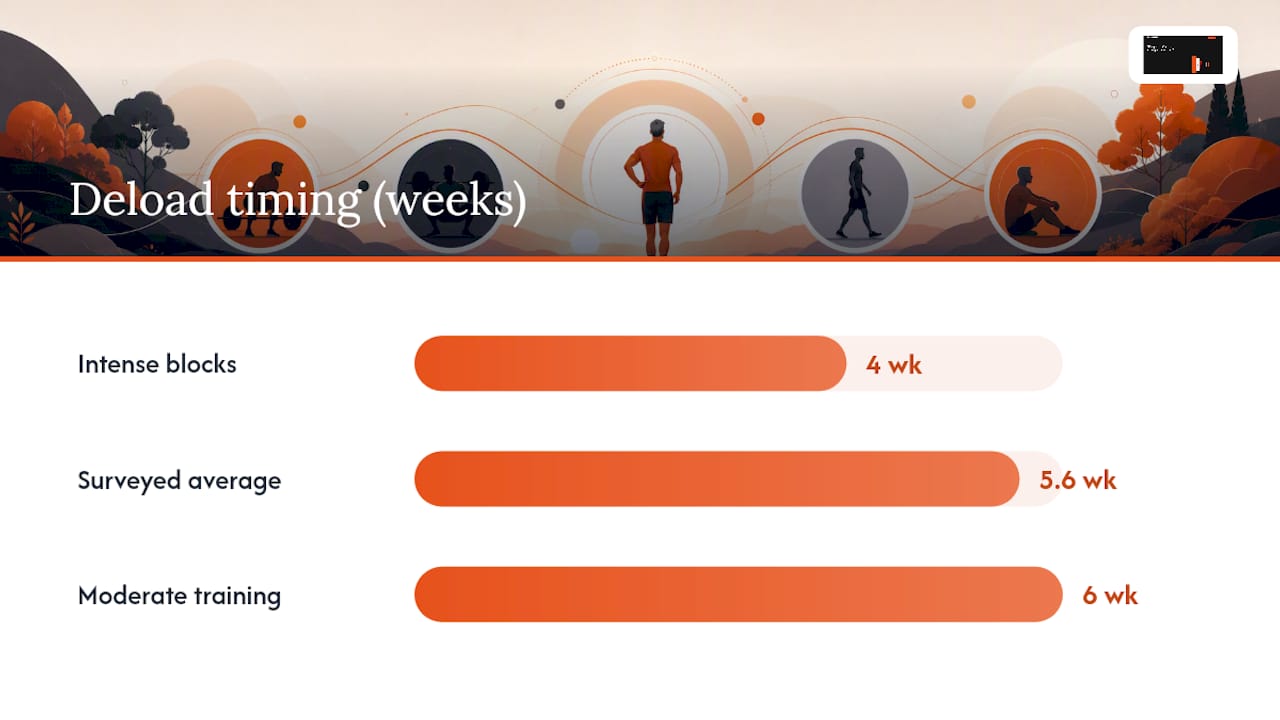
Default to a scheduled deload every 4 to 6 weeks if you are training with real intensity. That is not an arbitrary number. Surveyed strength and physique athletes reported deloading roughly every 5.6 weeks on average, with sessions lasting about 6.4 days, and the most common reasons were proactive fatigue management, stalled performance, and nagging joint or muscle soreness. If your blocks run especially intense, tighten that window toward 4 weeks. If you train moderately and recover well, 6 weeks is fine.
But calendars do not always know what your body knows. Watch for these signals and deload early when you see them:
- Your normal warm-up weight feels noticeably heavier for three or more sessions in a row (the "72-hour rule": a real strength drop that persists beyond three days is a signal, not a bad day).
- Resting heart rate creeps up 5 or more beats above your normal baseline for several mornings straight.
- Sleep quality drops and stays poor even when you are getting enough hours.
- Joint pain shows up during warm-up sets, not just under heavy loads.
- Your mood or motivation tanks for no obvious reason outside the gym.
Combine both approaches. Run your scheduled deload every 4 to 6 weeks as the baseline, and pull the trigger early if two or more of those flags show up together for three-plus days. That is how you avoid both undertraining out of fear and overtraining out of stubbornness.
How to run a deload week: three templates for lifters over 40
You do not need to guess what a deload week looks like. Pick the template that matches what your body is telling you, then follow it for 5 to 7 days.
- Maintenance deload. Cut total volume by roughly 40 to 60 percent (fewer sets, same exercises) while keeping intensity moderate, around 60 to 70% of your working weights. Keep your normal training frequency. This is the default choice when you feel generally fatigued but not injured.
- Nervous system deload. Drop to 2 to 3 sets per lift instead of your usual 4 or 5, but keep one or two heavier sets in each session at a higher reps-in-reserve (RIR of 3 to 4 instead of your usual 1 to 2). Sessions run shorter, maybe 30 to 40 minutes. Use this when your bar speed has slowed and warm-ups feel heavy, even though you are not sore or achy.
- Active recovery deload. Replace most lifting with light technical work, mobility drills, and Zone 2 cardio (a pace where you can still hold a conversation). Use bodyweight movements to keep patterns fresh without loading joints. This fits best when joint pain or systemic fatigue is the main flag.
A sample week for someone training 3 to 4 days normally: Monday, light squats and rows at reduced volume; Tuesday, off or a walk; Wednesday, upper body maintenance work; Thursday, mobility and Zone 2 cardio; Friday, light full-body session at 50 to 60 percent of normal loads; weekend, off or easy movement.
Pro Tip: Never go to zero on your main lifts unless pain forces it. A randomized trial found that a full week of complete cessation preserved hypertrophy and power fine, but produced smaller maximal strength gains than continuous training. Keeping some light, technical reps in the squat or bench during your deload protects the skill and the neural groove, not just the muscle.
Monitoring recovery and getting back to progress
You do not need lab equipment to know whether the deload worked. Three simple checks go a long way: a quick readiness questionnaire covering sleep and energy, your morning resting heart rate compared to baseline, and how your warm-up sets feel, specifically bar speed on the first few reps. If two of the three still look worse than normal three days into your next training block, extend easy training a bit longer before ramping back up.
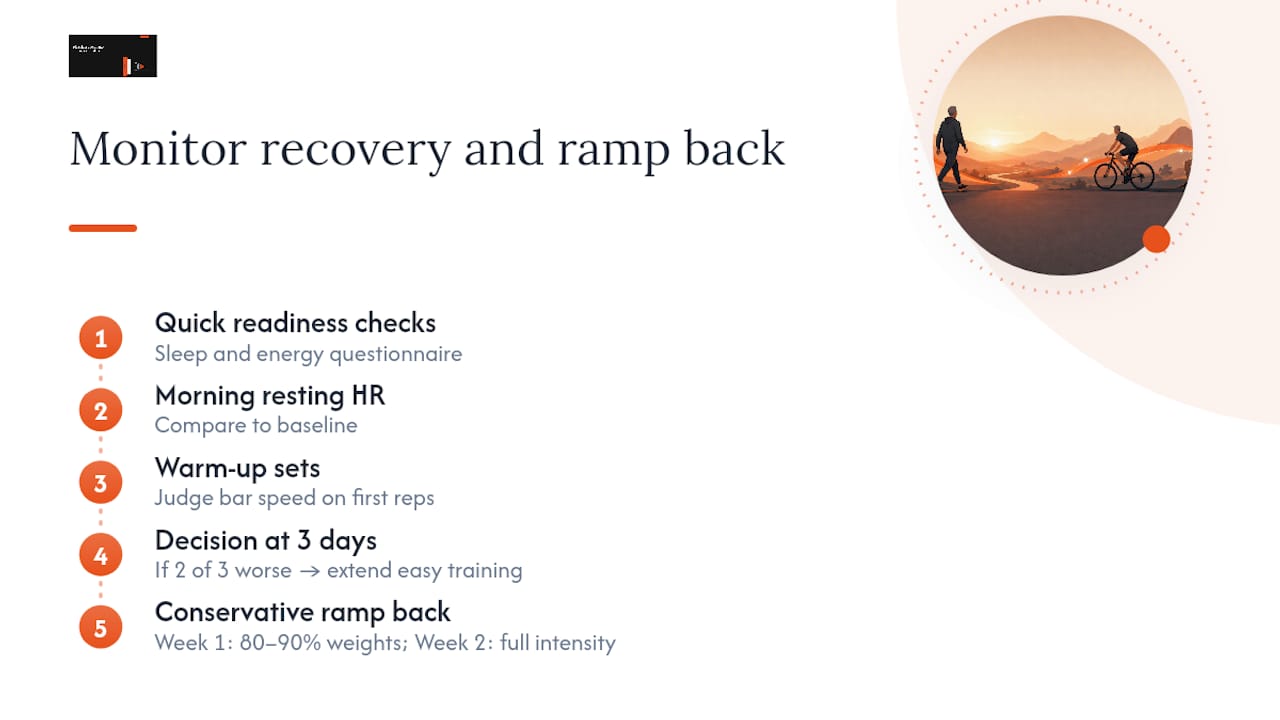
For the first one to two weeks after a deload, resist the urge to test a new personal record right away. Ramp back conservatively: week one at roughly 80 to 90 percent of your pre-deload working weights, week two back to full intensity if everything feels normal. Research backs the caution on the strength side specifically. Trials on deload periods implemented as volume or frequency reductions show similar hypertrophy and strength-endurance outcomes compared to continuous training, but maximal strength effects vary depending on how the deload was designed and who was tested. Muscle size holds up reliably. Peak strength is the variable that needs a patient ramp back.
Recovery practices that magnify a deload's benefit
A deload week works better when the other 6 days of the week are pulling in the same direction. None of the following requires fancy equipment, but each moves the needle for lifters over 40 specifically.
- Sleep first. Poor sleep blunts recovery more than almost anything else you control, and it is the highest-leverage fix available to most lifters.
- Protein consistency. Keep intake steady through your deload rather than cutting calories aggressively. Muscle maintenance depends on adequate protein even during lighter training weeks.
- Zone 2 cardio. Easy aerobic work speeds systemic recovery without adding fatigue on top of your training stress.
- Mobility and stress management. Simple daily mobility work and basic stress reduction (walking, breathing drills, time outdoors) support the nervous system recovery that muscle recovery depends on.
If fatigue, joint pain, or sleep problems persist for weeks despite a proper deload and these recovery basics, talk to your doctor before pushing further. That is especially true if you are managing a health condition or taking prescribed medication. Never stop or adjust a prescribed medication on your own to chase a training goal.
How Ironatforty applies deload guidance for readers over 40
Our stance is simple: schedule deloads earlier and more consistently than you did at 25, then let your own recovery data override the calendar when it disagrees. A 30 year old can often get away with reactive deloading. Past 40, waiting for a crash to tell you it is time usually means you are already behind. Use a tool like a TDEE calculator to keep nutrition steady through lighter weeks, and pair your deload calendar with an honest look at your training program's intensity curve before you build the next block.
— Iron@40 Staff
Personalize your deload with Ironatforty's free tools
Ironatforty offers free calculators and guides tailored to lifters beyond their twenties seeking training programs that acknowledge their needs. Our free training and nutrition tools let you calculate your actual calorie needs and estimate your working 1RM, so your deload week is based on your numbers instead of a guess pulled from a magazine article.

If you are building out your next training block, start with our training resources for programming structure, then check the nutrition hub for guidance on eating through recovery weeks without losing muscle. Run your numbers through the TDEE and 1RM calculators today, and build your next deload around data instead of guesswork about how you feel.
Sources
- Bell et al., Integrating deloading into strength and physique sports training programmes (PubMed Central)
- Integrating deloading into strength and physique sports training programmes: an international Delphi consensus (Sports Medicine - Open)
- Effects of deload periods implemented in resistance training (PeerJ)
FAQ
How heavy should you go on a deload week?
Most deload weeks call for training at moderate intensity—around 60 to 70% of your normal working weights—with a substantial cut in total sets, often between 40 and 60 percent. If you are running a nervous-system-focused deload instead, you can keep one or two sets closer to your usual weight but with more reps left in reserve.
What is the 72-hour rule for men over 40 who want to build muscle?
The 72-hour rule flags a real strength drop, if your normal lifts feel noticeably heavier or weaker for three straight days, that is a signal to deload rather than push through. A single off day is normal; three days in a row usually means accumulated fatigue that a lighter week will resolve faster than grinding through it.
Why are men over 40 turning to deloading every few weeks?
Recovery capacity shifts with age. Connective tissue and nervous system readiness lag behind muscle recovery, which is why a scheduled deload every 4 to 6 weeks, backed by survey data on typical deload timing, tends to protect joints and long-term progress better than training through fatigue and hoping it resolves on its own.
Does a deload week hurt muscle gains?
Not meaningfully. Research on short deloads, including a trial on complete one-week training cessation, found hypertrophy and power held up fine, though maximal strength gains were smaller compared to lifters who trained continuously. If preserving strength is your priority, a partial-volume deload rather than total rest is the safer choice.