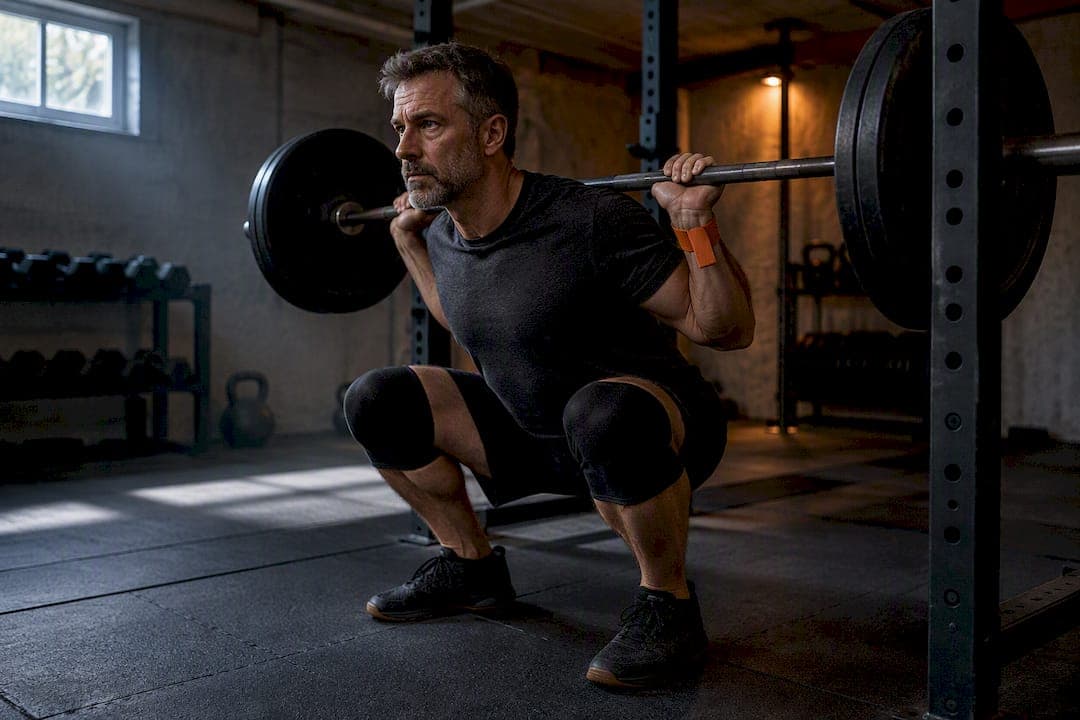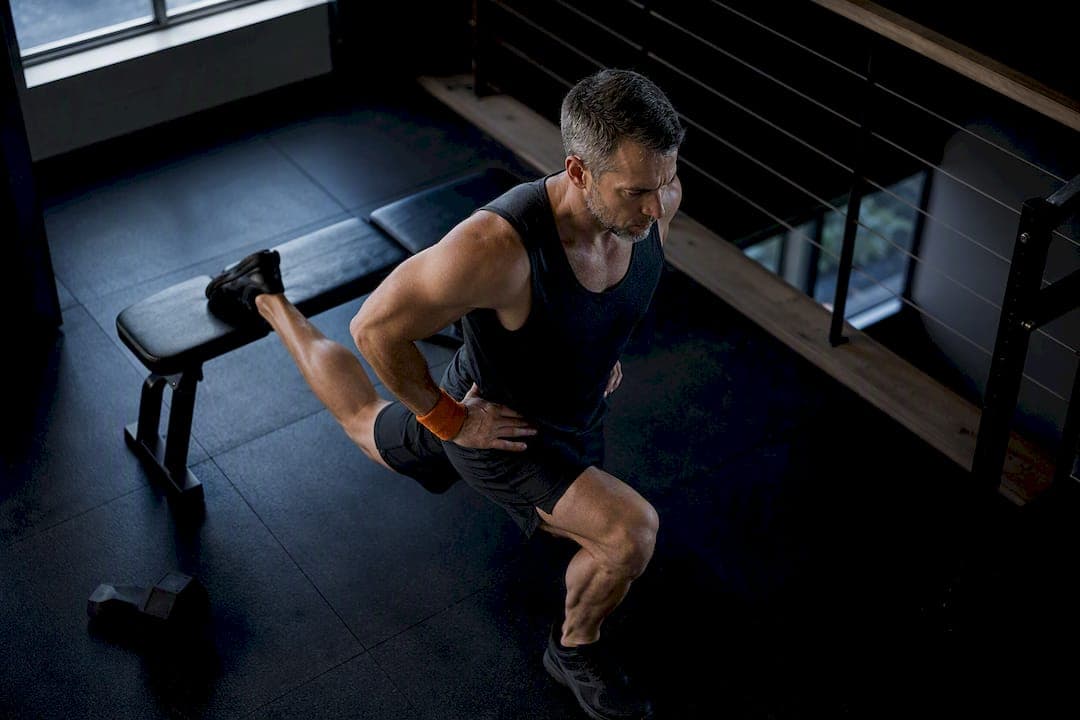
No, soreness doesn't confirm you built muscle. DOMS is mostly a sign of unaccustomed or eccentric loading, plus neural and connective tissue sensitization, not a scoreboard for hypertrophy. Research on integrated muscle protein synthesis shows growth tends to show up later, after damage and soreness have already faded. Track load, reps, and sets. Stop chasing the burn.
TL;DR:
- Soreness during weeks one and two of a program primarily signals muscle adaptation, not actual growth, which occurs after soreness diminishes.
- Resistance training research shows muscle protein synthesis peaks after damage repair, with hypertrophy correlating with reduced soreness and damage markers.
- Increased soreness from eccentric movements or novel exercises does not indicate greater muscle gains and can be minimized by gradual progression and proper load management.
- Recovery strategies like sleep and adequate protein intake support hypertrophy, whereas analgesics and supplements mainly reduce soreness without enhancing growth.
- Persistent soreness beyond a week or symptoms like swelling, dark urine, or inability to move indicate injury or conditions like rhabdomyolysis, requiring medical attention.
Table of Contents
- Soreness and Muscle Growth: What DOMS Actually Is
- Does Soreness Mean You're Building Muscle?
- Why Soreness Happens Without Cell Damage
- How to Train Without Chasing the Burn
- Recovery Tools: Soreness Relief vs. Real Growth
- When Soreness Is a Warning Sign, Not Just DOMS
- The IronAtForty Take on Soreness and Muscle Growth
- Sources
- FAQ
Soreness and Muscle Growth: What DOMS Actually Is
Delayed onset muscle soreness follows a fairly predictable clock. You usually feel nothing right after training, then discomfort creeps in over the next half day and builds from there.
- Onset: begins within about half a day after training
- Peak: builds and peaks over the next few days after exercise
- Resolution: symptoms usually resolve within several days to about a week
That timeline comes from research on how resistance exercise reshapes muscle tissue at the molecular level, and it holds up across most healthy lifters doing standard training.
DOMS shows up most after eccentric work, the lengthening phase of a lift, like the lowering portion of a squat or the negative on a bicep curl. It also spikes after novel exercises your body isn't used to, or after a sudden jump in volume or intensity. A first Bulgarian split squat session or your first week back after a long layoff will usually produce more soreness than a familiar exercise you've run for months.
Normal DOMS feels like a dull, diffuse ache. It's worse with stretching or contracting the muscle, tender to the touch, and it improves day by day. That's different from sharp, localized pain, joint pain, or swelling that gets worse instead of better, which point toward something else entirely and deserve a different conversation, covered later in this piece.
Does Soreness Mean You're Building Muscle?
The short answer from the research: not reliably, and often the opposite is true.
A longitudinal study on resistance training and muscle protein synthesis tracked lifters over multiple training sessions and found something that should reshape how you think about soreness. Early in a training block, muscle protein synthesis spiked high, but that spike was tied to repairing damage, not building new tissue. As training continued and the muscle adapted, MPS became more efficient. It stopped being a repair response and started correlating with actual hypertrophy, and that shift happened after damage markers dropped, not while they were elevated.
The data point that matters: Integrated myofibrillar protein synthesis was highest after the very first bout of a new stimulus, but only correlated with measurable hypertrophy at later time points, once muscle damage had attenuated.
Translate that into plain terms and the message is blunt. The soreness you feel during weeks one and two of a new program is mostly your body learning to handle a stress it hasn't handled before. The muscle growth you're actually chasing tends to show up once that learning curve flattens and the soreness fades.
A broader review of hypertrophy mechanisms backs this up from a different angle. Mechanical tension applied consistently over time, not acute damage or the hormonal response to a brutal session, is what the evidence points to as the primary driver of growth. Damage markers and soreness are weak, inconsistent predictors of long-term size gains.
A few variables shift how sore you get without changing whether you're growing:
- Training status: Beginners get hit hardest because almost everything is novel to their tissue.
- Exercise type: Eccentric-heavy movements produce more soreness than concentric-dominant ones at the same relative effort.
- Individual variability: Two lifters doing an identical program can report very different soreness levels while making similar strength and size progress.
None of that variability tracks cleanly with who actually gained the most muscle by the end of the block.
Why Soreness Happens Without Cell Damage
For decades the standard explanation was simple: exercise tears muscle fibers, tearing hurts, healing builds bigger fibers. That model is getting rewritten.
A review on fascial connective tissue makes a strong case that soreness often comes from the fascia and surrounding connective tissue rather than the muscle fibers themselves. Researchers have documented mechanical hyperalgesia, meaning heightened pain sensitivity to pressure, in cases with no clear microscopic fiber damage at all. The paper goes as far as calling DOMS a "false friend": it signals you did something your body wasn't ready for, but it doesn't reliably signal growth.
Two mechanisms are getting the most attention right now:
- Neural and fascial sensitization: Growth factors like NGF and GDNF appear to sensitize nerve endings in and around the fascia, making normal movement feel sore even without meaningful fiber-level injury.
- Proprioceptive channel involvement: Mechanistic reviews point to ion channels like Piezo2, involved in detecting mechanical stretch, as a possible player in why soreness has that biphasic, delayed pattern instead of hurting immediately.
This connects directly to something every experienced lifter has noticed: the repeated-bout effect. Do a new exercise or a big volume jump once, and you're wrecked for days. Repeat that same stimulus a week or two later, and soreness drops sharply even if you keep pushing intensity. Your muscle isn't done growing, it's simply adapted to that specific stress. Growth doesn't stop when soreness stops. It often continues quietly in the background.
Pro Tip: If a new exercise leaves you barely able to walk down stairs for four days, that's not a sign it's "working better." It's a sign you went in too hard, too fast, on something your body hadn't touched before. Ease into new movements at 60 to 70% of your working effort for the first session or two.
How to Train Without Chasing the Burn
If soreness isn't the signal, what is? Numbers you can write down.
-
Track load, not sensation. Log the weight, sets, and reps on every working set. If those numbers trend up over months, you're progressing, regardless of how sore you felt on any given Tuesday.
-
Use RIR instead of pain as your intensity gauge. Reps in reserve tells you how close to failure you trained. It's a far more honest measure of effort than how wrecked you feel two days later.
-
Increase volume conservatively. Big jumps in sets or reps from one week to the next are the fastest route to unnecessary soreness with no extra growth payoff. Small, steady increases let your connective tissue keep pace with your muscle. Structuring your training volume around gradual progression rather than dramatic swings protects both your joints and your recovery capacity.
-
Stop rotating exercises purely to feel more sore. Constant novelty keeps you stuck in the repair phase of MPS instead of letting the refined, hypertrophy-directed phase take over. Pick a handful of core movements and stick with them for a training block.
-
Schedule deloads instead of waiting for soreness to force one. A planned lighter week every four to six weeks lets tendons and connective tissue catch up, which matters more as you get older.
For lifters over 40, tendons and connective tissue adapt more slowly than muscle does. That mismatch is a big part of why chasing soreness through constant exercise novelty carries more risk at this age than it did at 25. Conservative progression, consistent movements, and tracking your actual training numbers protect the joints while still delivering the mechanical tension that drives size and strength.
Recovery Tools: Soreness Relief vs. Real Growth
Some recovery tactics change how sore you feel. A smaller set change how much muscle you build. Confusing the two wastes money and, in some cases, blunts progress.
What actually supports hypertrophy:
- Sleep. Recovery capacity and training performance both drop when sleep is cut short, and that's a well-documented relationship, not a wellness slogan. Consistent, adequate sleep is one of the few recovery levers with a direct line to both how you feel and how well you adapt. Ironatforty's breakdown of sleep and muscle recovery covers this in more depth.
- Consistent protein intake. Protein availability drives the muscle protein synthesis that eventually becomes new tissue, and this matters far more day to day than any single post-workout shake timing trick.
What mostly changes the sensation, not the outcome:
- BCAAs. A 2024 meta-analysis found BCAA supplementation can reduce perceived soreness and creatine kinase levels in many trials, with the effect appearing more pronounced at higher doses over longer supplementation periods. Feeling less sore is not the same as growing more muscle, and the same review doesn't show a hypertrophy benefit.
- NSAIDs and other pain relievers. These blunt the ache. Used occasionally for genuine discomfort, that's reasonable. Used chronically around every training session, they carry the risk of interfering with the adaptation process itself, on top of their own gastrointestinal and kidney risks with regular use. Talk to your doctor before using any medication regularly for training-related soreness, and never stop or adjust a prescribed medication without medical guidance.
- Foam rolling and collagen supplements. Both have some support for easing discomfort, tied to the fascial and connective tissue mechanisms discussed earlier, but the evidence for either meaningfully boosting hypertrophy is thin at best.
The practical version: eat enough protein, sleep like it's part of your program, and use soreness-relief tools only when discomfort is genuinely interfering with your ability to train well, not as a substitute for smart programming.
When Soreness Is a Warning Sign, Not Just DOMS
Ordinary DOMS fades within about a week. If it doesn't, or if it comes with any of the following, that's no longer routine post-workout soreness.
- Severe swelling in the muscle
- Dark, cola-colored urine
- Inability to move or use the limb normally
- Fever, nausea, or other whole-body symptoms
These can signal rhabdomyolysis or a genuine injury, not muscle-building soreness. If soreness passes the seven-day mark with real intensity, stop pushing that muscle group with eccentric work and check in with a doctor or physical therapist before your next hard session. Recognizing when post-activity pain crosses into warning-sign territory applies just as much to lifting as it does to any other physical activity.
The IronAtForty Take on Soreness and Muscle Growth
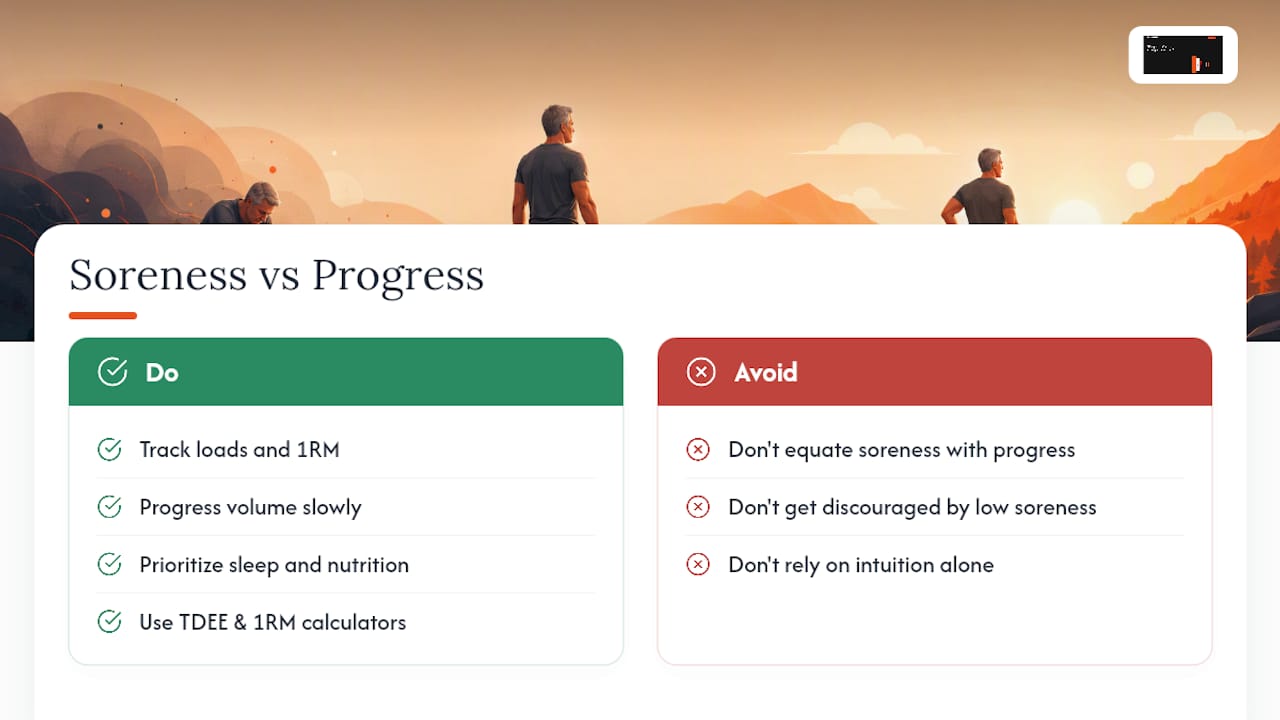
We see it constantly: lifters over 40 mistake a brutal DOMS flare for proof a program is "working," then get discouraged when a smooth, low-soreness week follows real strength gains. Flip that thinking. Soreness tells you what your body wasn't ready for. It doesn't tell you what you built.
Track your loads. Progress your volume slowly. Sleep and eat like recovery is part of training, not an afterthought. If you want to dial in the numbers behind that approach, Ironatforty's TDEE calculator and 1RM calculator are built for exactly this kind of tracking, not guesswork dressed up as intuition.
— Iron@40 Staff
Sources
The claims in this article rest on a handful of studies worth reading in full if you want the mechanistic detail:
- Resistance training‐induced changes in integrated myofibrillar protein synthesis are related to hypertrophy only after attenuation of muscle damage - PMC
- Meta-analysis on BCAA effects on DOMS and damage markers (2024)
FAQ
What kills muscle gains the most?
Inconsistent progressive overload, chronic under-recovery from poor sleep, and inadequate protein intake do more damage to muscle gains than anything related to soreness. Chasing novelty for the sake of feeling sore, instead of progressing load and volume steadily, is a common self-inflicted setback.
Does DOMS mean I'm not eating enough protein?
No. DOMS is driven by unaccustomed or eccentric loading and neural or connective tissue sensitization, not protein deficiency. Low protein intake can slow recovery over time, but soreness itself isn't a protein-status signal.
Is it bad to be sore for 4 days?
Soreness lasting close to the typical resolution window of about a week is still within normal range for a tough or novel session. If it extends well past seven days or comes with severe swelling, dark urine, or trouble moving the limb, stop and check in with a doctor.
What are the first signs of actual muscle growth?
The earliest reliable signs are performance-based: you can lift slightly more weight, complete an extra rep, or handle the same load with more reps in reserve than before. Visual size changes and measurable hypertrophy typically lag behind these strength gains by weeks.