
Magnesium for sleep works, but not the way most supplement marketing claims. The real benefit is modest and shows up strongest in people who start out low on magnesium: older adults, heavy drinkers, chronic PPI users, and anyone training hard enough to sweat out minerals daily. If your diet already covers your magnesium needs, expect a small bump in sleep quality at best, not a knockout sedative effect.
The realistic expectation over several weeks of consistent use: modestly shorter time to fall asleep and a measurable bump in sleep efficiency, the percentage of time in bed you actually spend asleep. That's it. It's not melatonin, and it's definitely not a sleeping pill.
One flag before you go further: if you have kidney disease or take medications that affect mineral clearance (certain diuretics, bisphosphonates, some antibiotics), talk to a clinician before adding magnesium. Your kidneys handle magnesium excretion, and impaired renal function changes the safety math entirely.
Quick verdict for the skimmers:
- Real but modest effect, concentrated in people with low baseline intake.
- Improvements show up in sleep onset time and sleep efficiency, not necessarily total hours slept.
- Full benefit usually takes several weeks of consistent dosing, not one night.
- Kidney disease or interacting medications mean you talk to a doctor first.
Key Takeaways
Magnesium supports better sleep primarily by restoring GABA and cortisol regulation in people with low baseline magnesium, with modest, gradual improvements over several weeks rather than immediate sedation.
| Point | Details |
|---|---|
| Who benefits most | People with low dietary magnesium, older adults, heavy drinkers, and hard-training lifters see the clearest results. |
| Best form for most people | Magnesium bisglycinate at 200 to 400 mg elemental absorbs well and rarely causes GI upset. |
| Timing matters | Take it 60 to 90 minutes before bed to align with your first slow-wave sleep window. |
| Give it real time | Evaluate over several weeks before concluding it isn't working; this isn't an overnight fix. |
| Safety first | Consult a clinician before supplementing if you have kidney disease or take interacting medications like certain diuretics or bisphosphonates. |
| Ironatforty's approach | Ironatforty recommends assessing diet and training-related magnesium losses first, then favoring glycinate over citrate or oxide for most lifters over 40. |
Table of Contents
- How Magnesium for Sleep Actually Works in the Body
- Clinical Evidence: What the Trials Actually Found
- Which Magnesium Forms Work Best for Sleep
- Magnesium Dosage for Sleep: How Much and When to Take It
- Safety, Side Effects, and Drug Interactions to Know
- A Step-by-Step Protocol for Trying Magnesium for Sleep
- Why This Guide Matters More After 40
- An Editorial Note for Lifters Over 40
- Tools to Help You Track Diet and Recovery While You Test This
- Sources
- FAQ
How Magnesium for Sleep Actually Works in the Body
Magnesium isn't a sedative. It's a cofactor, meaning it helps other systems in your body do their jobs correctly, and several of those jobs happen to matter a lot for sleep.
Start with GABA, the brain's main calming neurotransmitter. Magnesium helps regulate GABA receptor activity, which is part of why it has a reputation as "nature's relaxant." This is also why glycinate, magnesium bound to the amino acid glycine, tends to outperform other forms for sleep specifically. Glycine itself has calming properties and works through a related but separate pathway, so you're getting two mild sedative-adjacent effects stacked together instead of one.

Magnesium also acts as an NMDA receptor antagonist. NMDA receptors drive excitatory signaling in the brain, the opposite of what you want when you're trying to wind down. Blunting that excitatory tone is one plausible reason magnesium helps with the "tired but wired" feeling that plagues a lot of people over 40, especially those under chronic stress or training load.
Then there's the HPA axis, your hypothalamic pituitary adrenal system, which governs cortisol release. Magnesium appears to help moderate this axis, and chronically elevated evening cortisol is a well-known saboteur of sleep onset. If you're the person who's exhausted all day but wired the second your head hits the pillow, a dysregulated cortisol rhythm is often part of the picture.
Magnesium also plays a supporting role in melatonin synthesis, your body's actual sleep hormone, and contributes to muscle relaxation. That muscle-relaxation piece matters for people dealing with restless legs syndrome or periodic limb movements, conditions that fragment sleep without the person always realizing why they're waking up tired.
A statistic worth sitting with: a large share of adults in Western countries fall short of recommended dietary magnesium intake, and clinical evidence points to those with low baseline dietary magnesium as the group most likely to see real sleep improvement from supplementation. If your diet is already magnesium-rich, through leafy greens, nuts, seeds, and whole grains, you may be one of the people for whom supplementing does very little.
What this means for you:
- If you skip vegetables most days, drink regularly, or take a proton pump inhibitor, you're a likely responder.
- If your diet is already solid, don't expect a dramatic before-and-after.
- The "tired but wired" pattern is a specific clue that magnesium's cortisol-related mechanism might be relevant to you.
Clinical Evidence: What the Trials Actually Found
The most cited trial in this space is Abbasi and colleagues (2012), which tested 500 mg of elemental magnesium (as magnesium oxide) in older adults with insomnia over eight weeks. The results were genuinely good: participants saw improved sleep efficiency, longer total sleep time, and shorter time to fall asleep, along with favorable shifts in melatonin and cortisol markers.
But read the fine print before you assume this applies to you. The subjects were elderly, a population disproportionately likely to be magnesium-deficient to begin with. Magnesium oxide is also poorly absorbed compared to chelated forms like glycinate, so the dose that worked here doesn't translate cleanly to "take 500 mg of any magnesium and get the same result." It's a real trial with real results, in a narrow population, using a form most sleep-focused supplement brands don't even recommend anymore.
More recent research has looked at magnesium L-threonate, a newer form marketed heavily for cognitive and sleep benefits. Trials in this space, including work referenced in Sleep Foundation's overview, suggest improvements in sleep quality metrics for adults whose sleep problems are tied to racing thoughts or cognitive hyperarousal. The sample sizes are still small and the evidence is preliminary, so treat L-threonate as promising, not proven.
Broader systematic and narrative reviews paint a consistent picture: low dietary magnesium correlates with worse sleep, but the trials backing supplementation are heterogeneous, often small, and short in duration. That's not a reason to dismiss magnesium. It's a reason to calibrate your expectations correctly.
| Trial or Review | Population | Form and Dose | Key Finding |
|---|---|---|---|
| Abbasi et al., 2012 | Adults 60+ with insomnia | 500 mg elemental (oxide) | Improved sleep efficiency, total sleep time, reduced onset latency |
| L-threonate RCTs (recent) | Adults with cognitive-heavy sleep complaints | Varied, several weeks | Modest gains in subjective sleep quality and deep sleep metrics |
| Narrative/systematic reviews | General adult population | Mixed forms and doses | Association between low intake and poor sleep; effect sizes modest and inconsistent |
The pragmatic takeaway: if you're deficient or older, expect a real but moderate improvement within four to eight weeks. If your magnesium status is already fine, don't bank on this being your sleep fix.
Which Magnesium Forms Work Best for Sleep
Not all magnesium supplements are built the same, and the form you pick matters more than the total milligrams on the label.
Magnesium bisglycinate (glycinate) is the first-line choice for sleep, and for good reason. It's magnesium bound to glycine, which means you get the calming benefits of both compounds. It absorbs well, doesn't dump undigested magnesium into your colon the way weaker forms do, and pharmacist and clinical summaries consistently recommend it at 200 to 400 mg of elemental magnesium for sleep support. It's also gentle on the gut, which matters if you've ever taken a magnesium supplement and regretted it an hour later.
Magnesium L-threonate is worth considering as a second option, particularly if your sleep issue is more about a racing mind than physical tension. It's been studied specifically for cognitive and sleep-related outcomes, and the early evidence is encouraging even though it remains less established than glycinate. Doses used in trials tend to run higher in total compound weight because L-threonate has lower elemental magnesium content per milligram, so check labels carefully.
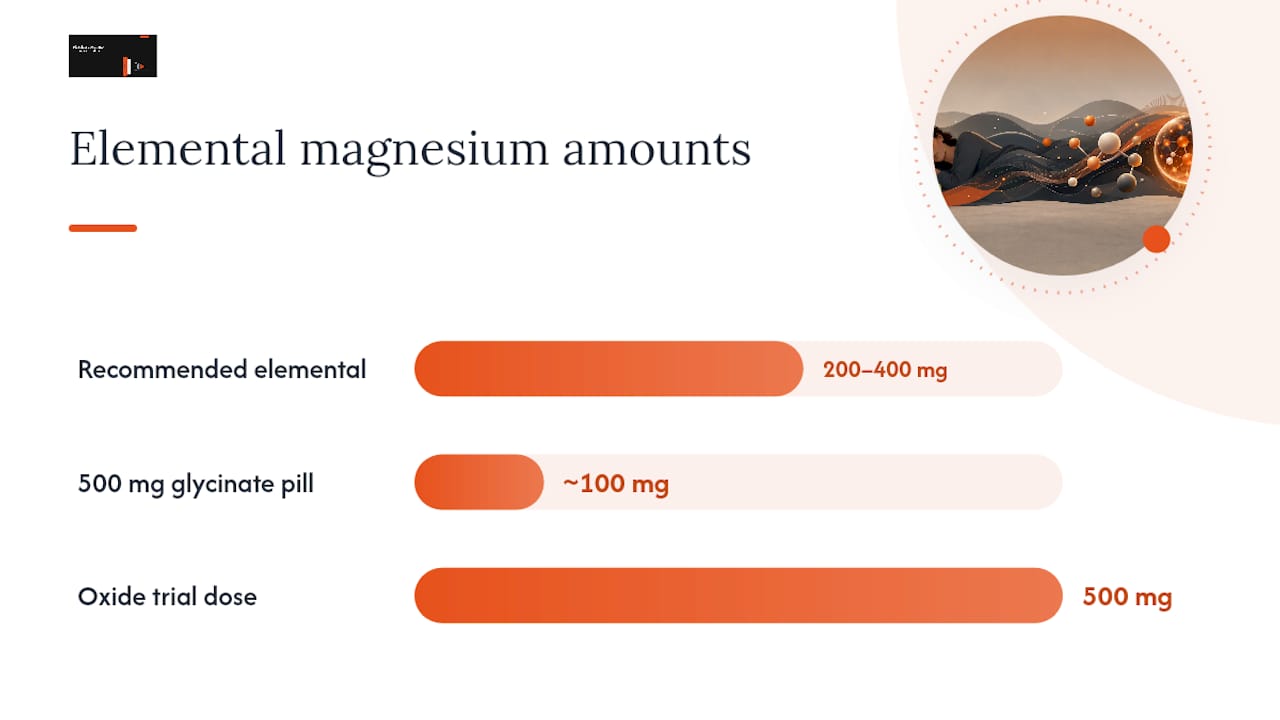
Magnesium citrate and magnesium oxide are the two forms to be cautious with when your goal is sleep. Citrate is popular for constipation relief because it pulls water into the intestines, an osmotic laxative effect that becomes more pronounced at the higher doses often needed for a sleep effect. Waking up at 2 a.m. for reasons unrelated to insomnia defeats the purpose. Oxide, meanwhile, has poor bioavailability, meaning your body absorbs relatively little of it, which is part of why the Abbasi trial needed such a high dose (500 mg) to see results.
A few label-reading rules that will save you money and frustration:
- Look for "elemental magnesium" on the label, not just the total compound weight. A 500 mg capsule of magnesium glycinate might only contain around 100 mg of actual elemental magnesium.
- Compare products by elemental content, not total pill weight, or you'll end up under-dosed without realizing it.
- If a label doesn't clearly state elemental magnesium content, treat that as a red flag on transparency.
- When comparing magnesium glycinate vs citrate for a sleep goal specifically, glycinate wins on tolerability and consistency, even if citrate is cheaper per bottle.
For a deeper breakdown of practical dosing patterns by form, Snozzing's guide on magnesium and sleep covers additional consumer-facing detail worth a look.
Magnesium Dosage for Sleep: How Much and When to Take It
Here's the part everyone actually wants: numbers you can use tonight.
- Pick your form first. Magnesium bisglycinate is the sensible default for most adults. L-threonate may be considered if a racing mind, rather than muscle tension, is your main sleep obstacle.
- Start at 200 mg elemental magnesium, taken 60 to 90 minutes before bed. That timing window isn't arbitrary. It lines up with your body's approach into the first slow-wave sleep cycle of the night, giving the mineral time to be absorbed before you need its calming effects.
- Titrate slowly. If tolerated well after one to two weeks, increase by 100 mg. Most people land in the 200 to 400 mg elemental range for meaningful sleep support, well below the point where GI side effects typically kick in with a well-absorbed chelate.
- Give it a real trial window. Evaluate over four to twelve weeks before deciding it isn't working. This isn't a same-night fix, and expecting one is the single biggest reason people give up on magnesium too early.
- Know your ceiling. If you've reached your upper tolerated dose with zero change in sleep by eight weeks, magnesium probably isn't your bottleneck. Something else is driving the insomnia.
Pro Tip: Take magnesium with a small amount of food if you notice any stomach upset, but avoid pairing it with a large protein-heavy meal right before bed, since digestion competing with your wind-down process can offset the calming effect you're going for.
One more practical note on timing: consistency matters more than precision. Taking it 90 minutes before bed on a good night and skipping it entirely on a bad one won't give you a fair read on whether it's actually helping.
Safety, Side Effects, and Drug Interactions to Know
Magnesium is generally well tolerated, but "generally" isn't "always," and the side effects that do show up are usually predictable.
The most common issue is gastrointestinal: diarrhea and abdominal cramping, particularly with magnesium citrate or with any form pushed past your personal tolerance. This happens through an osmotic mechanism, meaning unabsorbed magnesium draws water into the gut. It's uncomfortable, not dangerous, and it resolves quickly once you lower the dose or switch forms.
The more serious concern is renal. Your kidneys are responsible for clearing excess magnesium, and if that clearance is impaired, magnesium can accumulate to dangerous levels. The NIH Office of Dietary Supplements flags renal impairment as a key contraindication for supplementation, and this is not a caution to shrug off if you have any degree of kidney disease.
Drug interactions worth knowing before you start:
- Certain diuretics can alter magnesium excretion in either direction, so dosing needs clinician input.
- Bisphosphonates (common osteoporosis medications) can have their absorption reduced if taken too close to magnesium.
- Some antibiotics, including certain classes of tetracyclines and quinolones, bind to magnesium and lose effectiveness if timing isn't separated.
- Anyone on multiple prescription medications should run a new supplement past a pharmacist, not just assume it's fine because it's "just a mineral."
If you want objective confirmation of your magnesium status rather than guessing, ask your doctor about testing red blood cell (RBC) magnesium rather than standard serum magnesium. Serum levels are tightly regulated by the body and can look normal even when your cellular stores are genuinely low, which is why serum testing alone often misses real deficiency.
Watch for these signs that warrant stopping supplementation and checking in with a clinician: persistent diarrhea beyond the first week of a new dose, unusual muscle weakness, or an irregular heartbeat. These aren't common at typical supplemental doses, but they're the signals that mean stop and get checked, not push through.
A Step-by-Step Protocol for Trying Magnesium for Sleep
If you want to actually test whether magnesium helps your sleep, rather than just taking it and hoping, run it like an experiment.
- Establish your baseline. Before starting anything, take honest stock: how's your diet (leafy greens, nuts, whole grains), do you take a PPI regularly, how much alcohol do you drink weekly, and do you notice restless legs or twitching before sleep? If you have access to it, ask about RBC magnesium testing if your baseline suggests likely deficiency.
- Choose your starting protocol. Magnesium bisglycinate at 200 mg elemental, taken 60 to 90 minutes before bed, is the sensible entry point for most adults over 40. Track nightly: time to fall asleep (roughly), number of nighttime wakeups, and how rested you feel in the morning on a simple 1 to 5 scale.
- Titrate and track weekly, not nightly. Sleep varies night to night for reasons that have nothing to do with magnesium (stress, alcohol, late workouts). Look at weekly trends in your sleep diary rather than reacting to any single bad night.
- Set a real threshold for "it's working." A meaningfully shorter time to fall asleep, fewer wakeups, or a validated tool like the Insomnia Severity Index (ISI) showing improvement over four to twelve weeks counts as a genuine signal. No change at your upper tolerated dose by eight weeks means it's time to reassess.
Pro Tip: A sleep diary beats a wearable for this specific experiment. Wearables are decent at tracking total time asleep but notoriously unreliable at sleep staging, and what you're really trying to capture here is subjective wind-down time and how rested you feel, which a five-second nightly log captures better than a ring or watch algorithm.
If magnesium at a well-titrated dose over three months produces no change, the smarter move is to stop guessing at supplements and investigate the actual driver: undiagnosed sleep apnea, a circadian rhythm mismatch, or an anxiety or mood component that needs its own treatment path. Magnesium is a lever, not a cure-all, and knowing when to pull a different lever is part of using it well.
Why This Guide Matters More After 40
Ironatforty covers strength training, recovery, and nutrition for lifters over 40, and magnesium sits at an intersection our readers hit constantly: mineral status, sleep quality, and training recovery are tangled together in ways most generic sleep content ignores.
A few age-specific realities worth knowing:
- Magnesium absorption tends to decline somewhat with age, while dietary intake often declines too, a double hit that makes older lifters more likely candidates for real benefit.
- Heavy training increases magnesium losses through sweat, which is one reason athletes and serious lifters show up disproportionately in the "likely responder" category.
- Common medications in this age group, blood pressure drugs, PPIs for reflux, certain diabetes medications, can all interact with magnesium status or absorption, making the safety section above more than boilerplate for this audience.
- Poor sleep directly undermines strength gains and recovery capacity, so fixing a fixable mineral deficiency is a legitimate performance lever, not just a comfort issue.
If you train hard and haven't looked seriously at your mineral intake, our guide on meal prep for strength athletes over 40 walks through food sources that address this before you ever need a supplement bottle.
An Editorial Note for Lifters Over 40
We recommend fixing your diet before you fix your supplement stack. If you're eating enough leafy greens, nuts, and whole grains, and you're still not sleeping, magnesium probably isn't your bottleneck, and no amount of glycinate will out-supplement a bad training schedule or a bourbon habit. But if your diet is thin and your training volume is high, you're exactly the profile the research says benefits most.
Don't expect magic. Expect a modest, real shift over a few weeks if you're actually deficient. And if eight weeks at a well-titrated dose does nothing, stop wasting money and go figure out what's actually keeping you up. Sleep apnea and undiagnosed anxiety don't respond to minerals.
— Iron@40 Staff
Tools to Help You Track Diet and Recovery While You Test This
If you're running the magnesium protocol above, the hardest part usually isn't the supplement, it's knowing whether your diet was already covering your mineral needs in the first place. Ironatforty's nutrition hub breaks down how to structure meals around recovery and mineral intake for lifters over 40, so you're not guessing at whether food or a bottle should come first.
Pair that with the free TDEE calculator to make sure your overall calorie and nutrient intake supports both training recovery and sleep, since chronic undereating tends to tank mineral status right alongside sleep quality. If joint discomfort or recovery soreness is part of what's keeping you up at night, our joints resource covers the recovery side of that equation too. Start with the diet assessment, run the magnesium protocol for a real four to twelve week window, and use the calculator to make sure the rest of your nutrition isn't working against you.
This article is general information, not a substitute for advice from a qualified doctor. Consult a qualified healthcare professional about your own circumstances before acting on anything here.
Sources
- PubMed entry discussing magnesium and sleep (2023–2025 literature)
- NIH Office of Dietary Supplements — Magnesium (Health Professional)
- Abbasi B., et al., Journal of Research in Medical Sciences (2012) — Magnesium and insomnia trial
- Sleep Foundation: magnesium and sleep overview
FAQ
Which Form of Magnesium Is Best for Sleep?
Magnesium bisglycinate (glycinate) is the best first choice for most adults because it absorbs well, causes minimal GI upset, and pairs magnesium with calming glycine. L-threonate is a reasonable second option if racing thoughts, not physical tension, are your main issue.
What Are Signs Your Body Needs More Magnesium?
Common signs linked to low magnesium status include muscle cramps or twitches, fatigue, poor sleep quality, irritability, headaches, restless legs, and heart palpitations, though these overlap with many other conditions and aren't diagnostic on their own.
Is It Safe to Take Magnesium Every Night?
For most healthy adults, nightly magnesium bisglycinate at 200 to 400 mg elemental is considered safe, but anyone with kidney disease or on interacting medications should get clinician guidance before making it a daily habit.
Which Is Better for Sleep, Magnesium Citrate or Glycinate?
Glycinate is the better choice for sleep specifically. Citrate can trigger an osmotic laxative effect at the doses often needed for a sleep benefit, which risks disrupting the same sleep you're trying to improve.
How Long Does Magnesium Take to Improve Sleep?
Based on available trial data, meaningful improvements typically appear within four to eight weeks of consistent use, not overnight, so give any protocol a full evaluation window before judging whether it works for you.