
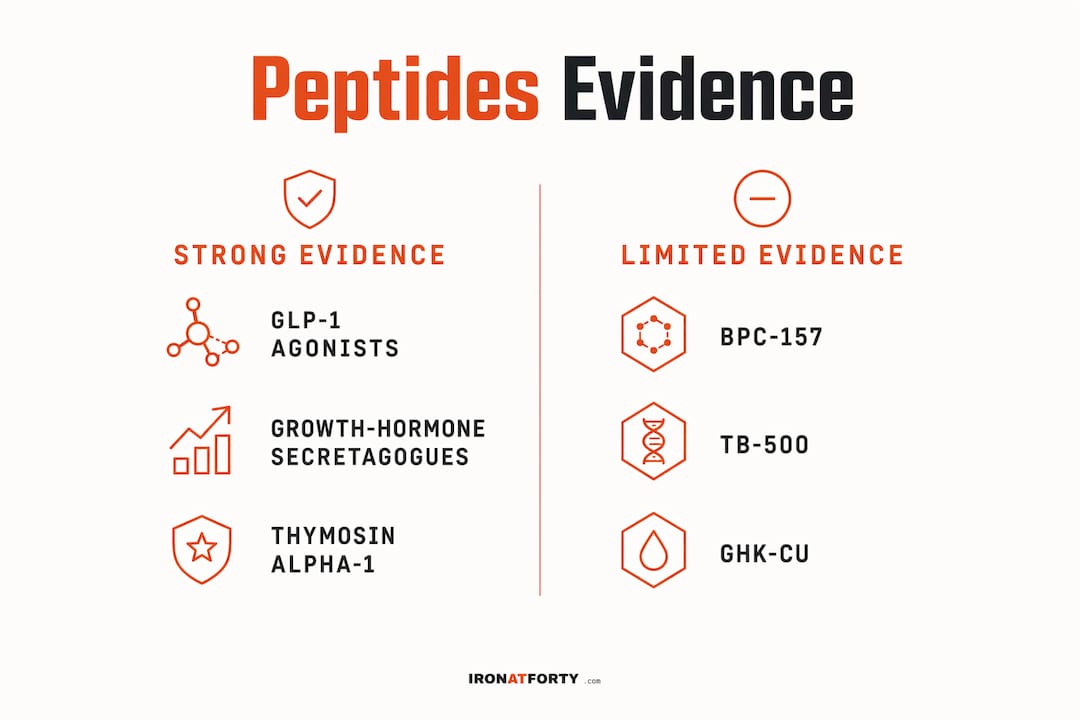
Only a handful of peptides have convincing human clinical evidence for meaningful health benefits. The rest, including most of what you see promoted on social media, are running on animal studies and anecdote. Here's the short version: GLP-1 agonists like semaglutide are FDA-approved with robust randomized controlled trial data for metabolic outcomes. Select growth-hormone secretagogues such as sermorelin have limited but real clinical use in supervised medical settings. Thymosin alpha-1 has numerous indexed human studies showing immune-modulation signals, though large-scale mortality trials have been inconclusive. BPC-157, TB-500, and GHK-Cu are widely hyped but lack the human RCT data to back longevity claims. If you're considering any injectable peptide, the immediate priorities are: consult a licensed clinician before starting, verify the product has a certificate of analysis from a domestic compounding pharmacy, and treat FDA-approved medications as the default before exploring off-label compounds.
The bottom line: Ask your doctor about FDA-approved options first. If you explore off-label peptides, bring the vial to your appointment, demand batch testing documentation, and get baseline labs before dose one. Skip the gray-market injectables entirely.
Table of Contents
- What are peptides and how might they affect aging?
- Which peptides have the strongest human evidence?
- Popular peptides with mainly animal or anecdotal evidence
- What are the real risks and how does U.S. regulation actually work?
- Who should actually consider peptide therapy?
- How do you evaluate a peptide protocol and start safely?
- Thymosin alpha-1: what the human literature actually shows
- Key Takeaways
- The honest take on peptides for lifters over 40
- Useful sources
- FAQ
What are peptides and how might they affect aging?
Peptides are short chains of amino acids of varying lengths, that act as signaling molecules in the body. They are not exotic. Insulin is a peptide. So is glucagon. The difference between a peptide and a protein is mostly size, and that size difference matters for how they interact with receptors and how they are absorbed, degraded, or delivered.
In a longevity context, the relevant mechanisms cluster around four pathways:
- Metabolic regulation: GLP-1 (glucagon-like peptide-1) slows gastric emptying, suppresses appetite, and improves insulin sensitivity. Semaglutide mimics this endogenous peptide at the GLP-1 receptor, producing measurable changes in body weight and cardiometabolic markers.
- Immune modulation: Thymosin alpha-1 is a naturally occurring thymic peptide that influences T-cell maturation and cytokine signaling. It's been studied in the context of infections, cancer adjuvant therapy, and immune senescence.
- Growth hormone axis: Secretagogues like sermorelin and ipamorelin stimulate the pituitary to release growth hormone rather than replacing it directly. The downstream target is IGF-1, which affects muscle protein synthesis, fat metabolism, and tissue repair.
- Tissue repair signaling: Peptides like BPC-157 and GHK-Cu are claimed to activate wound-healing and anti-inflammatory pathways, though the evidence for these effects in humans is thin.
Oral and topical formulations like collagen peptides and creatine have distinct regulatory and evidence profiles compared to injectable research peptides. Collagen peptides survive digestion poorly in their intact form, which is why the mechanism debate around them is ongoing. Injectable peptides bypass that problem but introduce contamination and infection risks that oral supplements don't carry.
Which peptides have the strongest human evidence?
This is where the field separates into two very different categories. A few peptides have gone through the rigorous trial process. Most have not.
GLP-1 agonists: the gold standard example
Semaglutide (Ozempic, Wegovy) is the clearest example of a peptide-derived drug with solid human evidence. FDA-approved GLP-1 medications have clear prescribing guidelines, established dosing protocols, and RCT data from large trials covering weight loss, glycemic control, and cardiovascular outcomes. The SELECT trial showed that semaglutide reduced major cardiovascular events in non-diabetic adults with obesity, which is a meaningful longevity-adjacent outcome. These drugs are not "wellness peptides." They are regulated pharmaceuticals with known side effect profiles and monitoring requirements.
The longevity extrapolation from GLP-1 data is reasonable but not proven. Reducing visceral fat, improving insulin sensitivity, and lowering cardiovascular risk are all associated with longer healthspan. Whether semaglutide extends lifespan in otherwise healthy adults is not established by current data.
Evidence reality check: GLP-1 agonists are the only peptide class where the human evidence is strong enough that a physician can prescribe them with confidence for a specific indication. Everything else in this space is operating at a lower evidence tier.
Growth-hormone secretagogues: limited but real clinical use
Sermorelin and ipamorelin-class peptides stimulate endogenous GH release rather than replacing it. Sermorelin has FDA approval history for pediatric GH deficiency, and some clinicians use it off-label in adults with documented GH deficiency or age-related decline. The evidence base here is smaller than GLP-1s. Small RCTs and observational studies show modest improvements in body composition and sleep quality in GH-deficient adults, but the data does not cleanly translate to healthy adults seeking longevity benefits. Off-label use in people without diagnosed deficiency is extrapolation, not evidence-based medicine.
Thymosin alpha-1: the most studied "wellness" peptide
With numerous indexed human studies, thymosin alpha-1 has more human data than most trending peptides. Trials have examined it in hepatitis B and C, cancer adjuvant settings, and sepsis. Meta-analyses suggest potential immune-modulation benefits in specific subsets, particularly older adults with immune senescence. Large sepsis trials, however, have been inconclusive for mortality reduction. The honest read: thymosin alpha-1 has a plausible mechanism and real human signal in immune contexts. Broad longevity claims go beyond what the trial data supports.
| Peptide | Evidence level | Primary outcome studied | Regulatory status |
|---|---|---|---|
| Semaglutide (GLP-1) | Large RCTs | Weight, metabolic, cardiovascular | FDA-approved |
| Sermorelin | Small RCTs / observational | GH deficiency, body composition | FDA history (pediatric); off-label adult use |
| Thymosin alpha-1 | over 45 indexed human studies, mixed RCTs | Immune modulation, infection | Not FDA-approved in U.S. |
| BPC-157 | Preclinical / case reports | Tissue repair, GI healing | Not approved; research compound |
| GHK-Cu | Preclinical / in vitro | Skin, wound healing | Topical cosmetic use only |
Popular peptides with mainly animal or anecdotal evidence
BPC-157, TB-500, and GHK-Cu dominate wellness social media. They also share a common problem: the human evidence is either absent or too thin to support the claims being made.
BPC-157 (Body Protection Compound-157) is a synthetic peptide derived from a protein found in gastric juice. Animal studies show impressive effects on tissue repair, gut healing, and even neurological recovery. The PMC literature on BPC-157 documents pleiotropic effects across multiple pathways in rodent models. What's missing is the human RCT. Small trials in ulcerative colitis exist, but they don't establish the broad anti-aging or performance effects marketed online. Generalizing rodent wound-healing data to human longevity is a leap the evidence doesn't support.

TB-500 (a synthetic fragment of thymosin beta-4) follows the same pattern. Animal data on tissue repair and cardiac recovery is interesting. Human data is essentially case reports and anecdote.
GHK-Cu (copper peptide) has in vitro and animal data suggesting effects on collagen synthesis, wound healing, and gene expression. Topical formulations are used in cosmetics. Injectable GHK-Cu for systemic anti-aging is a different claim entirely, and no human RCT supports it.
- Spotting overclaiming: A vendor cites animal studies as if they are human RCTs. Vague biomarker claims ("improves cellular health") with no clinical endpoints. Before-and-after photos as evidence. No certificate of analysis or batch number on the product.
- The stacking problem: Combining multiple experimental peptides multiplies unknown interaction risks. Immune responses, endocrine interference, and unpredictable pharmacokinetics are all real concerns when you layer compounds that have never been studied together in humans.
For a deeper look at the BPC-157 and TB-500 evidence specifically, Ironatforty's BPC-157 and TB-500 research breakdown covers the trial landscape in detail.
Pro Tip: Before you buy any injectable peptide, search PubMed for the compound name plus "randomized controlled trial" and "humans." If the results are thin or absent, the marketing is running ahead of the science.
What are the real risks and how does U.S. regulation actually work?
The safety picture for gray-market peptides is genuinely concerning, and the regulatory situation is in flux.
FDA scientists have repeatedly found limited human safety and effectiveness data for the peptides under review, with chemical variability flagged as an additional concern. Public demand is outpacing the evidence base by a wide margin.
The main safety risks with unregulated injectable peptides:
- Contamination: Products manufactured overseas without standard quality control can contain bacterial endotoxins, heavy metals, or incorrect concentrations.
- Immune and autoimmune responses: Synthetic peptides influence complex inflammatory and immune pathways. Unsupervised use risks triggering responses that are difficult to attribute and harder to reverse.
- Endocrine disruption: GH-axis peptides can suppress natural hormone production if used incorrectly or at high doses.
- Injection-site infection: Any injectable carries infection risk, and gray-market products with no sterility guarantee amplify it significantly.
- Lab test interference: Some peptides can alter IGF-1, thyroid markers, or inflammatory markers, making it harder to interpret routine bloodwork.
The "for research use only" label on many online peptide vials is a legal workaround, not a safety certification. It allows vendors to sell compounds without meeting FDA manufacturing standards. Harvard Health documents this clearly: many injectable peptides sold online lack FDA oversight, and human evidence for their benefits is sparse.
On the regulatory front, an An FDA advisory committee recently voted narrowly to recommend easing restrictions on certain compounded peptides, including BPC-157 and TB-500. That vote is non-binding. FDA staff warned of insufficient human safety data, and the agency is not required to follow advisory committee recommendations. Regulatory status for these compounds remains unsettled.
Sourcing red flags to avoid:
- "For research use only" labeling with no clinical-grade alternative
- No batch testing or certificate of analysis (COA) available
- Overseas compounding with no traceable lot number
- Unusually low price compared to domestic compounding pharmacies
- Influencer endorsements with no clinical citations
The AMA advises patients to discuss any injectable peptide with a physician before use. Cedars-Sinai physicians go further, recommending that patients bring the actual vial to clinical appointments so clinicians can inspect labeling and sourcing information.
Who should actually consider peptide therapy?
Not everyone. And for most people over 40 who lift, the foundational work comes first.
Reasonable candidates for supervised peptide exploration:
- Adults with a physician-confirmed GH deficiency or documented immune dysfunction who have exhausted standard-of-care options
- Patients already on FDA-approved GLP-1 medications for metabolic indications
- Individuals enrolled in monitored clinical trials or structured n-of-1 protocols with baseline and follow-up labs
- People with diagnosed deficiencies where a specific peptide has indexed human evidence
Who should avoid experimental peptides:
- Pregnant or nursing individuals (no safety data exists)
- Anyone with active cancer or a history of hormone-sensitive malignancy
- People with uncontrolled thyroid, adrenal, or other endocrine conditions
- Anyone on multiple medications without clinician oversight of potential interactions
- Individuals sourcing from gray-market vendors without COA documentation
For aging athletes and lifters over 40, the calculus is straightforward. Strength training, adequate protein intake, quality sleep, and managing recovery are the interventions with the strongest longevity evidence. Peptides, at best, are adjuncts. They are not a substitute for the core longevity practices that actually move the needle for most people. Clinicians typically assess candidate suitability by reviewing medical history, current medications, and baseline labs before recommending any peptide protocol.
Women considering peptides face additional sex-specific considerations around hormonal interactions. The 2026 evidence-based guide on peptides for women covers differential effects and candidate suitability in more detail.

How do you evaluate a peptide protocol and start safely?
If you've done the foundational work and still want to explore peptides under clinical supervision, here's how to do it without cutting corners.
Questions to ask any prescribing clinic:
- What is the origin and compounding pharmacy for this product?
- Can I see the certificate of analysis and batch number?
- What is the specific clinical indication, and what does the human evidence show?
- What side effects should I monitor for, and at what point do we stop?
- What is the expected timeline to see a measurable signal?
Baseline lab checklist before starting any peptide protocol:
| Lab test | Why it matters |
|---|---|
| CBC (complete blood count) | Baseline immune and hematologic status |
| CMP (comprehensive metabolic panel) | Kidney, liver, and electrolyte baseline |
| Fasting glucose and HbA1c | Metabolic baseline, especially for GLP-1 or GH-axis peptides |
| Thyroid panel (TSH, free T3/T4) | Endocrine baseline; some peptides affect thyroid markers |
| Sex hormones (testosterone, estradiol, LH, FSH) | Relevant for GH secretagogues and endocrine interactions |
| IGF-1 | Mandatory if using any GH-related peptide |
| CRP or hs-CRP | Inflammatory baseline for immune-modulating peptides |
Recheck these labs at 8–12 weeks into any protocol. Unexplained changes in IGF-1, thyroid markers, or inflammatory markers are a signal to pause and reassess with your clinician.
Cost and timeline reality: Clinic consultations for peptide protocols typically run $150–$400 for an initial visit. Compounded peptide vials from domestic pharmacies vary widely by compound and dose. Expect months, not weeks, before persistent changes in body composition or immune markers are measurable. Anyone promising dramatic results in 2–4 weeks is selling you something.
Stop the protocol immediately if: labs show unexplained changes outside reference ranges, you experience severe injection-site reactions, the supply chain becomes untraceable, or your clinician cannot explain the rationale for continuing.
Pro Tip: Use Ironatforty's TDEE Calculator to nail your caloric baseline before adding any metabolic-targeting peptide. Knowing your energy needs precisely makes it far easier to attribute changes to the intervention rather than diet drift.
For a broader look at recovery peptide evidence, the 2026 peptide recovery guide provides additional context on small human trials in recovery and pain contexts.
Thymosin alpha-1: what the human literature actually shows
Thymosin alpha-1 deserves its own section because it has more indexed human data than any other "wellness" peptide, and that data is worth reading carefully rather than dismissing or overstating.
The human evidence base spans 45+ studies across hepatitis B, hepatitis C, cancer adjuvant therapy, sepsis, and immune senescence in older adults. Meta-analyses suggest immune-modulation benefits in specific subsets. The sepsis trials, which are the largest and most rigorous, have been inconclusive for mortality reduction. That's a meaningful limitation.
| Trial context | Outcome signal | Sample size | Quality |
|---|---|---|---|
| Hepatitis B adjuvant | Improved viral clearance rates | Moderate (multiple trials) | RCT |
| Hepatitis C combination | Modest immune response enhancement | Small–moderate | RCT / observational |
| Cancer adjuvant (various) | Immune marker improvement; survival data mixed | Variable | RCT / case series |
| Sepsis (large trials) | No significant mortality benefit | Large | RCT |
| Immune senescence (older adults) | T-cell function signals | Small | Observational |
What the evidence actually supports: thymosin alpha-1 modulates T-cell function and cytokine signaling in specific populations, particularly those with impaired immune function. What it does not support: broad longevity claims, lifespan extension, or routine use in healthy adults without immune dysfunction.
For a clinician structuring an n-of-1 monitoring plan, the relevant endpoints are CD4/CD8 ratios, NK cell activity, and inflammatory markers (CRP, IL-6) at baseline and 12 weeks. IGF-1 is not a primary endpoint here since thymosin alpha-1 does not directly target the GH axis. Document any infections or illness frequency over the monitoring period as a practical functional endpoint.
Key Takeaways
Only a few peptides have solid human clinical evidence; most popular injectables are unregulated research compounds with animal-only data, and clinical supervision is non-negotiable before starting any protocol.
| Point | Details |
|---|---|
| GLP-1s lead on evidence | Semaglutide and related FDA-approved agents have large RCT data for metabolic and cardiovascular outcomes. |
| Thymosin alpha-1 has real human data | over 45 indexed human studies show immune-modulation signals, but large sepsis trials found no mortality benefit. |
| BPC-157, TB-500, GHK-Cu lack human RCTs | Animal data is interesting; generalizing it to human longevity is premature and potentially risky. |
| Gray-market sourcing is a hard no | "For research use only" labels bypass FDA manufacturing standards; demand a COA and domestic compounding source. |
| Foundational practices come first | Strength training, protein intake, and sleep have stronger longevity evidence than any experimental peptide. |
The honest take on peptides for lifters over 40
Here's where Ironatforty lands after going through the evidence: the peptide space is not a scam, but it is badly polluted by overclaiming. The gap between what the animal studies show and what vendors promise is enormous, and most people buying gray-market injectables are running an uncontrolled experiment on themselves with no baseline data and no monitoring plan.
For adults over 40 who train seriously, the four pillars of longevity — training, nutrition, sleep, and recovery — are where the evidence is strongest and the risk is lowest. Peptides, at best, are a layer on top of that foundation, not a replacement for it. GLP-1 medications are a legitimate tool for people with metabolic disease. Thymosin alpha-1 may have a role in specific immune contexts under physician supervision. Everything else in the wellness peptide market deserves serious skepticism until the human RCT data catches up to the hype.
If you're curious about where to start, talk to a clinician, get your baseline labs, and read the evidence yourself. Ironatforty's nutrition hub and free training tools are a better first investment than a gray-market vial.

Useful sources
- Thymosin alpha-1: human studies and immunomodulatory evidence (PMC) — Primary indexed literature on thymosin alpha-1 human trials, including meta-analysis data and trial summaries.
- Peptides: benefits, safety, and what the evidence shows (Harvard Health) — Covers the gray-market labeling problem, evidence gaps, and Dr. Pieter Cohen's assessment of online peptide claims.
- What doctors want patients to know about injectable peptides (AMA) — AMA guidance on clinician involvement, GLP-1 prescribing standards, and the lack of frameworks for wellness peptides.
- Are peptides an anti-aging wonder drug or a scam? (Cedars-Sinai) — Clinical expert perspective on contamination risk, unknown long-term harms, and the "bring the vial" practice.
- FDA advisers vote to ease peptide compounding restrictions (NPR) — Covers the July 2026 advisory committee vote (8–6) and FDA staff warnings about insufficient human safety data.
- BPC-157 cytoprotection and organoprotection: PMC review — Detailed preclinical literature on BPC-157 mechanisms; useful for understanding what the animal data actually shows and what it doesn't.
FAQ
What peptides have the strongest evidence for longevity?
GLP-1 agonists like semaglutide have the strongest human RCT evidence, with FDA approval for metabolic and cardiovascular outcomes. Thymosin alpha-1 has numerous indexed human studies showing immune-modulation signals, though large trials have not confirmed mortality benefits.
Are peptides really worth the hype for anti-aging?
For most popular wellness peptides, no. Harvard Health and the AMA both note that human evidence is sparse for most injectable peptides sold online, and many lack FDA oversight entirely.
What is GHK-Cu and does it work?
GHK-Cu is a copper peptide with in vitro and animal data suggesting effects on collagen synthesis and wound healing. There are no human RCTs supporting injectable GHK-Cu for systemic anti-aging; topical cosmetic use is the only application with any practical evidence base.
How do I know if a peptide source is safe?
Look for a certificate of analysis with a traceable batch number from a domestic compounding pharmacy. Avoid any product labeled "for research use only," sourced overseas without lot information, or priced significantly below domestic compounding rates. Bring the vial to your clinician for inspection before use.
Should people over 40 try peptide therapy?
Only under physician supervision and after optimizing foundational practices like strength training, protein intake, and sleep. FDA-approved options like GLP-1 medications are the defensible starting point for those with metabolic indications; experimental compounds require baseline labs, monitoring, and a clear clinical rationale.