If your back barks at conventional deadlifts or your hips just won't hinge the way they used to, the trap bar deadlift, Romanian deadlift, hip thrust, kettlebell swing, and single-leg RDL cover almost every gap. The trap bar is your spine-friendly pick, the RDL builds hamstrings, the hip thrust maxes out glute activation, the kettlebell swing trains hip power without heavy loading, and the single-leg RDL fixes the side-to-side strength gaps that show up after 40. The evidence, technique cues, and week-by-week programming below explain exactly why and how.
TL;DR:
- The trap bar deadlift reduces lumbar stress and is excellent for heavy lifting, especially for those with back issues, when modified with high handles.
- Romanian deadlifts and hip thrusts target hamstrings and glutes respectively, with hip thrusts providing significant glute activation and less spinal shear.
- Kettlebell swings and single-leg RDLs offer bodyweight or unilateral options for hip power, balance, and addressing strength gaps in older adults.
- Combining different alternatives like hip thrusts with hinge exercises offers a more comprehensive posterior chain workout than relying on a single lift.
- Proper form cues and gradual programming are essential for safety and effectiveness, especially for those with mobility limitations or recovering from injury.
Table of Contents
- What Are the Best Deadlift Alternatives?
- How Do These Alternatives Differ in Muscle Activation and Spinal Load?
- When Should You Avoid Conventional Deadlifts?
- How Should You Program Deadlift Alternatives for Strength and Size?
- How Do You Perform Each Alternative With Good Form?
- The Ironatforty Take: Fit These Alternatives to Your Body, Not the Other Way Around
- Key Studies and Resources Cited in This Article
- Editorial Take: Stop Treating the Deadlift as Mandatory
- Sources
- FAQ
What Are the Best Deadlift Alternatives?
Deadlift alternatives aren't a downgrade. They're a toolkit, and most lifters over 40 end up using several of them at once instead of hunting for one perfect replacement.
Here's the shortlist, ranked by how often this site recommends them to readers dealing with back pain, tight hips, or just wanting more bang for less spinal wear:
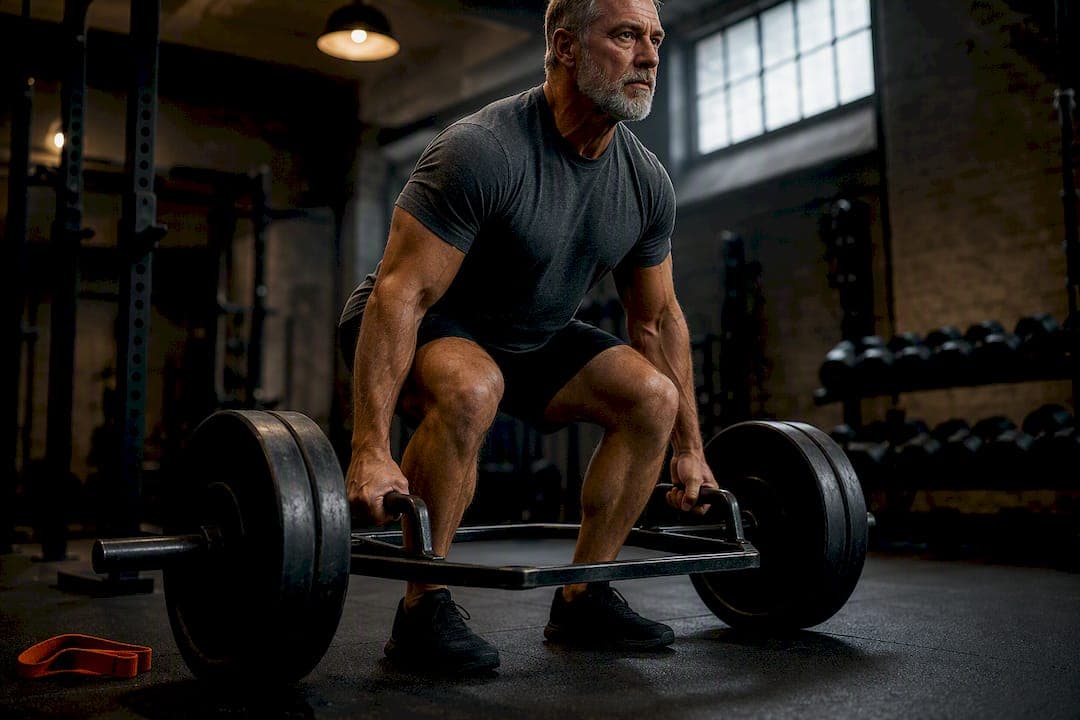
- Trap bar deadlift. Trains the same hip and knee extension pattern as a conventional deadlift but with the load centered around your body instead of in front of it. Best for lifters with a history of lower back tightness who still want a heavy pull. Modification: start with the high-handle position to reduce hip flexion demand.
- Romanian deadlift (RDL). A hip hinge that keeps tension on the hamstrings and glutes through a longer range of motion, with knees only slightly bent. Best for anyone chasing hamstring size and strength specifically. Modification: use dumbbells instead of a barbell if grip or wrist mobility is an issue.
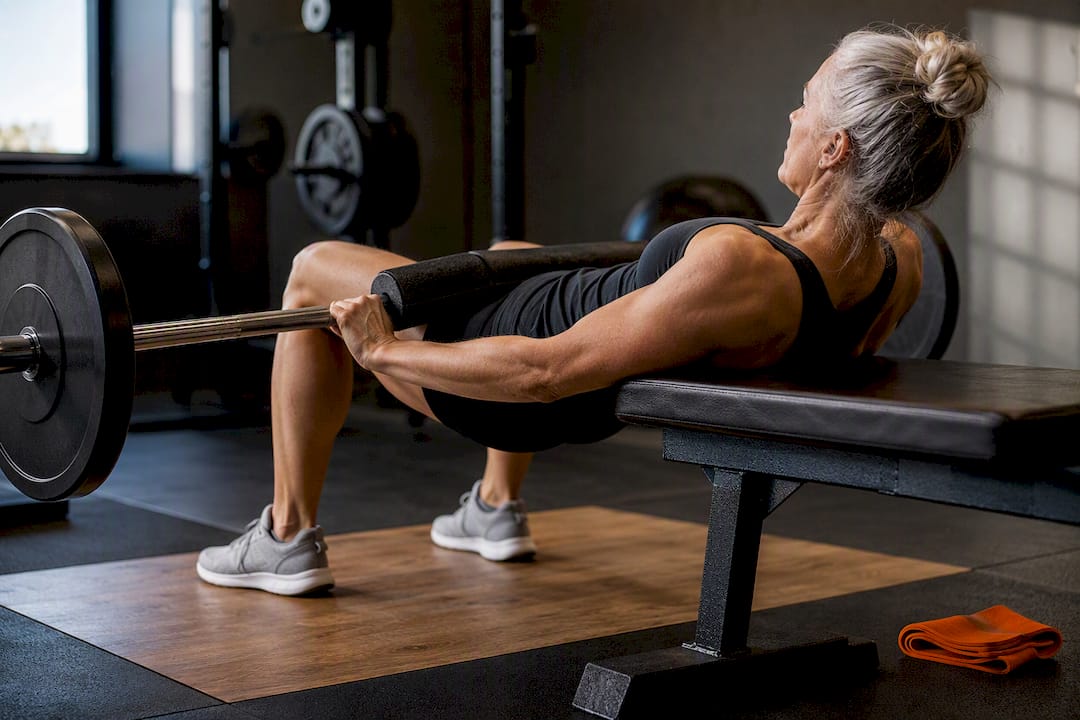
- Barbell or banded hip thrust. Isolates hip extension with your torso supported on a bench, which removes almost all lumbar shear force. Best for lifters managing disc issues or general low back sensitivity. Modification: banded hip thrusts on the floor work fine at home with zero equipment beyond a resistance band.
- Kettlebell swing. A ballistic hip hinge that trains power output and cardiovascular capacity in the same movement. Best for home lifters without a rack, or anyone wanting a conditioning element added to posterior chain work. Modification: reduce the range of motion (a "dead stop" swing) if you're new to the pattern.
- Single-leg RDL. Trains the hip hinge unilaterally, which exposes and fixes strength imbalances that bilateral lifts can hide for years. Best for lifters who feel one side working harder than the other during squats or deadlifts. Modification: hold a wall or rack for balance until control improves.
- Leg press or hack press. Trains quad and glute strength through a fixed path with your spine supported by the pad. Best for lifters with acute back pain who still need lower-body loading. Modification: adjust foot placement higher on the platform to bias glutes and hamstrings over quads.
- Glute-ham raise. A closed-chain hamstring exercise that trains the muscle through knee flexion rather than hip extension, which most hinge exercises miss. Best for lifters who want hamstring development the RDL alone doesn't fully deliver. Modification: use a stability ball or bench with a partner holding your ankles if a GHR machine isn't available.
- Cable pull-through. A hip hinge with the resistance directed from behind rather than straight down, which changes the loading curve. Best for lifters wanting hip hinge practice with lighter, more forgiving loading. Modification: start with a light band anchored low if no cable station is available.
Bodyweight-friendly options here are the kettlebell swing, banded hip thrust, and cable pull-through (with a band). Everything else benefits from at least a barbell, dumbbells, or a machine.
How Do These Alternatives Differ in Muscle Activation and Spinal Load?
The differences aren't cosmetic.
A widely cited comparison of barbell deadlift, hex-bar deadlift, and hip thrust found that hip thrusts produce noticeably higher gluteus maximus activation, particularly at the top of the movement, while the barbell deadlift produces higher biceps femoris (hamstring) activation. Neither exercise wins outright. They're complementary, not interchangeable, which is why programming both often beats trying to find one lift that does everything.
Muscle activation callout: Hip thrusts bias the glutes; deadlifts bias the hamstrings. If your goal is pure glute hypertrophy, the hip thrust wins. If you need hamstring strength for sprinting or knee protection, the deadlift pattern (or RDL) still has an edge.
Mechanics matter just as much as muscle group. Research on three straight-legged hinge-pattern exercises found that swapping a gravity-directed hinge like the RDL for a pulley-redirected version like the cable pull-through meaningfully reduces activation in both the lumbar extensors and the hamstrings. Open-chain reverse hyperextensions, by contrast, actually increase glute and hamstring recruitment compared with some closed-chain lifts. The takeaway: the exact angle the resistance pulls from changes which muscles do the work, not just how heavy the weight feels.
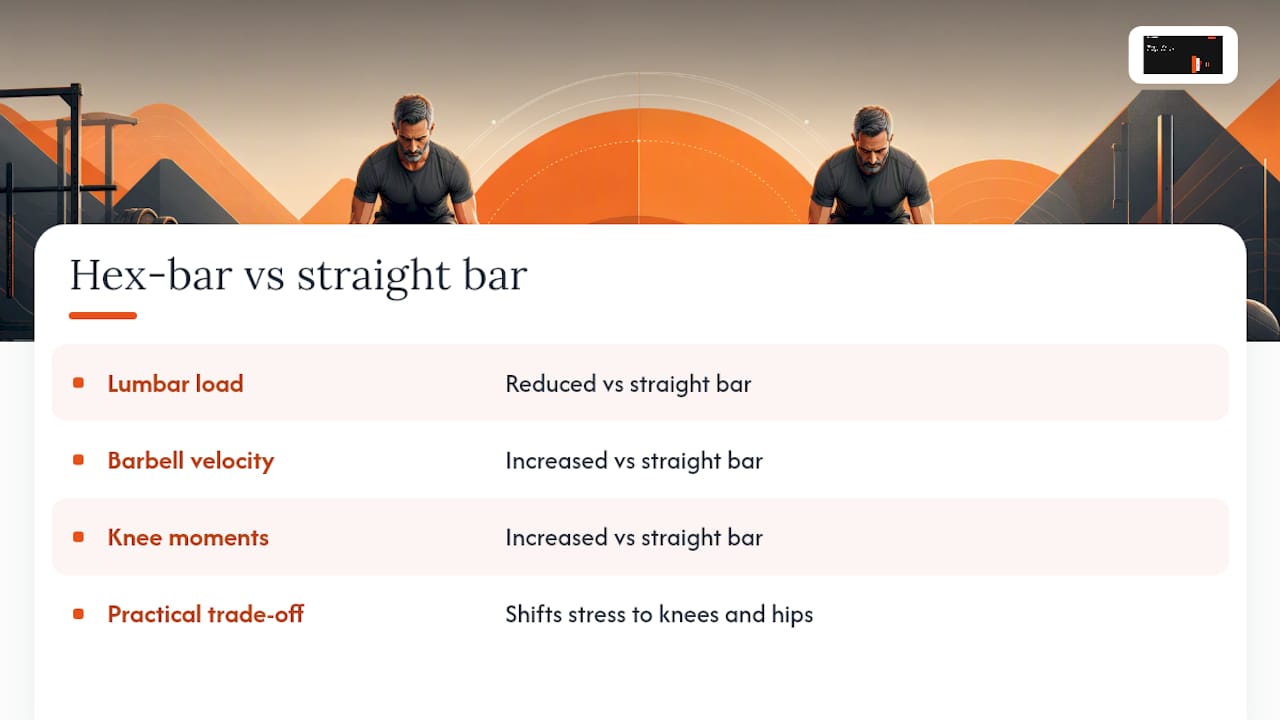
Then there's the trap bar, which changes the physics entirely. A biomechanical comparison of conventional, sumo, and hex-bar deadlifts in resistance-trained women found that the hex bar reduces peak lumbar joint moments while increasing barbell velocity and knee joint moments relative to a straight bar. In plain terms, the trap bar shifts stress away from your lower back and toward your knees and hips, which is exactly the trade-off most lifters over 40 want. A separate biomechanical analysis using submaximal loads backs this up, showing the same velocity and knee-moment increases with hex-bar pulls.
None of this means the deadlift is dangerous. It means the exercises aren't clones of each other, and choosing the right one depends on whether your priority is hamstring size, glute development, spinal load, or raw power output. Combining a hip-dominant movement (hip thrust) with a hinge movement (RDL or trap bar deadlift) is a more reliable strategy than betting everything on one lift, a point echoed by research on strength transfer between exercises, which found that neuromuscular coordination and movement specificity, not hypertrophy alone, drive how well strength carries over between lifts.
When Should You Avoid Conventional Deadlifts?
Not everyone needs to avoid the barbell deadlift. But certain red flags mean it's smarter to build strength elsewhere first, then reintroduce it later if you want to.
Run through this checklist honestly:
- Pain with spinal flexion or extension. If bending forward to tie your shoes already bothers your back, loading that same position with 200 pounds is a bad idea until it's addressed.
- Limited hip or ankle mobility. If you can't sit into a hip hinge without your lower back rounding, the deadlift setup position itself is the problem, not your strength.
- Grip or forearm fatigue that breaks form early. If your grip fails before your legs and hips do, you're compensating with your back to finish the rep.
- Your goal is hypertrophy, not a 1RM number. If you're training for muscle size and function rather than a competition total, hip thrusts and RDLs can get you there with less risk.
- Limited equipment access. A kettlebell swing or banded hip thrust at home beats skipping posterior chain work entirely because you don't own a barbell.
The trade-offs matter here. Hip thrusts dramatically reduce spinal shear force because your torso is supported, but they don't load the hamstrings nearly as hard as an RDL does. If you swap every hinge movement for hip thrusts, you'll build glutes but leave hamstring strength on the table. That's fine if hamstrings aren't your priority. It's a problem if you're trying to protect your knees, since hamstring strength plays a real role in that.
Research on functional resistance training in older women found that closed-chain functional exercises, deadlift patterns included, improved both strength and functional performance meaningfully. That's a reminder that the goal usually isn't permanent avoidance. It's finding a version your body tolerates today, then working back toward heavier hinge patterns as mobility and confidence improve.
Pro Tip: *If you've been away from conventional deadlifts for months, don't jump back in at your old working weight.
If you have a diagnosed back condition, a hernia, or you're recovering from surgery, talk to your doctor or a physical therapist before adding any heavy hinge pattern back into your training, and never stop or change a prescribed treatment plan based on an article. Ironatforty's piece on why deadlift form changes with age covers the specific mobility shifts worth addressing first.
How Should You Program Deadlift Alternatives for Strength and Size?
Programming for lifters 40+ isn't about doing less. It's about being deliberate with the volume you have time and joints to recover from.
For strength, keep reps low and intensity high. Two to four sets of three to six reps on your primary hinge movement (trap bar deadlift or hip thrust) twice a week is a solid baseline. A narrative review on heavy strength training in older adults found that training at 80% or more of 1RM can be both safe and effective for older lifters when it's programmed and supervised carefully, and that lower-volume heavy training can still produce large strength gains. You don't need 20 weekly sets to get stronger. You need consistent, well-recovered heavy sets.
For hypertrophy, moderate reps in the 8 to 15 range across your posterior chain exercises work well, aiming for roughly a dozen total weekly sets across your lower body hinge and hip-dominant movements, a volume the same review found feasible for older adults without excessive fatigue accumulation.
Here's a simple weekly framework:
- Session one: Trap bar deadlift, 3 sets of 5 reps, heavy. Follow with single-leg RDL, 2 sets of 8 per side.
- Session two: Hip thrust, 3 sets of 10 reps. Follow with kettlebell swings, 3 sets of 15 reps for power and conditioning.
- Optional session three: Glute-ham raise or cable pull-through, 2 to 3 sets of 10 to 12 reps, lighter and technique-focused.
Progress by adding reps before adding weight. Once you hit the top of your rep range with clean form across all sets, add 5 to 10 pounds and drop back to the bottom of the range. If a session feels unusually hard, use rate of perceived exertion (RPE) as your guide and cut a set rather than grinding through it. Cluster sets (short 15 to 20 second breaks within a set) or redistributing rest can help manage fatigue on heavier days without sacrificing total volume.
Two lower-body sessions a week is a reasonable baseline for most lifters over 40. Soreness lasting more than 72 hours, or joint pain that doesn't ease with a warmup, both signal you need to back off volume or intensity before the next session, not push through it. Ironatforty's guide to training programs for adults over 40 breaks down full weekly splits if you want a more complete template.
How Do You Perform Each Alternative With Good Form?
Cues matter more than reps here. Bad form on any of these exercises just relocates the risk somewhere else, usually your lower back.
Trap bar deadlift. Stand inside the hex frame with the bar aligned to mid-foot. Cues: chest up, push the floor away with your legs, keep the bar close to your shins the entire pull. Common fault: letting hips rise faster than the chest, turning the pull into a stiff-legged mess. Regression: elevate the bar on blocks to shorten the range. Progression: add a pause at knee height to build starting strength.
Romanian deadlift. Start standing tall with a slight knee bend that stays fixed. Cues: push hips back like closing a car door with your rear, keep the bar tracking against your thighs, stop the descent when you feel a hamstring stretch, not when your back rounds. Common fault: bending the knees more as the set gets harder, which turns it into a squat. Regression: use dumbbells and reduce range of motion. Progression: add a two-second pause at the bottom.
Barbell hip thrust. Upper back braced on a bench, bar over your hips, feet flat and shoulder-width. Cues: drive through your heels, squeeze glutes hard at the top, avoid overextending your lower back at peak height. Common fault: pushing through the toes instead of the heels, which shifts work to the quads. Regression: banded hip thrust on the floor. Progression: single-leg hip thrust for unilateral strength.
Kettlebell swing. Hinge to load the hips, then snap them forward to project the bell to chest height. Cues: power comes from hip snap, not shoulder muscles, keep your spine neutral throughout, let the bell float rather than muscling it up. Common fault: squatting the movement instead of hinging. Regression: shorten the arc with a dead-stop swing. Progression: increase bell weight before adding reps.
Single-leg RDL. Stand on one leg, hinge forward while the free leg extends back for counterbalance. Cues: keep hips square to the floor, load through the standing heel, hold light weight in the opposite hand for balance. Common fault: rotating the hips open as balance falters. Regression: hold a wall or rack. Progression: add a dumbbell in each hand. Ironatforty's breakdown of unilateral training benefits for lifters over 40 covers why this pattern matters more as you age.
Leg press. Feet shoulder-width on the platform, lower back flat against the pad. Cues: control the descent, stop before your lower back rounds off the pad, drive evenly through both feet. Common fault: letting the knees cave inward under heavy load. Regression: reduce range of motion by not lowering as deep. Progression: try a single-leg press. For readers deciding between machine work and free weights generally, this breakdown of what actually differs between the two is worth a look before you commit to one over the other.
Glute-ham raise. Anchor your ankles, start with your body straight and knees bent slightly. Cues: control the lowering phase, use your hamstrings to pull yourself back up, don't let your hips sag. Common fault: using momentum instead of hamstring strength to reverse direction. Regression: use a resistance band for assistance. Progression: hold a weight plate across your chest.
The Ironatforty Take: Fit These Alternatives to Your Body, Not the Other Way Around
Ironatforty's position is simple: matching the exercise to your joints matters more than chasing whatever movement looks impressive on someone else's feed. Form changes with age for real biomechanical reasons, not because you've gotten weak, and picking a trap bar over a straight bar isn't a concession. It's often the smarter tool for the job.
- Unilateral work like the single-leg RDL isn't a novelty add-on. It's often the fastest way to find and fix the strength gaps that cause pain elsewhere.
- Low-volume, higher-intensity training (per the older-adult strength review referenced above) fits real recovery capacity better than the high-volume programs built for 25-year-olds.
- These alternatives work best blended, not chosen in isolation. A trap bar day and a hip thrust day cover more ground than either alone.
If you're adjusting bodyweight or calorie intake alongside a new program, Ironatforty's TDEE calculator is worth running before you start.
Key Studies and Resources Cited in This Article
- EMG comparison of barbell deadlift, hex-bar deadlift, and hip thrust
- Muscle recruitment across straight-legged hinge exercises
- Biomechanical comparison of conventional, sumo, and hex-bar deadlifts
- Heavy strength training for older adults (narrative review)
- Hip thrust vs. squat training and transfer to deadlift strength
- Functional resistance training in older women
Ready to build this into an actual weekly plan instead of guessing? Ironatforty's free training and nutrition tools can help you set starting loads and calorie targets before your next session, and the training section has full program templates built around exactly this kind of low-spine-load approach.
Editorial Take: Stop Treating the Deadlift as Mandatory
The fitness industry has spent a decade treating the barbell deadlift as a loyalty test, as if skipping it means you're not serious about training. That framing doesn't hold up against the evidence. Hip thrusts build comparable glute size. Trap bars cut lumbar stress while letting you lift heavier. RDLs and glute-ham raises cover the hamstring work a deadlift provides, often with less risk to a cranky lower back.
What's overrated is the idea that one lift has to do everything. What's underrated is combining two or three complementary movements and programming them at an intensity your joints can actually recover from week after week. The research on older-adult strength training makes clear that heavy loading itself isn't the enemy. Reckless loading without matching the exercise to your current mobility and injury history is.
If you're 40 or older, prioritize the movement pattern that lets you train heavy and consistently, not the one with the most tradition behind it. Consistency beats nostalgia every time.
— Iron@40 Staff
Sources
- Electromyographic comparison of barbell deadlift, hex-bar deadlift, and hip thrust exercises
- A comparison of muscle recruitment across three straight-legged hinge-pattern resistance training exercises
- A biomechanical comparison between conventional, sumo, and hex-bar deadlifts among resistance trained women
- Heavy–very heavy strength training for older adults (narrative review)
- Hip thrust and back squat training elicit similar gluteus muscle hypertrophy and transfer similarly to the deadlift
FAQ
Is It Okay to Never Do Deadlifts?
Yes. Nothing about long-term strength or muscle requires the conventional barbell deadlift specifically. A combination of trap bar work, hip thrusts, and RDLs can build comparable posterior chain strength and size.
How Much Should a 200-Pound Man Be Able to Deadlift?
There's no single verified standard for this, and strength varies widely by training history, age, and body composition. Rather than chasing a number you found online, track your own progress against your prior best using a tool like Ironatforty's training tools.
Which Exercise Is Better Than the Deadlift?
None is universally "better," they train things differently. Hip thrusts produce higher gluteus maximus activation, while the barbell deadlift produces higher hamstring activation, so the right choice depends on your specific goal.
Can I Replace Deadlifts With RDLs?
Partially. RDLs train the hip hinge and hamstrings effectively, but they don't replicate the floor-to-lockout pull pattern or the grip and full-body bracing demands of a conventional deadlift. Pairing RDLs with a hip-dominant movement like the hip thrust covers more ground than RDLs alone.