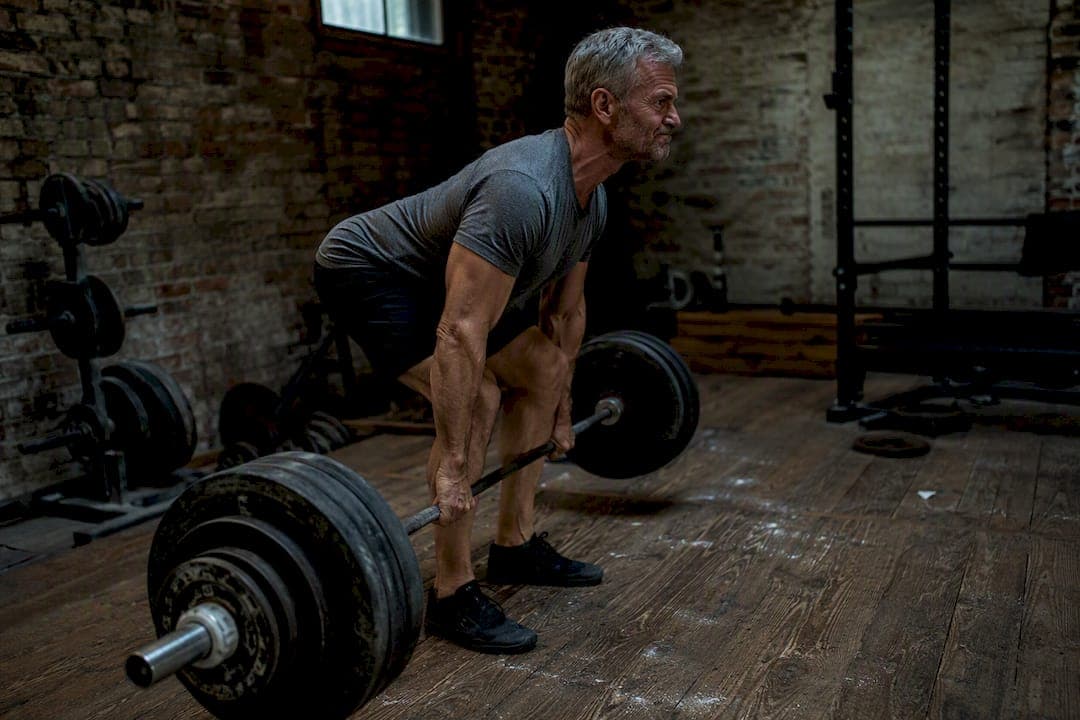
Deadlift form changes with age because spinal range of motion, muscle quality, and neuromuscular control all shift after 50, not because you've forgotten how to hinge. Your lumbar spine loses flexibility, your pelvis starts rotating more to compensate, your trunk muscles fire later and less efficiently, and you're carrying less contractile muscle than you did at 30. The practical rule: adjust technique and select safer variations instead of chasing the exact form you used at 35.
Here's what that looks like in practice:
- Do raise the bar off the floor with blocks or a trap bar if your hips feel locked into flexion.
- Do slow your tempo and brace before the bar leaves the floor, not after.
- Don't force a flat-back, deep-hinge pull if your hips and thoracic spine won't let you get there safely.
Ironatforty has covered enough lifters in their 50s and 60s to say this plainly: the goal isn't preserving your 2005 deadlift. It's building the strongest, safest version of the lift your body can do right now.
Key Takeaways
Deadlift form changes with age primarily because of reduced lumbar range of motion, compensatory pelvic rotation, slower neuromuscular reflexes, declining muscle quality, and the right response is adapted technique, not forced correction.
| Point | Details |
|---|---|
| Lumbar ROM declines after 50 | Reduced spinal flexibility drives compensatory pelvic rotation and altered setup position. |
| Watch for shear over compression | Greater pelvic rotation raises lower back shear force, a key risk factor to monitor. |
| Match variation to your assessment | Choose trap bar, sumo, or block pulls based on hip and thoracic mobility test results, not habit. |
| Brace before the pull, not during | Slower reflex response means bracing early reduces mismatch between load and stabilization. |
| Train moderate intensity, prioritize recovery | Aim for 60% of 1RM with consistent sleep, protein, and scheduled deloads. |
This article is general information, not a substitute for advice from a qualified doctor. Consult a qualified healthcare professional about your own circumstances before acting on anything here.
Table of Contents
- Why Deadlift Form Changes With Age: The Physiology Behind It
- What Older Lifters' Deadlift Form Actually Looks Like
- Adapted Form vs. a Warning Sign: How to Tell the Difference
- How to Adjust Your Deadlift Technique After 50
- Programming and Recovery: Training Smarter, Not Just Lighter
- Ironatforty's Take on Deadlifting After 50
- Sources
- FAQ
Why Deadlift Form Changes With Age: The Physiology Behind It
Your spine starts losing usable range of motion earlier than most lifters expect. Research on trunk flexion and extension shows lumbar range of motion begins declining around age 50, with older adults also showing less modulation of lumbar extensor muscle activity, meaning the muscles around your spine don't fine tune their firing the way they used to, according to research on age and gender related neuromuscular changes in trunk flexion extension. That's not a strength problem. It's a control and mobility problem, and it shows up the moment you try to set up over the bar.
As lumbar flexion shrinks, your body finds range somewhere else. That's usually the pelvis. Older lifters adopt larger pelvic rotation and smaller lumbar flexion during lifting tasks, which raises the peak shearing load placed on the lower back compared to younger lifters, per NIOSH research on age-related mechanical demands in manual material handling. Your center of gravity shifts forward and down as your hips take over work your spine used to handle.
The numbers behind the shift: Lumbar range of motion declines with age, and that decline, paired with weaker back extensors, changes how the whole lift is executed, according to research on maximum voluntary spinal motion in older adults.
Then there's the wiring. Age significantly affects trunk muscle activation during lifting, with older adults showing higher EMG amplitudes in several paraspinal muscles, meaning your back has to work harder just to stabilize the same load, according to research on age-related trunk activation and kinematics. Your reflexes are also slower to respond once the bar starts moving. That delay is why bracing early matters more now than it did a decade ago.
Add sarcopenia to the mix. Muscle mass and muscle quality decline with age, including increased intramuscular fat, which blunts both your ceiling for maximal strength and your ability to recover from heavy pulls, per research on age-related changes in muscle mass and quality. Put those four things together, reduced lumbar ROM, pelvic compensation, slower neuromuscular response, and lower muscle quality, and you get a deadlift that looks different by necessity, not by decline in effort.
What Older Lifters' Deadlift Form Actually Looks Like
You can usually spot the age-related pattern in about ten seconds of watching someone pull. Here's the checklist:
- Reduced lumbar flexion at setup. The lower back looks flatter and less rounded into position, because there's simply less range available.
- Greater pelvic rotation. The hips tip further back and up to make up for the spine's shortened arc.
- A more hip-dominant posture overall. The pull looks more like a stiff-legged hinge than a classic bent-knee deadlift.
- Slower trunk extension velocity. The lockout takes noticeably longer, and prolonged sitting during the day makes this worse. Older adults also take longer to complete a lift after seated work, showing reduced peak lumbar flexion and slower trunk movement, according to research on age, seated work, and lifting posture.
- Elevated starting position. Block pulls, mats, or a trap bar's raised handles become common tools rather than a sign of giving up range.
Mechanically, this matters. More pelvic rotation and less lumbar flexion increases shear force on the lower back even as it can reduce compressive load. Hip-dominant patterns shift more work onto the hamstrings and glutes, which is often a good trade for a spine that's lost flexibility. Slower trunk extension usually means lower peak force output at lockout, so don't be surprised if your top-end speed drops even when your working weight hasn't.
Run a quick self check with your phone camera. Film your setup and first three inches off the floor from the side. Watch for your hips shooting up faster than your chest, or your lower back rounding under load rather than staying neutral through pelvic tilt.
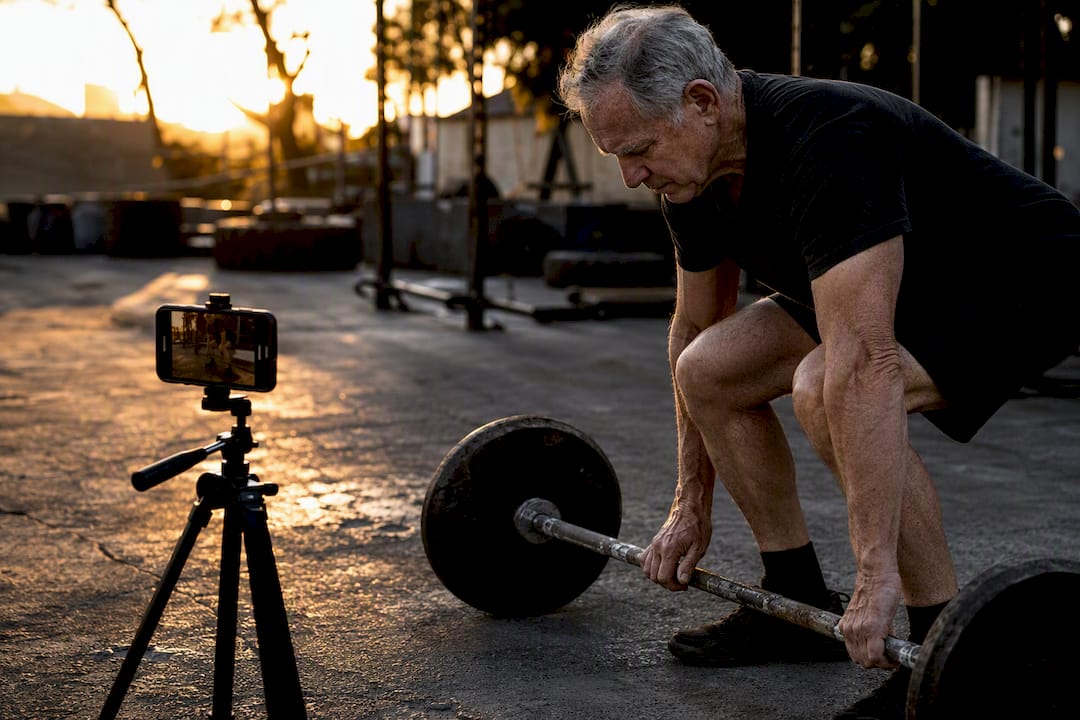
Pro Tip: Film your deadlift setup once a month, not once a year. Small drifts in pelvic position are far easier to correct early than after they've become your default pattern.
Adapted Form vs. a Warning Sign: How to Tell the Difference
Not every change in your pull is a problem. Some are smart adaptations. Others are your body telling you to back off and get checked out.
Signs your altered form is a managed, acceptable adaptation:
- You're using a controlled tempo and the bar path stays consistent rep to rep.
- Load is progressing slowly over weeks, not jumping in big leaps.
- You feel zero sharp pain, just normal muscular fatigue.
- Your setup position is stable and repeatable on video.
Signs you need a coach or clinician to look at your pull before you load it further:
- Sharp, localized spine pain during or right after the lift.
- Numbness, tingling, or weakness radiating into a leg.
- A sudden loss of bar control or your hips or knees buckling mid-pull.
- Pain that lingers for days rather than resolving within 24 to 48 hours.
The pelvic rotation pattern discussed above is worth watching closely, since it raises shear demand on the lower lumbar segments, per the NIOSH biomechanics data. Mild rotation with no symptoms is a normal age-related shift. Rotation paired with radiating leg pain or a pinching sensation at the base of the spine is a different story entirely, and that's a "see someone" situation, not a "push through it" situation.
How to Adjust Your Deadlift Technique After 50
Start with an honest assessment before you touch a barbell. Test your hip hinge with just your bodyweight: can you reach mid-shin without your lower back rounding? Test thoracic rotation by crossing your arms and twisting side to side while seated. These two checks tell you more about which variation you should pull than your ego does.
From there, pick your variation based on what your assessment showed:
- Trap bar deadlift if your hips feel locked into a forward-flexed pattern. The neutral grip and higher handle position reduces the lumbar flexion demand.
- Sumo stance if hip internal rotation is limited but hip external rotation feels fine. It shortens the pull distance and keeps your torso more upright.
- Block pulls or elevated pulls if full-range setup causes lower back rounding you can't control.
- Romanian deadlifts for building posterior chain strength without pulling from the floor at all.
- Kettlebell or single-leg deadlifts if balance and unilateral control are bigger limiters than raw load.
Cueing needs to change too, not just the variation. Because reflex latency in the back muscles slows with age, brace before the bar leaves the floor, not as a reaction to it starting to move. Slow your eccentric down to two or three seconds on the way down. Both changes give your nervous system time to catch up to the load instead of chasing it.
Build your accessory work around the gaps your assessment revealed:
- Hip hinge drills (dowel drills, wall taps) to groove the pattern without load.
- Posterior chain strength work like glute bridges and back extensions.
- Thoracic mobility drills, especially if your setup keeps collapsing forward.
- Deep trunk stability work like dead bugs and suitcase carries.
A simple session for a lifter 50+ might run: five to eight minutes of hip hinge and thoracic mobility work, three to four sets of your chosen deadlift variation at a controlled tempo, then two accessory movements targeting whatever your assessment flagged. Full warm-up sequencing matters more than most people over 50 realize, and Ironatforty's guide to warming up for heavy lifting walks through exactly how to structure that.
Pro Tip: If you can't tell whether your form change is a smart adaptation or early compensation for a real limitation, film the lift and compare it to your assessment results, not to how you pulled ten years ago.
Programming and Recovery: Training Smarter, Not Just Lighter
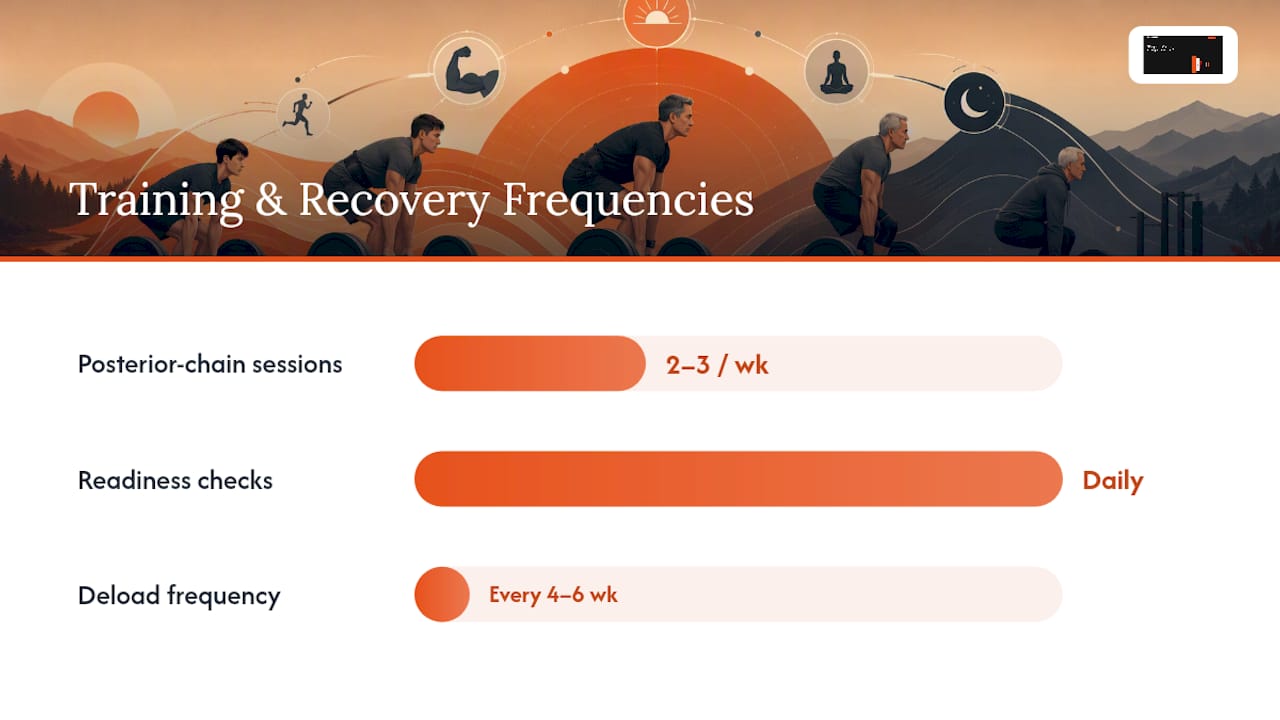
Your training plan needs to account for a slower recovery curve, not just an older spine. Resistance training remains highly effective for older adults, but the anabolic response to a given training stimulus is blunted; moderate to high intensity work at individualized volumes produces meaningful strength and function gains, according to research on optimizing anabolic response to resistance training in aging. Two to three sessions weekly targeting the posterior chain tends to be enough.
Recovery deserves equal weight in your plan; understanding age-related energy decline causes can help tailor your recovery strategies effectively.
- Prioritize sleep. Recovery capacity depends on it more heavily than it did at 30.
- Hit your protein target consistently, and use a TDEE calculator to make sure your total intake actually supports training, not just maintenance.
- Schedule deloads every four to six weeks rather than waiting until fatigue forces one on you.
- Track readiness daily with a simple RPE or fatigue check instead of guessing.
Skip frequent max-effort testing. Estimating your one-rep max through submaximal rep schemes and RPE tracking gets you a usable number without the joint stress of an actual max attempt. A dose-response review on resistance training in older adults backs individualized, progressive volume over chasing new maxes on a set schedule, and that approach protects your spine while still building real strength.
Ironatforty's Take on Deadlifting After 50
Ironatforty has spent years watching the same mistake play out: lifters over 50 treat their changed pull as a personal failure instead of what it actually is, a documented physiological shift. That mindset is what gets people hurt, because they force a young lifter's range of motion onto a spine that's lost a measurable percentage of its flexion capacity.
The conventional advice, chase the textbook hinge, keep your back flat like a 25 year old, misses the point entirely. Your pelvis is rotating more because your lumbar spine has less range to give. Fighting that with more mobility work alone rarely restores what's gone. Working with it, through variation choice and smarter cueing, is what actually protects you.
Prioritize this first: get an honest assessment of your current hip hinge and thoracic rotation before you touch heavy weight again. Everything else, trap bar versus sumo, tempo, accessory work, flows from what that assessment tells you. Skip that step and you're guessing.
Sources
- Age related differences in mechanical demands imposed on the lower back by manual material handling tasks — NIOSH (CDC) repository
- Age and gender related neuromuscular changes in trunk flexion-extension — PMC
- Optimizing skeletal muscle anabolic response to resistance training in aging — Frontiers in Physiology
- The effect of age, prolonged seated work and sex on posture and perceived effort during a lifting task — ScienceDirect
- Age-related variations in trunk muscle activation and kinematics during lifting in chronic low back pain — Scientific Reports (2025)
FAQ
Should a 67 Year Old Man Do Deadlifts?
Yes, in most cases, if the variation and load match current mobility and strength assessment. A trap bar or elevated pull, done with controlled tempo and progressive loading, is a reasonable and often beneficial choice for older adults without acute spine symptoms.
What Exercise Takes Years Off Your Life?
No single exercise reverses aging, but consistent resistance training, including deadlift variations done safely, supports muscle quality, function, and independence as you age, per research on resistance training and aging muscle.
Can a 70 Year Old Regain Muscle Tone?
Yes. Resistance training remains effective at rebuilding muscle quality and strength in older adults, though the anabolic response is blunted compared to younger lifters, so gains come more gradually with individualized, progressive loading according to research on resistance training in aging.
How Much Should a 60 Year Old Man Be Able to Deadlift?
There's no universal number, since strength depends heavily on training history, body weight, and current mobility. A more useful benchmark than a fixed weight is tracking progress against your own baseline using submaximal testing rather than chasing an age-based standard.
Why Does My Deadlift Feel Slower Than It Used To?
Slower lockout speed at this stage is usually normal, tied to reduced trunk extension velocity and longer lift completion times documented in older lifters, per research on age and lifting posture. It reflects a physiological shift, not necessarily a loss of effort or strength.