
Yes, you can build meaningful muscle after 40. The fastest path is consistent resistance training 2–3 times per week, raising your per-meal protein to around 0.4 g/kg per meal, and treating recovery as a non-negotiable part of the program, not an afterthought.
Here's your 30-second quick-start:
- Start lifting. Two full-body sessions per week is enough to trigger real hypertrophy. Harvard Health confirms meaningful strength and function benefits begin with two structured sessions weekly.
- Fix your protein. Hit roughly 0.4 g/kg at each meal, spread across 3–4 meals. Daily target: 1.2–1.6 g/kg of body weight.
- Schedule recovery. Sleep 7–9 hours. Plan a deload every 4–8 weeks. Protect your joints with a proper warm-up every session.
Pro Tip: Before your first session back, spend five minutes writing down your three main lifts and your current best weight for each. That baseline is your scoreboard for the next 8 weeks.
One safety note: if you have active chest pain, uncontrolled hypertension, a recent cardiac event, or advanced osteoporosis, get medical clearance before starting. For everyone else, the evidence is clear. Let's get into it.
Key Takeaways
Building muscle after 40 is achievable with the right training stimulus, adequate per-meal protein at 0.4 g/kg, and recovery treated as a core part of the program, not an optional extra.
| Point | Details |
|---|---|
| Train 2–3x/week with compound lifts | Two full-body sessions per week is enough to trigger hypertrophy; add a third after 6–8 consistent weeks. |
| Hit 1.2–1.6 g/kg protein daily | Spread across 3–4 meals at roughly 0.4 g/kg each to overcome anabolic resistance. |
| Work at 70–85% 1RM for hypertrophy | Use your 1RM calculator to set working weights; finish main sets with 1–3 reps in reserve. |
| Deload every 4–8 weeks | Reduce volume by 40% while keeping intensity; plan it before you feel like you need it. |
| Use Ironatforty's free tools | The TDEE and 1RM calculators at ironatforty.com set your calories and working weights in minutes. |
This article is general information, not a substitute for advice from a qualified doctor. Consult a qualified healthcare professional about your own circumstances before acting on anything here.
Table of Contents
- How to build muscle after 40: the principles that actually matter
- Practical training rules: frequency, intensity, and exercise selection
- Nutrition that drives muscle growth after 40
- Your 8-week starter program: two workouts and a weekly schedule
- Recovery, joint health, and how to avoid setbacks
- Programming tactics that work better after 40
- Realistic timelines: when will you see results?
- When you need medical clearance before lifting
- Anabolic resistance explained: why per-meal protein dosing matters
- What we actually see work at Ironatforty
- Ironatforty's free tools cut your setup time in half
- Sources
- FAQ
How to build muscle after 40: the principles that actually matter
The biology is real, but it's not a death sentence. After 40, your muscles develop what researchers call anabolic resistance, meaning the same protein dose or training stimulus that worked at 25 produces a smaller muscle-building response now. A landmark review on anabolic resistance and muscle protein synthesis confirmed that older adults need larger per-meal protein doses and a stronger resistance-exercise stimulus to maximize postprandial muscle protein synthesis (MPS). That's the core problem. Everything below is the solution.
Testosterone and growth hormone do decline with age, but the research on muscle hypertrophy responses across age groups shows that older adults still produce significant strength and size improvements with resistance training. Strength gains often outpace visible hypertrophy early on, which is actually useful: you get stronger and more functional before the mirror catches up.
The four principles that govern muscle gain over 40:
- Progressive overload is still king. Your muscles grow when you give them a reason to. Add weight, reps, or sets over time, or you're just maintaining.
- Intensity beats volume for older lifters. Fewer, harder sets beat endless moderate-effort work. Quality over quantity is not a cliché here.
- Protein distribution matters as much as total intake. Spreading protein evenly across meals overcomes anabolic resistance better than front-loading or skipping meals.
- Recovery is where the gains happen. Sleep, deloads, and joint-friendly mobility work are not optional extras. They're the mechanism.
- Power work preserves what age takes first. Fast-twitch muscle fibers decline fastest with age. Including explosive work at moderate loads keeps them firing.
- Individualization beats generic programs. Your injury history, schedule, and training age all change what works. A program that fits your life gets done; a perfect program that doesn't gets skipped.
Pro Tip: If you're returning after a break, your first 4 weeks are neural adaptation, not hypertrophy. Don't judge the program by the mirror yet. Judge it by whether you're lifting more than week one.
Practical training rules: frequency, intensity, and exercise selection
The NSCA's position on resistance training for older adults is specific: programs should be individualized and periodized, built around multi-joint exercises, and progress toward intensities of 70–85% 1RM for strength and hypertrophy, with power work performed at 40–60% 1RM. That's not a suggestion. It's the evidence-based floor.
Frequency
Training two to three times per week per muscle group is recommended. For many over 40 starting or returning, two full-body sessions per week is a sensible starting point. It meets the CDC's physical activity guidelines for muscle-strengthening on 2 or more days weekly, and it leaves enough recovery time between sessions. Once you've run 6–8 weeks consistently, adding a third session becomes a genuine option.
Intensity and reps
Use your 1RM calculator to set working weights. For hypertrophy, target 70–85% 1RM across sets of 6–12 reps. For strength phases, drop to 3–5 reps at 80–90% 1RM. For power work, use 40–60% 1RM and move the bar as fast as possible on the concentric. If you don't have a tested 1RM, use reps in reserve (RIR): finish your main sets with 1–3 reps left in the tank, not 6.
Volume
Eight to 12 hard sets per major muscle group per week is a solid starting target. Don't try to hit 20 sets per muscle in week one. Start at the low end, add one set per muscle group every 2–3 weeks, and back off when performance drops.
Exercise selection
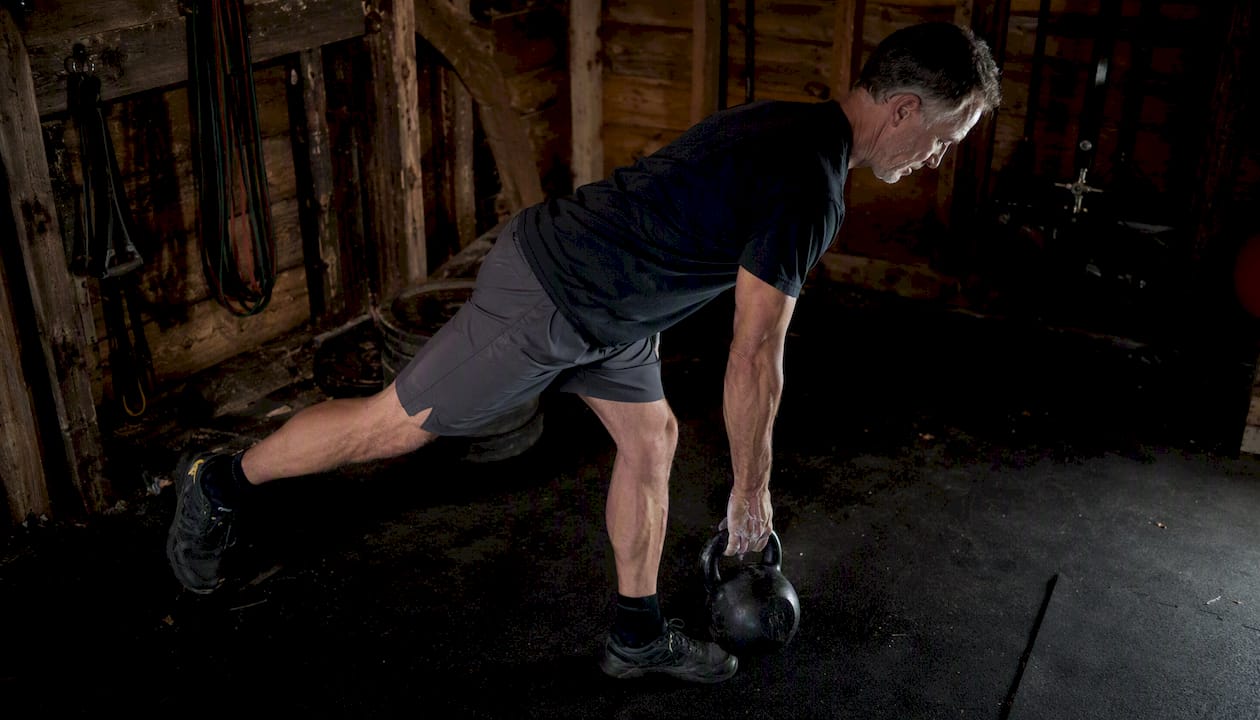
Prioritize compound, multi-joint lifts. Squats, deadlifts, Romanian deadlifts, bench press, rows, and overhead press should anchor every program. Add unilateral work like split squats, single-leg Romanian deadlifts, and single-arm rows to correct imbalances and reduce joint stress from asymmetrical loading.
Warm-up structure
Never skip this. A proper warm-up for heavy lifting takes 8–12 minutes and follows this sequence:
- 5 minutes of light cardio or movement (bike, rowing, brisk walk)
- Dynamic mobility: leg swings, hip circles, thoracic rotations, shoulder circles
- Movement-specific warm-up sets: 2–3 progressively heavier sets before your first working set
| Variable | Hypertrophy | Strength | Power |
|---|---|---|---|
| Intensity | 70–85% 1RM | 80–90% 1RM | 40–60% 1RM |
| Reps per set | 6–12 | 3–5 | 3–6 (explosive) |
| Sets per session | 3–4 per lift | 3–5 per lift | 3–5 per lift |
| Frequency | 2–3x/week per muscle | 2–3x/week per muscle | 1–2x/week |
Pro Tip: For power work, pick one explosive movement per session — a trap bar deadlift jump, a medicine ball slam, or a box jump — and do it first, when your nervous system is fresh. Three sets of 4–5 reps is enough.
Nutrition that drives muscle growth after 40
Protein is the lever you control most directly. The Cambridge review on nutrition strategies to counteract sarcopenia recommends raising daily protein above population reference intakes, with per-meal doses near 0.4 g/kg and daily totals of 1.2–1.6 g/kg/day. For a 180 lb (82 kg) person, that's roughly 98–131 g of protein per day, split across 3–4 meals at 33–44 g each.
The MDPI Nutrients review on supplements and resistance training in aging confirms that combining resistance training with adequate protein and targeted supplements produces greater gains in muscle mass and function than training alone. Nutrition isn't a bonus. It's half the program.
Calories for muscle gain
A conservative surplus of 200–300 calories above your TDEE is enough to support muscle growth without excessive fat gain. If you're carrying extra body fat, body recomposition (eating at maintenance while training hard) is a legitimate strategy, especially in the first 6–12 months of a new program. You can gain muscle and lose fat simultaneously when you're new or returning to training.
Sarcopenia risk is real. Adults lose roughly 3–8% of muscle mass per decade after 30, with the rate accelerating after 60. Resistance training and adequate protein are the two most evidence-supported tools to slow that loss.
Supplement priorities
Three supplements have the strongest evidence for older lifters:
- Creatine monohydrate: 3–5 g/day. Reviews consistently show it augments lean mass and strength gains in older adults when combined with resistance training.
- Vitamin D: 1,000–2,000 IU/day if you're deficient (get tested). Low vitamin D is associated with reduced muscle function.
- Omega-3s (EPA/DHA): 2–3 g/day. Evidence is mixed but some trials show enhanced MPS and reduced muscle protein breakdown. Worth including if your diet is low in fatty fish.
High-protein foods to anchor your meals
- Chicken breast, turkey, lean beef
- Eggs and egg whites
- Greek yogurt (plain, full-fat or low-fat)
- Cottage cheese
- Canned salmon or tuna
- Whey or casein protein powder
- Edamame and tempeh for plant-based options
For deeper guidance on hitting these targets with real food, the Ironatforty protein guide breaks it down meal by meal.
Your 8-week starter program: two workouts and a weekly schedule
This plan is built for someone training 2–3 days per week with access to a barbell, dumbbells, or a well-equipped gym. It follows the principles above: compound-first, progressive, and joint-friendly.
Workout A (Monday or Tuesday)
- Goblet squat or barbell back squat — 3 sets × 8–10 reps, 2 RIR
- Romanian deadlift — 3 sets × 8–10 reps, 2 RIR
- Dumbbell bench press — 3 sets × 8–12 reps, 2 RIR
- Single-arm dumbbell row — 3 sets × 10–12 reps per side, 2 RIR
- Plank — 3 × 30–45 seconds
Workout B (Thursday or Friday)
- Trap bar deadlift or conventional deadlift — 3 sets × 5–6 reps, 2 RIR
- Split squat (rear foot elevated) — 3 sets × 8–10 reps per leg, 2 RIR
- Overhead press (barbell or dumbbell) — 3 sets × 8–10 reps, 2 RIR
- Cable or dumbbell row — 3 sets × 10–12 reps, 2 RIR
- Pallof press — 3 × 10 reps per side
8-week progression schedule
| Weeks | Sessions/week | Focus | Adjustment |
|---|---|---|---|
| 1–2 | 2 | Learn movement patterns | Keep RIR at 3–4; no max effort |
| 3–4 | 2 | Build work capacity | Add 1 set per main lift; RIR 2–3 |
| 5–6 | 2–3 | Hypertrophy block | Add 5 lb to lower body, 2.5 lb to upper body lifts |
| 7 | 2 | Deload | Drop volume by 40%; keep intensity |
| 8 | 2–3 | Reassess and progress | Retest key lifts; plan next mesocycle |
Progression checklist
- Complete all sets and reps with 2 RIR before adding weight.
- Add the smallest increment available (microloading: 1.25–2.5 lb plates).
- If you miss reps two sessions in a row, hold the weight and add a set instead.
- Move from 2 to 3 sessions per week only after completing weeks 1–4 consistently.
- Schedule your deload before you feel like you need one, not after.
Modifications: No barbell? Swap squats for goblet squats, deadlifts for dumbbell Romanian deadlifts, and bench for push-up variations. Knee pain? Replace split squats with step-ups or leg press at a controlled depth. Shoulder issues? Sub overhead press for landmine press or neutral-grip dumbbell press.
Pro Tip: Microloading is not weakness. Adding 1.25 lb plates to each side of a barbell is still progressive overload. Over 12 weeks, that's 15 lb added to your squat. Respect the math.
For more structured program templates, the Ironatforty training programs guide covers full-body and upper/lower splits in detail.
Recovery, joint health, and how to avoid setbacks
Recovery is where the adaptation happens. Training is the stimulus. Sleep, nutrition, and managed stress are the environment where your body actually builds the muscle. Get that backwards and you're just accumulating fatigue.
Sleep
Target 7–9 hours per night. Growth hormone secretion peaks during slow-wave sleep. Chronic sleep restriction below 6 hours impairs MPS, elevates cortisol, and reduces testosterone. If your sleep is broken, that's the first thing to fix before adding training volume.
Mobility and joint protection
Dynamic warm-ups before every session are non-negotiable. Focus on thoracic spine rotation, hip hinge prep, and shoulder mobility. Static stretching belongs after training, not before. For joint longevity, unilateral training reduces the asymmetrical loading that causes chronic joint stress in bilateral-only programs.

Deload strategy
Plan a deload every 4–8 weeks. A simple rule: reduce training volume by 40% (fewer sets) while keeping intensity (same weight). You're not resting. You're letting your connective tissue and nervous system catch up to the work you've done.
Recovery checklist
- Sleep 7–9 hours per night, consistently
- Eat protein within 2 hours post-workout (0.4 g/kg minimum)
- Use dynamic warm-ups before every session
- Schedule deloads every 4–8 weeks, not reactively
- Manage weekly training stress: don't add volume and intensity simultaneously
- Use RIR to autoregulate: if your 8-rep set feels like a 5-rep max, back off
- Address soreness vs. pain: soreness fades within 48–72 hours; sharp or joint pain does not
Pro Tip: Soreness in the muscle belly is normal. Pain in a joint, tendon, or that's sharp and localized is a signal to stop and assess. If it persists more than a week, see a physiotherapist. Training through joint pain is how a minor issue becomes a 6-month setback.
For a deeper look at managing training load and avoiding the overtraining trap, this Ironatforty guide on overtraining signs and fixes covers the warning signs most lifters miss.
Programming tactics that work better after 40
The biggest mistake older lifters make is trying to add more: more sets, more sessions, more exercises. After 40, the smarter move is usually to redistribute, not accumulate.
Microloading is the most underused tool in the gym. Instead of jumping 5 or 10 lb when a lift feels easy, add 1.25–2.5 lb. It keeps you progressing without spiking joint stress. Fractional plates cost less than a single physio session.
Volume reallocation means shifting sets toward lagging muscle groups or weaker movement patterns rather than piling more total sets onto the week. If your squat is strong but your hip hinge is weak, move two sets from squats to Romanian deadlifts. Total weekly volume stays the same; the stimulus gets smarter.
Autoregulation using RIR or RPE lets you adjust daily based on how you actually feel. Set a weekly intensity target (say, all main sets at 2 RIR), then honor it. On a bad day, that might mean using less weight. That's not failure. That's intelligent training.
Block periodization is worth understanding once you've run 2–3 consistent mesocycles. A hypertrophy block (higher volume, 8–12 reps, 6–12 sets per muscle group per week) followed by a strength block (lower volume, heavier loads, 3–6 reps) produces better long-term results than staying in one rep range forever. Ironatforty's periodization guide walks through how to structure these blocks for lifters over 40.
For broader context on how adults can structure athletic performance programming, Level Up Gym's guide on improving athletic performance as an adult offers useful programming principles that complement what's here.
Realistic timelines: when will you see results?
Here's the honest version. Strength comes first. Visible muscle takes longer.
Weeks 1–4: Neural adaptation. Your nervous system learns to recruit motor units more efficiently. You'll feel stronger and move better before your muscles visibly change. This is real progress.
Weeks 5–12: Early hypertrophy. With consistent training and adequate protein, you'll start noticing changes in muscle fullness and definition. Tape measurements and strength numbers will move before the mirror does.
Months 3–6+: Visible, meaningful hypertrophy. Research on aging and hypertrophy responses shows that older adults achieve significant strength and size improvements, though the absolute hypertrophic response may be smaller than in younger cohorts. That's fine. The functional and health benefits are comparable.
What to track
- Estimated 1RM or reps at a fixed weight on your main lifts (use the Ironatforty 1RM calculator)
- Tape measurements at the chest, arms, waist, and thighs every 4 weeks
- Consistent photos in the same lighting, same time of day, every 4 weeks
- Performance markers: how many pull-ups, how fast you recover between sets
When your scale weight is stable but your tape measurements are shifting and your lifts are going up, you're recomping. Trust the strength and tape numbers over the scale.
When you need medical clearance before lifting
Most people over 40 can start a sensible resistance program without a doctor's visit. But some situations require a conversation first.
Get clearance before starting if you have:
- New or unexplained chest pain or pressure during exertion
- Uncontrolled hypertension (systolic consistently above 160 mmHg)
- A cardiac event (heart attack, stent, bypass) in the past 6 months
- Unexplained dizziness or syncope during activity
- Advanced osteoporosis (T-score below -2.5 with fracture history)
- Uncontrolled type 2 diabetes with neuropathy or retinopathy
Condition-specific modifications:
- Osteoporosis: Avoid spinal flexion under load (crunches, good mornings). Prioritize hip hinge, squat, and upper back work. Get physiotherapy input on loading strategy.
- Type 2 diabetes: Monitor blood glucose around sessions. Resistance training improves insulin sensitivity, but medication timing may need adjustment. Talk to your prescribing physician.
- Joint replacements: Work with a physiotherapist to establish safe range of motion and loading parameters before returning to compound lifts.
- Anticoagulants or beta-blockers: These affect heart rate response and bleeding risk. Your prescriber should know you're starting a resistance program.
The goal isn't to scare you off the bar. It's to make sure the program works with your health, not against it.
Anabolic resistance explained: why per-meal protein dosing matters
Anabolic resistance is the central challenge of building muscle after 40. Here's what it means in practice: when you eat protein, your body triggers muscle protein synthesis. In younger adults, a moderate dose of protein (say, 20 g) produces a near-maximal MPS response. In older adults, that same dose often falls short. The PMC review on anabolic resistance confirms that older muscles require both a larger per-meal protein dose and an appropriate resistance-exercise stimulus to achieve a comparable MPS response.
The practical fix is straightforward: aim for roughly 0.4 g/kg of body weight per meal, across 3–4 meals per day. For an 82 kg (180 lb) person, that's about 33 g per meal. Leucine is the key amino acid that triggers MPS. Prioritize leucine-rich sources: whey protein, eggs, chicken, beef, and dairy.
The Cambridge nutrition review notes that precision nutrition, tailoring protein dose and timing to individual phenotype and training status, is an emerging approach that goes beyond the one-size-fits-all RDA. The RDA for protein (0.8 g/kg/day) was set to prevent deficiency, not to support muscle growth in active adults over 40. It's the floor, not the target.
Timing matters too. Post-workout protein within 1–2 hours of training takes advantage of the exercise-induced increase in muscle sensitivity. That window doesn't close instantly, but hitting your per-meal target close to training is a low-effort win.
Pro Tip: If you struggle to hit 0.4 g/kg per meal from whole food alone, a whey shake post-workout is the most efficient fix. It's not a shortcut. It's a tool. Use it.
For a complete breakdown of food sources, timing strategies, and how to hit your targets on a real schedule, the Ironatforty nutrition hub has everything you need.
What we actually see work at Ironatforty
The most common myth we hear: "You can't build real muscle after 40." Wrong. The biology is harder, not impossible. Anabolic resistance is real, but it's a dial, not a wall. Older adults who train consistently and eat enough protein make genuine, measurable gains. The research backs it. So does every reader who sends us a progress photo after 12 weeks on a structured program.
Three other myths worth killing:
- "Cardio is enough." Cardio preserves cardiovascular health. It does not build or maintain muscle mass. Resistance training is the only stimulus that does.
- "Low protein is fine if I eat clean." Clean eating without adequate protein is just calorie management. Muscle requires amino acids. Hit the per-meal target.
- "High reps with light weight is safer for older joints." Load management matters, but avoiding heavy compound work entirely leaves gains and bone density on the table. The NSCA recommends progressing toward 70–85% 1RM for a reason.
At Ironatforty, our non-negotiables for lifters over 40:
- Progressive resistance training 2–3x/week with compound lifts at the core
- Per-meal protein at 0.4 g/kg, daily total at 1.2–1.6 g/kg
- Planned deloads every 4–8 weeks, not reactively
- Hormonal health awareness: if your recovery is consistently poor and your motivation is tanked, hormonal factors are worth investigating with your doctor
Ironatforty's free tools cut your setup time in half
The hardest part of starting a new program isn't the lifting. It's the setup: figuring out your calories, setting your working weights, and knowing whether you're progressing. That's exactly what Ironatforty's free tools handle.
Use the TDEE calculator to find your maintenance calories in two minutes, then add 200–300 calories for a lean muscle-building surplus. Use the 1RM calculator to convert your best rep sets into estimated maxes, then set your working percentages from there. No guesswork, no spreadsheet, no coach required.
Beyond the calculators, the Ironatforty tools hub connects you to training templates, nutrition guides, and joint health resources, all written for lifters over 40 who want science-backed answers without the bro-science noise. Pick your starting point and run the 8-week plan above. Your first progress check is 4 weeks away.
Sources
- Resistance Training for Older Adults: Position (NSCA)
- Strength and Power Training for Older Adults - Harvard Health
- Physical Activity Guidelines for Americans (CDC)
- Anabolic resistance and muscle protein synthesis (PMC6746962)
- Nutrition strategies to counteract sarcopenia: protein, LC n-3 PUFA and precision nutrition (Cambridge DOI)
FAQ
Is it really possible to build muscle after 40?
Yes. Longitudinal studies and meta-analyses confirm that older adults produce significant strength and size gains with consistent resistance training, though the hypertrophic response may be somewhat smaller than in younger cohorts. The key variables are training intensity (70–85% 1RM), adequate per-meal protein (around 0.4 g/kg), and consistency over months, not weeks.
What kills muscle gains the most after 40?
Insufficient protein per meal is the most common culprit, followed by inconsistent training and inadequate sleep. Anabolic resistance means older adults need a larger protein dose per meal than younger adults to trigger the same muscle protein synthesis response, so eating "enough" by general standards often falls short of what actually drives growth.
What is the 3-3-3 rule in the gym?
The 3-3-3 rule is not a formally established guideline in major strength and conditioning standards like the NSCA. The term is used informally in various ways, most commonly to describe a simple structure of 3 exercises, 3 sets, and 3 days per week.
At what age does building muscle become most difficult?
Muscle-building capacity declines gradually from the mid-30s onward, with the rate of muscle loss (sarcopenia) accelerating after 60. The 40s are not a cliff edge. It's a window where smart training and higher protein intake can still produce meaningful gains, and where the habits you build now directly determine your functional capacity later in life.
How long before I see visible results after 40?
Neural strength gains typically appear within 4–8 weeks. Noticeable hypertrophy, visible changes in muscle size and definition, generally takes at least 8 weeks of consistent training and adequate protein. Meaningful, lasting changes in body composition develop over 6–12 months. Track strength and tape measurements every 4 weeks rather than relying on the scale alone.