Submaximal training means working below your true maximum effort on every set, every session. You leave reps in the tank. You stop before failure. Typical submaximal training targets lie in a moderate percentage range of your one-rep max (1RM), or an RPE indicating a few reps left before failure. If you want to train more frequently, build real volume, sharpen technique, and still walk into the gym next week feeling ready, this is the approach. It is not the easy way out. It is the smarter floor.
Table of Contents
- What submaximal training actually means across lifts, runs, and rides
- Why submaximal training works: the physiology behind the method
- How to find and monitor your submax: practical testing and daily tracking
- Programming submaximal training: structure, progression, and warning signs
- Sample sessions: what submaximal training looks like in practice
- When to include maximal-intent work in a submax program
- What the evidence says: key findings from 2020–2026 research
- Key Takeaways
- The case for training below your ceiling
- Useful sources and further reading
- FAQ
What submaximal training actually means across lifts, runs, and rides
The term "submaximal" applies differently depending on what you are doing, but the core idea holds: you are working hard, just not at your ceiling.
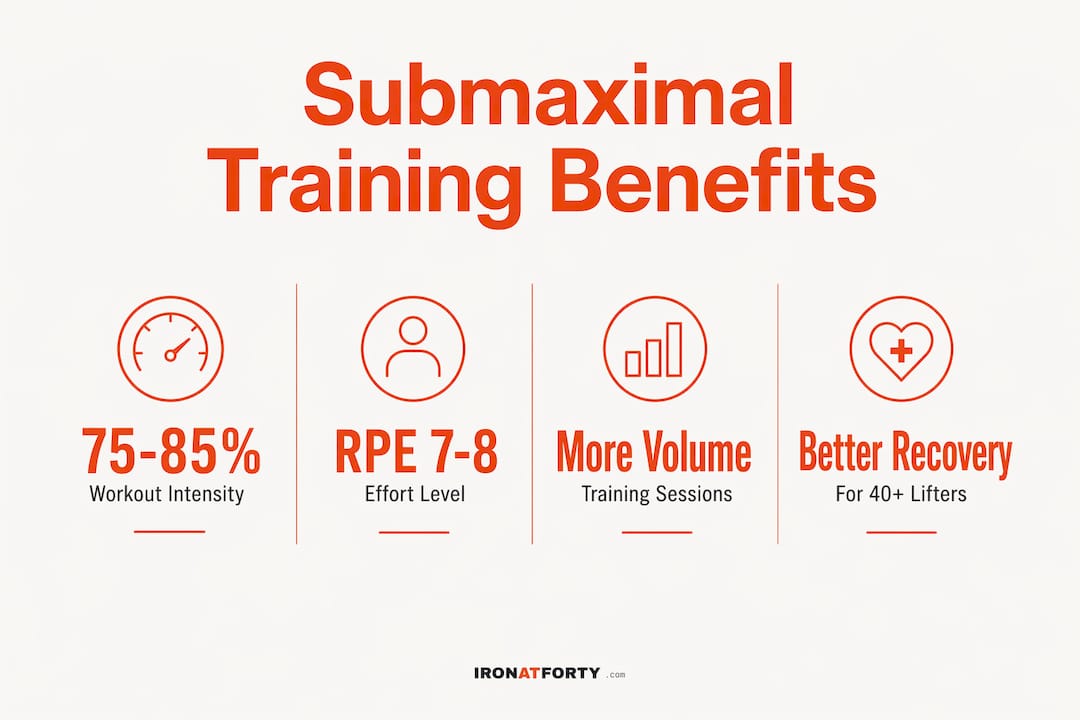
In resistance training, submaximal work typically lands in the 75–85% 1RM range. A set performed below maximal load leaves you with a few reps still available. That gap is the point. Coaches often describe this as "reps in reserve" (RIR) or rate of perceived exertion (RPE). An RPE 7 set means you could have done 3 more reps. An RPE 8 means 2 more. You are training with intent and load, not grinding to failure every session.
Velocity adds another layer. When your bar speed on the first rep of a set drops noticeably compared to a fresh warm-up rep, your nervous system is telling you something. Many coaches use mean concentric velocity (MCV) as a real-time autoregulation signal, stopping a set or session when bar speed degrades beyond a practical threshold. This is especially useful if you do not want to rely purely on feel.
In cardio, submaximal work means staying below the first lactate threshold, which for most people is at or below 75% of maximum heart rate. At this intensity, you can hold a conversation. Your breathing is elevated but controlled. This is Zone 1–2 training, and a 2026 meta-analysis across 50 studies (n=824) found a large effect size (ES = 0.94) on VO2max from low-intensity endurance training alone.
- %1RM: Moderate percentages are typical for submaximal strength work and lower for higher-rep hypertrophy blocks
- RPE: Moderate perceived exertion levels with a few reps left in reserve
- %HR: At or below a heart rate threshold aligned with aerobic submaximal sessions
- Velocity: stop when bar speed drops meaningfully from your first-rep baseline
One practical note: fixed percentages are a starting point, not gospel. Daily readiness varies. Autoregulation, using RPE or bar speed to adjust load on the fly, is more accurate than locking in a number from last month's test.
Why submaximal training works: the physiology behind the method
The short answer is volume. You cannot accumulate enough quality sets per week if every session pushes you to the edge. Submaximal loads let you train a movement pattern 3–5 times per week without the central nervous system (CNS) cost that comes with chronic maximal attempts.
That volume advantage directly drives hypertrophy. More weekly sets at a challenging but recoverable intensity means more mechanical tension over time, which is the primary driver of muscle growth. For strength, the same logic applies: technical practice under load is how movement patterns become automatic. You cannot practice a squat pattern well when you are grinding through a near-miss.
A 2026 systematic review and meta-analysis reported that submaximal-intended velocity resistance training produced effect sizes of g=0.47 for muscle mass and g=0.56 for muscle strength—both exceeding maximal-intent training outcomes in older adults (n=801).
The benefits include improved hypertrophy from manageable weekly volume, strength development through technical repetition under load, and reduced injury risk from avoiding failure-induced mechanical stress spikes.
- Adherence: Sessions feel hard but doable. You finish wanting to come back, not dreading next week
- Cardiometabolic health: Low-intensity aerobic submaximal work improves VO2max significantly, and duration in lower heart rate zones is the primary driver of cardiac remodeling
For lifters over 40, the adherence and recovery benefits are not secondary. They are the whole argument. Training consistency beats intensity over a multi-year horizon, and submaximal programming is the structure that makes consistency possible.
How to find and monitor your submax: practical testing and daily tracking
You do not need a lab. You need a few simple tests and a log.
- Predict your 1RM from a rep test. Load a bar to a weight you can lift for 3–8 clean reps. Stop when form breaks or you hit true failure. Use Ironatforty's 1RM calculator to convert that rep count into an estimated 1RM. From there, 80% of that number is your submaximal training target.
- Calibrate your RPE. After your next working set, ask: how many more reps could I have done with good form? Two reps left = RPE 8. Three reps left = RPE 7. Do this for four weeks and your RPE accuracy improves dramatically.
- Check your heart rate for aerobic work. Use a chest strap or wrist monitor. Find 75% of your estimated max HR (roughly 220 minus your age, though this is an approximation). Stay at or below that number for submaximal cardio sessions.
- Watch bar speed. You do not need a velocity tracker to notice when your bar is moving slower than it did on rep one. That slowdown is your signal. When the first rep of a new set looks sluggish compared to your warm-up, the session's quality work is done.
Daily autoregulation is the practical upgrade over fixed percentages. Instead of always hitting 80% regardless of how you feel, you set a target RPE and adjust the load to match. If 80% feels like RPE 9 today, drop to 77.5%. If it feels like RPE 6, you can push slightly higher. This is not an excuse to go easy. It is a system for staying in the productive zone consistently.
Pro Tip: Set a session stopping rule before you start: end all working sets when your RPE hits 8 or when bar speed on the first rep looks noticeably slower than your warm-up. Write it in your log before you train, not after.
A simple weekly log should track: date, exercise, load (lbs), reps completed, RPE, and a one-word recovery note (fresh/normal/tired). That is enough data to spot trends without turning training into a spreadsheet project.
Programming submaximal training: structure, progression, and warning signs
The table below shows practical weekly structures across three experience levels. These are starting points, not rigid rules.
| Level | Intensity | Sets per lift/week | Frequency | Deload |
|---|---|---|---|---|
| Entry (0–2 yrs) | Moderate intensity / RPE 6–7 | Moderate volume | Few times per week | Periodic deloads |
| Intermediate (2–5 yrs) | Moderate intensity / RPE 7–8 | Moderate to higher volume | Several times per week | Periodic deloads |
| Advanced (5+ yrs) | Moderate to high intensity / RPE 7–8 | Higher volume | Frequent sessions | Frequent deloads |
Progression rules:
- Add incremental load when you complete all sets at the target RPE with reps still in reserve
- Add sets before adding load when your recovery is lagging; more volume at the same weight is safer than heavier weight at the same volume
- A practical volume progression pattern: 16 sets per week → 20 → 25, then deload back to 16 before the next block
- Deload phases involve reducing intensity and volume significantly for recovery
Red flags that your submax block has drifted too heavy:
- The same load feels harder week over week (RPE creeping up without a load increase)
- Bar speed on working sets is consistently slower than it was three weeks ago
- Technique is breaking down on reps that used to feel clean
- You are dreading sessions, not just finding them hard
- Sleep quality is dropping and resting heart rate is elevated
For lifters over 40, recovery capacity is the limiting variable, not willpower. Training after 40 requires deliberate frequency management. Two to three days between sessions for the same muscle group is a reasonable floor, not a sign of weakness. When in doubt, drop a set, not the session.
Sample sessions: what submaximal training looks like in practice
These templates use %1RM, RPE, and %HR notation so you can replicate them directly.
| Session Type | Intensity | Sets × Reps | Frequency/Week | Rest |
|---|---|---|---|---|
| Strength emphasis | 83–85% 1RM / RPE 7–8 | 4 × 3–4 | 2–3x | 3–4 min |
| Hypertrophy block | 72–80% 1RM / RPE 7 | 4 × 6–8 | 3–4x | 90 sec |
| Aerobic base (cardio) | ≤75% max HR / RPE 5–6 | 30–60 min continuous | 2–3x | N/A |
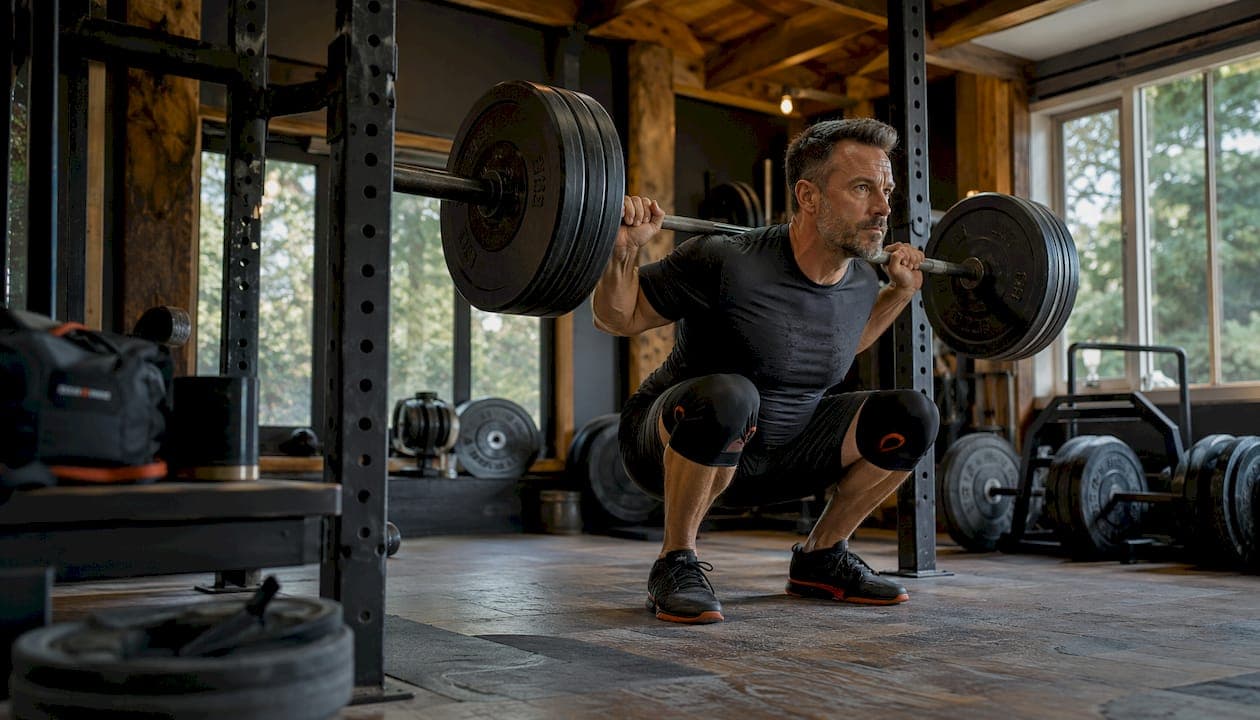
Strength emphasis session (example: squat day)
- Warm-up: 3 sets × 5 reps at 50–60% 1RM
- Working sets: 4 × 3 at 83% 1RM, RPE 7 target, 3.5 min rest
- Accessory: Romanian deadlift 3 × 8 at RPE 6, 90 sec rest
Hypertrophy block session (example: upper body push)
- Warm-up: 2 sets × 8 at 50% 1RM
- Working sets: 4 × 7 at 76% 1RM, RPE 7, 2 min rest
- Accessory: dumbbell incline press 3 × 10 at RPE 6–7, 90 sec rest
Aerobic base session
- 40 minutes at ≤75% max HR (brisk walk, easy bike, or slow jog)
- Keep it genuinely easy. Converting this into a tempo effort defeats the purpose. The cardiac adaptation comes from duration at low heart rates, not from pushing harder.
Mixing resistance and cardio in the same week:
- Place aerobic sessions on off days or after resistance work, never before heavy lifting
- A few aerobic sessions per week at moderate heart rate zones typically do not interfere with strength gains when volume is well managed
- If fatigue accumulates, cut an aerobic session before cutting a strength session
When to include maximal-intent work in a submax program
Maximal efforts have a place. They just do not belong in every week.
The right situations for true max-effort work are: testing blocks (every 8–12 weeks to reassess your 1RM and recalibrate percentages), peaking phases before a competition or a planned PR attempt, and technical diagnostics when you need to see how a movement pattern holds under genuine load. Outside those contexts, maxing out is a diagnostic tool, not a training stimulus.
Practical guidelines for including max-effort work:
- Limit true 1RM attempts or near-maximal work (95%+) to planned blocks, not spontaneous sessions
- Place max-effort sessions at the start of a training week, when recovery is highest
- Follow any max-effort block with a full deload week before returning to submaximal volume
- Keep technique as the non-negotiable: if form breaks at 90%, that is your working ceiling for now
Red flags that maximal attempts are hurting long-term progress:
- You are testing your 1RM more than once every 6–8 weeks
- Your submaximal working weights have stalled or dropped after a max block
- Joint soreness is persisting beyond 72 hours after a heavy session
- You are skipping submaximal sessions because you feel wrecked from a max day
The case for submaximal work is not that maximal efforts are bad. It is that they are expensive. Use them sparingly, plan the recovery around them, and let your submaximal volume do the actual building. Periodization planning makes this systematic rather than guesswork.
What the evidence says: key findings from 2020–2026 research
The research base for submaximal training has strengthened considerably in recent years. Here are the findings that actually change how you should program.
Submaximal velocity training outperforms maximal intent in older adults. A 2026 meta-analysis covering 16 studies (n=801) found submaximal-intended velocity resistance training produced effect sizes of g=0.47 for muscle mass and g=0.56 for muscle strength, both exceeding maximal-intent training outcomes. The population was adults aged 60 and older. For anyone in that range, or approaching it, this is the most directly applicable finding in the literature.
Low-intensity endurance training produces large VO2max gains. The 2026 meta-analysis across 50 studies (n=824) reported an effect size of ES = 0.94 on VO2max from training at or below 75% max HR. That is a large effect. Duration, not intensity, drives this adaptation.
Velocity-loss thresholds matter for strength outcomes. Research comparing 20% versus 40% velocity loss cutoffs found the lower velocity-loss group achieved superior strength gains with lower markers of fatigue at 8 weeks. Stopping sets earlier, not grinding through speed loss, produces better strength results.
Stopping rules improve reproducibility. Research published in 2026 supports anchoring submaximal prescriptions to pre-testing data and clear stopping rules rather than sets to failure, improving reproducibility and reducing non-specific systemic fatigue.
Practical takeaways from the evidence:
- For lifters over 60, submaximal velocity training is the evidence-backed default for both muscle mass and strength
- For aerobic fitness, accumulate duration at ≤75% max HR rather than converting easy sessions into tempo work
- Use velocity loss as a session-level stopping rule; 20% MCV drop is a practical upper limit
- Anchor all prescriptions to tested data (predicted 1RM, calibrated RPE) rather than guesswork
Limitations to note: The older-adult meta-analysis focused on adults 60+. Younger lifters will likely see similar directional benefits from submaximal work, but the effect-size advantage over maximal training may be smaller. The endurance meta-analysis included adults aged 18–65, making it broadly applicable.
Key Takeaways
Submaximal training, anchored to 75–85% 1RM and RPE 7–8, is the most sustainable path to long-term strength and hypertrophy for lifters over 40.
| Point | Details |
|---|---|
| Definition and intensity range | Submaximal training means stopping 2–4 reps short of failure, typically at 75–85% 1RM or RPE 7–8. |
| Monitoring method | Use predicted 1RM from rep tests, calibrated RPE, and bar speed to set and track your submaximal targets daily. |
| Volume progression rule | Increase weekly sets progressively (e.g., 16 → 20 → 25) before adding load, then deload every 3–4 weeks. |
| Cardio submax standard | Keep aerobic sessions at or below 75% max HR; duration drives VO2max gains (ES = 0.94 in a 2026 meta-analysis). |
| Max-effort placement | Reserve true maximal attempts for planned testing blocks every 8–12 weeks, followed by a full deload week. |
The case for training below your ceiling
Here is what most gym content gets wrong about submaximal training: it frames the approach as conservative, as if leaving reps in the tank means you are not working hard enough. That framing is backwards.
The lifters who make the most consistent progress over a decade are not the ones who maxed out the most. They are the ones who showed up the most. Submaximal programming is the structure that makes showing up possible. When sessions are repeatable, recovery is manageable, and technique stays clean under load, you build something that actually lasts.
The 2026 meta-analysis data on older adults is particularly striking because it challenges the assumption that you need to push to your limit to get results. You do not. In fact, for adults over 60, submaximal velocity training produced effect sizes of g=0.47 for muscle mass and g=0.56 for muscle strength—both superior to maximal-intent training, according to a 2026 meta-analysis of 16 studies (n=801). That is not a small footnote. It is a reorientation of the whole approach.
For lifters over 40, the argument is even clearer. Recovery slows. Connective tissue takes longer to adapt than muscle. The cost of a bad session, a tweaked shoulder, a strained hip flexor, is not one missed day. It is two weeks of modified training and three weeks of rebuilt confidence under the bar. Submaximal work is not playing it safe. It is playing the long game.
Start with four weeks. Pick two or three main lifts. Set your working weight at 80% of your estimated 1RM. Stop every set at RPE 8. Log it. You will be surprised how hard that actually is, and how good you feel on day 29.
Useful sources and further reading
The studies and resources below back the claims in this article. Use them to verify the evidence and go deeper on any section.
- Effects of maximal versus submaximal intended velocity resistance training on muscular fitness in older adults (2026 meta-analysis): 16 studies, n=801; effect sizes for muscle mass and strength favoring submaximal velocity training in adults 60+.
- Effects of low-intensity endurance training on aerobic fitness: a meta-analysis (2026): 50 studies, n=824; ES = 0.94 on VO2max from training at or below 75% max HR.
- Stopping rules, task failure, and reproducible prescriptions (Springer, 2026): Evidence for anchoring submaximal prescriptions to pre-testing data and clear stopping rules.
- Submaximal training philosophy and velocity-loss research (PoinT GO): Practitioner guide covering 75–85% zones, frequency benefits, and velocity-loss cutoff comparisons.
- The case for submaximal training in powerlifting (Ironside Training): Practical programming distinctions between submaximal and maximal-effort models.
- Why low-intensity endurance training matters for heart health (The Active Edge): Review synthesis on duration at low heart rates as the primary driver of cardiac remodeling.
- VO2 Max After 40: The Number That Predicts Your Next 30 Years (Ironatforty): How submaximal cardio below the first lactate threshold builds aerobic fitness after 40.
- Periodization Training for Strength After 40 (Ironatforty): How to schedule submaximal blocks, deloads, and maximal testing phases.
- Free Training and Nutrition Tools (Ironatforty): 1RM Calculator and TDEE Calculator for setting submaximal targets and calorie needs.
- Minimum Effective Dose Training for Adults Over 40 (Ironatforty): How to prescribe submaximal workloads using task-failure avoidance and intensity measurement.
FAQ
What does submaximal mean in training?
Submaximal means working below your maximum effort. In practice, it means stopping a set with 2–4 reps still available, typically at 75–85% of your 1RM or an RPE of 7–8 out of 10.
What are examples of submaximal exercise?
A squat at 80% 1RM for 4 sets of 4 reps stopped at RPE 8 is a classic submaximal strength example. A 40-minute easy bike ride at or below 75% of your max heart rate is the aerobic equivalent.
What is submaximal heart rate?
Submaximal heart rate for aerobic training is at or below 75% of your maximum heart rate, which keeps you below the first lactate threshold. A 2026 meta-analysis found this intensity zone produces a large effect size (ES = 0.94) on VO2max when sessions are long enough.
How is submaximal training different from maximal training?
Maximal training pushes to or near true failure on most sets. Submaximal training stops short, preserving recovery capacity and allowing higher weekly frequency and total volume. Research in older adults shows submaximal velocity training produces superior muscle mass and strength outcomes compared to maximal-intent training.
What is the 3-3-3 rule in the gym?
The 3-3-3 rule is not a standardized training framework with a single canonical definition. Some coaches use the phrase to describe 3 sets of 3 reps at a heavy load, which can be applied within a submaximal context (e.g., 3 × 3 at 85% 1RM, RPE 8), but the term itself does not refer to a specific published protocol.