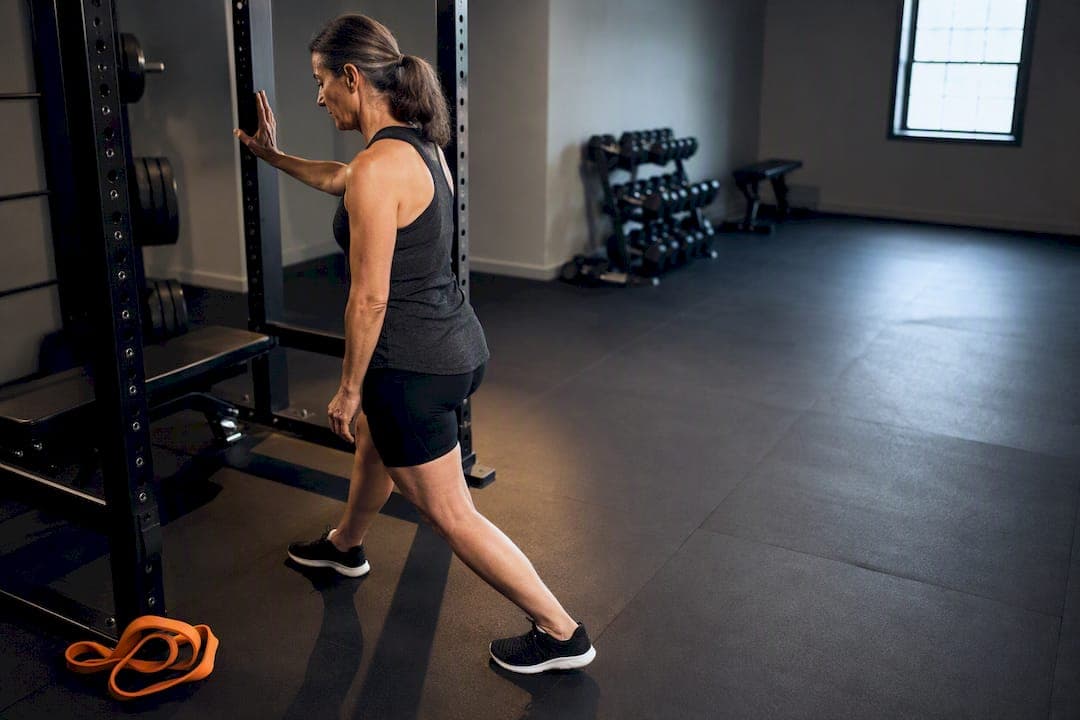
Skip the long static holds and go dynamic instead. The evidence backs a dynamic warm-up followed by ramp-up sets, with brief static stretching used only as an optional, situational add-on. Hold anything past 60 seconds per muscle group before a heavy set and you're gambling with force output for no real payoff. Stay under that, inside a proper warm-up, and the cost is close to zero.
TL;DR:
- Stretching for 30 seconds or less per muscle group during a warm-up has minimal impact on strength and power performance.
- Holding static stretches longer than 60 seconds per muscle increases the risk of strength loss, especially when done in isolation without dynamic movement.
- A typical effective warm-up should include aerobic activity, dynamic mobility, activation drills, and ramp-up sets totaling around 20 to 26 minutes.
- Static stretching is unnecessary before max-effort lifts, competition, or when peak power is critical, and should be reserved for outside the warm-up.
- For lifters over 40, incorporating joint-friendly routines and proper pacing can better protect mobility and optimize performance during training.
Table of Contents
- Does Static Stretching Before Lifting Hurt Your Strength?
- How Long Is Too Long to Stretch Before Weights?
- Why Does Stretching Sometimes Reduce Strength?
- Your Pre-Lift Warm-Up Should Look Like This
- When Should You Skip Static Stretching Before Lifting?
- An 8 to 12 Minute Pre-Lift Routine You Can Use Today
- The Evidence Is Clear. The Old Rule Wasn't.
- Dial In Your Warm-Up With the Right Numbers
- Sources
- FAQ
Does Static Stretching Before Lifting Hurt Your Strength?
The short answer: it depends almost entirely on how long you hold the stretch and what you're comparing it to. A 2019 review in Frontiers in Physiology found that static stretching held for 60 seconds or less per muscle group inside a full warm-up produced only trivial performance effects, somewhere around a 1 to 2% dip.
That's the headline number, but it's worth sitting with the older meta-analytic data too, because it's what built the "never stretch before lifting" rule that's been repeated in gyms for two decades. Behm and Simic's meta-analysis pooled dozens of studies and landed on an average strength decrement of about 5.4% and a power decrement of about 1.9% tied to pre-exercise static stretching. That's a real number, but it's an average across a huge range of stretch durations, populations, and test types. It's not a verdict on a 20-second calf stretch before your warm-up set.
Then there's the trial that gets cited more than almost any other in this debate. A controlled study on moderately trained men measured what happened to a 1RM back squat after passive static stretching and found an 8.36% drop in strength, along with a 22.68% reduction in lower-body stability. That's not a small number. If you're testing a true max, that's the difference between a PR and a missed lift.
Here's the detail most summaries skip: that trial used stretching in isolation, without a dynamic warm-up layered in afterward, and the stretches held well past the 60-second threshold that later reviews flagged as the tipping point. It's a clean, well-controlled look at what happens when you stretch hard and then test max strength cold. It is not a model of how most lifters actually train.
That gap between lab results and gym reality comes down to two things:
- Isolation versus context. Most lab studies test stretching alone, with no dynamic movement or ramp-up sets afterward. Your actual warm-up almost never looks like that.
- Test type matters. A 2024 multilevel meta-analysis found small effects on maximal strength but little to no negative effect on jumping and sprinting performance, meaning the deficit shows up more reliably in force-output tests than in athletic movement tasks.
Put together, the consistent finding across the Frontiers review, the Behm/Simic meta-analysis, and the 2024 update is dose-dependent: short holds inside a warm-up barely register, and long holds in isolation reliably cost you strength. The disagreement in the literature isn't about whether stretching can hurt performance. It's about how much stretching, for how long, and under what conditions, actually triggers that cost.
How Long Is Too Long to Stretch Before Weights?
Duration is the variable that decides almost everything here, and the thresholds are more specific than most gym advice lets on.
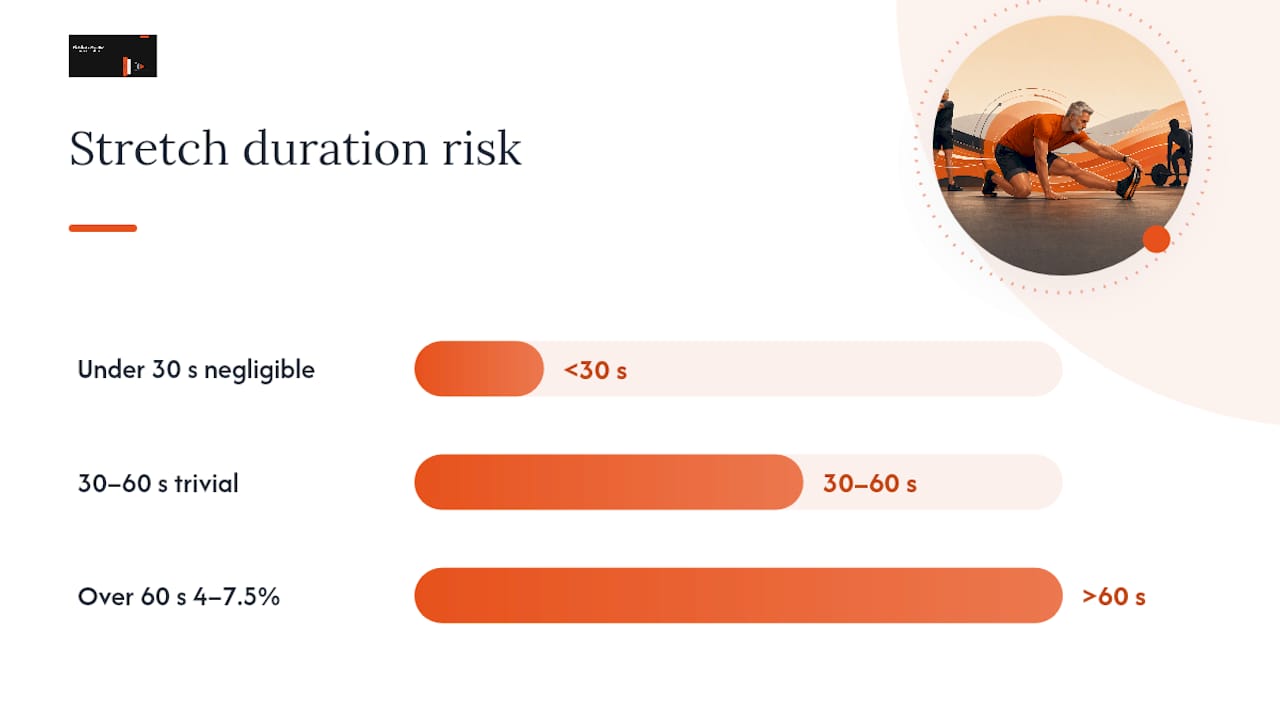
Under roughly 30 seconds per muscle group, the effect on strength and power is negligible in most of the research. Between 30 and 60 seconds, you're still in trivial territory, especially if the stretch is followed by dynamic movement and ramp-up sets. Cross 60 seconds per muscle group and the risk curve steepens, with the Frontiers review reporting declines of 4 to 7.5%, and some older meta-analytic work showing losses approaching that same range or higher when durations stack up across multiple muscle groups.
Accumulated time is the part lifters miss. If you stretch your hamstrings for 30 seconds, then stretch them again for another 30 seconds a few minutes later, that's 60 seconds of total exposure, not two separate "brief" stretches. The research measures total stretch time per muscle group, not per set of stretching. Keep a running mental tally if you're doing any pre-lift static work at all.
A few caveats worth knowing before you build your own rule of thumb:
- Test type changes the picture. Isometric strength tests (like a max squat hold or a force plate reading) tend to show larger deficits than dynamic, ballistic movements like jumping or sprinting.
- Training age matters less than you'd think. The dose-response relationship shows up in both trained and untrained populations, though well-conditioned lifters sometimes show smaller relative deficits.
- Joint and muscle group differ. Multi-joint muscles (hamstrings, calves) and the movements that depend heavily on stored elastic energy (jumping, explosive pulls) appear more sensitive to long-duration stretching than single-joint muscles used in slower, controlled lifts.
The practical takeaway isn't "never stretch." It's "know your number." Sixty seconds total per muscle group, inside a real warm-up, is the line most of the evidence converges on.
Why Does Stretching Sometimes Reduce Strength?
Two mechanisms explain most of what shows up in the data, and both are context-dependent rather than fixed.
The mechanical explanation is about stiffness. Muscles and tendons store and return elastic energy the way a stretched rubber band snaps back. Holding a long static stretch temporarily reduces musculotendinous stiffness, which means less elastic energy gets returned during a lift. That's part of why jumping and explosive movements sometimes show bigger deficits than a controlled squat.
The neural explanation is separate. Longer stretch holds are associated with short-term reductions in motor unit recruitment, measurable through surface EMG amplitude drops after extended static stretching. Your muscle is still capable of producing force, but the nervous system's ability to fully activate it dips for a short window after a long hold.
Here's where dynamic warm-up earns its reputation. Raising muscle temperature through aerobic activity and dynamic movement counteracts both mechanisms to some degree, restoring stiffness and priming the central nervous system for output. This is likely a major reason why brief static stretching folded into a full warm-up shows such small effects compared to static stretching tested in isolation. The lab studies that show the biggest deficits often test stretching cold, with no dynamic component afterward. Your gym warm-up, if you're doing it right, never looks like that.
Your Pre-Lift Warm-Up Should Look Like This
A good warm-up has three jobs: raise your core and muscle temperature, prime your central nervous system, and rehearse the actual movement pattern you're about to load heavy. Static stretching, even the brief kind, does none of these particularly well on its own.
Here's a sequence built around what the evidence actually supports:
- General aerobic work, 4 to 6 minutes. Rowing, biking, or brisk incline walking to raise core temperature without pre-fatiguing anything.
- Dynamic mobility, 4 to 6 minutes. Leg swings, walking lunges with a twist, world's greatest stretch, band pull-aparts. Movement-based, not held positions.
- Activation drills, 2 to 4 minutes. Glute bridges, band walks, scapular retractions. Wake up the muscles you're about to load.
- Ramp-up sets, 8 to 12 minutes total. Progressive loading from light to working weight, rehearsing the exact lift.
That's roughly 20 to 26 minutes for a full session warm-up before your first heavy working set, though most of that overlaps with the beginning of your training session rather than adding dead time.
If you've got a genuinely tight muscle group between sessions, brief static holds still have a place. Keep it to 30 to 60 seconds total per muscle group, and place it early, before the dynamic mobility phase, never right before your ramp-up sets. That order matters: a short static hold followed by five minutes of dynamic movement and ramp-up sets gives your nervous system and muscle temperature time to recover any lost readiness before you touch real weight.
Pro Tip: If you're not sure whether a muscle is "tight" or just undertrained, try the activation drill first. Tightness that disappears after two sets of band work is usually a warm-up issue, not a mobility issue.
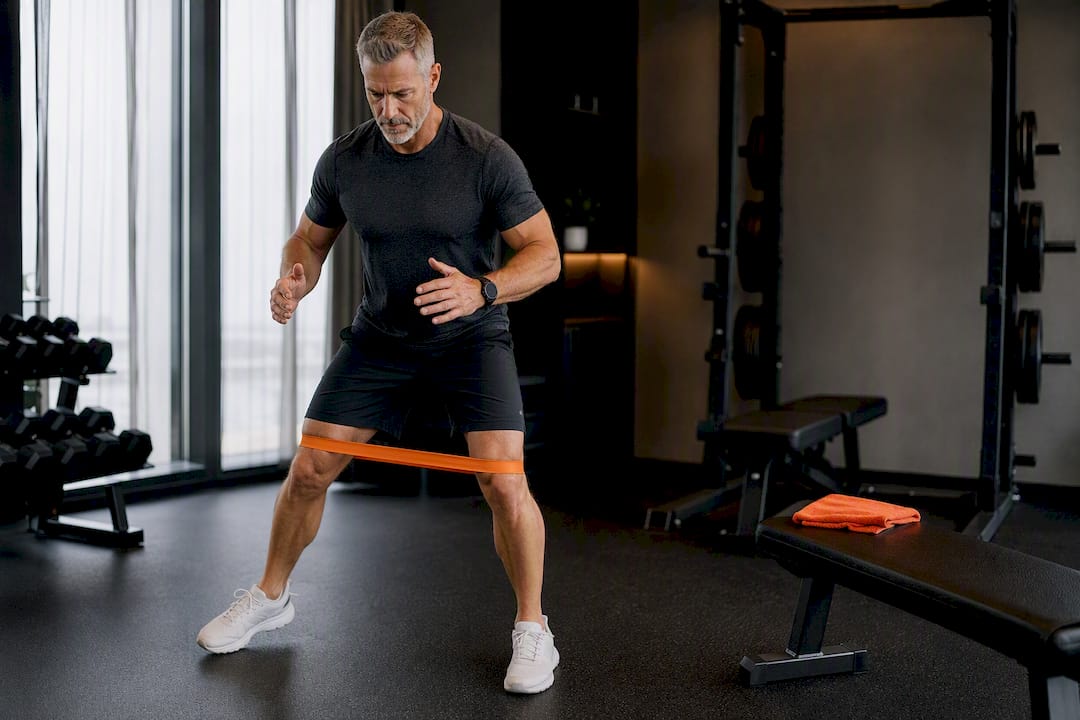
Lifters over 40 benefit from tweaking the pacing rather than the structure. Favor lower-impact aerobic options (bike, rower, incline walk) over jumping rope or high-impact cardio to protect knees and ankles that don't bounce back the way they used to. Extend the ramp-up phase by an extra set or two if a joint feels stiff that day. None of that changes the sequence. It just gives your body more runway to get there.
When Should You Skip Static Stretching Before Lifting?
There are specific situations where even brief static stretching before lifting is the wrong call, and knowing them matters more than memorizing a duration cutoff.
- Skip it before max-effort testing. If today is a 1RM test or a competition attempt, any pre-lift static stretching, even short holds, introduces unnecessary risk for zero benefit. Stick to a conservative ramp-up protocol instead.
- Skip it when peak power or bar velocity is the priority. If you're doing velocity-based training or an explosive lift where every percentage point of output counts, dynamic warm-up alone gets you closer to full readiness.
- Skip it if a joint or muscle is acutely painful. Sharp or acute pain isn't a stretching problem. Talk to your doctor before adding any stretching, static or dynamic, and lean on gentle activation work in the meantime.
- Skip it as a fix for bad form. If you can't hit depth on a squat because of ankle or hip mobility, a 30-second stretch in your warm-up won't solve that. Mobility limitations need dedicated training outside the warm-up window, not a quick patch before you load the bar.
An 8 to 12 Minute Pre-Lift Routine You Can Use Today
This is the compressed version of the full warm-up, built for a normal training day when you don't have 25 minutes to spare.
- Minutes 0 to 3: General aerobic. Bike or rower at an easy pace, just enough to break a light sweat.
- Minutes 3 to 6: Dynamic mobility. Leg swings (10 per side), walking lunges with rotation (8 per side), world's greatest stretch (5 per side).
- Minutes 6 to 8: Activation. Band glute walks (10 steps each direction), scapular pull-aparts (15 reps).
- Minutes 8 to 12: Ramp-up sets. Progressive loading toward your working weight.
For bench press, the same percentage jumps work, though you can compress to four stages if time is tight.
If you've got genuinely tight hip flexors or calves, add one 30 to 60 second static hold per tight muscle group right at minute 3, before the dynamic mobility block starts. Don't add it after minute 8. That's too close to your first working set.
Scaling for joint issues or limited time: cut the aerobic phase to 2 minutes, keep dynamic mobility intact (it's doing most of the real work), and add one extra ramp-up set at a lighter percentage before jumping to your top weight. If you're using wrist wraps or similar support gear for your top sets, know when that gear actually helps versus when it's masking a mobility gap worth addressing separately.
The Evidence Is Clear. The Old Rule Wasn't.
The "never stretch before lifting" rule that dominated gym culture for years wasn't wrong so much as incomplete. It got built on studies that tested long-duration static stretching in isolation, no dynamic warm-up, no ramp-up sets, and treated the result as universal. That's bad science communication, not bad science.
Short holds inside a real warm-up cost you almost nothing. Somewhere in the middle is a threshold most lifters can use without overthinking it: 60 seconds total per muscle group is the line, and everything after that is where the risk climbs.
For lifters over 40, the stakes around this are slightly different than they are for a 22-year-old competitive powerlifter chasing a meet PR. You're less likely to need max-effort testing on a random Tuesday, and more likely to be managing a stiff shoulder or a cranky lower back that makes stretching feel necessary before you touch a barbell. That instinct isn't wrong, it just needs better placement. Save the dedicated flexibility work for outside your warm-up window, and let the warm-up itself do what it's actually good at: raising temperature, priming the nervous system, and rehearsing the movement you're about to load.
If mobility limitations are showing up in your lift technique specifically, that's a signal for dedicated prehabilitation work between sessions, not a longer stretch before your ramp-up sets. And if joint discomfort is part of what's driving the urge to stretch, a joint-friendly warm-up checklist will do more for you than an extra 30 seconds on a hamstring stretch. Conservative progression, not more static holds, is what actually protects a 45-year-old shoulder or knee over a training cycle.
— Iron@40 Staff
Dial In Your Warm-Up With the Right Numbers
Getting the routine right is only half the equation. The other half is knowing your actual working weights and energy needs, so your ramp-up sets and recovery match what your body can handle at your age and training history.

Ironatforty's free training tools let you calculate your estimated 1RM and your daily energy needs before you ever set foot in the gym, so your ramp-up percentages and recovery nutrition are based on your numbers, not a generic chart built for someone half your age. The 1RM calculator gives you the working-weight targets for the ramp-up sequence above, and pairing that with a solid look at your joint health strategy helps you figure out where mobility work belongs in your week versus where it doesn't belong in your warm-up. Start by running your numbers through the calculators, then build your next session's ramp-up sets around what they tell you.
Sources
- Acute Effects of Static Stretching on Muscle Strength and Power: An Attempt to Clarify Previous Caveats
- Effect of acute static stretch on maximal muscle performance (PMID 22692125)
- Does pre-exercise static stretching inhibit maximal muscular performance? A meta-analytical review
FAQ
Is it better to stretch static or dynamic before a workout?
Dynamic stretching and movement are better before lifting because they raise muscle temperature and prime your nervous system without the force deficits associated with long static holds. Brief static stretching (60 seconds or less per muscle group) inside a full warm-up is a reasonable option if you need it, but it isn't required for most lifters.
What is the 3-3-3 rule in gym?
Definitions of this term vary across fitness content, and there's no single research-backed standard behind it, so it's best treated as informal gym shorthand rather than an evidence-based protocol.
When should you avoid static stretching before lifting?
Avoid it before max-effort testing, competition attempts, or any session where peak power and bar velocity are the priority, and skip it entirely if you have acute joint pain until you've talked to a doctor. It's also not the right fix for mobility-driven form breakdowns, which need dedicated mobility training instead.
What are five static stretches lifters commonly use?
Common pre- or post-lift static stretches include the standing hamstring stretch, calf stretch against a wall, hip flexor lunge stretch, doorway chest stretch, and seated glute stretch, each typically held for 15 to 30 seconds per side when used briefly within a warm-up.
Should you foam roll before or after lifting?
Foam rolling before lifting can be used as part of the activation phase since research suggests it has minimal negative effect on strength and may modestly improve short-term range of motion, while foam rolling after lifting is more commonly used for recovery and reducing muscle soreness.
This article provides general fitness information and isn't a substitute for personalized medical advice. Talk to your doctor before starting a new training or stretching routine, especially if you have an existing joint condition, injury, or are taking medication.