Prehabilitation is a short, regular set of targeted exercises and supportive nutrition habits that build joint and connective-tissue resilience so you can keep lifting heavy without breaking down. Think of it as maintenance you do before something goes wrong, not physical therapy you're forced into after it does.
You don't need a coach to start. Three things you can do today:
- Run an 8 to 12 minute joint-prep flow before every lift (more on the exact sequence below).
- Pick two stabilization drills for your weakest joint (shoulder, hip, or knee) and do them consistently instead of chasing novelty.
- Hit a daily protein target of roughly 0.7 to 1 gram per pound of body weight, split across meals.
The framework behind this isn't guesswork. Ironatforty leans on the NASM corrective-exercise continuum, the same inhibit-lengthen-activate-integrate model physical therapists use to fix movement dysfunction, adapted here for lifters who want to stay ahead of injury rather than rehab one. Strength and spine researcher Dr. Stuart McGill's work on stability under load informs a lot of the core-bracing logic you'll see in Section 3.
Key Takeaways
Prehabilitation works because it targets the slow-adapting connective tissue that heavy lifting outpaces, using short, consistent sessions rather than occasional long ones.
| Point | Details |
|---|---|
| Definition | Prehab is short, regular exercise plus nutrition habits that build joint and tendon resilience before injury forces the issue. |
| Follow the four phases | Use inhibit, lengthen, activate, integrate to structure drills for shoulders, hips, knees, and core. |
| Time budget | Run an 8 to 12 minute pre-lift flow daily plus one or two 10 to 15 minute standalone sessions weekly. |
| Protein rule of thumb | Target a moderate protein intake per pound of body weight, split across multiple meals. |
| Use free tools | Ironatforty's TDEE Calculator and Tools hub help set the nutrition and tracking numbers this plan depends on. |
Table of Contents
- Why Prehabilitation Matters More After 40
- The Four-Phase Approach: Inhibit, Lengthen, Activate, Integrate
- A Simple 6 to 8 Week Prehab Program You Can Run Solo
- Nutrition That Actually Supports Joint and Tissue Repair
- How to Track Progress and Know When to Stop
- Minimal Equipment for Home or Garage Gym Setups
- What Actually Works for Lifters Over 40 in Practice
- Put This Into Practice With Ironatforty's Free Tools
- Sources
- FAQ
Why Prehabilitation Matters More After 40
Your muscles adapt fast. Your tendons don't. Muscle shows measurable hypertrophy in about four to eight weeks of consistent training, but tendons and connective tissue often need 12 to 24 months of progressive loading to remodel collagen and catch up. That gap is exactly why a lifter who feels stronger every month can still tweak a shoulder or blow out a knee tendon out of nowhere. The muscle got the memo. The tendon didn't.
Layer in the failure modes that show up disproportionately in lifters over 40:
- Overuse patterns from repeating the same lifts for years without addressing asymmetry.
- Strength imbalances between pushing and pulling, or dominant and non-dominant sides.
- Reduced ankle dorsiflexion and thoracic mobility, both of which quietly wreck squat and press mechanics.
- Slower neuromuscular reaction time, meaning your stabilizers fire a beat late when a rep gets ugly.
Prehab exists to close the gap between what your muscles can produce and what your joints and connective tissue can actually absorb.
That's the whole argument for spending 10 minutes on this instead of walking straight into your working sets. It's also why Ironatforty treats prehab as programming, not an afterthought, using the same corrective-exercise continuum NASM built for clinical movement correction, just applied earlier in the process.
The Four-Phase Approach: Inhibit, Lengthen, Activate, Integrate
This is the engine room of prehab, and it's simpler than it sounds once you see it applied.
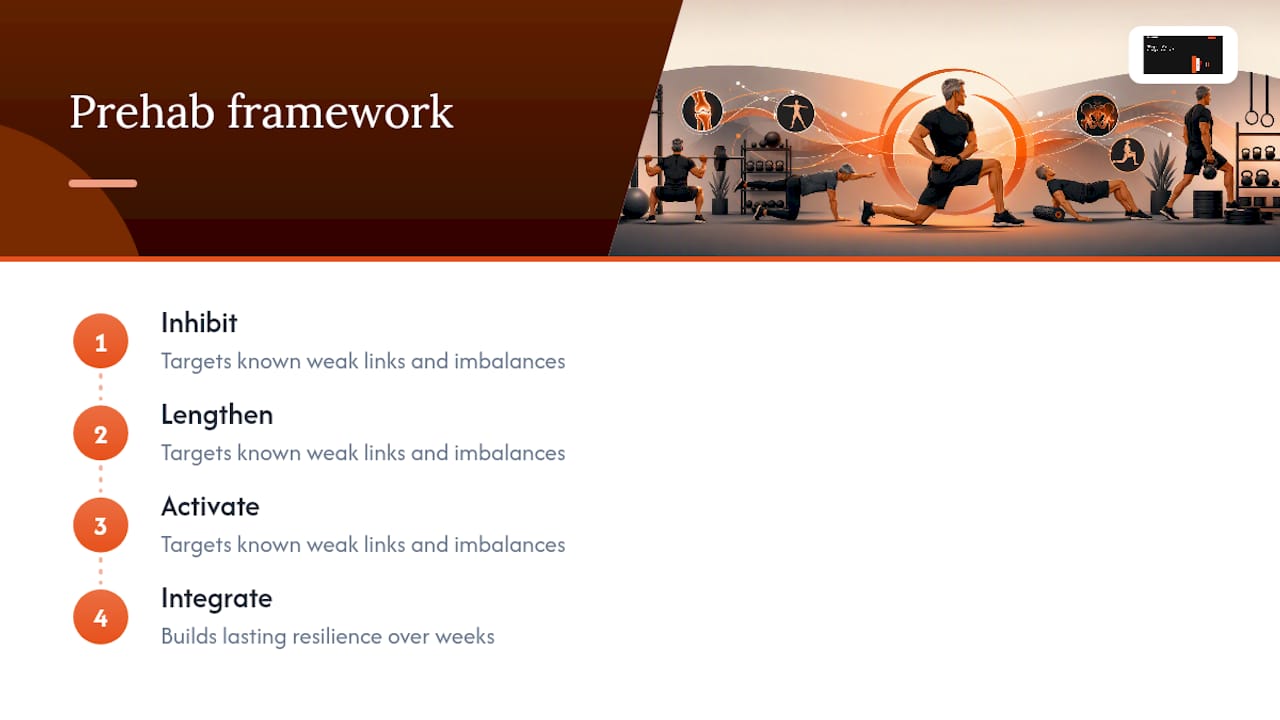
- Inhibit calms down overactive tissue, usually with a lacrosse ball, foam roller, or massage gun on tight spots like the lats, hip flexors, or calves.
- Lengthen restores range of motion in that same tissue through static or dynamic stretching.
- Activate wakes up the muscles that aren't pulling their weight, typically stabilizers that get lazy when bigger muscles compensate.
- Integrate trains those activated muscles inside a real movement pattern, so the improvement actually shows up under the bar.
Here's how that maps to exercises lifters over 40 actually need:
- Shoulders: Banded external rotations and face pulls for activation; wall slides for the lengthen phase.
- Hips: Clamshells and single-leg glute bridges to fix the lateral hip weakness that wrecks knee tracking on squats.
- Knees: Spanish squat isometrics and slow Nordic hamstring curl progressions. Isometric holds around 45 seconds at a moderate knee angle carry an analgesic effect and give patellar tendons a low-peak-load stimulus without the pounding of full-range reps.
- Core: Weighted dead-bugs and side planks, both of which train anti-extension and anti-rotation, the exact demands a heavy squat or deadlift places on your spine.
Where these fit depends on the day. Fold two or three drills into your warm-up before lifting, or run a standalone 10 to 20 minute session on an off day when your trouble joint needs more direct attention.
Pro Tip: Sequence tendon-loading work like Spanish squat isometrics on recovery days, not right before a max attempt. Localized fatigue in the exact tissue you're about to load heavy is how a good idea turns into a strain.

A Simple 6 to 8 Week Prehab Program You Can Run Solo
You don't need a periodized spreadsheet for this. You need consistency and a plan to progress the loading over time.
Weekly structure:
- Lifting days several times per week: 8 to 12 minute pre-lift flow covering breathing, shoulder control, hip and knee prep, ankle mobility, a hinge pattern, and a core brace.
- Off days a couple of times per week: 10 to 15 minute standalone session targeting your specific weak link.
- Total weekly time investment is moderate, which is nothing compared to the training time you'd lose to an actual injury.
Progression checklist across the 6 to 8 weeks:
- Weeks 1 to 2: Establish baseline range of motion and hold times; focus on form over load.
- Weeks 3 to 4: Increase isometric hold duration (aim for 45 to 60 seconds on Spanish squats or wall sits).
- Weeks 5 to 6: Add slow tempo eccentrics, especially on Nordic curls and single-leg work.
- Weeks 7 to 8: Increase band resistance and introduce light balance perturbation, like single-leg reaches on an unstable surface.
One rule matters more than any exercise selection: never front-load your heaviest prehab work immediately before a max-effort lift. Active mobility and light activation drills prep your nervous system without draining force output, but aggressive static stretching or high-volume tendon isometrics right before a heavy set can leave you weaker exactly when you need strength most. Save the harder tendon work for after training or on a separate day. This dovetails with how Ironatforty structures training stress balance across a full week, and if you already run a structured plan, these sessions slot cleanly into periodized programming after 40.
Nutrition That Actually Supports Joint and Tissue Repair
Prehab isn't just movement. What you eat determines whether your tendons and muscles have the raw material to adapt at all.
Aim for 0.7 to 1 gram of protein per pound of body weight daily, and don't dump it all into one meal. Lifters over 40 show a blunted anabolic response to protein compared to younger lifters, meaning your body needs a higher per-meal dose, generally 30 to 40 grams, to trigger the same muscle-protein synthesis response. Spreading that across three or four meals beats one giant dinner.
Do:
- Fatty fish, olive oil, berries, and leafy greens for anti-inflammatory support.
- Adequate hydration and electrolytes, which affect tendon pliability more than people assume.
Don't:
- Load up on added sugars, which drive low-grade systemic inflammation.
- Overdo alcohol, which impairs both sleep quality and tissue recovery.
On supplements: collagen peptides paired with vitamin C show some supporting evidence for tendon health when timed before loading, and omega-3s have a reasonable case for joint comfort. Neither replaces a real protein target. If you're on medication or managing a condition like insulin resistance, check with a clinician before adding anything new.
Pro Tip: Take your collagen or protein dose about 30 to 60 minutes before your prehab flow, not after. The loading that follows is what turns raw material into actual tissue adaptation.
How to Track Progress and Know When to Stop
Reassess every two to four weeks using simple, objective markers instead of guessing whether things feel better.
- Single-leg balance hold time (eyes open, then eyes closed for a harder version).
- Pain-free range of motion on your key lifts, checked with an empty bar or light warmup set.
- Isometric hold duration on your problem joint (track seconds, not reps).
- Bar speed on your first warmup set, a rough proxy for how "ready" your nervous system is that day.
Log these numbers. If a metric stalls or drops for two consecutive checks, dial back intensity before it becomes a real setback.
Red flags that mean stop and call a professional, not push through: sharp or radiating pain, swelling that builds day over day, or any noticeable loss of motor control in a joint. None of that is "just soreness," and no prehab drill is worth training through it.
Minimal Equipment for Home or Garage Gym Setups
You need less gear than you think:
- A resistance band set (light, medium, heavy loops)
- One light dumbbell or kettlebell
- A single anchor point, like a door anchor or pole
- A yoga mat and a small bench or box
No cable machine for face pulls? Loop a band through a door anchor. No Spanish squat machine? Anchor a strap around a pole at knee height and lean back into it. Choose band resistance conservatively at first. Progressive overload applies to bands too, and grabbing the heaviest one out of the gate defeats the point of controlled, joint-friendly loading.
What Actually Works for Lifters Over 40 in Practice
Consistency beats perfection, every single time. The lifters who stay injury-free for years aren't doing elaborate 45-minute prehab routines. They're doing a boring 8 to 12 minute flow before nearly every session, without skipping it when they're tired or short on time.
The biggest mistake we see is trying to fix every joint at once. Pick the two drills that address your actual weak link, whether that's a cranky shoulder or a knee that barks on leg day, and rotate secondary work weekly instead of cramming everything into one session. Depth of focus beats breadth of exercise selection.
Put This Into Practice With Ironatforty's Free Tools
Ironatforty exists so you can build a real prehab and nutrition plan without paying for a personal coach to hand you the same information. Once you know your protein target and training load, the next step is dialing in the numbers, and that's exactly what our free tools are built for.
Start with these:
- The TDEE Calculator to nail down your daily calorie baseline before setting a protein target.
- The full Tools hub for tracking strength progressions alongside your prehab work.
- The Joints resource for deeper programming ideas once you've got the basics running.
None of this replaces a doctor or physical therapist if you're already dealing with an injury. Prehab is prevention, not treatment. If something hurts sharply or doesn't improve after a few weeks of consistent work, see a clinician before you self-program your way into a bigger problem.
Sources
These sources shaped the framework, physiology claims, and exercise templates in this guide:
- Prehabilitation guide — NASM blog
- Injury Prevention Prehab: Joint-by-Joint Strategy | PoinT GO Research
- Prehab Exercise Guide: 8–12 Min Joint Prep Routine — HealthLifeBlog
FAQ
What Is Prehabilitation in Simple Terms?
Prehabilitation is a short, regular routine of targeted exercises and supportive nutrition that builds joint and tendon resilience to reduce injury risk before it happens, unlike rehab, which treats an injury after it occurs.
How Is Prehab Different From a Regular Warm-Up?
A warm-up raises body temperature and preps you for that day's session, while prehab specifically targets known weak links and imbalances using the inhibit-lengthen-activate-integrate framework to build lasting resilience over weeks.
How Long Should a Prehab Session Take?
An 8 to 12 minute flow before lifting covers most needs, with an optional 10 to 15 minute standalone session on off days for a specific problem joint.
Can I Do Prehab Without a Coach?
Yes. The exercises are low-equipment and self-guided, and Ironatforty's free tools can help you set the nutrition and load-tracking numbers that support the routine.
How Much Protein Do I Need for Joint and Tissue Repair?
Aim for roughly 0.7 to 1 gram of protein per pound of body weight daily, spread across 3 to 4 meals rather than concentrated in one sitting.