The safety squat bar earns its keep by solving a problem the straight bar can't fix: it lets you squat heavy without loading your shoulders into a compromised position. Expect more upper-back and trunk demand, a quad-shifted movement pattern, and a genuine option for training through shoulder or rack-position limits. The catch is that loads typically run 5 to 15% lower than your straight-bar numbers, and how that translates to your back squat depends entirely on how you program it.
TL;DR:
- The safety squat bar typically loads 11.3% fewer reps than a straight bar at the same effort level, requiring programming adjustments.
- Its anterior center of mass promotes a more upright torso, increasing upper-back activity and emphasizing the quads over the posterior chain.
- The bar is especially beneficial for those with shoulder limitations, upper-back development goals, or during shoulder rehab, but transfers to competitive back squat are inconsistent.
- biomechanical studies show reduced trunk and hip flexion and higher velocity at submax loads, though long-term effects depend on specific programming.
- Programming strategies include using it as a primary, accessory, or rehabilitative tool, with conservative load increases and mobility work to prevent overuse.
Table of Contents
- Safety Squat Bar Benefits Start With the Design
- Key Benefits: Performance, Rehab, and Coaching Advantages
- What the Research Says About SSB vs Barbell Squats
- How to Program the Safety Squat Bar for Real Results
- Safety Squat Bar Exercises Worth Adding to Your Program
- Who Should Use the SSB and When to Be Careful
- Coaching Cues for SSB Training
- Coaching the SSB for lifters over 40
- Get More Out of Your SSB Training With Free Ironatforty Tools
- Sources
- FAQ
Safety Squat Bar Benefits Start With the Design
Before you can understand why the safety squat bar changes your training, you need to see what's physically different about the tool. The SSB isn't a straight bar with pads slapped on. It's a fundamentally different lever.
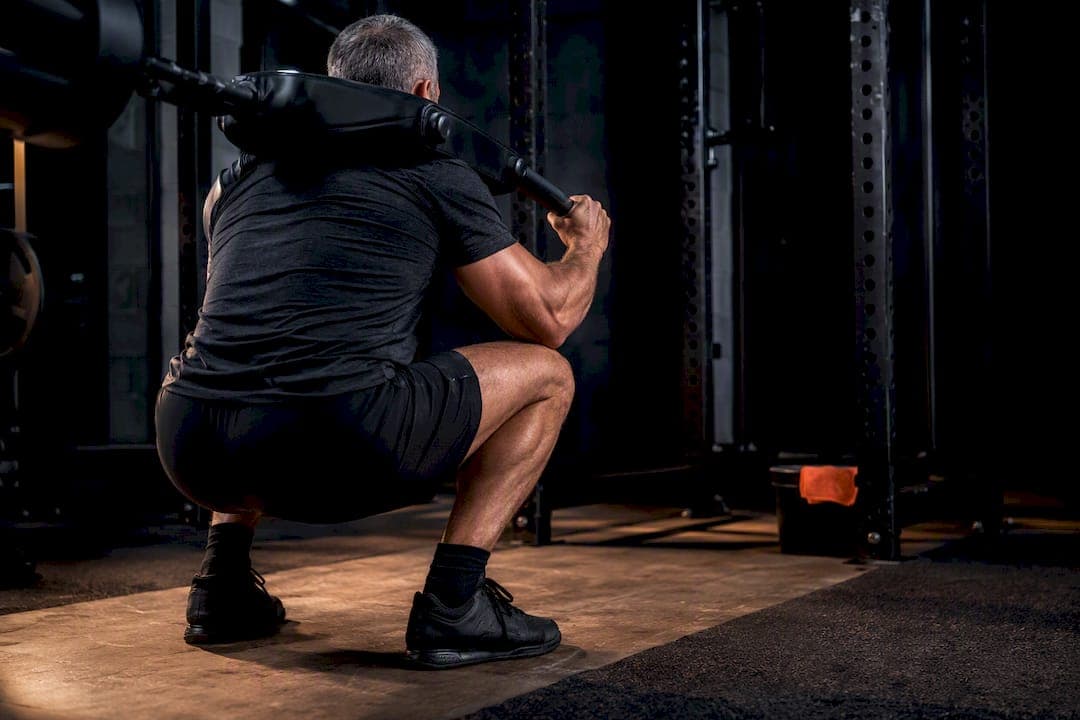
The cambered yoke sits forward of your shoulders, shifting your center of mass anterior compared to a standard barbell. That single design choice is why almost every other benefit exists. Your torso responds by staying more upright, which changes the entire demand profile of the lift.
- The cambered yoke curves around your neck and rests on padded shoulder supports rather than crossing your traps in a straight line.
- Forward handles let you grip in a neutral or semi-pronated position, taking your shoulders out of external rotation entirely.
- Grip independence means your hands do almost none of the stabilizing work a straight bar demands, which is exactly why lifters with shoulder impingement or a history of labrum issues gravitate toward it.
- The padded yoke distributes pressure across a wider surface, reducing the localized trap and cervical discomfort some lifters get under a straight bar.
- Commercial SSBs generally run in the 60 to 75 pound range unloaded and are rated for typical gym loading, so weight math on your plates needs a quick recalibration versus your usual bar.
That anterior shift in center of mass is the mechanical root of everything covered below. It's not a gimmick. It's a lever change.
Key Benefits: Performance, Rehab, and Coaching Advantages
Here's where the safety bar squat benefits actually show up in your training, not just on a spec sheet.
- Upper-back and trunk development. Because the load sits forward, your torso has to stay more upright to keep the bar path over your midfoot. That upright position forces your erectors and lower traps to work harder to resist the bar pulling you into flexion. Hecker et al. measured this directly and found a large jump in lower-trapezius activation during SSB squats compared to standard back squats.
- Quad emphasis and altered mechanics. The forward load increases the knee moment arm relative to the hip, which shifts work toward the quads and away from the posterior chain compared to a traditional back squat. If your goal is quad-driven hypertrophy or you're chasing knee extension strength for sport, this is a legitimate tool, not a substitute for real front squats.
- Shoulder and thoracic accessibility. This is the benefit most lifters over 40 actually care about. If external rotation at your shoulder is painful, or you can't get into a comfortable rack position because of a stiff thoracic spine, the SSB lets you keep squatting heavy while that issue resolves.
- Transfer and trade-offs. The SSB is not a free upgrade. Hecker et al. also documented reduced trunk and hip flexion during the SSB squat, meaning the movement pattern genuinely differs from a back squat rather than just feeling different. Direct transfer to your competition back squat is inconsistent unless you program it deliberately.
Don't panic when your SSB numbers look smaller than your back squat. That's the tool working as designed, not a sign you're weaker.
Pro Tip: Track your SSB working weight separately from your back squat max. Comparing them directly will make you think you're regressing when you're actually building a different quality.
What the Research Says About SSB vs Barbell Squats
The peer-reviewed literature on the SSB is still thin, but the studies that exist are consistent enough to draw real conclusions, provided you respect their limits.
The most cited paper here, from Hecker et al. in the Journal of Strength and Conditioning Research, found trunk flexion dropped by roughly 7.3 degrees and hip flexion by roughly 5.7 degrees during SSB squats compared to straight-bar squats, alongside a 50.3% increase in lower-trapezius activation. That's a meaningful shift in joint angles for a lift most people assume looks identical regardless of bar.
- Trunk and hip flexion both decrease on the SSB, confirming the more upright torso position lifters and coaches describe anecdotally.
- Lower-trapezius activation rises sharply, which lines up with the upper-back demand claim.
- The same research recorded an 11.3% decrease in 3RM load on the SSB compared to the straight bar at matched effort.
- Several other muscle activations decreased at matched relative loads, meaning the SSB isn't simply "harder everywhere."
A more recent controlled study published through MDPI adds a velocity dimension: lifters produced a higher mean propulsive velocity with the SSB at tested loads, along with higher peak velocity at 85% of 1RM. That's a counterintuitive finding given the load is typically lower, and it suggests the SSB's altered bar path may let some lifters move weight faster relative to their max, not just heavier.
A separate 2026 comparative analysis measured joint power output at the ankle and hip and found real differences between bar types, while confirming that 1RM values differ between the standard barbell and SSB under tested conditions. It found no EMG differences for some lower-limb muscles, a reminder that not every muscle group responds to the bar switch.
The honest interpretation: these are small-sample, acute studies measuring single sessions or short protocols. They tell you what happens biomechanically in the moment, not what happens to your squat over a full training cycle. Long-term transfer is a programming question, not a biomechanics question, and no study yet answers it definitively.
How to Program the Safety Squat Bar for Real Results
The SSB works best when you treat it as a tool with a specific job, not a permanent replacement for your primary squat.
- Primary role (4 to 8 week block). Run the SSB as your main squat pattern when you're chasing upper-back conditioning, working through shoulder discomfort, or want a change of stimulus after a long back squat block.
- Secondary role (once weekly accessory). Pair it with your normal back squat training as a second squat session, using it to build trunk stiffness and quad volume without adding fatigue to your primary lift's specific pattern.
- Rehab-bridging role. Use light to moderate SSB work to keep squat volume in your program while a shoulder issue resolves, then transition back to the straight bar once you're pain-free in the rack position.
Calibrate your starting load conservatively.
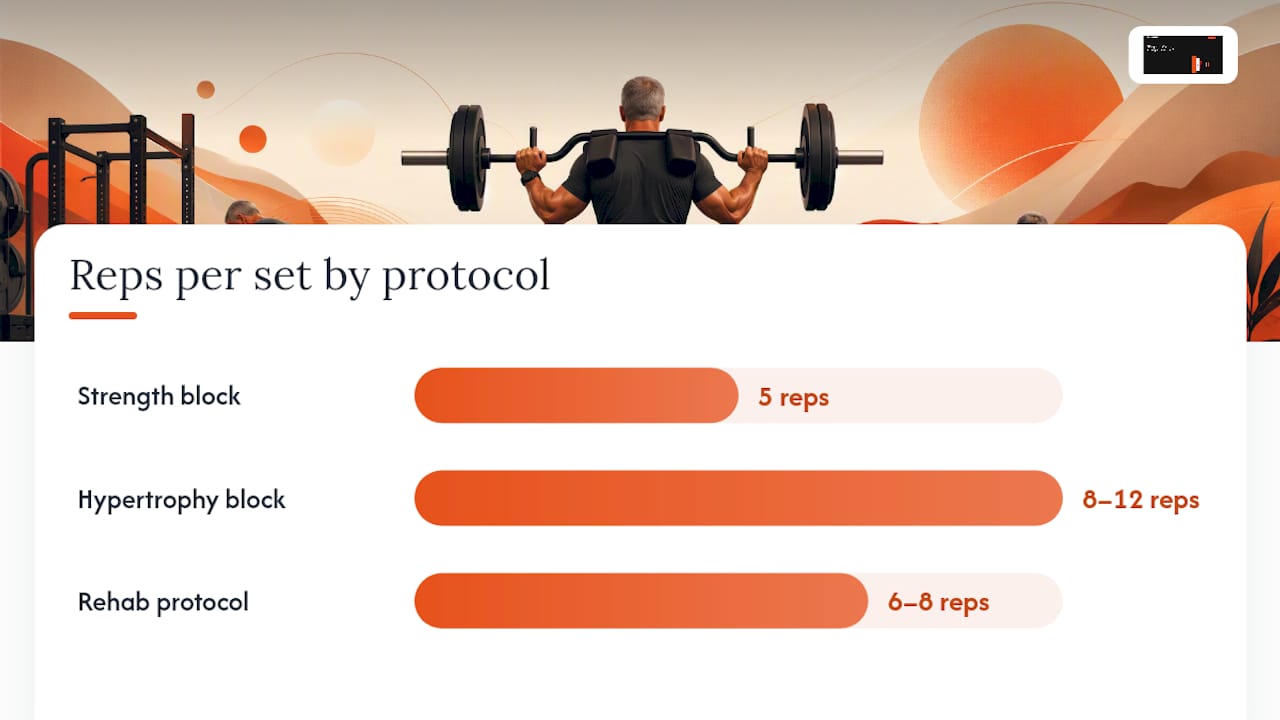
Sample strength block: 4 sets of 5 reps at RPE 7 to 8, three days apart, for 5 weeks, adding load only when the last set feels like RPE 7 or lower.
Sample hypertrophy block: 3 to 4 sets of 8 to 12 reps, two sessions weekly, with a tempo pause at the bottom to increase time under tension for the quads.
Rehab-friendly protocol: 3 sets of 6 to 8 reps at a conservative RPE 5 to 6, prioritizing pain-free range of motion over load, adjusted week to week based on how your shoulder responds.
Pro Tip: If your upper back is smoked from an SSB session, don't stack heavy deadlifts or rows the same day. The erector and trap demand from the SSB compounds fast with other posterior-chain work, and that's how a good training week turns into an overuse problem.
Safety Squat Bar Exercises Worth Adding to Your Program
The standard SSB back squat is the foundation, but the variations are where this bar earns a permanent spot in your gym.
- Standard SSB back squat. Set the pad so the yoke sits evenly across both shoulders, grip the handles firmly, and push forward against them to stay tall. The most common setup error is letting the bar sit too high on the neck, which defeats the padding's purpose entirely.
- Pause and tempo SSBs. A two to three second pause at the bottom builds positional strength and forces genuine postural control, since the forward load punishes any collapse instantly.
- SSB box squats and Kang/Anderson variations. These target specific joint angles and are useful for lifters working on strength out of the bottom or managing knee discomfort at full depth.
- Unilateral SSB split squats and lunges. Loading one leg at a time with the SSB exposes and corrects side-to-side imbalances that a bilateral squat can mask for years.
- SSB good mornings. With the load already shifted forward, the good morning variation becomes a solid posterior-chain accessory that still keeps the shoulder-friendly setup intact.
Who Should Use the SSB and When to Be Careful
The SSB fits a specific set of lifters especially well: anyone with shoulder mobility limits, anyone chasing more upper-back and quad work, and anyone rehabbing an upper-body injury who still wants to squat heavy.
Be more cautious if you have active lumbar pathology or haven't built enough erector and thoracic tolerance yet, since the upright torso demand hits that area hard and fast.
- Check pad placement every session. It shouldn't sit directly on your cervical spine.
- Adjust handle angle to something that lets your wrists stay neutral, not forced into extension.
- Progress load gradually. The upper-back fatigue often lags a day behind the session, so don't judge tolerance from how you feel walking out of the gym.
- Talk to a physical therapist or qualified coach before using the SSB as a rehab bridge if you have a diagnosed shoulder or spine condition.
Coaching Cues for SSB Training
Getting the SSB right comes down to a few repeatable cues, not complicated technique overhauls.
- Push the handles forward like you're bracing against a wall. That single cue keeps your chest tall and prevents the forward lean that turns the SSB into a good morning.
- Brace your midsection hard before you unrack, the same way you would for any heavy squat. A strong anti-flexion brace makes the upright position far easier to hold.
- Pair your SSB sessions with regular hip and thoracic mobility work so the upright demand doesn't turn into lower-back compensation.
- Use the 1RM calculator to set your SSB working weights independently from your back squat numbers.
Coaching the SSB for lifters over 40
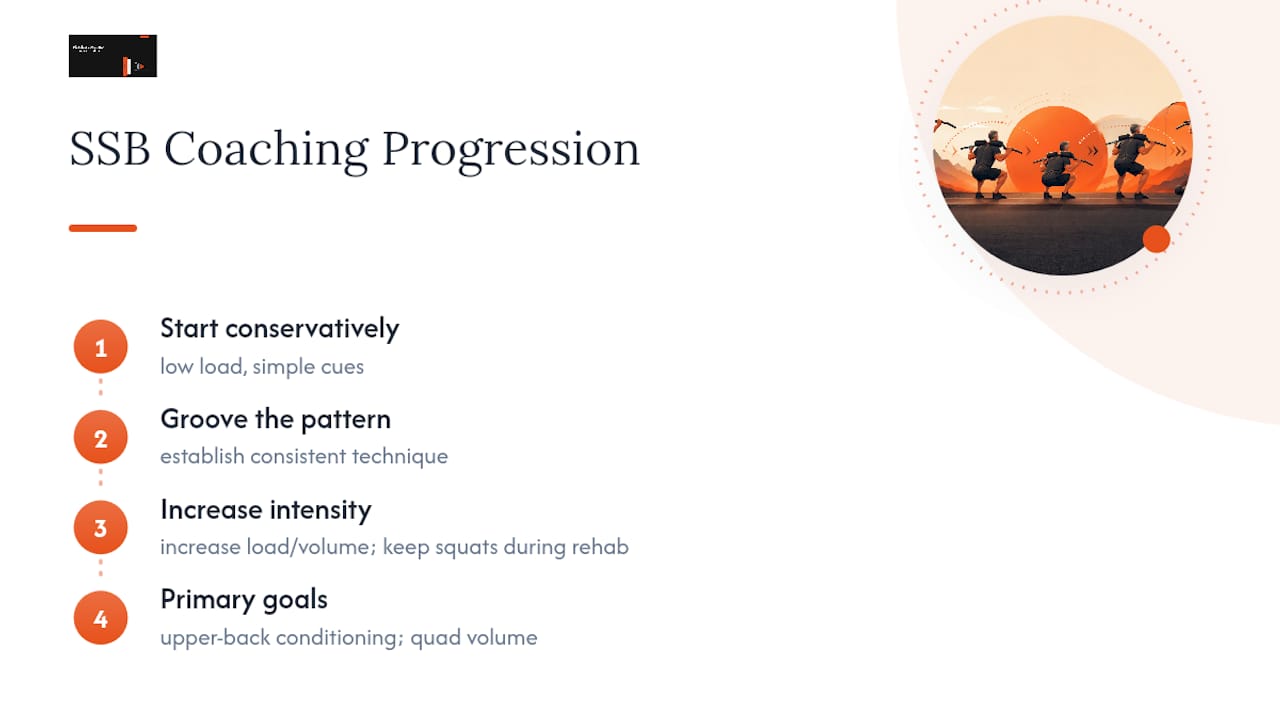
Coaching should be done conservatively at first, then more aggressively once the pattern is grooved. Realistic expectations matter here. The focus is on building upper-back conditioning and quad volume, and in many cases, maintaining squat training during shoulder rehab periods when using a straight bar is not feasible.
Get More Out of Your SSB Training With Free Ironatforty Tools
Programming the SSB well comes down to knowing your numbers, and guessing at load is how lifters either stall out or overdo the upper-back demand too fast. Ironatforty gives you two free calculators built specifically for this kind of adjustment. Run your 1RM Calculator to set SSB-specific working weights instead of borrowing your back squat max, and use the TDEE Calculator to make sure your calories actually support the recovery a new upper-back stimulus demands.
If you're bridging back from a shoulder issue, our prehab guide walks through how to sequence mobility work around heavier SSB sessions. And if joint health is the bigger concern driving you toward the SSB in the first place, our joints resource hub breaks down recovery strategies built for lifters over 40. Start with the 1RM calculator this week and build your next SSB block around real numbers instead of a guess.
Sources
- Effects of the safety squat bar on trunk and lower-body mechanics during a back squat (Hecker et al.)
- Effects of the Safety Squat Bar on Trunk and Lower-Body Mechanics During a Back Squat — J Strength Cond Res (Hecker et al.)
- Neuromuscular performance differences between traditional barbell and safety squat bar (MDPI)
- Comparative study on SB vs SSB neuromuscular responses (2026)
FAQ
Is it harder to squat with a safety squat bar?
It feels different rather than uniformly harder. Your upper back and trunk work more due to the upright torso demand, while Hecker et al. found 3RM loads run about 11.3% lower than on a straight bar at matched effort.
Is doing 10 squats equal to a 30 minute walk?
No, they train different systems entirely. Ten heavy squats build strength and muscle through mechanical tension, while walking is a low-intensity cardiovascular activity, and neither substitutes for the other in a well-rounded program.
Which is better for me, a back squat or a safety bar squat?
Neither is universally better. The back squat carries more direct transfer if you compete in it, while the SSB is the stronger choice when shoulder limits, upper-back weakness, or quad-focused goals are driving your decision.
Where should the safety squat bar be placed?
The padded yoke should sit evenly across both shoulders, similar height to where you'd rest a straight bar, with the handles gripped firmly enough to push forward and keep your torso upright throughout the lift.