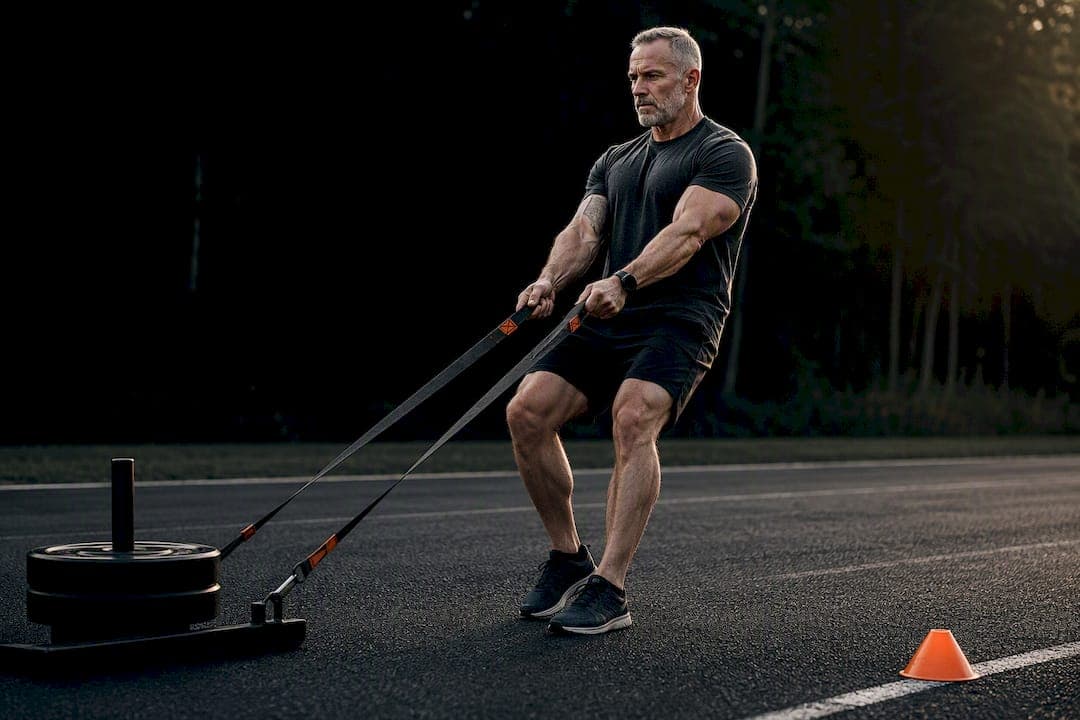
The reverse sled drag is a backward sled pull that hammers the quads and builds conditioning while sparing your knees the eccentric pounding that squats and lunges deliver. You walk backward, harness or straps attached to a loaded sled, driving through your legs the entire way. It works because almost all the muscle action is concentric, so there's little of the muscle damage that comes from lowering under load. That makes it useful for general leg conditioning and, in many cases, for knee rehab once your clinician has cleared you for loaded movement.
TL;DR:
- Reverse sled drags primarily strengthen the quadriceps through concentric movement, allowing frequent training without causing soreness or microtrauma.
- Using light loads and small steps is essential to maintain proper posture, avoid leaning back, and prevent strain on the lower back.
- The movement is effective for knee rehab and conditioning, especially when performed daily with low volume, progressing gradually in load and distance.
- Bodyweight or resistance-band alternatives can replicate the concentric benefits for those without access to a sled, increasing resistance gradually over time.
- Sled work should be introduced only after professional clearance, with attention to pain signals and asymmetries, to prevent aggravating existing knee issues.
Table of Contents
- What Is a Reverse Sled Drag and Why Do Lifters Use It?
- What Muscles Does the Reverse Sled Drag Work?
- How Do You Perform a Reverse Sled Drag Correctly?
- How Do You Program Reverse Sled Drags for Rehab and Strength?
- When Should You Avoid Sled Drags or See a Clinician First?
- What If You Don't Have Access to a Sled?
- Why Trust Ironatforty's Take on Sled Training?
- Our Take: Stop Treating Sled Work Like a Warmup
- Sources
- FAQ
What Is a Reverse Sled Drag and Why Do Lifters Use It?
You load a sled, hook up straps or a harness, then walk backward while keeping steady tension on the cable. That's the entire setup. No barbell, no rack, no complicated technique to memorize.
What makes it worth your time is what it does for your legs without beating them up. Here's the short list:
- Quad strength without the soreness — the movement is almost entirely concentric, so you can train it often without the two-day limp.
- Blood flow for recovery days — light sled work between heavy sessions helps flush the legs.
- Real conditioning — a few rounds and your heart rate climbs fast, especially with heavier loads.
- Low eccentric stress — no lowering phase means less microtrauma to muscle fibers.
Compare that to the sled push, which loads the quads and glutes through both concentric and eccentric phases and tends to hit the hips and lower back harder. The drag is the gentler cousin. If you're managing a cranky knee or just tired of feeling wrecked after leg day, the reverse sled drag deserves a spot in your rotation.
What Muscles Does the Reverse Sled Drag Work?
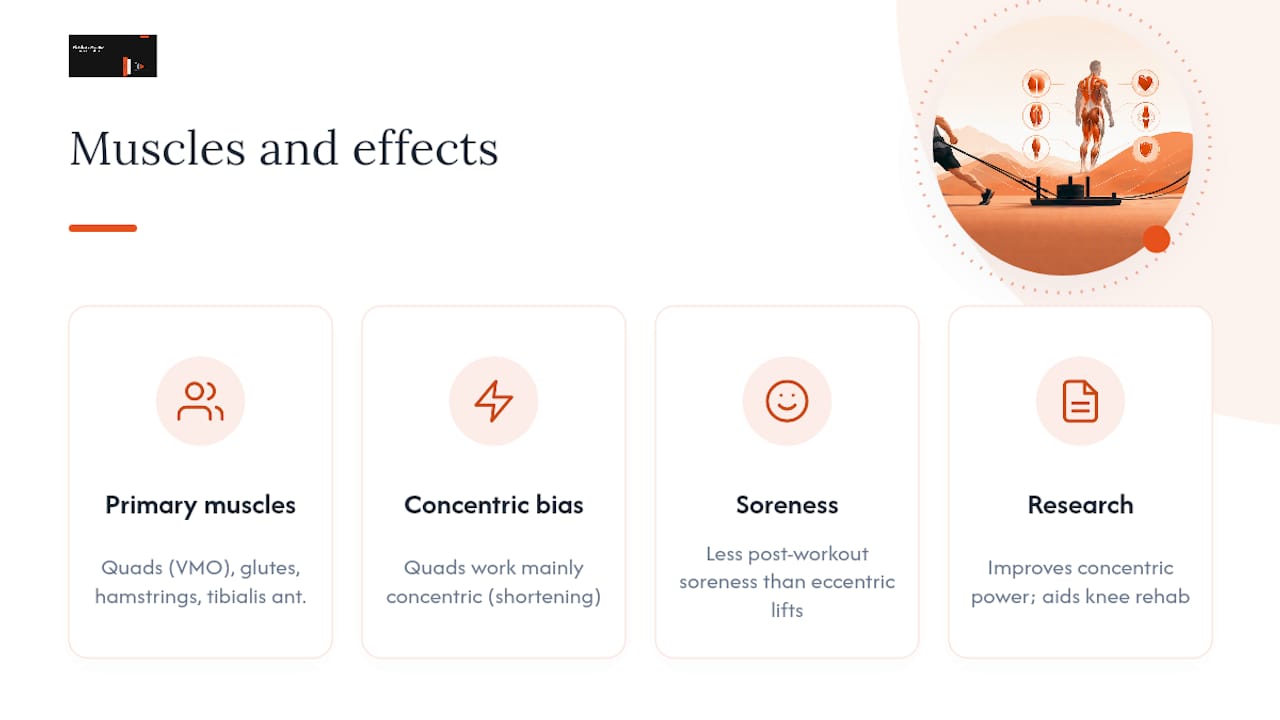
The quadriceps, particularly the vastus medialis oblique (VMO), do most of the work here, with your glutes, hamstrings, and tibialis anterior pitching in to stabilize the stride. Your core stays braced the entire time to keep your torso upright against the pull of the sled.
The mechanics matter more than the muscle list. Walking backward against resistance keeps your quads working almost purely on the concentric side, meaning the muscle shortens under load instead of lengthening under load, like it does when you descend into a squat. That concentric bias is exactly why sled work doesn't leave you sore the way eccentric-heavy lifts do.
Research on resisted backward movement backs this up. Studies using sled resistance scaled to body mass show improvements in concentric power and eccentric strength markers over several weeks of resisted backward movement training. Separately, retro-walking research on knee osteoarthritis patients has shown gains in quadriceps strength and joint function through backward walking rehabilitation programs, which lends real support to using backward movement patterns as a rehab tool, not just a conditioning gimmick.
How Do You Perform a Reverse Sled Drag Correctly?
Start lighter than your ego wants. This is not the lift to test your max on day one.
Setup:
- Attach a harness or hand straps to the sled. Harnesses free your hands; straps let you feel the tension more directly.
- Load the sled light for your first few sessions. You should be able to maintain a steady pace without gasping.
- Face the sled, step back until the cable or strap has slight tension, then set your stance shoulder-width apart.
Execution:
- Take small, controlled steps backward, driving through the ball of your foot.
- Keep your torso upright and your chest up. Don't lean back to compensate for the load.
- Maintain constant tension on the strap or harness. Never let the cable go slack between steps.
- Cover your chosen distance, then walk back around to reset.
The most common mistake is leaning back like you're waterskiing. That shifts the load off your quads and onto your lower back. The fix is simple: shorten your stride and stay tall. The second mistake is going too heavy too soon, which turns small controlled steps into a lurching shuffle. Drop the weight until your steps look clean.
Coaching guides consistently point to the same cues: stay low, take small powerful steps, and never let the tension drop, cues echoed across reverse sled drag technique breakdowns used by trainers everywhere.
Starter set: 4 rounds of 20 to 30 meters (or 30 to 40 seconds), light load, with 60 to 90 seconds of rest between rounds.
Pro Tip: Film your first session from the side. Most lifters are shocked at how far back they're leaning until they see it on video.
How Do You Program Reverse Sled Drags for Rehab and Strength?
Progression here isn't about piling on plates. It's about matching the load to your goal, whether that's rehab, conditioning, or general strength endurance.
A simple progression ladder looks like this:
- Regression: bodyweight backward walking, no sled, for reps or distance.
- Base level: light sled, short distances (20 to 30 meters), high frequency.
- Conditioning level: moderate sled load, interval format (work to rest ratios around 1:2).
- Strength endurance level: heavier sled, shorter distances, longer rest between sets.
For rehab-focused use, daily light-volume sessions tend to work well because there's minimal muscle damage to recover from. Think 3 to 5 short bouts most days, not a once-a-week grind. For conditioning, intervals of 20 to 40 meters with short rest hit the cardiovascular system hard while still sparing the joints. For strength endurance, heavier loads over shorter distances with fuller recovery between sets build capacity without turning into a max-effort test.
Load prescription doesn't need to be complicated. Some coaches scale sled weight as a percentage of body mass, or track velocity decrement, the drop in your walking speed as load increases, to find a dose that's challenging without wrecking your gait. Sprint-training research on backward sled towing suggests moderate velocity decrements produce a meaningful training stimulus, while lighter loads preserve tolerance and conditioning value, per research on resisted backward sled training. For lifters 40+, that usually means starting lighter than you think you need and adding load in small increments every one to two weeks, not every session. Once your knee tolerates consistent volume without swelling or pain the next day, you can start reintroducing eccentric work gradually, things like reverse step-ups or slant board progressions, to rebuild the lowering strength the sled deliberately skips. For a broader framework on adding load responsibly, our guide to progressive overload for lifters over 40 covers the same principle applied across your whole program.
When Should You Avoid Sled Drags or See a Clinician First?
Stop the movement if you feel sharp pain, buckling, or swelling that shows up the next day. Those are signals your knee isn't ready for the load, not signals to push through.
Sled work isn't automatically safe just because it's concentric-dominant. Laboratory research on towing a sled after ACL reconstruction found that sled towing increases knee and hip joint moments, and can produce movement asymmetries in people early in ACLR recovery. That's a real reason clinicians are cautious about prescribing sled work too soon after surgery.
Use a simple pain scale during and after sessions, anything above mild discomfort (say, 3 out of 10) that lingers past a day is a signal to back off. Check for left to right symmetry in your stride, too. Talk to your doctor or physical therapist before starting sled work if you're recovering from surgery, have an unstable knee, or have any diagnosed joint condition you haven't cleared for loaded exercise. This isn't a movement to self-prescribe your way through a fresh injury.
What If You Don't Have Access to a Sled?
You don't need a gym-grade sled to get the same concentric benefit. Bodyweight backward walking is the simplest regression, and it still trains the same movement pattern.
- Single-leg sled drags for lifters chasing more unilateral quad work and stability.
- Alternating-leg drags to mimic natural gait patterns more closely.
- Resistance-band backward walks, looped around a rack or anchor point, for a portable version anywhere.
- Plate-on-towel drags across a gym floor or garage, useful if you travel or train at home.
To match intensity without a sled, increase resistance gradually, heavier bands, more plates, or steeper resistance, while keeping the same short, controlled steps. The goal stays the same across every variation: constant tension, no eccentric lowering, and steady effort over distance or time.
Why Trust Ironatforty's Take on Sled Training?
This site exists because lifters over 40 got tired of recycled gym advice that ignores what aging joints actually need. The site offers joint-friendly training resources built around the same principle behind this article: match the tool to the tissue, not the trend.
Our recommendations lean on peer-reviewed research on backward gait and sled biomechanics, cross-checked against what actually holds up in training programs for lifters managing knee issues. If you're building a week around sled work, guides to training programs for adults over 40 and a TDEE calculator can help you plan the conditioning load and the calories to support it.
Our Take: Stop Treating Sled Work Like a Warmup
Most gym advice treats the reverse sled drag as filler, something you do for five minutes before the "real" workout starts. That's backward. For lifters over 40, this movement deserves a real slot in your program, not a leftover corner of it.
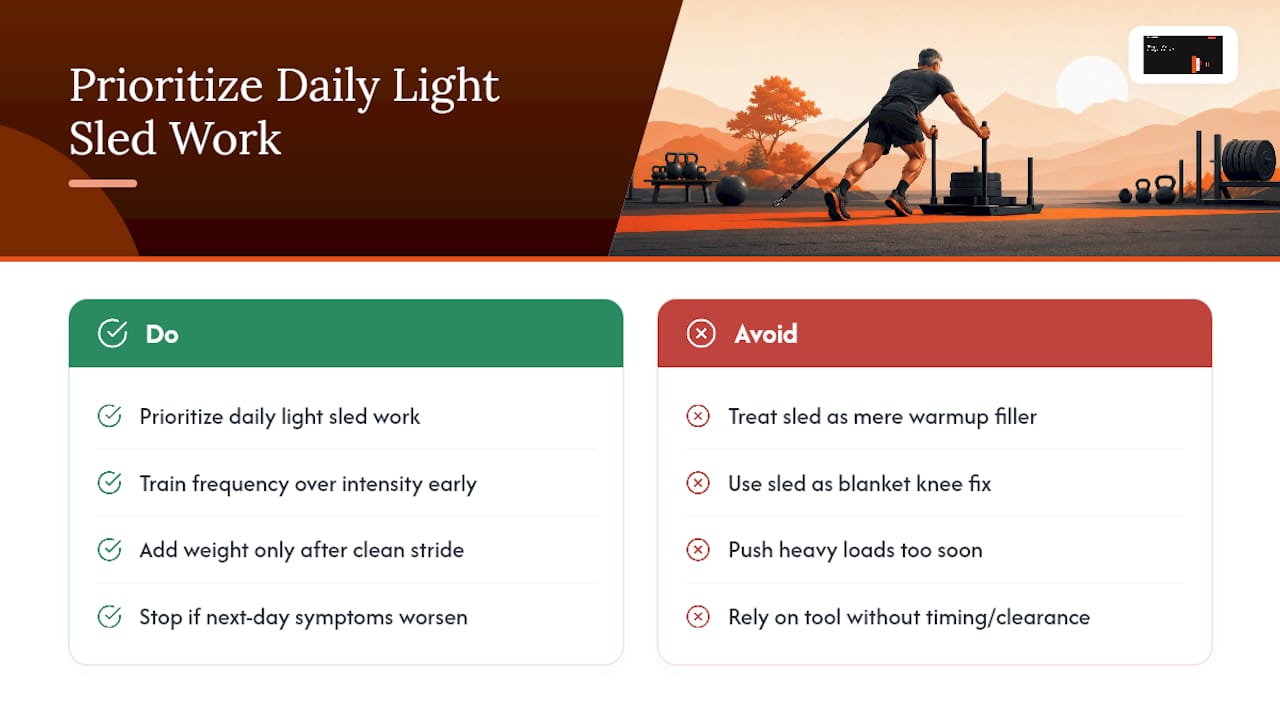
The conventional advice gets two things wrong. First, it undersells how useful low-damage concentric volume is for a joint that's already cranky, you can train it far more often than a squat variation and actually recover between sessions. Second, it oversells sled work as a blanket fix for knee pain, when the evidence on backward gait and ACL recovery says timing and clearance matter more than the tool itself.
What should you prioritize? Frequency over intensity early on. A knee that tolerates daily light sled work is building real capacity, even if the load looks unimpressive on paper. Add weight only when your stride stays clean and your next-day symptoms stay flat. That's the whole program, no hype required.
— Iron@40 Staff
This article is general information, not a substitute for advice from a qualified doctor. Consult a qualified healthcare professional about your own circumstances before acting on anything here.
Sources
- Biomechanical profiles when towing a sled and wearing a weighted vest after ACL reconstruction
- Systematic review/meta-analysis references on backward walking and rehabilitation
- Research summary on resisted sprint/backward movement training (2026)
- Reverse sled drag: video exercise guide & tips — Muscle & Strength
FAQ
What Does the Reverse Sled Drag Work?
It primarily trains the quadriceps, especially the VMO, with secondary work for the glutes, hamstrings, tibialis anterior, and core stabilizers through a concentric-dominant movement pattern.
What Should You Do Instead of a Reverse Sled Drag if You Have No Sled?
Bodyweight backward walking, resistance-band backward walks, or plate-on-towel drags approximate the same concentric quad emphasis without any sled equipment.
What Muscles Does a Sled Drag Work Overall?
Both sled pushes and sled drags hit the quads, glutes, and hamstrings, but the drag leans more heavily on quad-dominant concentric loading while the push adds more hip and posterior chain demand.
What Is the Difference Between a Sled Push and a Sled Drag?
A sled push loads muscles through both concentric and eccentric phases and tends to stress the hips and lower back more, while a sled drag is largely concentric, making it gentler on the knees and easier to recover from.
Is the Reverse Sled Drag Safe for Knee Rehab?
Many rehab programs use backward sled or gait work once a clinician clears loaded movement, but sled towing increases joint moments and can create asymmetries early after ACL reconstruction, so professional clearance matters before starting.