
Evidence from randomized trials shows metformin commonly blunts muscle hypertrophy during progressive resistance training in older adults. The clearest signal comes from the MASTERS trial, where 14 weeks of supervised lifting produced significantly smaller gains in lean mass and thigh muscle size for the metformin group compared to placebo. Strength and function outcomes tell a messier story, with some studies pointing to real benefits for grip strength and mobility. If you're over 40 and lifting on metformin, size gains may run slower, but that's not the whole picture.
TL;DR:
- Metformin significantly reduces lean mass and thigh muscle size gains during resistance training in adults over 65, with a very low p-value indicating a strong effect.
- The drug activates AMPK, which inhibits the mTORC1 pathway essential for muscle protein synthesis and hypertrophy, explaining the blunted size gains.
- In frailer older men, metformin may improve strength and mobility by stabilizing neuromuscular junctions, showing benefits beyond muscle size.
- To offset metformin’s effects, lifters should focus on progressive overload, higher protein intake, and longer training periods, especially when tracking function rather than just size.
- Always consult your healthcare provider before modifying metformin use, as stopping or changing the medication can impact blood sugar management, and goals should guide the decision.
Table of Contents
- What the Research Shows About Metformin and Muscle Gain
- Inside the MASTERS Trial: What Actually Happened
- Why Metformin Blunts Hypertrophy: The Molecular Story
- When Metformin Helps: The Neuromuscular Function Angle
- Training and Nutrition Adjustments for Lifters on Metformin
- Talking to Your Doctor About Metformin and Training Goals
- The IronAtForty Take on Metformin and Muscle Gain
- Tools to Help You Train Smarter Around Metformin
- Sources
- FAQ
What the Research Shows About Metformin and Muscle Gain
The evidence base here isn't huge, but it's unusually well-designed for a supplement or drug question in strength training. Three lines of research carry the most weight, and each one answers a slightly different question.
- The MASTERS trial (Walton et al., published in Aging Cell) is the flagship randomized, double-blind, placebo-controlled study. It found metformin blunted gains in lean body mass and thigh muscle mass during supervised progressive resistance training in adults 65 and older.
- Transcriptome analysis from the same research group, published in the journal Aging, dug into muscle biopsy samples and found metformin altered gene expression tied to extracellular matrix remodeling, the scaffolding process muscle needs to grow bigger.
- A 2024 study in Archives of Gerontology and Geriatrics looked at a different population, frailer geriatric men, and found metformin was tied to improved handgrip strength and physical performance, with signs of neuromuscular junction stabilization.
Here's where it gets interesting: the endpoints that moved were not uniform. Lean mass and thigh CT area dropped in the metformin groups with statistical significance. Strength measures like leg press and knee extension showed a similar downward trend, but not always one that crossed the threshold for significance. Handgrip strength, tested in an entirely different, frailer population, moved the other way.
Duration matters too. Most of this research ran around 14 weeks, which is the enough time to see meaningful hypertrophy from a well-run resistance program but far short of the months or years a real-world lifter spends chasing size and strength. The MASTERS cohort skewed toward generally healthy older adults, while the Archives study focused on men with existing functional disabilities. That population gap explains a lot of the apparent contradiction, and it's worth keeping in mind before you draw sweeping conclusions from either study alone.
Inside the MASTERS Trial: What Actually Happened
The MASTERS trial remains the single most cited piece of evidence on metformin and muscle gain, and for good reason. It was built to answer exactly this question with real rigor: randomized, double-blind, placebo-controlled, and run across multiple centers with supervised training sessions rather than a "go lift on your own" honor system.
Participants were adults 65 and older. Half received metformin at a dose of approximately 1,700 mg per day, split across the day; the other half got a placebo. Both groups completed the same structured progressive resistance training program for 14 weeks, hitting major compound lifts under supervision so adherence and technique weren't confounding variables.
The Numbers: Metformin users gained significantly less lean body mass than the placebo group, with a statistically significant between-groups difference (https://pubmed.ncbi.nlm.nih.gov/31557380/). Thigh muscle mass measured by CT scan showed an even sharper gap, at p < .001.
Those are not marginal statistical footnotes. A p-value that low means the size difference between groups was very unlikely to be random noise. The full trial data also tracked strength outcomes using DXA scans for lean mass and CT imaging for thigh muscle area and density, alongside functional strength tests.
What's notable is the asymmetry between size and strength results:
- Lean mass and thigh muscle area: statistically significant reduction with metformin.
- Muscle density on CT: trends favored placebo, though not always reaching significance.
- Strength measures like leg press one-rep max: trended lower with metformin but didn't consistently hit statistical significance.
That gap between "smaller muscle" and "not definitively weaker" is one of the more underappreciated findings in this entire body of research. Limitations matter here too. The trial ran in generally healthy older adults, not people managing severe frailty or advanced diabetes complications, so the results don't automatically generalize to every metformin user. Fourteen weeks also captures early-phase hypertrophy, not the plateau-and-adapt cycles that define years of consistent training. A larger sample and a longer intervention window would sharpen the picture considerably.
Why Metformin Blunts Hypertrophy: The Molecular Story
Understanding the "why" here matters if you're going to make smart decisions about training around this drug rather than just training scared. The mechanism runs through two competing cellular signaling pathways that most lifters have never heard of but that directly shape whether a hard training session turns into muscle growth.
Metformin's primary mode of action is activating AMPK, an enzyme that functions as the cell's energy sensor. AMPK gets switched on when cellular energy runs low, and one of its jobs is to conserve resources by putting the brakes on energy-expensive processes. Muscle protein synthesis, the process that actually builds new muscle tissue after a lifting session, runs through a pathway called mTORC1. AMPK and mTORC1 work in opposition: when AMPK activity rises, mTORC1 signaling tends to get suppressed.
Resistance training normally triggers a strong mTORC1 response, which is exactly what drives the adaptation you're chasing under the bar. Layer chronic AMPK activation from metformin on top of that same training stimulus, and you get a tug-of-war where the anabolic signal doesn't win as cleanly.
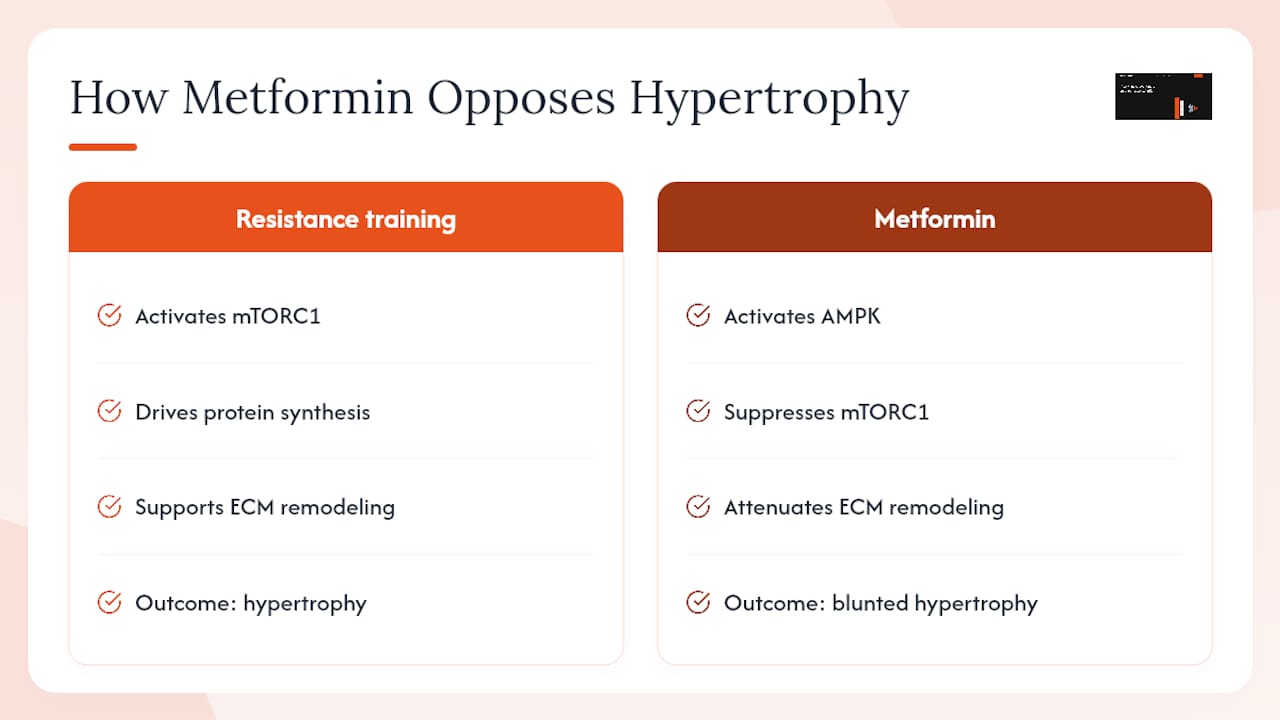
The transcriptome data backs this up at the gene expression level. Muscle biopsies from trial participants showed metformin attenuated the normal training-induced rise in genes tied to extracellular matrix remodeling, the connective tissue scaffolding that muscle fibers need to remodel and expand around as they grow. Blunt that process, and you blunt the structural side of hypertrophy even if the fibers themselves are firing hard.
Here's the nuance that gets lost in most gym-forum takes on this topic: the same transcriptome work flagged changes in pathways tied to cellular senescence and autophagy, both linked to how tissue ages over time. That opens a real possibility that metformin trades some short-term size for longer-term cellular maintenance benefits, a tradeoff that plays out very differently depending on whether your priority is looking jacked at 55 or staying mobile and injury-resistant at 75.
Pro Tip: If you're chasing size on metformin, don't just add more volume to compensate. Add more protein and more patience. The molecular brakes on hypertrophy respond better to sustained, generous nutrition and a longer training runway than to grinding out extra sets.
When Metformin Helps: The Neuromuscular Function Angle
Not every study lines up neatly behind "metformin equals smaller gains," and the outliers deserve real attention instead of being waved off as noise. A 2024 study in Archives of Gerontology and Geriatrics found metformin associated with improved handgrip strength and better physical performance scores in geriatric men dealing with functional disabilities. The researchers also flagged evidence pointing toward stabilization of the neuromuscular junction, the connection point where nerve signals reach muscle fibers and tell them to fire.
The population gap explains most of the apparent contradiction with the MASTERS results:
- MASTERS enrolled generally healthy older adults doing a structured hypertrophy-focused lifting program.
- The Archives study looked at frailer geriatric men already dealing with functional limitations, where the outcome that mattered was walking speed and grip strength, not muscle size on a CT scan.
Different starting points, different questions, different answers. A healthy 68 year old chasing bigger legs under a barbell is not the same case as an 80 year old struggling to get out of a chair. In the frailer group, the nervous system's ability to fire muscle reliably may be the limiting factor, and if metformin genuinely helps stabilize that neuromuscular connection, you'd expect exactly the kind of grip strength and mobility gains this study reported, independent of whether muscle fibers themselves are growing.
Both patterns can be true at once because hypertrophy and function are not the same target. A muscle can grow more slowly while still firing more reliably. That distinction is easy to miss if you only track the number on a tape measure, and it's precisely why function-based testing deserves more weight than most lifters give it once they're past 60.
Training and Nutrition Adjustments for Lifters on Metformin
None of this means metformin turns your gym time into a waste. It means you adjust your inputs to compensate for a drug that's putting a partial brake on the anabolic signal. Here's what actually moves the needle:
- Anchor your program around progressive overload on compound lifts. Squats, presses, rows, and deadlift variations recruit the most muscle mass and generate the strongest mTORC1 signal available to you. A minimum effective dose approach works well here, since it keeps you consistent rather than chasing junk volume that adds fatigue without adding stimulus.
- Hit 1.2 to 1.6 grams of protein per kilogram of body weight daily. Older muscle tissue is less responsive to a given protein dose than younger tissue, a phenomenon researchers call anabolic resistance, and metformin's molecular brakes make that resistance a little steeper still.
- Split that protein into leucine-rich meals of roughly 25 to 40 grams, or about 0.4 to 0.55 grams per kilogram per meal. Spreading intake this way keeps muscle protein synthesis switched on more consistently across the day instead of relying on one enormous dinner.
- Get protein in near your training session, ideally within a couple of hours before or after. This isn't about some narrow "anabolic window" myth, it's about making sure the raw material is available when the mTORC1 signal is already fighting an uphill battle.
- Track strength and function, not just the mirror. Log your working weights on major lifts, and if you want a second data point, time yourself on a simple gait or step test every few weeks. A 1RM calculator can help you estimate true strength progress without constantly testing to failure.
- Give the program more time than usual before judging results. Fourteen weeks was the trial window, but real hypertrophy decisions play out over 6 to 12 months. Training age changes what your program should look like, and that's doubly true when a medication is part of the equation.
On monitoring: tape measures and progress photos are fine for motivation, but they're blunt instruments. DXA and CT scans, the tools researchers used in these trials, are far more precise at catching real changes in lean mass, but they're not something you'll run monthly on your own. Functional tests like grip strength, gait speed, or a simple sit-to-stand timer are cheap, repeatable, and arguably more meaningful for a lifter over 40 than a half-pound shift on the scale.
Pro Tip: Don't panic if your one-rep max climbs while your measurements barely move. Strength and size can decouple on metformin, and a stronger lift with a steady tape measure is still a genuine win, not a plateau.
Talking to Your Doctor About Metformin and Training Goals
This is the part where good judgment matters more than gym enthusiasm. Metformin is prescribed for real medical reasons, usually type 2 diabetes management or prediabetes prevention, and those reasons don't disappear because you want bigger quads.
Do not stop or reduce metformin on your own. Abrupt cessation carries real risk for people managing blood sugar, and the modest hit to hypertrophy documented in trials is not a reason to gamble with glycemic control.
Worth Weighing: The MASTERS trial's lean mass difference reached p = .003, a real effect but still a modest one over 14 weeks compared to the well-established metabolic benefits metformin provides for diabetes management.
What you can do is bring a specific, informed conversation to your next appointment:
- Ask whether metformin is medically necessary for your specific case, or whether it was prescribed more conservatively.
- Ask if a supervised trial period off the drug, with baseline testing and monitored reintroduction, would be appropriate given your health profile.
- Ask about alternative glucose-lowering strategies, dose timing adjustments, or a monitored drug holiday if hypertrophy is a genuine priority for you.
Your clinician might also weigh whether your main goal is size or function, a key consideration in embracing healthy aging with functional medicine. If mobility and fall prevention matter more than bicep size, the calculus shifts entirely, and the neuromuscular benefits seen in frailer populations become the more relevant data point.
The IronAtForty Take on Metformin and Muscle Gain
Most of the internet treats this as a binary: metformin is either a muscle killer or a secret weapon. It's neither. It's a tradeoff, and tradeoffs require you to know what you actually want first.
If your priority is maximum hypertrophy and you have flexibility in your medical situation, talk to your doctor about the options above, because the data on blunted lean mass gains is real and reproducible. But if your priority is staying functional, mobile, and metabolically healthy into your 70s and 80s, the same drug that slows your bicep growth might be protecting the exact systems that let you keep training at all. Define which goal comes first before you let a percentage on a research paper dictate your next move.
Our longevity-focused training guidance exists precisely for lifters wrestling with this exact tension, where the goal isn't just growing muscle but keeping the whole system running well enough to keep training at all.
— Iron@40 Staff
Tools to Help You Train Smarter Around Metformin
If metformin is putting a partial brake on your hypertrophy, the fix isn't more suffering in the gym, it's tighter execution on the variables you fully control. Ironatforty built its free tools specifically for lifters over 40 navigating exactly this kind of trade-off.
Start with the TDEE calculator to nail down your true daily calorie needs, since a surplus that's too small will sabotage hypertrophy faster than any medication will. Pair that with the 1RM calculator to track strength progress objectively instead of guessing. Our full nutrition guidance for lifters over 40 breaks down protein timing and leucine thresholds in more depth than any single article can, and it's built around the same anabolic-resistance realities that make metformin's effects more pronounced with age. Browse the full toolkit and start tracking your numbers today instead of relying on a mirror that lies more than a spreadsheet does.
Sources
The research behind this article comes from a small set of tightly focused studies, each answering a different piece of the puzzle:
- Metformin blunts muscle hypertrophy in response to progressive resistance exercise training in older adults: The MASTERS trial
- Metformin blunts muscle hypertrophy in response to progressive resistance exercise training in older adults: The MASTERS trial (PMC full text)
- Metformin alters skeletal muscle transcriptome adaptations to resistance training in older adults
- Metformin improves skeletal muscle and physical capacity by stabilizing neuromuscular junction in older adults
This article is general information, not a substitute for advice from a qualified doctor. Consult a qualified healthcare professional about your own circumstances before acting on anything here.
FAQ
Why Do Some Bodybuilders Take Metformin?
Some bodybuilders use metformin off-label hoping for metabolic or longevity benefits, but the trial evidence actually shows it can blunt muscle and strength gains from resistance training in older adults, the opposite of a bodybuilding advantage.
Is Metformin Hard on Your Muscles?
Metformin doesn't damage muscle tissue, but the MASTERS trial found it significantly reduces the amount of lean mass and thigh muscle size gained from a structured resistance training program in older adults.
Why Do I Feel So Good on Metformin?
Metformin improves blood sugar control and insulin sensitivity for many people, which often reduces fatigue and energy crashes tied to blood sugar swings; a 2024 study also linked it to improved grip strength and physical performance in some older, functionally limited men.
Does Metformin Boost Testosterone?
The trials reviewed here did not find metformin to be a testosterone booster; its documented effects center on AMPK activation, blunted hypertrophy signaling, and in some populations, improved neuromuscular function rather than hormonal changes.
Can You Still Build Muscle While Taking Metformin?
Yes, muscle growth is still achievable on metformin, but expect it to progress more slowly than it would off the drug; prioritizing progressive overload, adequate protein intake of 1.2 to 1.6 g/kg daily, and longer training windows helps offset the blunting effect documented in trial data.