Yes: progressive strength training is safe and appropriate for most people with osteoporosis, and it's one of the few interventions that actually builds bone instead of just slowing its loss. The catch is technique. Spine-sparing movement patterns, individual screening, and a program that respects recent vertebral fractures are non-negotiable. This isn't generic gym advice — it's backed by consensus statements and clinical trial data, not gym folklore.
TL;DR:
- Maintaining proper technique and avoiding spinal flexion during exercises are crucial to prevent fractures and ensure safe bone-loading.
- Consistent adherence to prescribed resistance training, especially with moderate-to-high intensity and progressive overload, produces meaningful increases in bone density at the spine and hip.
- Movements that load the spine directly, such as squats, step-ups, deadlifts, and back extensions, are the most effective for stimulating bone growth in osteoporotic patients.
- Balance and spinal extensor endurance exercises significantly reduce fall risk, which is essential for fracture prevention beyond improving bone density.
- High-impact or power training should be introduced only after building a strength base and with professional supervision, especially for individuals with recent fractures or high risk.
Table of Contents
- Why Osteoporosis Strength Training Actually Works
- Safety First: Screening Rules and Movements to Avoid
- What a Bone-Focused Program Should Include
- An 8 to 12 Week Sample Program You Can Actually Follow
- Safe Exercises by Movement Pattern
- When to Bring in a Physical Therapist or Physician
- Training Smarter After 40: Nutrition and Recovery Notes
- The Myth That Keeps People From Lifting
- Get Started With IronAtForty's Training Tools
- Primary Sources and Further Reading
- Sources
- FAQ
Why Osteoporosis Strength Training Actually Works
Bone responds to mechanical stress the same way muscle does. When you load a joint through resistance training, muscles pull on tendons, tendons pull on bone, and that pull triggers osteoblasts to lay down new bone tissue. Ground reaction forces from standing exercises add a second stimulus. This is why walking alone rarely moves the needle at the hip or spine — those sites need direct, targeted loading to adapt, not just general activity.
The site-specific nature of this response matters more than most people realize. Your femoral neck doesn't care how many steps you logged on a treadmill; it responds to squats, step-ups, and loaded hip work. Your lumbar spine responds to controlled axial loading like deadlifts and back extensions, not aerobic movement.
The data backs this up with real numbers. A 2023 systematic review found that resistance programs following ACSM-style dosing, meaning consistent adherence to prescribed sets, reps, and intensity, produced a standardized mean difference of 0.31 at the lumbar spine and 0.45 at the femoral neck. Programs with poor adherence showed far smaller changes. That gap between high-adherence and low-adherence groups tells you something coaches have said for years: showing up and following the plan matters as much as the plan itself.
Bone Density Gains by Adherence Level
Programs that stuck closely to prescribed loading, frequency, and progression saw meaningfully greater bone mineral density improvements than programs where people trained inconsistently or backed off intensity too early. This adherence effect showed up specifically at the femoral neck and lumbar spine, the two sites where osteoporotic fractures cause the most disability.
Beyond bone density, multimodal programs that combined resistance training with impact loading and balance work improved muscle strength, functional power, and dynamic balance in randomized trials. Stronger legs and better balance mean fewer falls, and fewer falls mean fewer fractures regardless of what your bone scan says. That's the part of this equation people underestimate: strength training protects you even on days your bones don't visibly change.
Effects vary by dose, training site, and how consistently you progress, which is exactly why the next section covers safety before programming.
Safety First: Screening Rules and Movements to Avoid
Before you load a barbell, you need an honest inventory of your risk factors. Not because strength training is dangerous, but because the wrong movement pattern on a fragile spine can turn a training session into an emergency room visit.
Run through this checklist, ideally with a doctor or physical therapist, before starting:
- History of vertebral compression fractures, even old ones
- Recent falls or a sense of unsteadiness during daily activities
- Balance impairments, vertigo, or inner-ear issues
- Comorbidities like severe kyphosis, rheumatoid arthritis, or cardiovascular conditions
- Medications that affect bone density, such as long-term corticosteroids
- Current bone density scores (T-scores) and fracture risk category from your physician
If you've had a recent vertebral fracture, treat your program as a clean slate. Consensus guidance recommends limiting impact activity to brisk walking until a qualified professional clears you for more.
Certain movements carry outsized risk for anyone with reduced bone density, and they show up constantly in mainstream fitness content. Weighted spinal flexion, the kind you get from sit-ups, crunches, and toe touches with a plate held to your chest, compresses the front of the vertebrae exactly where compression fractures happen. Loaded rotation, like a weighted Russian twist or a golf-swing simulation with a cable, combines flexion and rotation in a way that multiplies the risk. Uncontrolled forward bending, whether it's picking a dumbbell off the floor with a rounded back or a deep, unbraced good morning, loads the spine at its most vulnerable angle.
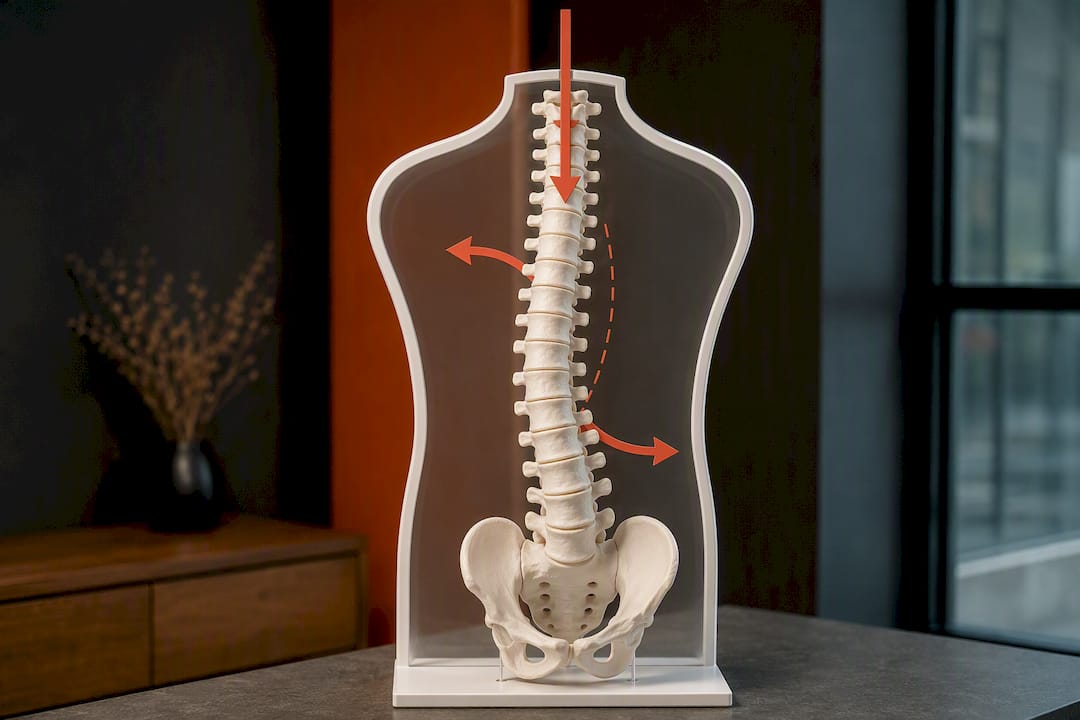
The fix isn't avoiding movement. It's swapping the pattern. Replace crunches with dead bugs or standing anti-rotation presses. Replace loaded twists with Pallof presses, which train rotational strength without moving the spine at all. Replace rounded-back deadlifts with a hip hinge cued from a neutral spine, hips driving back before the knees bend.
Three cues will carry you through almost every exercise in this article:
- Neutral spine first. Brace your core lightly and keep the natural curve of your lower back before you move any weight.
- Hinge from the hips, not the low back. Any time you bend forward, think "push the hips back" rather than "fold at the waist."
- Limit overhead and above-shoulder loading early on. Save heavier pressing above shoulder height until you've built base strength and confirmed your shoulder mobility doesn't force your spine into extension.
Pro Tip: Film yourself from the side during your first few sessions of any new exercise. A rounded back during a deadlift setup is nearly invisible to you but obvious on video, and catching it early prevents months of reinforcing the wrong pattern.
If you're newly diagnosed or training after a fracture, work with a physical therapist or a coach experienced in spine-sparing technique for at least your first several sessions. The UK consensus statement on osteoporosis exercise is explicit that supervised instruction matters most in this early window.
What a Bone-Focused Program Should Include
A program built for bone health needs three ingredients working together: progressive resistance, controlled impact or power work, and balance training. Skip any one of them and you leave gains on the table.
Progressive resistance training is the foundation. Aim for at least two non-consecutive days per week, working in the 8 to 12 rep range per set, which clinical reviews associate with meaningful bone mineral density improvements when combined with moderate-to-high intensity, roughly 70 to 85% of your one-rep max, or an RPE of 6 to 8 out of 10 if you're not testing a true max. The principle that makes this work over months, not weeks, is progressive overload: once a weight feels like an 11 or 12 rep effort at 12 reps, it's time to add load, not before.
Impact and power training comes next, and it deserves more respect than most osteoporosis guides give it. High-velocity movement, think low box step-downs or gentle heel drops, provides a bone stimulus that slow, controlled resistance work doesn't fully replicate. But power training should wait until you've built a base of strength and ideally have supervised coaching, especially if your fracture risk is elevated. This isn't a beginner-day-one exercise category.
Balance and spinal extensor endurance round out the program, and skipping them is the most common mistake IronAtForty sees in people rebuilding after a diagnosis. Bone density is only half the fracture-prevention equation; the other half is not falling in the first place. Simple standing balance drills and prone or standing back extensions build the postural endurance that keeps you upright when you trip on a curb.
Here's how these three elements typically split across a week:
- Two resistance training sessions, full body, 8 to 12 reps per set, 3 to 4 sets per major movement pattern.
- One to two short balance sessions, 5 to 10 minutes, which can be tacked onto the end of a resistance day.
- Impact or power elements added within resistance sessions once you have 6 to 8 weeks of consistent, well-executed strength work behind you.
Programs that hit these targets consistently show the largest gains in both bone density and function. Programs that skip balance work or never progress load past week one tend to plateau early, regardless of how many days per week someone trains.
An 8 to 12 Week Sample Program You Can Actually Follow
Structure beats intensity when you're building a habit that has to last for years, not weeks. This template uses a simple A/B split you can run two to three times weekly.
Warm-up (5 to 8 minutes): Light cardio like marching or a stationary bike, followed by hip circles, cat-cow (moving gently, never forcing end-range flexion), and bodyweight squats to prime the pattern.
Session A
- Sit-to-stand squats or goblet squats, 3 sets of 8 to 12 reps
- Hip hinge (dumbbell deadlift or cable pull-through), 3 sets of 8 to 12 reps
- Standing band row, 3 sets of 10 to 12 reps
- Standing single-leg balance, 3 sets of 20 to 30 seconds per side
Session B
- Wall or incline push-up progressing toward standard push-up, 3 sets of 8 to 12 reps
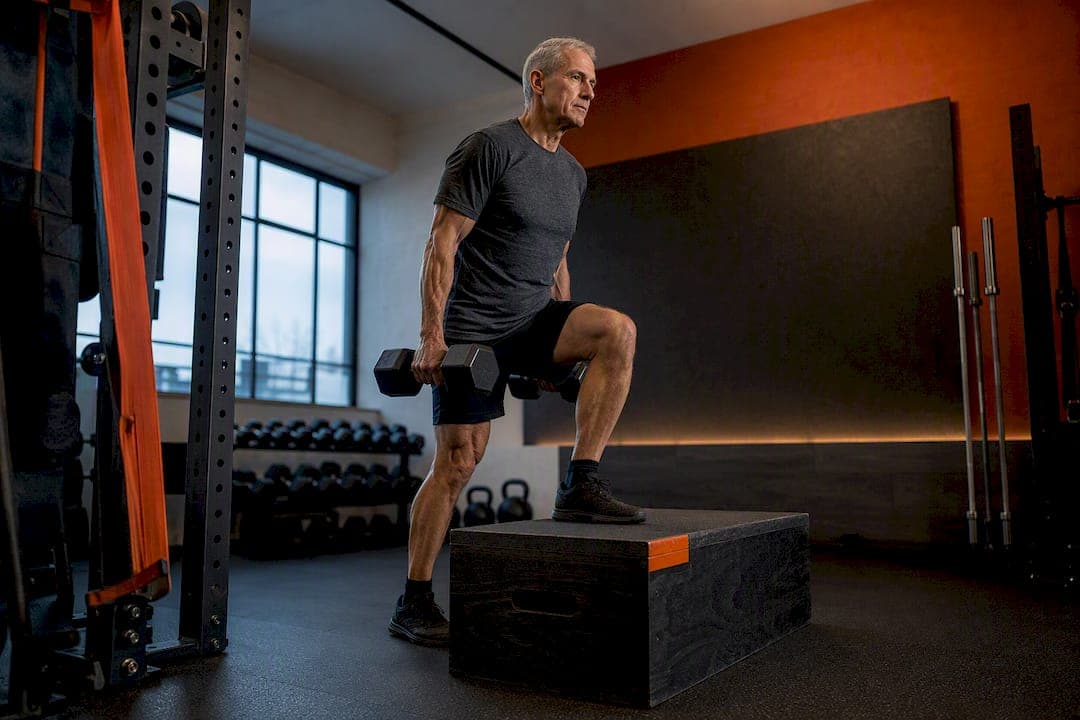
- Step-ups, 3 sets of 8 to 10 reps per leg
- Prone back extension, 3 sets of 10 to 12 reps
- Farmer's carry, 2 to 3 sets of 20 to 30 seconds
Cool-down (5 minutes): Gentle walking followed by static stretching for hips and shoulders, avoiding any deep spinal flexion stretches.
If you're not comfortable estimating a one-rep max, RPE alone works fine, aim to finish most working sets at a 5 to 8 out of 10 effort.
For readers with a recent vertebral fracture or a very high fracture risk score, stay conservative longer. Hold each exercise progression for an extra two to three weeks before adding load, and delay impact and power elements until a physical therapist confirms you're ready. A systematic review found that programs sticking closely to prescribed dosing produced SMDs of 0.31 at the lumbar spine and 0.45 at the femoral neck, well above low-adherence groups, which is the clearest evidence yet that consistency outperforms intensity for this population.
Rest at least one full day between resistance sessions, and treat unusual joint pain, not muscle soreness, as a signal to back off rather than push through.
Safe Exercises by Movement Pattern
Building sessions from movement patterns rather than random exercise lists makes substitution easy when equipment or ability changes.
- Squat pattern. Primary: goblet squat. Regression: sit-to-stand from a chair, hands assisting if needed. Progression: barbell back squat once form and core bracing are solid.
- Hinge pattern. Primary: dumbbell Romanian deadlift with neutral spine. Regression: hip hinge against a wall or dowel for feedback, no weight. Progression: trap-bar deadlift, which keeps the load closer to the body's center of mass than a straight bar.
- Push pattern. Primary: incline push-up on a counter or bench. Regression: wall push-up. Progression: standard floor push-up or a light dumbbell chest press.
- Pull pattern. Primary: seated band row or cable row. Regression: standing band row with a shorter band for less resistance. Progression: single-arm dumbbell row, bracing on a bench.
- Back extension. Primary: prone back extension on the floor, lifting only to a neutral spine, never hyperextending. Regression: standing back extension against a wall. Progression: back extension on a machine or bench with light added resistance.
- Balance drills. Primary: single-leg stance near a countertop for safety. Regression: tandem stance (heel-to-toe standing). Progression: single-leg stance with slow head turns or a soft surface underfoot.
Keep tempo controlled on every rep, roughly two seconds down and two seconds up, since momentum is what turns a safe exercise into a risky one. Bands and machines are excellent starting points because they guide the movement path and reduce the coordination demand; free weights become appropriate once form is automatic and consistent.
Power progressions, like small step-downs from a low box or gentle skipping in place, belong later in a program and only for people without a recent fracture or significant balance impairment. If you feel unsteady landing from any impact movement, that's your body telling you to regress, not push through.
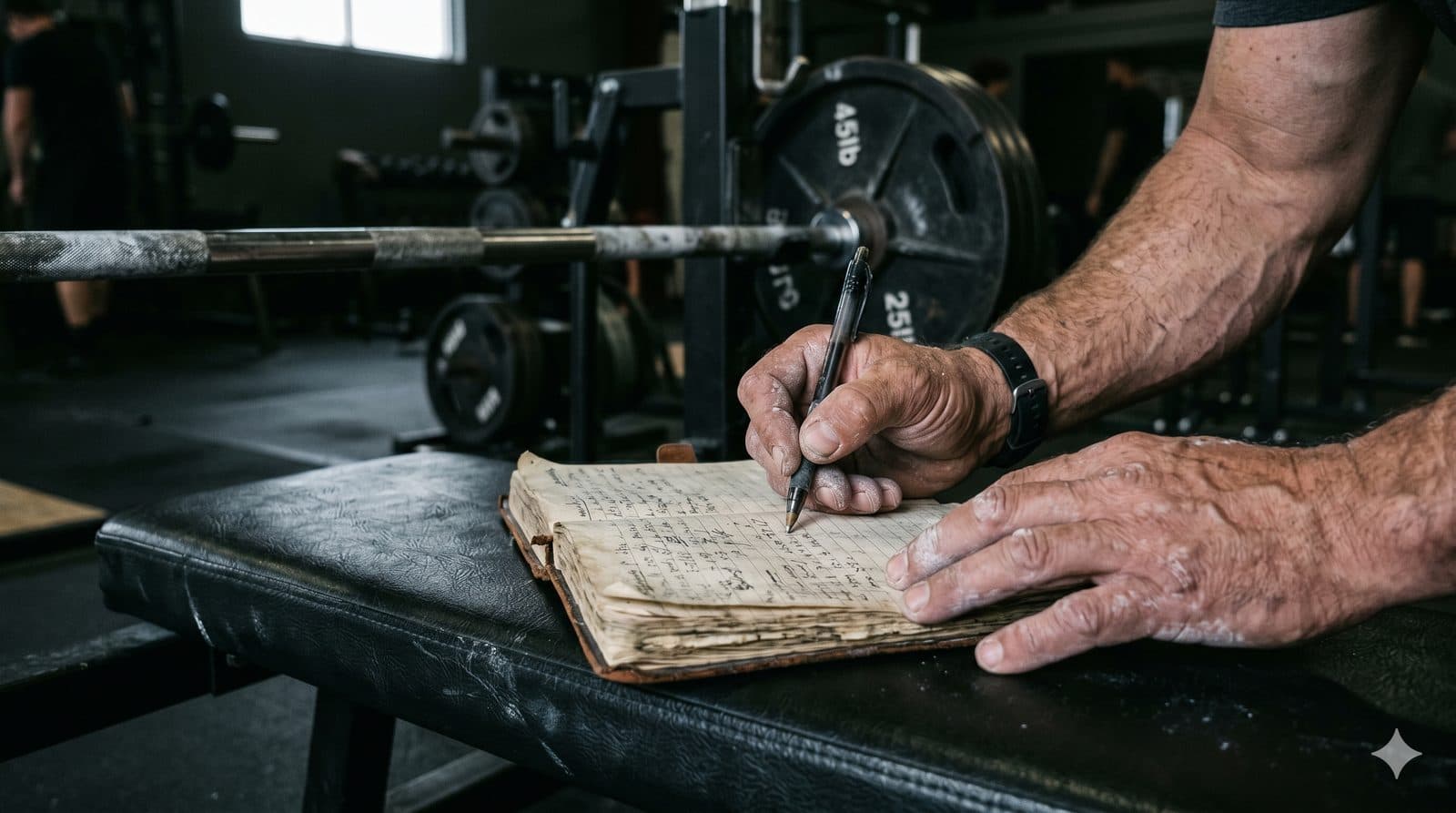
Pro Tip: Record your working sets' RPE in a simple notes app for four weeks. Most people either progress too slowly out of fear or too fast out of impatience, and a written RPE log is the fastest way to catch either mistake before it becomes a pattern.
When to Bring in a Physical Therapist or Physician
Some situations call for professional eyes before you touch a weight, not after something goes wrong. Watch for these red flags:
- A recent vertebral or hip fracture, even a minor one
- More than one low-trauma fracture in the past two years
- Pain that doesn't resolve with rest or worsens during daily activity
- Frequent falls or a strong fear of falling that limits movement
A physical therapist or exercise physiologist will typically assess your posture, spinal range of motion, balance, and functional strength before building a plan. This is similar to how sports medicine professionals approach return-to-movement protocols after an injury: establish a safe baseline first, then load progressively. Ask specifically for spine-sparing coaching cues and a supervised progression schedule. That request alone tends to filter out generic advice and get you a program built for your actual risk level.
Training Smarter After 40: Nutrition and Recovery Notes
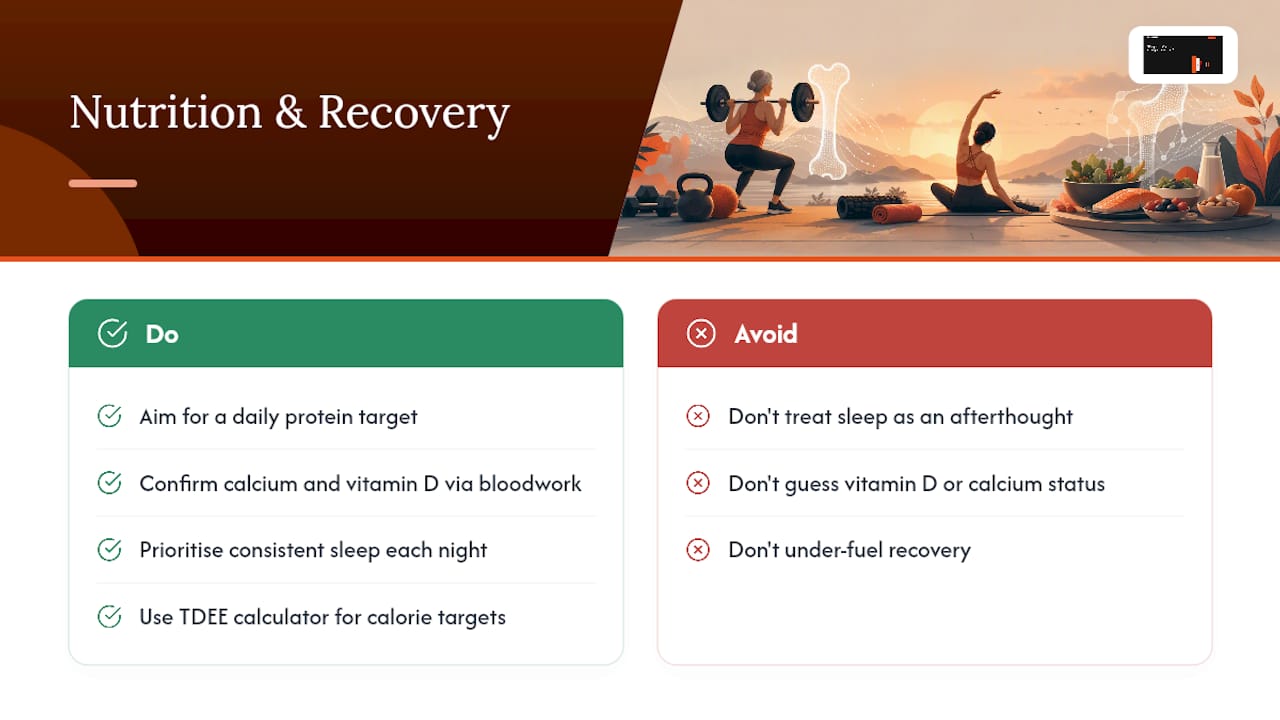
Bone and muscle respond to the same recovery windows, which means your progression plan only works if nutrition and sleep back it up. Protein intake matters more after 40, since muscle protein synthesis becomes less efficient with age; aim for a daily target that supports both training adaptation and bone matrix repair. Calcium and vitamin D remain foundational, ideally confirmed through bloodwork with your physician rather than guessed at.
Recovery needs also shift with age. Sleep quality affects hormone regulation tied to bone remodeling, so treat consistent sleep as part of the program, not an afterthought. IronAtForty's TDEE calculator helps you set calorie targets that support training without under-fueling recovery, and pairing that with a 1RM calculator takes the guesswork out of choosing safe starting loads for the program above.
The Myth That Keeps People From Lifting
The biggest myth in this space isn't that strength training is safe, it's that it's risky. Inactivity is the real threat. People with osteoporosis frequently avoid resistance training out of fear, then lose muscle and balance faster, which raises fall risk more than any properly coached squat ever would.
Targeted, progressive loading is protective, not dangerous, when the technique respects a neutral spine and the progression respects your current capacity. Start conservative. Book at least one supervised session if you're new to lifting or newly diagnosed. Track your RPE and your reps, not just how you feel that day. Then follow the sample plan above and adjust as your strength builds.
— Iron@40 Staff
Get Started With IronAtForty's Training Tools
Building a bone-focused program is one thing; sticking to it for the months it takes to see real change is another. Ironatforty exists for exactly that gap, giving lifters over 40 science-backed programming instead of recycled advice that ignores age, joint history, or bone density.
Start with the free training and nutrition tools, where the 1RM calculator helps you set safe starting loads for the squat, hinge, push, and pull patterns covered above without guessing at percentages. Pair it with the TDEE calculator to make sure your calorie intake supports muscle and bone recovery rather than working against it. If joint discomfort is holding back your progression, the joints resource hub covers recovery strategies built for lifters managing exactly this kind of setback. And for a deeper library of age-aware programming beyond this single plan, the training section is the next stop. Pick one tool, plug in your numbers today, and build your first week from the sample program above.
Primary Sources and Further Reading
- Systematic review (2023) on resistance training and BMD
- Exercise for the prevention of osteoporosis in postmenopausal women: evidence-based guide (PMC)
- Effects of resistance exercise on bone health (PMC)
- UK consensus statement on physical activity and exercise for osteoporosis (2022)
- Practical clinician guidance on exercise for osteoporosis
This article is general information, not a substitute for advice from a qualified doctor. Consult a qualified healthcare professional about your own circumstances before acting on anything here.
Sources
- Systematic review (2023) on resistance training and BMD
- Exercise for the prevention of osteoporosis in postmenopausal women: evidence-based guide (PMC)
- Effects of resistance exercise on bone health (PMC)
- UK consensus statement on physical activity and exercise for osteoporosis (2022)
FAQ
Can You Still Strength Train With Osteoporosis?
Yes. Progressive resistance training is appropriate for most people with osteoporosis and is one of the few interventions that stimulates new bone formation, provided you use spine-sparing technique and appropriate screening.
What Is the Best Strength Exercise for People With Osteoporosis?
There's no single best exercise, but hip hinges, squats, and controlled back extensions rank highest because they load the hip and spine directly, the two sites most affected by fracture risk.
What Type of Weightlifting Is Best for Osteoporosis?
Moderate-to-high intensity resistance training, roughly 70 to 85% of your one-rep max or an RPE of 6 to 8, performed at least two days per week in the 8 to 12 rep range, shows the strongest bone density outcomes in clinical reviews.
What Exercises Should Be Avoided With Osteoporosis?
Avoid weighted spinal flexion like crunches and toe touches, loaded rotation like Russian twists, and uncontrolled forward bending, since all three load the front of the vertebrae in ways linked to compression fractures.