Progressive resistance training is the single most effective tool perimenopausal women have for stopping muscle and bone loss before it starts. The prescription is specific: multi-joint lifts, progressive overload, and 2 to 3 sessions per week, screened for any joint or cardiovascular red flags first. Trial data from the STOP-EM program and a recent systematic review both point the same direction. Lift, and lift often, or you lose ground you won't easily get back.
TL;DR:
- Training at 80 to 85% of one-rep max three times weekly enhances muscle strength and bone density more effectively than lower intensities or less frequent sessions.
- Postmenopausal women may need more than 8 sets per muscle group weekly to see significant improvements in body composition and muscle preservation.
- Incorporating flexibility in training intensity and using tools like 1RM calculators can optimize progress while reducing injury risk and accommodating hormonal fluctuations.
- Progression should involve gradually increasing weight by small percentages once a person consistently hits their rep range, with deloads every 4 to 8 weeks.
- Strength training does not cause excessive muscle bulk or lower estrogen levels; it primarily supports muscle maintenance, bone health, and mood during perimenopause.
Table of Contents
- Why Strength Training Helps in Perimenopause
- What to Aim for: Frequency, Intensity, and Weekly Volume
- Sample 8-Week Beginner-Friendly Strength Program
- Progression and Periodization for Midlife Lifters
- Safety, Common Concerns, and Myth-Busting
- Nutrition and Recovery Basics That Support Training Outcomes
- How Ironatforty Backs This Program
- Managing Hot Flashes and Joint Pain Around Your Training
- Strength Training and Perimenopausal Weight Gain
- The Mental Health Case for Lifting During Perimenopause
- Adjusting Your Routine to Fluctuating Energy and Hormones
- What I've Learned Coaching Women Through This Transition
- Get the Tools to Train This Program Right
- Sources
- FAQ
Why Strength Training Helps in Perimenopause
Estrogen decline during perimenopause accelerates both muscle protein breakdown and bone resorption. That's not a vague hormonal side effect. It's a mechanical problem with a mechanical solution: loading tissue forces your body to rebuild it.
When you lift heavy enough to stress a muscle fiber, you trigger muscle protein synthesis, the process that rebuilds and thickens the fiber. The same loading stimulates bone. Mechanical stress activates the Wnt/β-catenin signaling pathway, which suppresses sclerostin, a protein that otherwise blocks new bone formation, and pushes stem cells toward becoming bone-building osteoblasts rather than fat cells.
The trial data backs this up directly. In the STOP-EM randomized waitlisted controlled trial, peri and early postmenopausal women who did nine months of supervised heavy strength-plus-impact training at 80 to 85% of their one-rep max increased their 1RM strength by 12.6% to 30.5%, gained 0.90 kg of total body lean mass, and improved lumbar spine bone density compared to a waitlisted control group.
Pro Tip: The STOP-EM protocol used heavy loads, not light circuit weights. If your "strength training" is 3-pound dumbbells and endless reps, you're not getting these results.
A systematic review and meta-analysis of interventions in women aged 40 to 60 found resistance training three times weekly, in sessions running 20 to 90 minutes for at least six weeks, produced the most consistent gains in strength and sarcopenia prevention.
What to Aim for: Frequency, Intensity, and Weekly Volume
Here's the practical version of strength training during menopause transitions, stripped of fluff:
- Frequency: two sessions per week is your floor. Three sessions per week, when your schedule allows it, produces better bone outcomes, particularly for lumbar spine and femoral neck density at higher intensities and frequencies.
- Intensity: work in the 60 to 85% 1RM range. Beginners start closer to 60 to 70% (roughly 10 to 15 reps per set); experienced lifters push toward 80 to 85% (4 to 6 reps) for the bone and strength adaptations the research keeps flagging.
- Session structure: 5 to 10 minutes of warm-up, 30 to 45 minutes of actual resistance work, and optionally a few minutes of impact or balance drills at the end.
Sample 8-Week Beginner-Friendly Strength Program
You don't need a barbell gym to start. You need consistency and a plan that gets slightly harder every week.
2-day template (weeks 1 to 4):
- Goblet squat, 3 sets of 10 to 12
- Dumbbell Romanian deadlift, 3 sets of 10
- Push-up or incline push-up, 3 sets of 8 to 12
- Seated or band row, 3 sets of 10 to 12
- Plank, 3 sets to 30 to 45 seconds
3-day template (weeks 5 to 8):
- Barbell or dumbbell squat, 4 sets of 6 to 10
- Hip hinge (deadlift or hip thrust), 3 sets of 8 to 10
- Overhead or bench press, 3 sets of 8 to 10
- Row or lat pulldown, 3 sets of 8 to 10
- Loaded carry or step-up, 2 sets of 10 per side
Progression is simple: once you hit the top of your rep range for two sessions in a row, add weight as explained in this Training Periodization for Athletes: A Complete Guide. Five percent is plenty. No barbell? Resistance bands and dumbbells cover every movement pattern here, and bodyweight step-ups or split squats substitute cleanly for barbell squats if joints need a gentler entry point.
Progression and Periodization for Midlife Lifters
Random hard workouts stall out fast. Structure prevents that.
- Linear blocks: run 8 to 12 weeks building intensity while volume drops slightly, then reset.
- Undulating cycles: vary intensity and volume day to day within the same week (heavy day, moderate day, lighter technique day).
- Deloads: cut volume by 40 to 50% every 4 to 8 weeks, especially if sleep or soreness is dragging.
Increase frequency first if recovery feels fine but you're plateauing. Increase intensity when reps feel easy at your current load. Increase volume when you have the recovery bandwidth for more sets, not less. Track lifts, rate of perceived exertion, sleep, and soreness. Ironatforty's periodization guide breaks these cycles down in more detail if you want a full template.
Safety, Common Concerns, and Myth-Busting
You will not "get bulky" from lifting weights during menopause. Women lack the testosterone levels required for that kind of hypertrophy, and the STOP-EM trial's 0.90 kg lean mass gain over nine months proves the actual pace of change is modest and welcome, not dramatic.
Lifting also doesn't dangerously lower estrogen. Hormonal responses to exercise are complicated, and if you're on hormone therapy or managing a specific endocrine condition, that's a conversation for your doctor, not a fitness article.
Run through this before every session:
- Warm up 5 to 10 minutes with dynamic movement.
- Scale the load down on days you feel off. Public health guidance still supports a minimum of two strength sessions weekly even on lower-capacity weeks.
- Prioritize technique over load, always.
- See a clinician for pain that doesn't resolve, or that shows up during a specific movement pattern repeatedly.
Pro Tip: If a joint hurts during the lift but not after, that's usually a form or range-of-motion issue. If it hurts after and lingers, that's a signal to back off and get it checked.
Nutrition and Recovery Basics That Support Training Outcomes
Lifting builds the stimulus. Nutrition and sleep build the tissue.
- Aim for roughly 1.6 to 2.2 grams of protein per kilogram of bodyweight daily, split across three to four meals so your body has amino acids available consistently.
- Don't chase an aggressive calorie deficit while trying to build strength. A small deficit is fine; a steep one blunts lean mass gains.
- Get enough vitamin D and calcium to support the bone remodeling your lifting is triggering, and treat sleep and stress management as part of the program, not an afterthought.
Ironatforty's nutrition guides go deeper on meal timing and protein sourcing if you want specifics for your body weight and goals.
How Ironatforty Backs This Program
Ironatforty builds these recommendations on trial data, not gym-bro tradition. Use the 1RM calculator to set your training percentages and the TDEE calculator to dial in calories for muscle retention. Every claim here traces back to a cited trial or review, not a hunch.
Managing Hot Flashes and Joint Pain Around Your Training
Hot flashes and joint aches are the two symptoms most likely to derail a workout, and both need tactical adjustments rather than avoidance.
For hot flashes: train in a cooler room when you can, wear layers you can shed mid-session, and keep water nearby. If a flash hits mid-set, finish the set if you're safe to, then take an extra minute of rest before the next one. Don't schedule your hardest sessions in the two or three hours after a flash-heavy morning if you can help it; your body is already managing a thermoregulatory load.
For joint pain, the fix usually isn't less lifting, it's smarter lifting. Swap high-impact movements for controlled tempo work if knees or hips are cranky that day. A goblet squat to a box is often more joint-friendly than a deep barbell squat. Warming up longer, 8 to 10 minutes instead of 5, matters more in perimenopause than it did at 30, because joint lubrication and connective tissue elasticity both shift as estrogen drops.
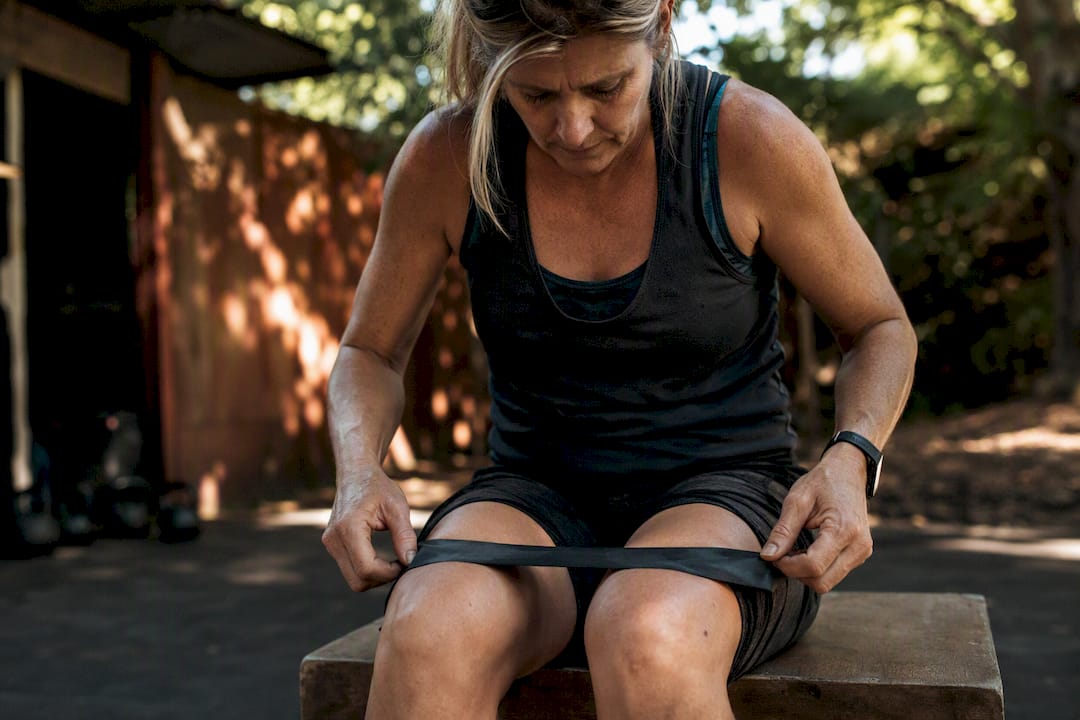
Resistance bands are worth keeping in your bag specifically for this. They let you maintain a training stimulus on a flare-up day without loading a joint the same way a barbell would. And counterintuitively, the systematic review on strength exercises and menopausal symptoms found progressive resistance work improved some menopausal symptoms rather than aggravating them, likely because stronger muscles around a joint reduce the mechanical strain that joint absorbs day to day.
The takeaway: adjust the exercise selection and environment, not your commitment to training. Skipping sessions because of symptoms usually makes the underlying issue, weaker muscles and stiffer joints, worse over time.
Strength Training and Perimenopausal Weight Gain
Weight gain during perimenopause is rarely just "eating too much." It's largely a body composition shift: muscle mass declines while visceral fat tends to increase, even at a stable weight on the scale. That's why the number on the scale can stay flat while your clothes fit differently.
Strength training directly counters this shift by preserving the muscle mass that helps maintain your resting metabolic rate, supporting better metabolism throughout the day.
The 20-week trial on resistance training and body composition in middle-aged women found something specific worth noting: postmenopausal women often need higher training volume, more than 6 to 8 sets per muscle group weekly, to see the same body composition changes that premenopausal women get with less volume. That's not a discouraging finding. It's a dosing instruction. If your results have stalled, the fix is often more sets, not a stricter diet.
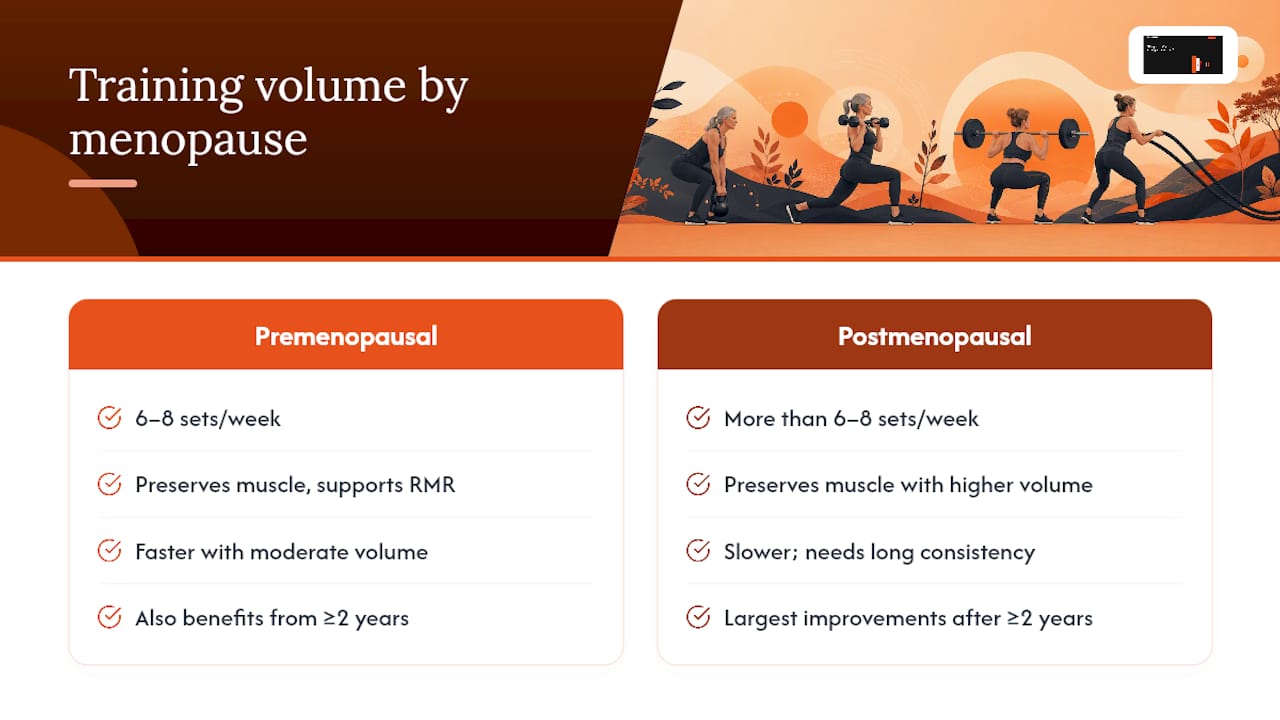
Long-term consistency matters more here than any single program tweak. Research tracking women who trained consistently for two or more years at three sessions weekly found the largest improvements in trunk fat reduction and cholesterol profile, well beyond what shorter interventions produced, according to research on long-term resistance training outcomes. Strength training won't undo perimenopausal weight gain in six weeks. Given a couple of years of consistent effort, it changes where that weight sits and how your body handles it.
The Mental Health Case for Lifting During Perimenopause
Perimenopause hits mood in ways that surprise a lot of women who've never dealt with anxiety or low motivation before. Fluctuating estrogen affects serotonin and dopamine regulation, and that shift shows up as irritability, brain fog, or a flat, joyless feeling that doesn't match anything going on in your actual life.
Strength training addresses this on more than one front. The act of lifting releases endorphins and improves sleep quality, and better sleep alone resolves a meaningful share of perimenopausal mood complaints. There's also a less discussed piece: competence. Hitting a new personal record on a squat or finally doing a full push-up gives you a tangible, measurable sense of progress at a life stage where a lot else feels like it's happening to you rather than something you're steering.
That sense of control is not a minor side effect. Perimenopause often arrives alongside other stressors, aging parents, teenagers, career pressure, and having one area of your life where effort produces a clear, trackable result (heavier weight, more reps, a faster recovery between sets) tends to buffer against the rest.
The systematic review of strength exercises and menopausal symptoms documented improvements across several outcome categories tied to menopausal symptom management, reinforcing that the benefits of lifting during this transition extend well past the muscle and the barbell.
Adjusting Your Routine to Fluctuating Energy and Hormones
Perimenopause doesn't hand you a stable baseline. Some weeks you'll feel strong and recovered; others you'll feel like you're lifting through wet cement, and both can happen in the same training block for no obvious reason.
Build flexibility into the plan rather than fighting your own physiology. On high-energy days, push toward the top of your intensity range, closer to 80 to 85% 1RM if you're experienced. On low-energy days, keep the same movements but drop to 60 to 65% 1RM and focus on clean technique instead of chasing a number. This is exactly what undulating periodization is designed for, adjusting the day's intensity to match your actual recovery state instead of a rigid schedule written weeks in advance.
Sleep disruption, a common perimenopausal complaint, is often the biggest hidden variable here. If you slept four broken hours last night, don't attempt a personal record today. Swap that session for moderate volume work or even active recovery, and save the heavy attempt for a day you actually feel it in your body, not just on the calendar.
The goal across an entire training block isn't a perfect week. It's showing up close to your planned frequency, 2 to 3 sessions, most weeks, while letting daily intensity flex around whatever your hormones and sleep are doing that particular day.
What I've Learned Coaching Women Through This Transition
The women who stick with strength training through perimenopause aren't the ones with the most willpower. They're the ones who stopped treating hard days as failures and started treating flexibility as the strategy. Pull up the 1RM calculator, pick the 2-day template above, and give it four weeks before you judge anything.
— Iron@40 Staff
Get the Tools to Train This Program Right
You've got the science and the program. What you need now is a way to stop guesstimating your numbers. Ironatforty's 1RM calculator turns the 60 to 85% intensity ranges in this article into actual pounds on the bar, and the TDEE calculator tells you exactly what to eat to retain the muscle you're building instead of guessing at portions.
These tools exist because generic fitness advice ignores what's actually happening in a 40-plus body. Ironatforty builds every recommendation around trial data like STOP-EM, not recycled gym-bro programming aimed at 25-year-olds. Pair the calculators with the nutrition guides and the joint health resources if aching knees or shoulders are part of your current picture.
Start by running your numbers through the 1RM calculator today, then plug your results into the 2-day starter template above. That's the entire first step.
FAQ
How Many Days a Week Should a Perimenopausal Woman Strength Train?
Two sessions weekly is the minimum for maintaining strength and preventing sarcopenia; three sessions weekly produces better bone density outcomes according to systematic review data.
How Often Should a Woman Around 50 Lift Weights?
The same guidance applies at 50 as during perimenopause generally: two to three sessions weekly, with sessions running 20 to 90 minutes, produces the most consistent strength and muscle-mass results.
Does Lifting Weights Lower Estrogen?
No. Strength training doesn't dangerously suppress estrogen; hormonal responses to exercise are complex, and women managing hormone therapy or an endocrine condition should discuss their specific situation with a doctor.
Can You Build Muscle During Perimenopause?
Yes. The STOP-EM trial showed peri and early postmenopausal women gained 0.90 kg of lean mass and significant strength over nine months of heavy strength and impact training, proving muscle gain is achievable at this life stage with the right program.