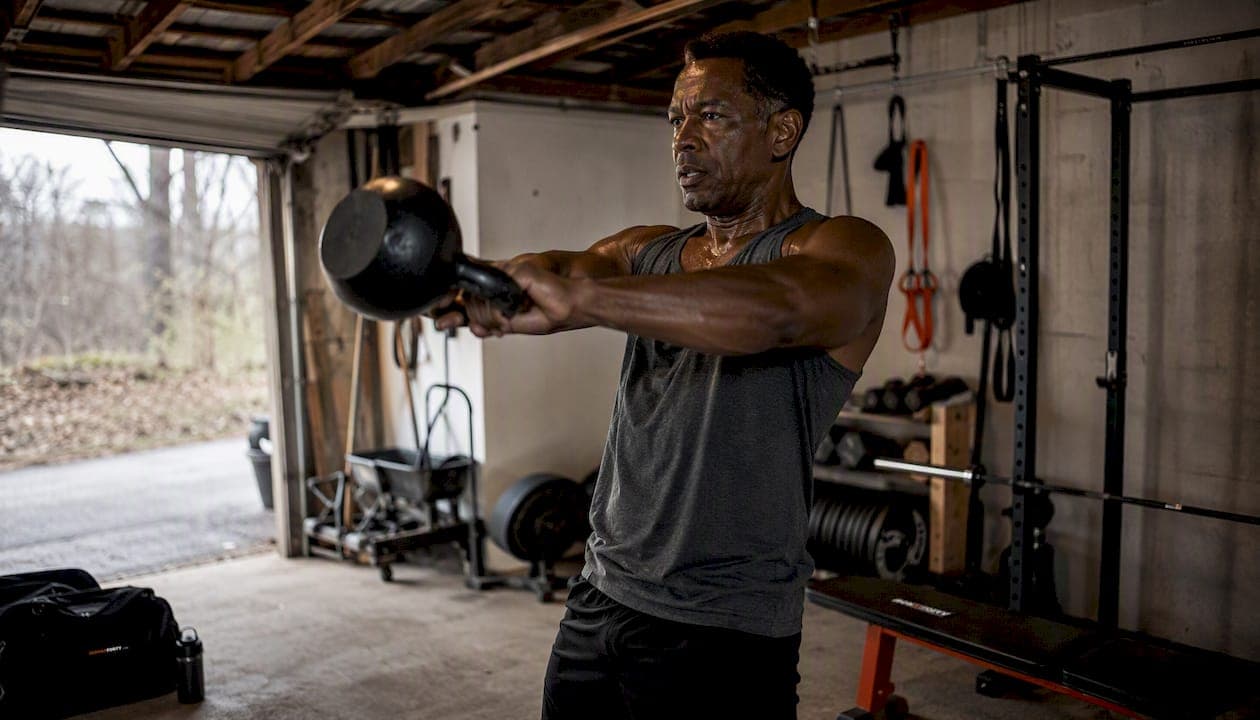
Here's your start-today workout. One kettlebell, a solid floor, and 20–30 minutes. That's the floor: everything else builds from there.
Equipment: One kettlebell (10–16 kg for most men; start at the lighter end if you're new to the hip hinge pattern), a rubber mat or hard floor.
Goal: Full-body strength and muscle, posterior chain emphasis.
| Exercise | Sets x Reps | Rest | Block Time |
|---|---|---|---|
| Two-hand kettlebell swing | 4 x 15 | 60 sec | ~6 min |
| Goblet squat | 3 x 10 | 60 sec | ~5 min |
| Single-arm row (each side) | 3 x 8 | 45 sec | ~5 min |
| Single-arm press (each side) | 3 x 6 | 60 sec | ~6 min |
| Romanian deadlift | 3 x 8 | 60 sec | ~5 min |
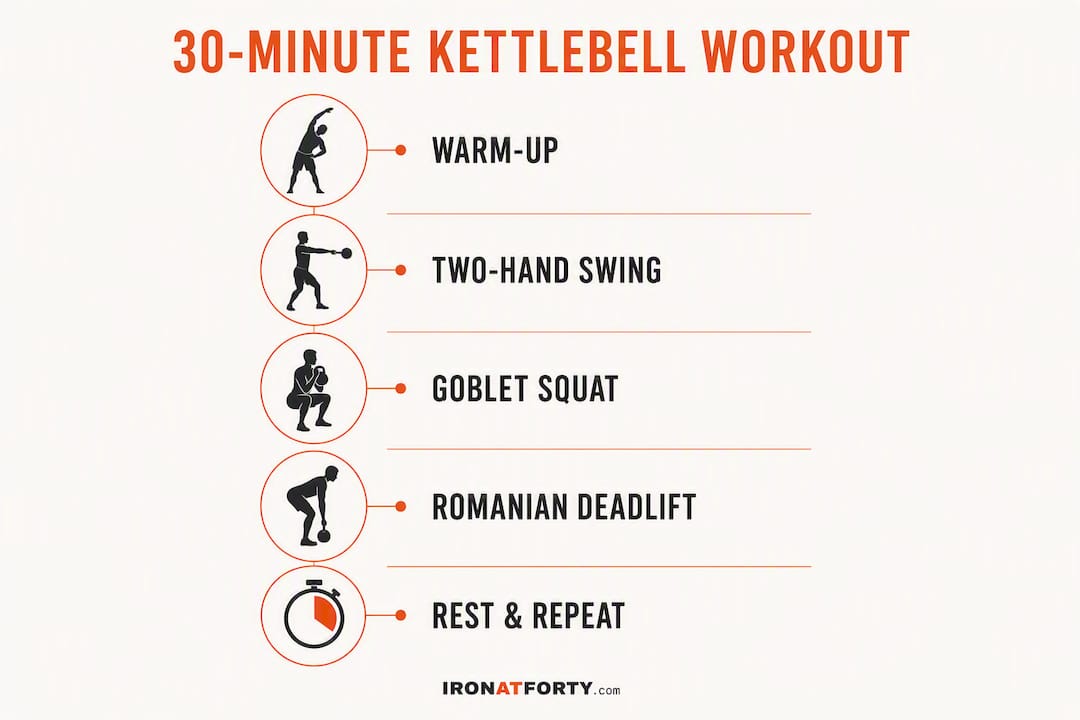
Total: ~27 minutes including transitions.
Three scaling options:
- Easier: Drop to 10–12 kg, reduce swings to 10 reps, cut press to 4 reps per side. Focus on hip hinge pattern over load.
- Standard: Follow the table as written. Stop each set 2 reps short of failure.
- Harder: Add a Turkish get-up (2 x 3 per side) at the end, or increase swing reps to 20 and add a fourth set to the press.
Table of Contents
- Why kettlebell workouts build both strength and muscle
- How to warm up before a kettlebell session
- The core kettlebell exercises: how to do them right
- Movement quality, the hip hinge, and safe progression
- Programming templates for beginners, intermediate lifters, and strength focus
- How to choose the right kettlebell weight
- Common mistakes, injury prevention, and recovery
- A quick cooldown to protect your shoulders, hips, and lower back
- Nutrition to support muscle growth and recovery
- Key Takeaways
- The case against beast mode
- Ironatforty's free tools and training resources
- Useful sources and further reading
- FAQ
Why kettlebell workouts build both strength and muscle
Most gym tools force a choice: lift heavy for strength or move fast for conditioning. Kettlebells don't. The ballistic nature of swings and cleans trains explosive hip extension and posterior chain power, while loaded-control moves like the goblet squat and press drive hypertrophy through time under tension. You get both in the same session.
The research backs this up. Continuous kettlebell swings drove heart rate to approximately 87% of maximum and VO2 to approximately 65% of maximum in a 12-minute protocol. That's a genuine cardiovascular and metabolic demand on top of the strength stimulus. A 12-week randomized controlled trial comparing kettlebell resistance training to bodyweight training in obese male adults found significant improvements in body composition and aerobic capacity in the kettlebell group.
Statistic to know: Kettlebell swings alone can push VO2 to ~65% of max — a threshold that produces meaningful aerobic adaptation alongside the strength work.
What this means for how you train: rep ranges of 8–15 work well for hypertrophy on goblet squats and rows, while lower rep sets of 3–6 at heavier loads build maximal strength on presses and deadlifts. Ballistic moves like swings and cleans sit in their own category — sets of 10–20 reps with controlled hip snap, not grinding effort. Kettlebell training applies progressive overload principles the same way barbell work does: add reps, then add load, then add sets.
How to warm up before a kettlebell session
A 5–8 minute warm-up isn't optional. The hip hinge is the foundation of swings, deadlifts, and cleans, and if you skip prep, you'll compensate with your lower back instead of loading your glutes and hamstrings. That's how injuries start.
Run through this sequence before every session:
- Hip hinge drill (2 x 8): Stand a foot from a wall, push your hips back to touch it, keep your spine neutral. This teaches the pattern without load.
- Glute bridges (2 x 12): Lying on your back, drive hips up and squeeze at the top for one second. Activates the posterior chain before you load it.
- T-spine rotations (2 x 6 per side): In a half-kneeling position, rotate your upper back open. Stiff thoracic spine is a major cause of shoulder and lower back problems under load.
- Shoulder circles and band pull-aparts (2 x 15): Prepares the rotator cuff and rear delts before pressing or cleaning.
- Bodyweight squat to hip hinge (2 x 5 each): Alternating between the two patterns primes your nervous system for the session ahead.
Pro Tip: Train barefoot or in flat-soled shoes like Converse or Vans. Running shoes with thick, cushioned soles create an unstable base for loaded hip hinges and presses. Also, train on a rubber mat or hard floor — thick carpet raises your trip and balance risk during dynamic moves.
For a deeper look at pre-session prep, Ironatforty's warm-up guide for heavy lifting covers the full protocol.
The core kettlebell exercises: how to do them right
These eight moves form the backbone of any serious kettlebell workout routine. Master these and you have everything you need to build strength and muscle for years.
-
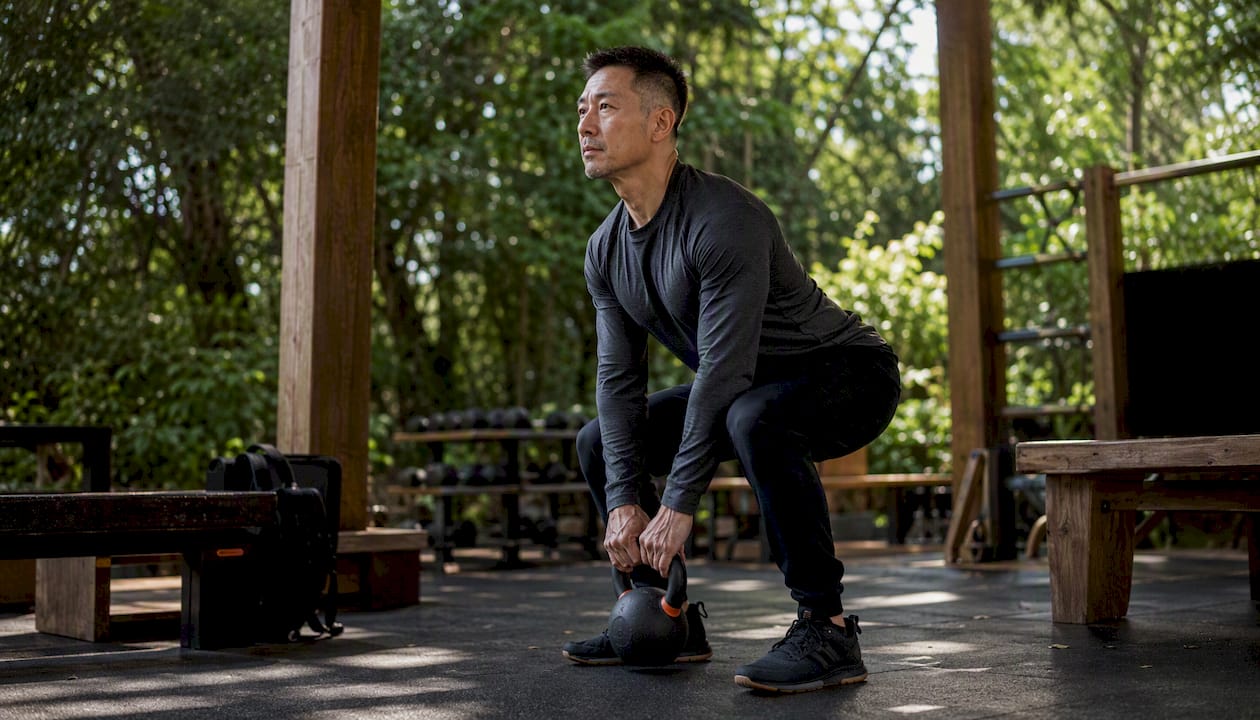
Two-hand kettlebell swing. Hinge at the hips, not the knees. The bell hikes back between your legs like a football snap, then you drive your hips forward explosively to float the bell to chest height. Arms stay loose; the power comes from the hip snap. Common mistake: squatting the swing. If your knees are bending deeply, you're losing the posterior chain drive.
-
Goblet squat. Hold the bell by the horns at chest height. Squat deep, keeping elbows inside your knees. Drive through your heels to stand. Common mistake: forward lean caused by tight hip flexors. Pause at the bottom for one second to build depth.
-
Kettlebell Romanian deadlift. Hold the bell in both hands, hinge back until you feel a hamstring stretch, then drive hips forward to stand. Keep the bell close to your legs. Common mistake: rounding the lower back at the bottom. If you can't maintain a neutral spine, reduce the range of motion.
-
Single-arm clean. Hike the bell back, then drive your hips and pull the bell into the rack position at shoulder height. The bell should land softly on your forearm, not crash into your wrist. Common mistake: using the arm to curl the bell up instead of letting the hip drive do the work.
-
Single-arm press. From the rack position, press the bell straight overhead until your arm is locked out and your bicep is next to your ear. Brace your core and glutes throughout. Common mistake: pressing with a flared elbow. Keep the elbow at roughly 45 degrees from your torso on the way up.
-
Kettlebell row. Hinge forward with a flat back, bell in one hand, opposite hand on your knee for support. Pull the bell to your hip, not your armpit. Common mistake: rotating the torso to get the bell higher. Lock your hips square and pull with your lat. The benefits of single-arm training go beyond aesthetics — unilateral rows expose and correct left-right strength imbalances.
-
Snatch or high-pull progression. If you're new, start with the high-pull: hike the bell back, drive the hips, and pull the elbow high to ear level. Once that's clean, progress to the full snatch by punching the hand through at the top to lock out overhead. Common mistake: early arm pull. The arm doesn't move until the hips have fired.
-
Turkish get-up. Lie on your back, bell pressed overhead in one hand. Move through six distinct positions to stand up, then reverse. This is the best single exercise for shoulder stability, hip mobility, and core control. Turkish get-ups build stability and mobility that transfers directly to every other kettlebell move. Start with a light bell or even a shoe balanced on your fist until the pattern is clean.
On unilateral vs. bilateral choices: Use two-handed moves (swing, goblet squat, Romanian deadlift) when you're learning or going heavy for strength. Switch to single-arm variations (clean, press, row, snatch) when you want to address imbalances, increase core demand, or add variety to a program.
Movement quality, the hip hinge, and safe progression
Movement quality first. Load second. This isn't a soft suggestion — it's the difference between consistent progress and a six-week layoff with a tweaked back.
Coaching guidance for lifters over 50 consistently emphasizes movement quality and graded progression over chasing heavier bells. Tendons and connective tissue adapt more slowly than muscle, especially after 40. You can build muscle strength faster than your tendons can handle the load, which is exactly when injuries happen.
Practical progression rules:
- Add reps before adding weight. If the program calls for 3 x 8, get to 3 x 12 with clean form before moving up in load.
- Use the press-overhead test: if you can't lock out a bell cleanly overhead with a straight arm and neutral spine, it's too heavy for pressing work.
- Apply tempo to build quality. A 3-second eccentric (lowering phase) on goblet squats and rows forces you to own the position, not just survive it. Ironatforty's tempo training guide explains exactly how to use this for progressive overload.
For men over 40 specifically:
- Limit high-intensity kettlebell sessions to three per week. Allow 48–72 hours between hard sessions for connective tissue recovery.
- On off days, do mobility work or low-intensity movement, not more loading.
- Watch for grip fatigue as an early warning sign. If your grip is failing before your target muscles, your nervous system is already under-recovered.
Pro Tip: Film yourself from the side doing a set of swings. If your lower back rounds at the bottom or your knees cave on the squat, those are the patterns to fix before adding a single kilogram.
In-session quality checklist:
- Neutral spine maintained throughout each rep
- Hips hinging before knees bend on all deadlift and swing patterns
- Bell landing softly in rack position (no wrist crash on cleans)
- Breathing: exhale at the top of each rep, inhale on the way down
Programming templates for beginners, intermediate lifters, and strength focus
Three complete 3x/week templates. Pick the one that matches where you are right now, not where you want to be.
| Template | Goal | Duration | Difficulty | Equipment | Scaling |
|---|---|---|---|---|---|
| Beginner | Movement mastery + base strength | 20–30 min | Beginner | Single kettlebell | Reduce reps, use lighter bell |
| Intermediate | Strength + hypertrophy | 20–30 min | Intermediate | Single or two kettlebells | Add sets, increase load |
| Strength-focused | Maximal strength | 30–40 min | Intermediate+ | Two kettlebells optional | Lower reps, longer rest |
Beginner template (weeks 1–4)
- Hip hinge warm-up drill: 2 x 8
- Two-hand swing: 3 x 10, rest 60 sec
- Goblet squat: 3 x 8, rest 60 sec
- Kettlebell row: 3 x 8 per side, rest 45 sec
- Romanian deadlift: 3 x 8, rest 60 sec
Progression rule: When all sets feel like RPE 6 or lower, add 2 reps per set. When you hit the top of the rep range (e.g., 3 x 12), increase load by the smallest available increment.
Intermediate template (weeks 5–8)
- Warm-up sequence: 5–8 min
- Two-hand swing: 4 x 15, rest 60 sec
- Goblet squat: 4 x 10, rest 60 sec
- Single-arm clean + press: 3 x 5 per side, rest 75 sec
- Kettlebell row: 3 x 10 per side, rest 45 sec
- Romanian deadlift: 3 x 10, rest 60 sec
Progression rule: Add one set every two weeks. When you reach 5 sets on a main lift, increase load and drop back to 3 sets. This is progressive overload applied practically.
Strength-focused template (weeks 9–12)
- Warm-up: 8 min
- Single-arm press: 5 x 3–5 per side, rest 90 sec
- Two-hand swing: 5 x 10, rest 75 sec
- Romanian deadlift: 4 x 5, rest 90 sec
- Turkish get-up: 2 x 3 per side, rest 90 sec
Progression rule: Add load when you complete all reps with RPE below 8. Rest 90 seconds minimum between heavy sets. For scheduling around other training, Ironatforty's training frequency guide covers how to sequence sessions across the week.
How to choose the right kettlebell weight
Start lighter than your ego wants. Kettlebell technique is more demanding than fixed-path gym machines, and a motor pattern learned wrong under load is harder to fix than one learned right with a lighter bell.
Starting weight guidelines by experience:
- New to kettlebells, some gym background: 16 kg for swings and deadlifts; 12 kg for presses and rows
- Experienced lifter, new to kettlebells: 20–24 kg for swings; 16 kg for presses
- Men over 40 returning to training: start in the 10–16 kg range for most exercises; overhead and rotational moves often need a lighter bell than you expect
- Complete beginners: 10–12 kg to learn the hip hinge and goblet squat pattern
Scaling by goal:
- Strength: Lower reps (3–6), heavier load, longer rest (75–90 sec). Stop 1–2 reps short of failure.
- Hypertrophy: Moderate reps (8–12), moderate load, 60-second rest. Last 2 reps should feel challenging.
- Conditioning: Higher reps (15–20) or timed sets (30 sec on, 30 sec off), lighter load, shorter rest.
Use RPE (rate of perceived exertion) on a 1–10 scale to guide load increases. A set at RPE 7 means you had 3 reps left in the tank. That's the sweet spot for strength work. When a set drops to RPE 5 or below, it's time to add load or reps.
Common mistakes, injury prevention, and recovery
The most common kettlebell injuries are predictable and preventable. Here's what to watch for.
Top mistakes:
- Squatting the swing. The swing is a hip hinge, not a squat. Excessive knee bend kills the posterior chain drive and loads the lower back wrong.
- Too much volume, too soon. Three hard sessions per week is the ceiling for most men, especially over 40. More is not better when connective tissue is still adapting.
- Training on unstable surfaces. Thick carpet raises trip and balance risk during dynamic moves. Use a rubber mat or hard floor.
- Progressing load before the pattern is clean. Adding weight to a broken movement pattern just makes the broken pattern stronger.
Stop immediately if you experience:
- Sharp, localized spine pain during or after a set
- Persistent joint swelling that doesn't resolve within 48 hours
- Numbness or tingling down an arm or leg
These are red flags, not soreness. For a full breakdown of overtraining warning signs, Ironatforty's overtraining guide covers what to look for and how to fix it.
Recovery practices that actually work:
- 48–72 hours between high-intensity sessions
- 7–9 hours of sleep per night (this is where connective tissue repairs)
- A foam roller or lacrosse ball on the glutes, thoracic spine, and lats after sessions
- One 20-minute mobility session per week, separate from training days
For practical injury prevention habits that apply directly to kettlebell training, the HTK Training blog has a solid breakdown worth reading alongside this guide.
A quick cooldown to protect your shoulders, hips, and lower back
Five minutes at the end of a session pays dividends for weeks. Don't skip it.
- Hip flexor stretch (60 sec per side): Half-kneeling, drive your hip forward until you feel the front of the rear hip. Tight hip flexors are a leading cause of lower back strain during swings.
- Glute activation hold (30 sec per side): Lying on your back, cross one ankle over the opposite knee and pull the thigh toward your chest. Holds the glute in a lengthened position post-session.
- Thoracic rotation (6 reps per side): Seated or in a half-kneeling position, rotate your upper back open. Counteracts the forward-loaded position of rows and deadlifts.
- Pec opener / doorway stretch (60 sec): Arms at 90 degrees in a doorframe, lean forward gently. Presses and cleans tighten the anterior shoulder over time.
- Diaphragmatic breathing (10 slow breaths): Lie on your back, breathe into your belly, exhale fully. Shifts your nervous system out of the high-intensity state and accelerates recovery.
Pro Tip: If you're training three days per week, add one dedicated 20-minute mobility session on a rest day. Target the hips and thoracic spine specifically. Over time, this single habit does more for your long-term training availability than any extra workout set.
For joint-specific recovery work, Ironatforty's joint health resources cover the hips, shoulders, and lower back in detail.
Nutrition to support muscle growth and recovery
Training stimulus is only half the equation. Without the right nutritional support, you're asking your body to rebuild with inadequate materials.
Protein is the non-negotiable. Aim for 0.8–1 gram of protein per pound of bodyweight per day to support muscle protein synthesis. For a 185-pound man, that's 148–185 grams daily. Distribute it across 3–4 meals rather than loading it all at dinner — your muscles can only use so much at once.
Carbohydrates fuel your sessions. A small meal containing carbohydrates and protein 1–2 hours before training gives you the glycogen to push hard. Post-session, a similar combination within 60–90 minutes supports recovery. Rice, oats, sweet potato, and fruit are practical choices.
Calorie surplus for muscle gain. You can't build significant muscle in a sustained calorie deficit. A modest surplus of 200–300 calories above your maintenance level is enough to support hypertrophy without excessive fat gain. Use Ironatforty's TDEE calculator to find your maintenance number first, then add from there.
Hydration matters more than most men think. Even mild dehydration impairs strength output and slows recovery. Aim for at least half your bodyweight in ounces of water daily, and add electrolytes if you're sweating heavily.
For a deeper look at nutrition strategies that support training after 40, including insulin resistance and meal prep, Ironatforty's nutrition hub has the full picture.
Key Takeaways
A single kettlebell, three sessions per week, and a commitment to the hip hinge pattern is all you need to build real strength and muscle with kettlebell training.
| Point | Details |
|---|---|
| Start with the right weight | Men new to kettlebells should begin at 10–16 kg; master the hip hinge before adding load. |
| Three sessions per week is enough | Allow 48–72 hours between hard sessions; connective tissue needs that recovery window. |
| Swings drive serious conditioning | Kettlebell swings can push VO2 to ~65% of max, delivering strength and aerobic adaptation together. |
| Progress reps before weight | Add reps until you hit the top of the range, then increase load and reset — this is progressive overload in practice. |
| Ironatforty has the tools | Use the free TDEE calculator and training resources at Ironatforty to track calories and build your program. |
The case against beast mode
Here's the honest take: the biggest mistake men make with kettlebells isn't poor technique or wrong weight selection. It's the belief that more intensity, more volume, and more sessions equals faster results.
It doesn't. Not after 40, and often not before it either.
The research on movement quality and graded progression is consistent. Chasing heavier bells before the pattern is clean doesn't build more muscle — it builds compensation patterns that eventually become injuries. And an injury doesn't just cost you a few sessions. It costs you months of detraining, cautious rebuilding, and the psychological grind of starting over.
Three quality sessions per week, built around the hip hinge, with honest load selection and real recovery between sessions — that's the program that compounds over years. The guy who trains at RPE 7 consistently for 12 months will outperform the guy who goes beast mode for six weeks and then spends eight weeks recovering.
Ironatforty's editorial stance has always been the same: train hard enough to create an adaptation signal, recover enough to express it, and repeat. That's not a conservative approach. It's the only approach that actually works long-term.
Ironatforty's free tools and training resources
The workout and templates in this article give you a clear starting point. What they can't do is tell you your exact calorie target, your one-rep max baseline, or how to adjust your program as you progress over months.
That's what Ironatforty's free training tools are built for. The TDEE calculator gives you a precise daily calorie target based on your weight, age, and activity level — the number you need before you can set a meaningful nutrition strategy. The 1RM calculator helps you track strength progress over time. And the training hub pulls together programming articles, exercise guides, and recovery resources specifically for men who lift seriously and want to keep lifting for decades.
No subscription. No paywall. Just the information you need to train smarter, recover better, and build strength that lasts. Start with the TDEE calculator, set your calorie floor, and use the templates in this article to build your first four weeks.
Useful sources and further reading
The claims in this article are grounded in peer-reviewed research and practical coaching guidance. Here are the primary sources:
- The effects of kettlebell training versus resistance training using own body mass on physical fitness and physiological adaptations in obese adults — PMC
- Enhancing Athletic Performance: A Comprehensive Review on Kettlebell Training — PMC
- Transference of Kettlebell Training to Strength, Power, and Endurance — Journal of Strength and Conditioning Research
- Build a Workout Routine from Scratch — HTK Training
Before loading up on swings or attempting the Turkish get-up with any real weight, spend at least two weeks drilling the hip hinge with a light bell. The pattern you build in those early sessions is the foundation everything else sits on.
FAQ
What weight kettlebell should a man start with?
Most men new to kettlebell training should start in the 10–16 kg range for most exercises, using the lighter end if new to hip hinge patterns. Overhead and rotational moves often need a lighter bell. This helps protect connective tissue while learning the patterns.
How many days a week should men do kettlebell workouts?
Three sessions per week is the practical ceiling for most men, with 48–72 hours between hard sessions to allow connective tissue recovery. More frequent training is possible if intensity is managed, but three quality sessions consistently outperforms five rushed ones.
Can kettlebell training build real muscle mass?
Yes. A 12-week randomized controlled trial found significant improvements in body composition in men using kettlebell resistance training. The key is applying progressive overload principles: add reps, then add load, then add sets over time.
What is the most important kettlebell exercise for men?
The two-hand swing is the foundation. It trains explosive hip extension, posterior chain strength, and cardiovascular demand simultaneously. Master the hip hinge pattern behind the swing and every other kettlebell move becomes easier to learn.
How long should a kettlebell workout be?
A well-structured kettlebell session of 20–30 minutes built around compound, posterior-chain-dominant moves delivers a full strength and conditioning stimulus. Longer isn't automatically better — quality of movement and appropriate load matter more than session duration.