The first time my sacroiliac joint went, I was three reps into a 405 deadlift and felt something on the right side of my pelvis shift in a way that bones are not supposed to shift. Not a disc. Not a muscle. Something deeper and more structural, right where the base of the spine meets the pelvis. I racked the bar, walked it off, and spent the next four months pretending it would resolve on its own.
It did not resolve on its own. Here is what actually worked — including two things that made a bigger difference than anything else I tried.
What the SI joint actually is
The sacroiliac joint connects the sacrum — the triangular bone at the base of your spine — to the ilium, the large wing of the pelvis. There are two of them, one on each side, and they barely move. A few millimeters of glide, total. Their entire job is to transfer load between your upper body and your legs, which is exactly the job a heavy deadlift or squat demands of them.
Unlike a ball-and-socket joint like your hip, the SI joint has no real range of motion by design. It is a force-transfer joint, held together by some of the strongest ligaments in the body — the interosseous sacroiliac ligaments, the sacrotuberous ligament, and the long dorsal sacroiliac ligament. When these ligaments are healthy and the muscles around the pelvis are balanced, the joint is remarkably stable. When they are not, things go sideways — sometimes literally.
Why lifters wreck it
SI joint dysfunction is not random. For lifters over 40, there are specific mechanical reasons the joint fails, and understanding them matters because the fix has to address the cause, not just the symptom.
Decades of asymmetry
This is the big one. Twenty-plus years of training build up tiny imbalances that you never notice until they matter. One hip slightly tighter from always leading with the same leg. One side of the posterior chain marginally stronger from a dominant-side bracing pattern. A hip shift under heavy squats that you have been told about but never fixed because the weight kept going up.
Under sub-maximal weight the joint tolerates asymmetry just fine. Under a heavy single or a grinding rep where form breaks down, those millimeters of play in the joint get exploited. The joint jams, shears, or — in the worst case — the ligaments stretch past the point where they can hold things together. Mine jammed on the right side and stayed that way.
Tight hip flexors pulling the pelvis forward
This one does not get enough attention. The iliacus muscle — the deeper, less-talked-about partner of the psoas — attaches directly to the inside of the ilium, the same bone that forms one half of the SI joint. When the iliacus is chronically tight, which it is in almost everyone who sits for a living and then loads a barbell, it pulls the ilium into an anterior tilt. That tilt changes the angle at which force passes through the SI joint, and over time the joint starts bearing load it was not designed to handle in that position.
Most people have heard of tight hip flexors. Almost nobody addresses the iliacus specifically, because you cannot stretch it with a standard hip flexor stretch — it is too deep, too anatomically awkward to reach. This matters. I will come back to it.
Weak stabilizers around the pelvis
The SI joint has no muscles of its own. It is stabilized entirely by the muscles around it — glute med, the deep hip rotators, the obliques, the pelvic floor, the adductors. If those muscles are weak or uncoordinated, the ligaments take the full load. Ligaments are not designed to be primary stabilizers under heavy, repeated loading. They stretch, they get irritated, and eventually the joint develops more play than it should have.
The hormonal and connective tissue reality after 40
Ligament and tendon tissue recovers slower after 40. Collagen turnover declines. The inflammatory response that is supposed to kick off healing becomes less efficient. This does not mean you are falling apart — it means that the same insult that would have resolved in three weeks at 28 now takes three months, and the window where you can train through it without making things worse is much narrower. This is part of the broader reality that training after 40 is a fundamentally different sport.
The mistakes I made first
I rested. Complete rest is the worst thing you can do for an SI joint, because the joint is stabilized by the muscles around it, and when you stop training those muscles, the joint gets less stable, not more. Six weeks off and my first session back was worse than the day I tweaked it.
Then I went the other way and tried to train through it — loading heavy and hoping the pain would teach my body to adapt. That is not how connective tissue works after 40. The joint does not toughen up under load when the ligaments are already irritated. It just gets angrier.
I also tried aggressive stretching. Everyone told me to stretch my piriformis, stretch my hamstrings, stretch everything. Stretching a hypermobile, irritated SI joint is like picking a scab. What the joint needed was stability, not more range of motion.
What actually worked
Five things, in order of impact. The first two were game-changers. The rest were necessary support.
1. Prolotherapy — this was the turning point
I had never heard of prolotherapy until a sports medicine doctor suggested it after months of nothing else working. The concept is straightforward: a doctor injects a hypertonic dextrose solution — medical-grade sugar water, essentially — directly into the damaged ligaments around the SI joint. The dextrose creates a controlled, localized inflammatory response at the injection site. That inflammation is the point. It kickstarts a healing cascade that your body was not producing on its own — the inflammatory response recruits your body's own repair cells to the area, stimulates collagen production, and over a series of treatments, the ligaments tighten and strengthen.
It is not a cortisone shot. Cortisone suppresses inflammation, which feels good temporarily but does nothing to repair the tissue and can actually weaken it over time. Prolotherapy does the opposite — it deliberately triggers the healing response that damaged connective tissue needs to rebuild.
Here is the honest reality of it: prolotherapy is not a one-and-done treatment. A rough rule of thumb that my doctor shared is that for every decade of age, expect about that many treatments. At 40-something, I was looking at four to five sessions, spaced about six weeks apart. I have done three so far and each one produced a noticeable step forward — not overnight, but over the weeks following the injection, the joint felt tighter, more stable, less reactive to load. I plan to do at least one more.
The treatments themselves are not pleasant. Dextrose injected into irritated ligaments stings, and the 48 hours after a session involve more inflammation, not less — that is the mechanism working. But for a joint that was not healing on its own despite doing everything else right, prolotherapy was the thing that actually moved the needle on the structural problem. The stabilizer work and movement corrections I was already doing became dramatically more effective once the ligaments had enough integrity to hold the joint in place.
2. The Hip Hook — immediate relief, daily maintenance
If prolotherapy fixed the structural problem, the Hip Hook fixed the muscular one. And I use the word "game-changer" reluctantly because it gets thrown around too loosely, but in this case it is accurate.
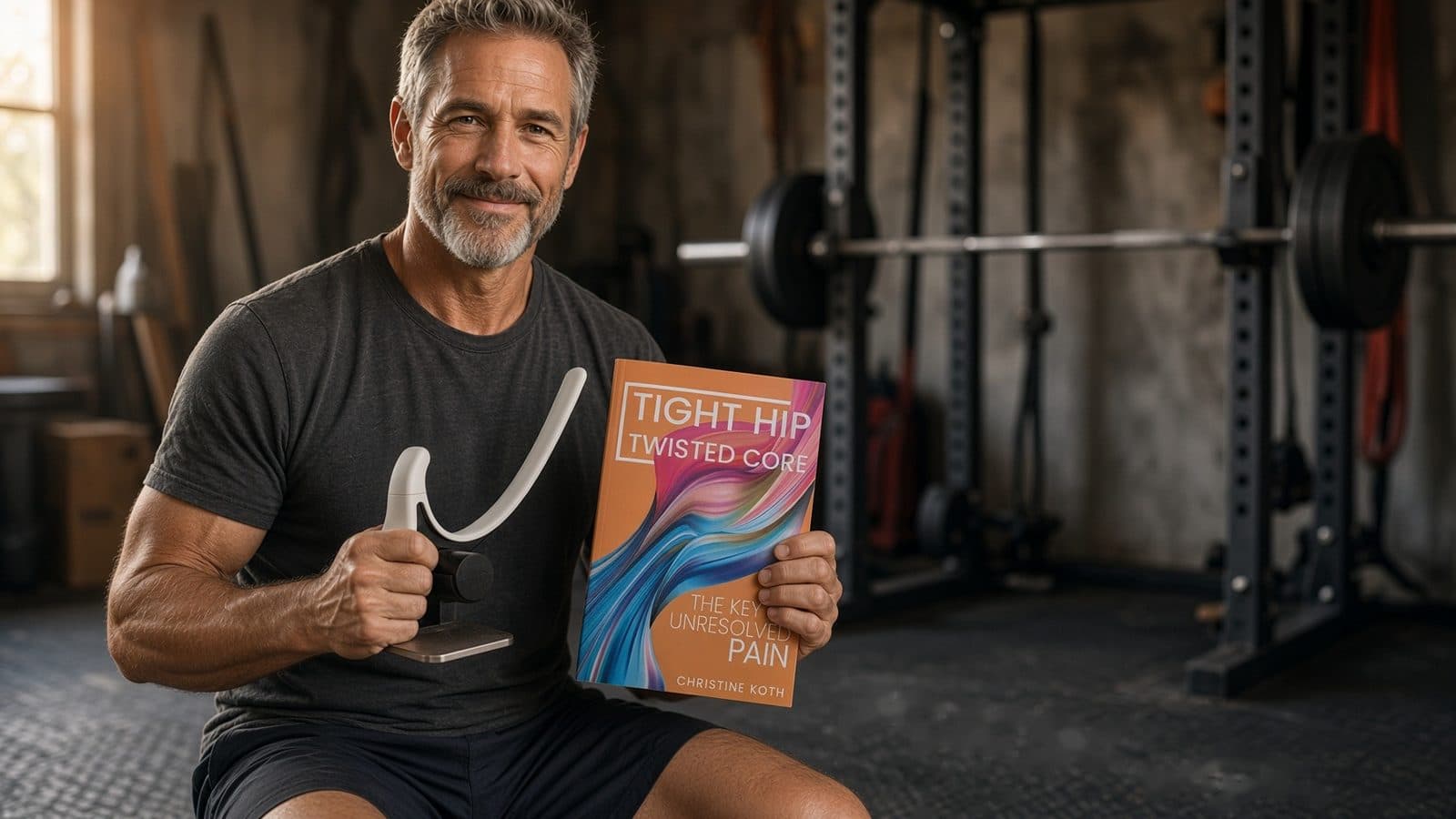
The Hip Hook is a tool designed by physical therapist Christine Koth to apply sustained, precise pressure directly to the iliacus muscle — the deep hip flexor that attaches to the inside of the ilium. Remember the problem I described earlier: a chronically tight iliacus pulling the pelvis into anterior tilt, changing the load angle through the SI joint. That is exactly what the Hip Hook addresses, and it reaches the iliacus in a way that no stretch, foam roller, or lacrosse ball can, because the muscle sits deep inside the pelvic bowl where those tools cannot access.
You lie on it, it presses into the iliacus with an angle that mimics what a manual therapist would do with their hands, and within about ninety seconds you can feel the muscle release. The first time I used it, I stood up and the difference in my pelvic position was immediately noticeable. The low-grade, one-sided ache that had become my constant companion was just — quieter.
I still use the Hip Hook daily. Not because I am in crisis, but because the iliacus re-tightens from sitting, from training, from life. Ninety seconds per side, every morning, and the SI joint stays pain-free. On the rare occasions I skip it for a week, I can feel the old pattern creeping back — the subtle pelvic tilt, the faint stiffness getting out of the car. Then I use it and it resolves again. It has become as non-negotiable as warming up before I train.
3. Unilateral and anti-rotation work
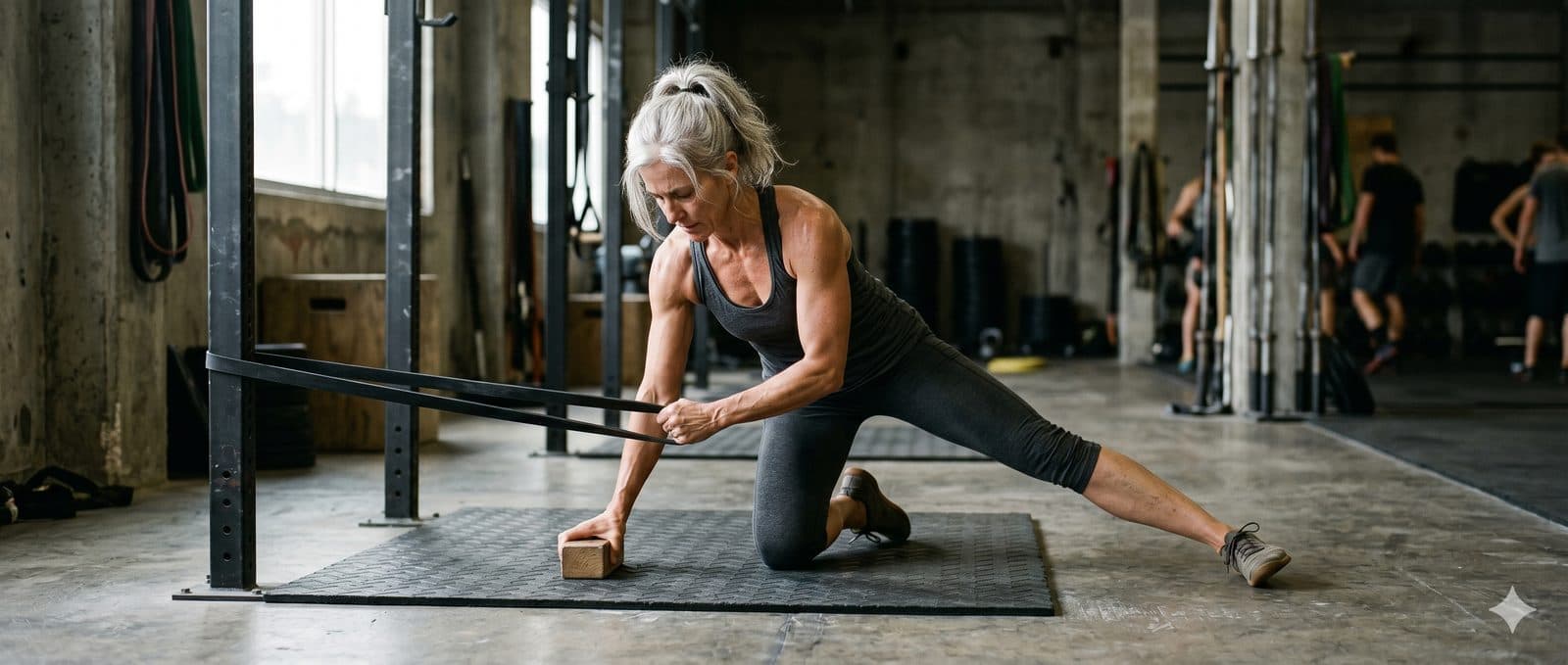
Once the ligaments were tightening up from prolotherapy and the iliacus was no longer yanking my pelvis out of alignment, the stabilizer work I was already doing started to actually hold. The exercises that moved the needle:
- Single-leg glute bridges — slow, paused at the top, focused on keeping the pelvis level
- Pallof presses — anti-rotation core work that taught my obliques to resist the shear
- Copenhagen plank progressions — for the adductors, which almost everyone neglects
- Suitcase carries — loaded, asymmetrical, and brutally honest about which side is weak
I did these daily at first. Not heavy. High quality. The key insight was that these exercises worked far better after prolotherapy and iliacus release had addressed the underlying structural and muscular problems. Before that, I was trying to stabilize a joint that was structurally loose and being pulled out of position by a tight muscle. No amount of glute bridges fixes that.
4. Reintroducing the main lifts with obsessive bracing
When I came back to deadlifts I started at 135 and treated every single rep like a max attempt in terms of setup. Wedge, brace, even pressure across both feet, and — critically — a 360-degree brace that loaded both obliques equally instead of letting my dominant side yank the pelvis. I added load only when I could complete a session with zero next-morning ache. It took eleven weeks to get back to 315. It was worth every patient session.
The lesson here ties directly into why chasing a one-rep max is the wrong approach for lifters over 40 who are managing joint issues. Every session needs to build something. A max attempt on a joint that is still stabilizing is not building — it is gambling.
5. Sleep and the boring recovery basics
The flares correlated almost perfectly with bad sleep weeks. When I was sleeping six hours, the joint was angry. When I strung together eight-hour nights, it calmed down within days. Connective tissue remodels overnight — that is when collagen synthesis peaks and when the repair work from prolotherapy actually consolidates. There is no peptide, no supplement, and no fancy modality that substitutes for sleep, though I did go down the rabbit hole on whether recovery peptides like BPC-157 actually help connective tissue remodeling. The honest answer there is more complicated than the marketing suggests.
Where I am now
I pull heavy again. But I train differently, and two things are permanently in my routine that were not there before.
Every morning, ninety seconds per side on the Hip Hook. Non-negotiable. It keeps the iliacus from tightening up and pulling my pelvis back into the pattern that caused the problem in the first place.
And I will continue prolotherapy sessions as needed. Three treatments in and the joint is more stable than it has been in years. The ligaments are tighter, the joint does not shift under load, and the early-warning signs — that faint one-sided stiffness getting out of the car — have essentially disappeared.
Beyond that, the principles are simple: single-leg work stays in my program permanently as insurance, not rehab. I warm up the stabilizers before every heavy session. I never deadlift without a thorough brace check. And I pay attention to the signals early, before a whisper becomes a flare.
The SI joint taught me the lesson that defines training in your forties:
You cannot out-tough connective tissue. You can only out-smart it.
Find the actual cause — not just the symptom — fix the structure, release the muscles that are pulling things out of alignment, build the stabilizers, and respect your sleep. Do that and the joint will let you keep training heavy for a long time.
| What I tried | What happened |
|---|---|
| Complete rest | Joint got less stable — stabilizers detrained |
| Training through it | Irritated ligaments got angrier, not tougher |
| Aggressive stretching | Picking a scab — it needed stability, not range |
| Prolotherapy | The turning point — ligaments finally tightened |
| Hip Hook on the iliacus, daily | Immediate relief, permanent maintenance |
| Stabilizers + patient reloading | Finally held, once the structure could support it |
If you are in the four-month-of-denial phase right now, skip ahead. Get evaluated for prolotherapy. Order a Hip Hook. Start the unilateral work this week. Your future self pulling a clean PR with a pain-free pelvis will thank you.
This is one lifter's experience, not medical advice. SI joint dysfunction has many presentations and a genuinely unstable or acutely injured joint warrants evaluation from a sports medicine physician or orthopedic specialist.