If your shoulder is barking at you, stop doing five moves first: upright rows, behind-the-neck presses or pulldowns, deep bench dips, heavy overhead presses that hurt, and lateral raises done with thumbs down or lifted above shoulder height. These are the shoulder pain exercises to avoid when you already feel pinching, aching, or catching in the joint, because each one crowds the space where your rotator cuff tendons live.
Here's your immediate move list:
- Sharp or increasing pain? Stop the exercise now. Don't grind through it.
- Use the 24-hour rule: if pain is worse a day later, or shows up at night, that exercise stays benched until you regress the load or range.
- Swap, don't skip: trade the risky version for a pain-free alternative in the same movement pattern (we'll list them below).
- Track it: a one-line note per session ("lateral raises, 10 reps, no pain" or "upright rows, sharp pinch at rep 6") tells you more than any generic advice ever will.
Keep reading for the biomechanics behind each culprit, what the research actually shows, and a progression plan to rebuild real shoulder capacity.
Key Takeaways
Shoulder pain gets worse from a small set of high-risk movements, and it improves fastest when you swap those movements for pain-free alternatives and progress load gradually.
Table of Contents
- Why These Shoulder Injuries to Avoid Keep Showing Up in Gyms
- What the Research Says About Movements That Worsen Shoulder Pain
- How to Tell If an Exercise Is Making Your Shoulder Worse
- Safer Shoulder Pain Recovery Exercises and How to Progress Them
- The IronAtForty Take on Training Around a Cranky Shoulder
- Why We'd Rather You Modify Than Quit Lifting
- Resources to Help You Train Around Shoulder Pain
- Sources
- FAQ
Why These Shoulder Injuries to Avoid Keep Showing Up in Gyms
Every exercise on this list shares a mechanism: it either jams the humeral head up into the acromion or twists the shoulder into a position where the rotator cuff has no leverage. Here's the breakdown, exercise by exercise, with what to do instead.
1. Upright rows. Pulling a bar straight up to your chin forces internal rotation and scapular elevation at the exact moment your arm crosses 90 degrees, the classic setup for subacromial impingement. High-bar upright rows are the worst offenders. If your traps and delts need work, switch to a band pull-apart or a high cable row to the sternum, both of which train the same muscles without the internal rotation twist. If you're not ready to cut it entirely, widen your grip and stop the pull at nipple height, never chin height.
2. Behind-the-neck presses and pulldowns. Pressing a bar overhead behind your head, or pulling a lat bar down behind your neck, drives your shoulder into extreme horizontal abduction and forced external rotation, a range most shoulders were never built to load. Front presses and lat pulldowns to the chest hit the same muscles through a joint-friendly path. There's no modification here worth keeping. Drop this pattern entirely.
3. Deep bench dips. Letting your hips sink low between two benches puts your shoulder into extreme extension while your body weight compresses the front of the joint, a recipe for anterior shoulder strain and subacromial irritation. Triceps pushdowns on a cable, or close-grip bench presses, build the same muscle without the compromised position. If you like dips, limit the depth so your upper arm never travels past parallel to the floor.
4. Lateral raises with thumbs down or arms above 90 degrees. Rotating your thumbs down (sometimes called the "empty can" position) narrows the subacromial space and increases compression on the supraspinatus tendon, especially once your arms climb past shoulder height. A case-control study of recreational lifters found this exact pattern significantly linked to impingement signs. Flip your thumbs up, stop the raise at roughly ear height, or try a lean-away lateral raise that keeps the load in the scapular plane instead of straight out to the side.
5. Heavy overhead presses that hurt. Pushing through pain on an overhead press doesn't build resilience, it builds a worse tendon problem. If a standing barbell press provokes pain, drop to a seated neutral-grip dumbbell press with lighter load, or try a landmine press, which angles the bar path away from the impingement zone.
6. Deep push-ups and painful push-up variations. Full-range push-ups that let your chest drop below your hands can load the front of the shoulder hard, particularly if you already have anterior instability or tendon irritation. Knee push-ups or incline push-ups against a bench let you keep training the pattern while you reduce the angle, then progress by lowering the incline as pain allows.
One more distinction worth knowing: machines aren't automatically safer, but a chest-supported row machine or a seated shoulder press machine can remove the stabilization demand that makes free-weight versions harder to control with a cranky shoulder. Use that as a bridge, not a permanent crutch.
Pro Tip: Film yourself from the side during lateral raises and overhead presses. Most people don't realize how far their elbow drifts behind their torso or how high their arm climbs until they watch the replay.
What the Research Says About Movements That Worsen Shoulder Pain
The upright row and high lateral raise link isn't a gym myth. A study of 77 men (154 shoulders) found a significant association between performing lateral raises and upright rows above 90 degrees, and the clinical signs of subacromial impingement, the same study behind the ROM limits above.
That doesn't mean every painful shoulder needs total rest. Clinical guidance published in the Journal of Orthopaedic & Sports Physical Therapy treats structured exercise, not surgery, as the first-line approach for rotator cuff tendinopathy, built around relative rest and graded loading rather than blanket avoidance. A 2025 systematic review and meta-analysis backs this up, finding that specific exercise modes, including concentric strengthening and scapular stabilization work, produce measurable improvements in pain and function for rotator cuff-related shoulder pain.
The practical takeaway: avoid painful ranges, manage your load, and progress toward concentric strengthening once your shoulder tolerates it.
How to Tell If an Exercise Is Making Your Shoulder Worse
Not all discomfort means damage, but some signals mean stop now. Use these rules:
- The 24-hour test: if pain is worse the next day, or you're waking up at night with it, the last exercise was too much. Regress it.
- Soreness versus pain: mild, dull soreness that fades within a day is normal training stress. Sharp, stabbing, or reproducible pain during the movement is not.
- Red flags that need medical review: sudden inability to lift your arm, major new weakness, numbness or tingling down the arm, or fever alongside shoulder pain. See a provider promptly if any of these show up.
- Keep a log: one line per session noting the exercise, load, and pain response builds a pattern faster than memory ever will.
Pro Tip: If you can't remember whether an exercise hurt yesterday, you need the log more than you think. Shoulder pain has a way of blurring together after a few sessions.
Safer Shoulder Pain Recovery Exercises and How to Progress Them
Rebuilding shoulder capacity is a sequence, not a single fix. Start with movements that load the tendon without provoking pain, then add difficulty as your 24-hour response stays clean.
- Submaximal isometrics. Push into a wall or a fixed band in the pain-free direction (usually external rotation and abduction) for 20 to 30 seconds. This loads the tendon with almost no joint movement.
- Scapular retractions and band rows. Squeezing your shoulder blades together, then adding a light resistance band row, wakes up the mid-back muscles that stabilize the shoulder blade during pressing and pulling.
- Supported external rotation. With your elbow tucked against your side or resting on a table, rotate a light band or dumbbell outward. This isolates the rotator cuff without asking your shoulder to hold position on its own.
- Short-lever anterior raises in the scapular plane. Raise a light weight at roughly a 30-degree angle from your body, not straight forward, with your elbow slightly bent to shorten the lever arm.
A workable timeline: run daily low-load isometrics for a week or two, then shift to low-load concentric strengthening three times a week or every other day as tolerated. Add load gradually, always checking the 24-hour rule before increasing weight again. Most people can consider reintroducing overhead work somewhere in the four to eight week range, but that depends entirely on how your shoulder responds, not the calendar.
| Progression Stage | What to Do |
|---|---|
| Week 1 to 2 | Daily submaximal isometrics, pain-free range only |
| Week 2 to 4 | Concentric strengthening 3x/week, light bands or dumbbells |
| Week 4 onward | Add load slowly, reintroduce overhead work only if pain-free |
The IronAtForty Take on Training Around a Cranky Shoulder
Progressive, careful loading protects your ability to lift for another decade. Ditching the gym over shoulder pain almost always costs you more strength than it saves you. The lifters we hear from who stay in the game the longest are the ones who modify fast and skip the ego lifts.
A few habits that make the difference:
- Favor unilateral work (single-arm rows, single-arm presses) when you're returning from a flare, it's easier to control range and catch pain early.
- Prioritize scapular control before you chase load again.
- Consistency beats spikes. Three light, pain-free sessions a week beat one heroic session that sets you back two weeks.
- Check the progressive overload guide and the joints hub for more on reloading safely, and use the free training tools to calibrate volume instead of guessing.
Why We'd Rather You Modify Than Quit Lifting
We don't believe shoulder pain means you're done training. It means your programming needs to catch up to your joint, not the other way around. Most of the lifters we talk to over 40 make the mistake of choosing between "push through it" and "give up entirely," when the actual answer sits in the middle.
If pain persists past a couple weeks of smart modification, pair this guidance with an actual clinician, not another article.
Resources to Help You Train Around Shoulder Pain
Before you touch a barbell again, spend five minutes on the warm-up checklist for joint pain. It's built for exactly this situation: raising blood flow and priming the rotator cuff before you load it, which matters more at 45 than it did at 25.
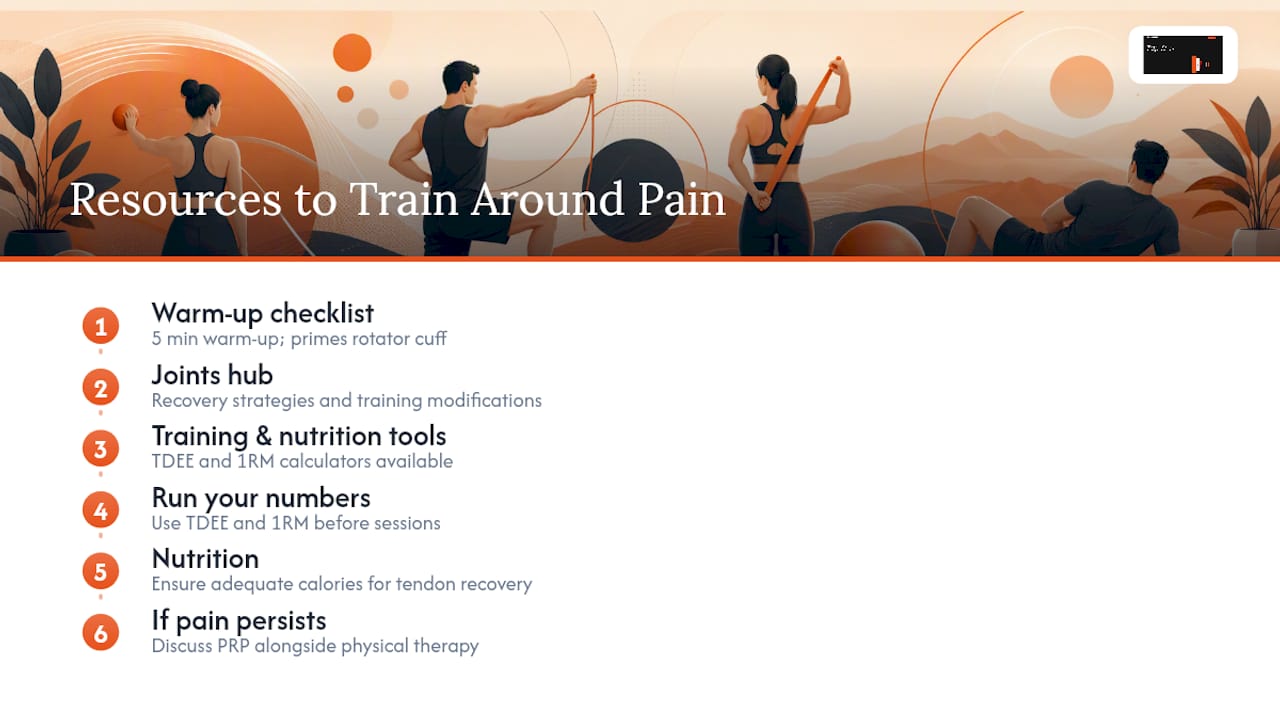
From there, the joints hub covers recovery strategies and training modifications for shoulders, knees, and everything in between, written for lifters who want their joints to last as long as their motivation does. If you're rebuilding after a flare and need to know whether your calories and training volume actually match your recovery capacity, the free training and nutrition tools include a TDEE calculator and a 1RM calculator, both useful when you're scaling load back up without guessing. Pair training changes with a look at your nutrition, since under-fueling slows tendon recovery as much as bad programming does. If your shoulder pain doesn't respond to modification within a few weeks, some readers explore adjunct options like PRP therapy for rotator cuff pain alongside their physical therapy, worth a conversation with your provider. None of this replaces a diagnosis. Start with the warm-up checklist, run your numbers through the 1RM calculator before your next session, and build from there.
Sources
- Characteristics of shoulder impingement in the recreational weight-training population
- Rotator Cuff Tendinopathy: Navigating the Diagnosis-Management Conundrum | JOSPT
- Specific modes of exercise to improve rotator cuff-related shoulder pain: systematic review and meta-analysis
This article is general information, not a substitute for advice from a qualified doctor. Consult a qualified healthcare professional about your own circumstances before acting on anything here.
FAQ
What is the best exercise for shoulder pain?
Submaximal isometrics in a pain-free direction, followed by light concentric strengthening, tend to work best as a starting point for most rotator cuff-related shoulder pain.
How can you tell if shoulder pain is muscular or joint-related?
Muscular pain usually feels like a dull ache that improves with light movement, while joint or tendon pain often catches sharply at specific angles and worsens with overhead motion; a clinician can confirm which you're dealing with.
What should you not do with shoulder pain?
Don't push through sharp or increasing pain, don't perform upright rows or lateral raises above 90 degrees, and don't ignore pain that's worse 24 hours after training.
What are good exercises to help a rotator cuff tear avoid surgery?
Structured exercise programs built around concentric strengthening, scapular stabilization, and supported external rotation are linked to reduced need for surgery according to clinical guidance from JOSPT, progression should stay within pain-free limits.