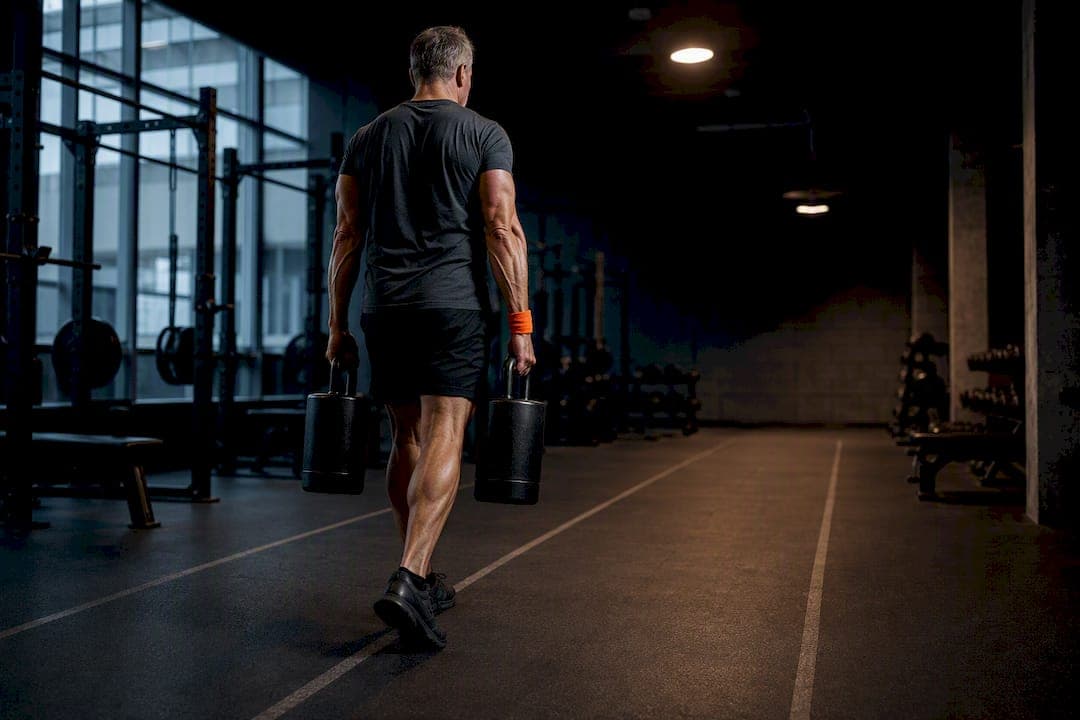
The farmer's carry builds grip strength, dynamic core stability, posterior-chain endurance, and better gait mechanics, all from one simple movement: pick up something heavy and walk. For lifters over 40, it delivers that functional package with less spinal load than a heavy deadlift, provided you program it conservatively and follow cardiovascular precautions.
TL;DR:
- Heavier loads increase activation of trunk stabilizers and forearm muscles, but straps or trap bars can help manage grip fatigue and overload the posterior chain.
- The farmer's carry mainly strengthens hip stabilizers like the gluteus medius, which supports pelvis stability and improves gait mechanics essential for aging adults.
- The exercise offers reliable grip strength gains and enhances dynamic core stability, making it a practical spine-friendly alternative to heavy deadlifts for lifters over 40.
- Individuals with blood pressure or cardiovascular concerns should start with lighter loads, shorter distances, and seek medical clearance before progressing to heavier carries.
- Incorporating carries 1 to 3 times weekly as an accessory movement supports overall strength, conditioning, and injury prevention, especially when programmed with gradual progression.
Table of Contents
- What Are the Farmer's Carry Benefits, and How Does It Work?
- Which Muscles Does the Farmer's Carry Actually Train?
- What Are the Proven Benefits of Farmer's Carry Training?
- How Should Lifters Over 40 Program Farmer's Carries?
- Which Farmer's Carry Variation Should You Use?
- Is the Farmer's Carry Safe for Lifters With Blood Pressure Concerns?
- How Strong Is the Evidence Behind Farmer's Carry Training?
- IronAtForty's Take: Carries as a Smart Deadlift Substitute After 40
- Put the Programming Into Practice With Free Tools
- Sources
- FAQ
What Are the Farmer's Carry Benefits, and How Does It Work?
Pick up two loaded implements, one in each hand, and walk. That is the entire farmer's carry exercise. What makes it different from a static hold or a conventional barbell lift is the combination of vertical side-loading and locomotion, and that combination changes the training stimulus in ways most lifters don't expect.
Holding weight at your sides, rather than in front of your body like a zercher carry or on your back like a squat, keeps your trunk more upright. That posture reduces anterior shear on the lumbar spine compared with a forward-hinged lift such as a deadlift.
Walking adds a second layer. Research on loaded locomotion found significantly higher activation in the low-back stabilizers, the longissimus and multifidus, during walking carries compared with static holds like a plank or suitcase hold performed standing still. Your spine has to react, stride after stride, instead of simply resisting one fixed position.
A few mechanical details matter for how you'll feel the exercise:
- Heavier loads increase activation in both the trunk stabilizers and the muscles of the hands and forearms, so the exercise gets harder everywhere at once, not just in your grip.
- Straps or a trap bar shift the limiting factor away from grip and toward hip and core endurance, letting you load the posterior chain more heavily without your hands failing first.
- Occupational load-carriage research, the kind done on soldiers and firefighters, shows that carrying weight over distance drives up cardiopulmonary strain independent of the muscular work involved, which is part of why carries double as a conditioning tool.
Which Muscles Does the Farmer's Carry Actually Train?
The muscle map here surprises people who assume carries are mostly a forearm exercise. Grip is involved, obviously, but the bigger story is what happens through the hips and trunk.
Biomechanical analysis shows gluteus medius activation scaling upward as the load increases, which supports its role as your primary lateral hip stabilizer during the movement. That is a muscle most lifters barely train directly, and it's the one keeping your pelvis from dropping with every step under load.
Statistic Callout: A biomechanical analysis of the farmer's walk found peak anterior-propulsive and braking forces 1.72 and 1.84 times greater than during unloaded walking, along with increased ankle dorsiflexion and knee flexion.
That's a meaningfully different gait pattern than casual walking. A few other findings round out the picture:
- Knee-extensor (vastus) activation tends to run lower than lifters expect, since the exercise leans more on hip and trunk stabilization than on knee-dominant force production.
- Trunk activation during carries differs from lifting-phase activation in strongman events; research comparing strongman events found greater abdominal engagement during walking phases than during static lifting phases.
- The propulsive and braking force increases translate into better dynamic balance and ankle/hip force production, both of which matter more for daily function as you age than a bigger one-rep max.
What Are the Proven Benefits of Farmer's Carry Training?
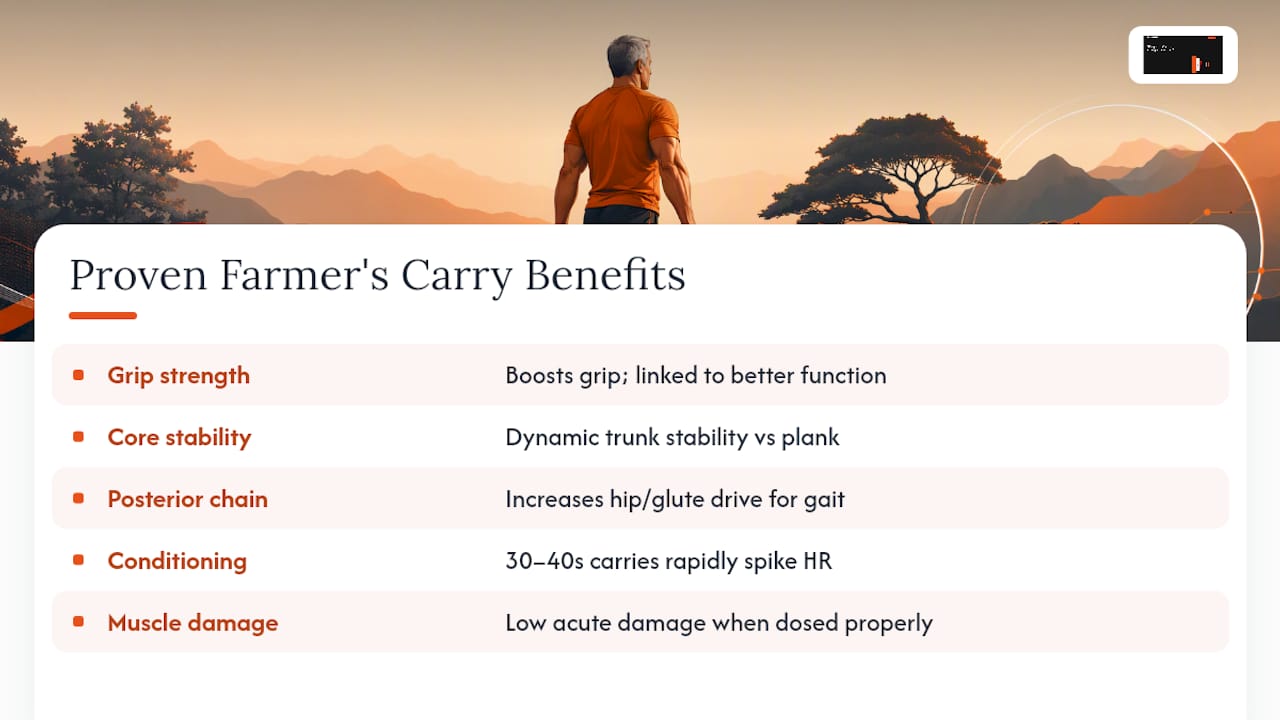
Grip strength. This is the most reliable adaptation, and it matters beyond the gym. Grip capacity correlates with broader functional outcomes in older adults, which is one reason carries show up so often in programs built for lifters 40+.
Dynamic core and spinal stability. Because carries force your trunk stabilizers to react to each step rather than hold one static position, they tax the longissimus and multifidus more than a plank does. If your goal is a spine that holds up under real-world, moving loads (groceries, a toddler, a suitcase), this is a more honest test than an isometric hold.
Posterior chain and hip drive. The gluteus medius work described above compounds with general hip and glute engagement to support the propulsive force you need for walking, climbing stairs, and recovering your balance when you stumble.
Conditioning. A heavy carry for 30 to 40 seconds spikes heart rate fast. Used between heavy compound lifts, it functions as a short conditioning block that doesn't require extra equipment or a separate cardio session.
Low acute muscle damage when dosed properly. One controlled trial using ten 20-meter walks at 70% of deadlift 1RM found increased subjective soreness but no significant rise in myoglobin or creatine kinase compared with unloaded walking. Translation: you'll feel it, but a well-dosed carry session isn't tearing your muscles up the way people assume.
How Should Lifters Over 40 Program Farmer's Carries?
Start simpler than you think you need to. Three structures work well, and none require guessing:
- Time-based: 20 to 60 seconds per carry, a good starting point if you're new to the movement or rebuilding after time off.
- Distance-based: 20 to 40 meters, useful once you have a consistent walking surface and want a repeatable benchmark.
- Rep-based sets: Two to four carries per session, treating each carry like a set in your normal training block.
Progress distance or time before you add load. Once grip becomes the limiting factor before your hips or trunk fatigue, that's your signal to bring in straps or switch to a trap bar so you can keep overloading the posterior chain without your hands failing first.
Frequency of one to three sessions per week works for most lifters, with carries slotted in as an accessory movement rather than the centerpiece of a session. A simple microcycle might pair a strength-focused day (heavier load, shorter distance, two to three sets) with a conditioning-focused day later in the week (lighter load, longer distance, more total volume).
Pro Tip: Track which hand fatigues first. A persistent gap between your dominant and non-dominant grip is often the earliest sign you need unilateral or suitcase carry work to correct an asymmetry before it shows up in a bigger lift.
Watch for delayed soreness in the traps and forearms after your first few sessions, and treat that early fatigue as data, not a problem to push through. Fitting carries into your broader load management plan keeps them additive instead of one more source of accumulated fatigue.
Which Farmer's Carry Variation Should You Use?
The standard two-dumbbell carry is the most accessible entry point. It's balanced, forgiving, and works for general strength and conditioning without any special setup.
A trap-bar carry takes grip out of the equation as the limiting factor and shifts more of the demand onto your legs and hips, which makes it a solid option if grip fatigue ends your sets too early or if you're managing back sensitivity and want a more centered load path.
Kettlebell carries and unilateral suitcase carries increase the anti-rotation demand on your trunk, since you're resisting a lopsided pull instead of a balanced one. These are useful for correcting side-to-side strength asymmetries.
Zercher and other front-loaded carry variations carry a distinct caution: front loading raises arterial stiffness more than side loading does, according to load carriage physiology research, which is a reason to use them sparingly if you're older or managing cardiovascular risk. Incline and uneven-surface carries add extra demand on your ankle and hip stabilizers, but they also raise cardiopulmonary stress, so treat them as a progression, not a starting point.
Is the Farmer's Carry Safe for Lifters With Blood Pressure Concerns?
This is the part of the conversation that gets skipped in most gym advice, and it shouldn't be.
Statistic Callout: Load carriage physiology research found that front-loaded carries like the zercher raise arterial stiffness (AIx) more, while side-loaded farmer's carries raise peripheral systolic blood pressure more. Both patterns matter for anyone managing cardiovascular risk.
The upright trunk position of a farmer's carry does reduce anterior lumbar shear compared with a conventional deadlift, but that postural advantage doesn't cancel out the acute blood pressure response. You still need solid trunk bracing to protect your spine, and you still need to respect what a loaded carry does to your circulatory system in the moment.
A few contraindications and red flags are worth naming directly: uncontrolled hypertension, a recent cardiac event, or severe balance impairment are all reasons to get clinician clearance before adding carries, not reasons to guess. If any of those apply to you, talk to your doctor before starting, and never stop or adjust a prescribed medication on your own to accommodate a training program.
Practical modifications for anyone with cardiovascular caution: lighter loads, shorter carry distances, a trap bar instead of a side-loaded grip, longer rest between sets, and supervised progression rather than jumping straight to heavier loads.
- Uncontrolled hypertension or a recent cardiac event: get clearance first.
- Severe balance impairment: start with lighter loads and shorter distances under supervision.
- General caution: reduce load and volume rather than pushing through fatigue.
How Strong Is the Evidence Behind Farmer's Carry Training?
The honest answer: strong on mechanism, thinner on long-term outcomes, especially in older adults.
The EMG and biomechanical studies backing the muscle-activation and gait claims in this article are well-designed for what they measure, muscle activation and force production during a single carry, but most rely on small samples of trained or athletic populations rather than a broad cross-section of lifters 40 and up. The acute training trial on muscle damage used a controlled protocol, but it captured one bout, not months of accumulated training.
That gap matters: what happens in a lab across one session doesn't automatically prove what happens across a year of programmed training in a 55-year-old lifter with a history of lower back pain. We've made the programming recommendations in this article conservative on purpose, favoring lower starting loads and gradual progression precisely because the clinical-risk literature (blood pressure and arterial stiffness responses) is clearer than the long-term outcome literature.
- Muscle activation and gait mechanics: well supported by direct measurement.
- Long-term adaptation in older lifters: plausible but not directly tested at scale.
- Cardiovascular caution: supported by acute-response data, which is exactly why the safety section above isn't optional reading.
IronAtForty's Take: Carries as a Smart Deadlift Substitute After 40
We treat the farmer's carry as one of the better trade-offs in a 40+ program, not a replacement for heavy pulling, but a lower-risk way to train grip, trunk stability, and hip drive on the days you don't want full spinal loading. It pairs naturally with deadlift alternatives for lifters managing back sensitivity, and it slots in well as accessory work after a main lift rather than as the session's centerpiece.
Use your estimated 1RM to set a sensible starting carry load, and progress distance and time before you touch load, following the same progressive overload principles that govern the rest of your training. If you have any cardiovascular risk factors, get clinician clearance before you start. Progress it like you'd progress anything else: patiently, and with your numbers written down.
Put the Programming Into Practice With Free Tools
Reading about starting loads and progression rules only helps if you can turn them into numbers for your own body. That's the gap Ironatforty's free training tools are built to close, no subscription, no sales call, just calculators you can use in five minutes.
Run your numbers through the 1RM calculator to set a starting carry load relative to your deadlift strength, then use the TDEE calculator to make sure your recovery and nutrition can support the extra conditioning volume carries add to your week. If you're rebuilding your whole approach to training after 40, our nutrition and recovery guides are the natural next stop.
Sources
- EMG and loaded locomotion study (2024)
- A biomechanical analysis of the farmers walk (2014)
- Hormonal, psychological, and muscle damaging effects of a Farmer's Walk bout (MSS 2020)
FAQ
How long should you do a farmer's carry for?
Most programs use 20 to 60 seconds per carry or 20 to 40 meters of distance, with two to four sets per session depending on whether you're training for strength or conditioning.
Does the farmer's carry actually work?
Yes. Research links it to measurable gains in grip strength, gluteus medius activation, and gait propulsive force, with peak anterior-propulsive and braking forces 1.72 and 1.84 times greater than during unloaded walking in one biomechanical study.
Are farmer's carries good for seniors?
They can be, when loads start light and progression is gradual, but anyone with uncontrolled hypertension, a recent cardiac event, or balance impairment should get clinician clearance first, since side-loaded carries raise peripheral systolic blood pressure during the effort.
Is it good to do farmer's carries every day?
Daily carries aren't necessary and can accumulate grip and low-back fatigue faster than you recover from; one to three sessions per week, built into a broader load management plan, is a more sustainable frequency for most lifters 40 and up.