Autoregulation in training is defined as the practice of adjusting workout intensity and volume daily based on real-time feedback about your performance and recovery state. Instead of following a fixed percentage of your one-rep max every session, you let your body's actual readiness drive the load. The three primary methods are Rate of Perceived Exertion (RPE), Reps in Reserve (RIR), and Velocity-Based Training (VBT). A 2023 meta-analysis of 14 randomized controlled trials found that autoregulated training produces 10–15% greater strength gains than traditional fixed-percentage programs for natural lifters. That gap matters more after 40, when sleep, stress, and recovery variability hit harder and more often.
What are the main methods of autoregulation in strength training?
As of 2026, RPE, RIR, and VBT are the three established methods for adjusting training loads in real time. Each works differently, and each has a specific use case depending on your equipment, experience, and goals.
Rate of Perceived Exertion (RPE)
RPE uses a 1–10 scale to rate how hard a set feels. A set at RPE 7 means you could have done 3 more reps. RPE 9 means you had 1 rep left. RPE 10 is an all-out max effort. This scale gives you a language for effort that connects directly to load decisions. If your target is RPE 8 and you hit RPE 6, you add weight. If you hit RPE 9, you back off.
Reps in Reserve (RIR)
RIR flips the RPE concept into a more intuitive format. Instead of rating effort, you estimate how many reps you had left in the tank. An RIR of 2 means you stopped with 2 reps to spare. RIR anchors your perception of exertion to a concrete number, which many lifters find easier to calibrate than a pure effort rating. RIR 2–3 is the sweet spot for most working sets when you want to train hard without burning out your recovery.
Velocity-Based Training (VBT)
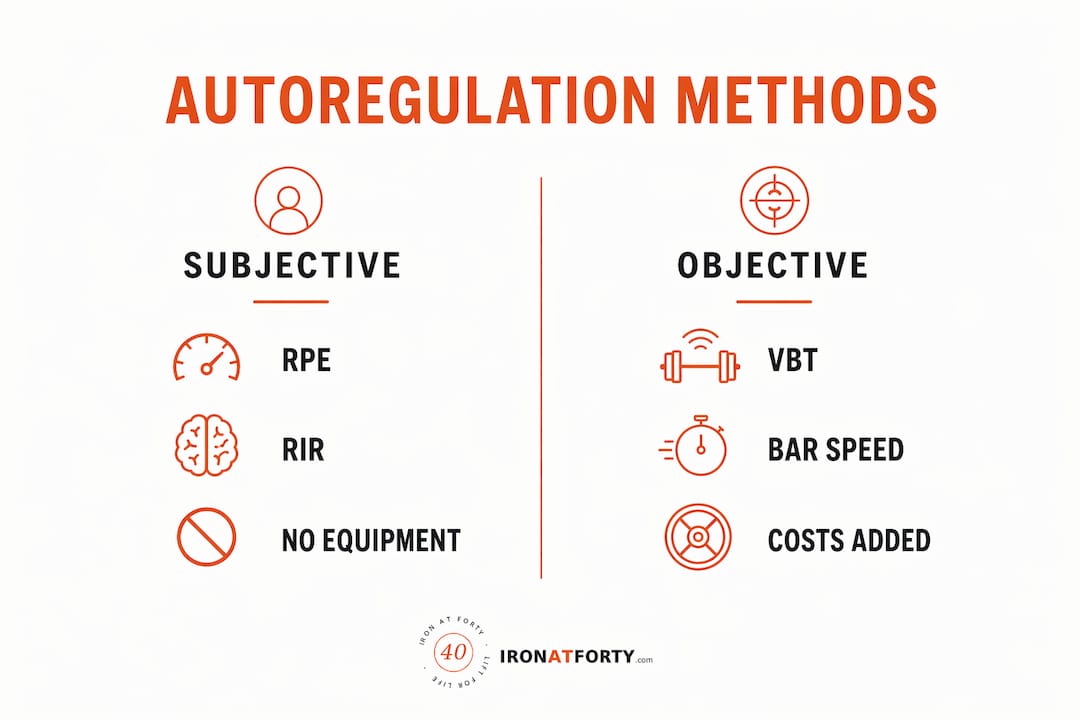
VBT is the only autoregulation method that removes subjective error entirely. VBT relies on objective bar speed data measured by a linear position transducer or accelerometer device. When bar velocity drops below a preset threshold, you stop the set or reduce the load. No guessing. No ego. The bar tells you the truth.
The tradeoff is cost and complexity. VBT devices require an upfront investment and a learning curve. RPE and RIR cost nothing and can be applied today.
| Method | Feedback type | Equipment needed | Best for |
|---|---|---|---|
| RPE | Subjective effort rating | None | Intermediate to advanced lifters |
| RIR | Reps remaining estimate | None | Beginners building effort awareness |
| VBT | Objective bar speed | Velocity device | Advanced lifters, coaches |
Pro Tip: Start with RIR if you are new to autoregulation. It is the most concrete and easiest to learn before moving to RPE-based programming.
What does the science say about autoregulation effectiveness?
The research on autoregulated training methods is clear and consistent. Fixed-percentage programs assume your capacity is the same every Monday. It is not. Sleep, nutrition, stress, and life all shift your readiness daily, and a rigid program ignores that completely.
"Autoregulated training leads to 10–15% greater strength improvements than traditional fixed-percentage methods for natural lifters, based on a 2023 meta-analysis of 14 randomized controlled trials. That finding means the method is not just a preference. It is a measurable performance advantage."
The velocity-based training data reinforces this further. A 2020 study on VBT showed that velocity-based training maintained power output metrics while matching the strength gains of traditional methods. The key difference was that VBT groups showed less neuromuscular fatigue at the end of training blocks. Less accumulated fatigue means better quality reps in the next session.
Natural lifters benefit most from autoregulation because their daily performance varies more than enhanced athletes. Factors like sleep quality, caloric intake, and psychological stress all shift your actual strength capacity on any given day. A program that ignores those factors is leaving gains on the table.
For lifters aged 30–50, this science carries extra weight. Recovery slows as you age. A bad night of sleep at 45 hits your squat harder than it did at 25. Autoregulation gives you a built-in mechanism to protect your training quality without skipping sessions or grinding through junk volume. That is how you stay consistent for years, not just weeks.
How to implement autoregulation in your workouts
Autoregulation sounds complex in theory. In practice, it comes down to a simple set of rules you apply before and after each working set. Here is a practical framework to get started.
-
Set your target rep range and RPE before the session. Example: 4 sets of 5 reps at RPE 7–8. This is your anchor. Everything else adjusts around it.
-
Warm up and assess your readiness. How does the bar feel during warm-up sets? Moving fast and smooth signals a good day. Grinding through warm-up weights signals a rough day. Adjust your expectations before your first working set.
-
Apply load adjustment rules after each set. Recommended load adjustments are 2.5–5% per set based on performance signals. If you hit your reps with RPE below 7, add 2.5–5% to the next set. If you hit RPE 9 at low reps, reduce by 2.5–5%.
-
Track your first and last working sets. Write down the load, reps, and RPE or RIR for both. This gives you the data you need to spot trends over time without tracking every single set.
-
Build a two-week baseline before making programming changes. Two weeks of data shows you your real performance range. Without that baseline, your adjustments are guesses.
-
Set a ceiling on daily load increases. Never add more than 5% in a single session based on feel alone. Autoregulation is not a license to chase PRs every time you feel good.
-
Review weekly, not daily. Look at your tracking data once a week. Adjust your working weights for the next week based on the trend, not a single session.
Pro Tip: If you use a 1RM calculator to set your starting loads, you get a reliable anchor point for your RPE targets from day one.
The discipline here is in the rules, not the feel. You are not training by mood. You are training by a system that responds to real data.
What are common misconceptions about autoregulated training?
The biggest mistake lifters make with autoregulation is treating it as permission to train easy. Effective autoregulation requires pre-determined rules and discipline. Without those rules, it becomes ego-driven inconsistency dressed up as a system.
Here are the most common errors and how to fix them:
-
Confusing psychological fatigue with neuromuscular fatigue. High RPE combined with high bar velocity signals psychological fatigue, not physical failure. The fix is to reduce volume, not load. Low RPE with slow bar speed signals neuromuscular fatigue. That is when you reduce load and rest more.
-
Adjusting loads inconsistently. If you add weight when you feel great but never reduce it when you feel flat, you are not autoregulating. You are just adding weight randomly. The rules must apply in both directions.
-
Ignoring technical form degradation. A set that grinds out of position is not an RPE 8. It is a failed set. Form breakdown is a hard stop, regardless of what the numbers say.
-
Switching methods too often. RPE and RIR take weeks to calibrate accurately. Jumping between methods before you have a baseline destroys the data you need to make good decisions.
Pro Tip: Write your autoregulation rules on your phone before the session. If you have to think about the rule mid-set, you will make an emotional decision instead of a systematic one.
Training age affects how quickly you calibrate RPE. Lifters with more years under the bar read their effort more accurately. If you are newer to lifting, give yourself a full month of RIR tracking before trusting your RPE ratings.
Key Takeaways
Autoregulation is the most evidence-backed method for matching training stimulus to daily recovery capacity, producing measurably greater strength gains than fixed-percentage programs for natural lifters.
| Point | Details |
|---|---|
| Core definition | Autoregulation adjusts load and volume daily based on real-time performance feedback, not fixed percentages. |
| Three primary methods | RPE, RIR, and VBT are the established autoregulation tools, each with different cost and precision tradeoffs. |
| Science-backed gains | A 2023 meta-analysis shows 10–15% greater strength gains with autoregulation versus traditional programming. |
| Practical starting point | Track first and last working sets for two weeks to build a reliable baseline before adjusting your program. |
| Biggest pitfall | Autoregulation without pre-set rules becomes inconsistent and ego-driven, not recovery-based. |
Why autoregulation changed how I train after 40
I spent years following fixed-percentage programs. They worked until they did not. The problem was not the programming. The problem was that my recovery at 44 does not look like my recovery at 28. A bad week of sleep, a stressful work deadline, a nagging shoulder. All of that changes what I can actually do under the bar on any given day.
Autoregulation is not a shortcut. It is a control system that matches your training stimulus to your actual daily capacity. When I started using RPE-based loading, I stopped grinding through sessions that were doing more harm than good. I also stopped leaving gains on the table on days when I felt strong.
The thing most articles miss is that autoregulation requires more discipline than fixed programming, not less. You have to write the rules before you train. You have to follow them when your ego says otherwise. That is the hard part. But for lifters over 40 who want to keep making progress without wrecking their joints or burning out, it is the most sustainable system I have found. Pair it with solid training fundamentals for over 40 and you have a framework that can last decades.
— Jeff
Ironatforty tools to support your training
Autoregulation works best when you have reliable data to work with. Ironatforty builds free tools specifically for lifters over 40 who want to train smarter without hiring a coach.
The Ironatforty training hub covers programming principles, recovery strategies, and strength methods grounded in real science. If you want to dial in the nutrition side of recovery, the nutrition resources address fueling for performance and body composition after 40. And if you need a starting point for your RPE targets, the free tools page includes a 1RM Calculator and TDEE Calculator to anchor your numbers from day one. No guesswork, no recycled advice.
FAQ
What is autoregulation in training?
Autoregulation in training is the method of adjusting workout load and volume based on daily performance feedback rather than fixed percentages. The three primary methods are RPE, RIR, and Velocity-Based Training.
Is autoregulation better than percentage-based programming?
A 2023 meta-analysis of 14 randomized controlled trials found autoregulated training produces 10–15% greater strength gains than fixed-percentage methods for natural lifters. The advantage is largest when recovery varies significantly between sessions.
How do I start using RPE in my workouts?
Assign a target RPE to each working set before you train, then rate your actual effort after each set and adjust load by 2.5–5% accordingly. Track your first and last working sets for two weeks to build an accurate baseline.
What is the difference between RPE and RIR?
RPE rates overall effort on a 1–10 scale, while RIR estimates how many reps you had remaining at the end of a set. RIR is generally easier for beginners to learn because it anchors effort to a concrete number.
Do I need special equipment for autoregulation?
RPE and RIR require no equipment and can be applied immediately. Velocity-Based Training requires a bar speed measurement device and is better suited for advanced lifters or coached environments.