
Menopause is defined as the permanent end of menstruation, and it directly reduces estrogen levels in ways that slow muscle protein synthesis, impair recovery, and accelerate lean mass loss. Understanding how menopause affects strength training is not optional for women over 40 who lift. It is the difference between a program that works and one that quietly fails you. The good news is that resistance training remains effective at preserving and building muscle even after estrogen declines. Your muscles can still adapt. The challenge is managing the conditions around that adaptation.
How does menopause affect strength training physiology?
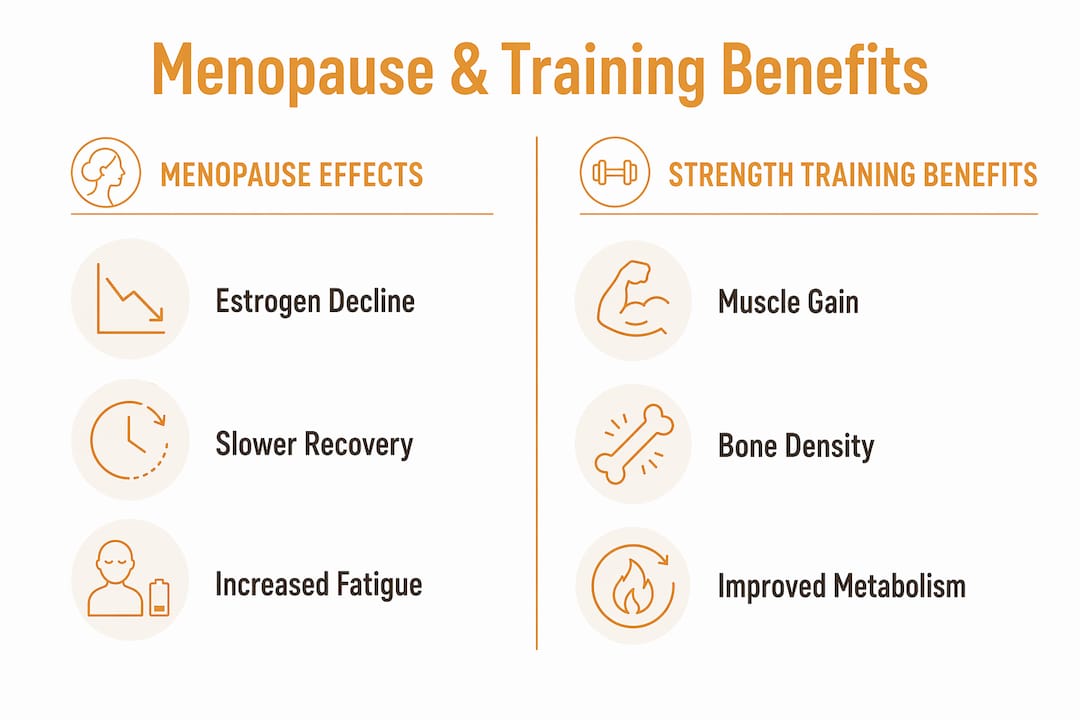
Estrogen does more than regulate your cycle. It plays a direct role in muscle protein synthesis, neuromuscular function, and connective tissue repair. When estrogen drops during perimenopause and postmenopause, all three slow down. You recover more slowly between sessions, you fatigue faster during them, and the window for muscle repair narrows.

The clinical term for age-related muscle loss is sarcopenia. Menopause accelerates it. Women can lose 3–8% of muscle mass per decade after 30, and that rate increases after menopause. That is not a scare statistic. It is a reason to get under the bar consistently.
Here is what changes physiologically:
- Muscle protein synthesis slows. Estrogen normally supports anabolic signaling. Without it, the same training stimulus produces a smaller muscle-building response.
- Neuromuscular efficiency drops. Reaction time, motor unit recruitment, and coordination all decline, which affects strength expression even when muscle mass is maintained.
- Recovery windows lengthen. Inflammation after training takes longer to resolve. Soreness that used to clear in 24 hours may take 48–72 hours.
- Metabolic rate falls. Lower estrogen correlates with reduced resting metabolism and increased fat storage, particularly around the abdomen.
- Sleep quality declines. Poor sleep compounds all of the above. Combined training over 8 weeks significantly improved sleep quality in early postmenopausal women, with effect sizes between d≈1.08 and 1.19. That matters because sleep is when muscle repair happens.
Pro Tip: Track your recovery, not just your lifts. If you are consistently sore for more than 48 hours after a session, that is data. Reduce volume before you reduce intensity.
Does resistance training still build muscle during menopause?
Yes. Definitively. The research is consistent on this point. A systematic review of 17 randomized controlled trials covering 744 postmenopausal women found consistent strength and functional gains from exercise interventions, including improvements in grip strength, knee extension strength, and gait speed. Muscle mass changes were modest, but functional performance improved reliably.
That distinction matters. The scale and the DEXA scan do not tell the full story. Grip strength and gait speed are better predictors of long-term health outcomes than body weight. Training for function is training for longevity.
A 12-week resistance training program showed that women aged 40–60 achieved a 19% improvement in hip function, a 21% gain in flexibility, and a 10% improvement in dynamic balance compared to controls who showed no gains. Critically, these gains were similar across perimenopausal, postmenopausal, and premenopausal women. Menopause does not blunt your training response. It changes the conditions around it.
| Outcome | Evidence |
|---|---|
| Muscle strength | Consistent gains across RCTs in postmenopausal women |
| Hip function | 19% improvement after 12 weeks of resistance training |
| Flexibility | 21% improvement in women aged 40–60 |
| Dynamic balance | 10% improvement versus no change in controls |
| Bone mineral density | Positive association with resistance training programs |
| Metabolic markers | Improved body composition and lipid profiles with regular training |
Bone health is another area where strength training delivers. Resistance training benefits bone mineral density in postmenopausal women, which matters because estrogen decline accelerates bone loss. Fracture prevention starts with load-bearing exercise, and prevention beats fracture treatment in both cost and quality of life.
What are the best training strategies for menopausal women?
The principles of progressive overload still apply. What changes is how you manage volume, recovery, and exercise selection. Here is a practical framework built around the current evidence.
- Start with three sessions per week. This frequency gives you enough stimulus for adaptation while allowing adequate recovery between sessions. Two sessions is a floor, not a goal.
- Prioritize lower body and compound movements. Squats, deadlifts, Romanian deadlifts, hip thrusts, and lunges target the largest muscle groups and produce the greatest hormonal and metabolic response. They also directly address the hip function and balance deficits that menopause accelerates.
- Use moderate loads with controlled progression. Training volume influences muscle hypertrophy in postmenopausal women, but strength responses depend on load and program design. Working in the 8–12 rep range at 65–75% of your one rep max is a reliable starting point. Use the 1RM Calculator at Ironatforty to set your training loads accurately.
- Build in deload weeks every 4–6 weeks. This is not optional. Hormonal changes mean your recovery capacity is lower than it was at 30. A deload is not a setback. It is part of the program.
- Include balance and functional work. Single-leg exercises, step-ups, and stability work address the neuromuscular decline that menopause accelerates. These are not warm-up fillers. They are training.
- Track performance, not just weight. Functional outcomes like grip strength and gait speed are more reliable indicators of progress than the scale. Log your lifts, your rep quality, and your recovery.
Pro Tip: Home-based and supervised training produce similar outcomes when program quality is consistent. You do not need a gym. You need a plan and the discipline to follow it.
If you want a broader look at how training after 40 changes, Ironatforty covers the full picture of hormonal and structural shifts that affect your results.
Does supplementation improve strength training results during menopause?
Supplements are not the lever most people think they are. A systematic review and meta-analysis of 14 trials covering 763 women found that nutritional supplementation combined with exercise showed no significant additional effects on skeletal muscle mass or bone mineral density beyond exercise alone. That is a clear finding. The training is doing the work, not the protein powder.
There were some modest exceptions worth noting:
- Bench press and handgrip strength showed small improvements with targeted supplementation, suggesting some benefit for strength expression specifically.
- Protein and creatine did not significantly add to muscle mass gains, but they may support recovery and reduce training-related fatigue at the margins.
- Baseline nutrition matters more than supplementation. If your protein intake is below 0.8 grams per pound of bodyweight, fix that first. Supplements cannot compensate for a poor diet.
The takeaway is direct. Eat enough protein, get your calories right using a TDEE calculator, and let the training do the heavy lifting. Supplements are a small addition to a solid foundation, not a replacement for one. If you want to understand how insulin resistance after 40 interacts with your nutrition and training, that context is worth reading before you spend money on supplements.
How does menopause change metabolic health and what can training do?
Menopause accelerates negative metabolic changes. Estrogen decline correlates with rising blood glucose, worsening lipid profiles, increased abdominal fat, and higher cardiovascular disease risk. A 4-year follow-up study found that menopause accelerates metabolic health decline independent of aging alone. That is the honest picture.
Physical activity helps, but it does not fully reverse these changes. The same research showed that higher physical activity linked to healthier lipid levels and lower body adiposity, but accelerated waist-to-hip ratio changes still occurred, suggesting some loss of gluteal muscle mass regardless of activity level.
| Metabolic Marker | Effect of Menopause | Effect of Strength Training |
|---|---|---|
| Blood glucose | Rises with estrogen decline | Improved insulin sensitivity |
| Lipid profile | Worsens, especially LDL | Modest improvement with regular activity |
| Abdominal fat | Increases significantly | Reduced with consistent training |
| Cardiovascular risk | Elevated post-menopause | Lowered with regular resistance training |
| Waist-to-hip ratio | Worsens even with activity | Partially mitigated by lower body training |
Strength training is the most effective tool for managing these metabolic shifts. It builds the muscle tissue that acts as a glucose sink, improves insulin sensitivity, and shifts body composition toward lean mass. It will not undo every hormonal change. But it is the best intervention available without a prescription.
Key takeaways
Strength training during menopause works because muscle adaptation persists despite estrogen decline, but recovery capacity and training volume tolerance require deliberate management.
| Point | Details |
|---|---|
| Estrogen decline slows recovery | Expect longer soreness windows and plan deload weeks every 4–6 weeks. |
| Muscle gains remain achievable | RCTs confirm strength and functional improvements in postmenopausal women with consistent training. |
| Function beats scale weight | Track grip strength, balance, and performance rather than body weight alone. |
| Supplements add little | Protein and creatine do not significantly boost muscle mass beyond training stimulus. |
| Metabolic risk is real but manageable | Regular resistance training improves insulin sensitivity, lipid profiles, and body composition. |
What i've learned training women through menopause
Here is the thing most fitness content gets wrong. It frames menopause as a wall. It is not a wall. It is a shift in conditions, and your program needs to shift with it.
The biggest barrier I see is not muscle responsiveness. The muscles still respond. The barrier is recovery tolerance. Women in perimenopause and early postmenopause often push the same volume they trained at in their 30s, get crushed by fatigue, and conclude that training is not working. The training is fine. The volume is wrong.
I have watched women drop from five sessions per week to three, add a deload week, and suddenly start making progress again after months of stalling. That is not a coincidence. That is physiology. Recovery limitations are the primary barrier, not muscle capacity.
The other mindset shift worth making: stop chasing the body you had at 35. Train for the body that performs well at 50 and 60. That means prioritizing hip strength, balance, and functional capacity. It means measuring success by what you can do, not what you weigh. Consistent, structured training is not a consolation prize for getting older. It is the most powerful tool you have.
If you are showing up and lifting consistently, you are doing the right thing. Adjust the conditions around the training, not the training itself.
— Jeff
Train smarter after 40 with Ironatforty
Ironatforty is built for lifters who want real guidance, not recycled gym content. If you are navigating menopause and weight training, the site gives you science-backed articles, practical programming advice, and free tools designed for people who lift seriously after 40.
Start with the free training and nutrition tools to set your calorie targets and training loads accurately. The 1RM Calculator helps you program progressive overload without guessing, and the TDEE Calculator keeps your nutrition dialed in for muscle maintenance. Everything at Ironatforty is written for the lifter who cannot afford a personal coach but refuses to settle for generic advice.
FAQ
Does menopause stop muscle growth from strength training?
No. Research confirms that postmenopausal women achieve consistent strength and functional gains from resistance training. Muscle adaptation persists despite estrogen decline, though recovery takes longer.
How often should menopausal women lift weights?
Three sessions per week is the evidence-supported starting point. This frequency provides enough training stimulus while allowing adequate recovery between sessions.
Do protein supplements help with muscle building during menopause?
Protein and creatine supplementation show no significant additional effect on muscle mass beyond training alone. Prioritize hitting 0.8–1 gram of protein per pound of bodyweight from whole food sources first.
Is strength training safe for bone health during menopause?
Resistance training is one of the most effective tools for maintaining bone mineral density after menopause. Load-bearing exercise directly stimulates bone remodeling and reduces fracture risk.
How do i know if my training program is working during menopause?
Track functional performance measures like grip strength, balance, and lift numbers rather than body weight. These are more reliable indicators of progress in postmenopausal women than scale changes.