Short workouts absolutely work. Research across 27 systematic reviews and 135 studies confirms that short-bout accumulated exercise (SBAE) improves more than 20 health outcomes, including peak oxygen uptake and resting blood pressure. The catch? You need the right format for your goal, and you need to do them regularly. Here's the fastest way to match your goal to a routine:
Fastest wins from great quick workouts:
- Cardio fitness and VO2max: 10–20 minute HIIT sessions or accumulated exercise snacks (≤10 min bouts, multiple times per day)
- Glycemic control: Multiple short bouts spread across the day outperform a single continuous session for acute blood sugar management
- Strength maintenance: 10–20 minute focused resistance circuits with compound moves
- Mobility and stress relief: 5–10 minute yoga or mobility flows, especially in the evening
- Activity maintenance: Daily exercise snacks or 3x/week brief sessions keep the baseline high
Goal-to-workout cheat sheet:
| Goal | Best format | Duration |
|---|---|---|
| Weight loss / conditioning | HIIT or accumulated snacks | 10–20 min |
| Strength maintenance | Resistance circuit | 10–20 min |
| Glycemic control | Multiple short bouts daily | 5–10 min each |
| Mobility / stress relief | Yoga or mobility flow | 5–10 min |
| Metabolic blast | Tabata | 4 min |
One caveat before you dive in: high-intensity options need to be scaled back for untrained adults, older lifters managing joint issues, or anyone with a cardiac or metabolic condition.
Table of Contents
- Why do short workouts actually work?
- Five great quick workouts you can do today
- Are short workouts safe, and what should you modify?
- Where do you fit short workouts into a busy day?
- How do you make short workouts stick long-term?
- Key Takeaways
- The case for short workouts is stronger than the fitness industry admits
- Ironatforty's free tools help you personalize your quick-workout plan
- Useful sources
- FAQ
Why do short workouts actually work?
The science here is cleaner than most fitness content lets on. Short-bout accumulated exercise, or SBAE, is defined as exercise bouts of 10 minutes or less performed multiple times per day. A related concept, VILPA (vigorous intermittent lifestyle physical activity), refers to very brief vigorous bursts embedded in daily life, like taking stairs fast or a brisk walk between meetings. Both are distinct from traditional continuous exercise, and both produce real physiological change.
A 2025 meta-analysis across 27 studies involving 970 adults found that exercise snack interventions produced a standardized mean difference of 0.63 for VO2max, alongside significant improvements in body fat percentage, waist circumference, systolic and diastolic blood pressure, fasting blood glucose, HDL, LDL, and total cholesterol. Body mass and triglycerides showed no significant change. That's a meaningful cardiometabolic package from sessions most people would dismiss as "too short to count."
Statistic worth noting: A PLOS One trial found that just a few minutes of all-out sprint-interval work per week (three short efforts within a session, done multiple times weekly) produced a 12% improvement in peak VO2 and a 7% reduction in resting mean arterial pressure over six weeks in overweight adults.
On the VILPA side, a wearable-based national cohort study found that median daily VILPA of roughly a few minutes was associated with notably lower all-cause and cardiovascular mortality risk. Observational data, so interpret with appropriate caution, but the signal is consistent across methods.
What short workouts don't do well: produce large hypertrophy or major strength gains. If you're chasing a new squat PR or adding significant muscle mass, brief sessions are a supplement, not a replacement, for dedicated resistance training. They're a floor, not a ceiling.
What drives the adaptation?
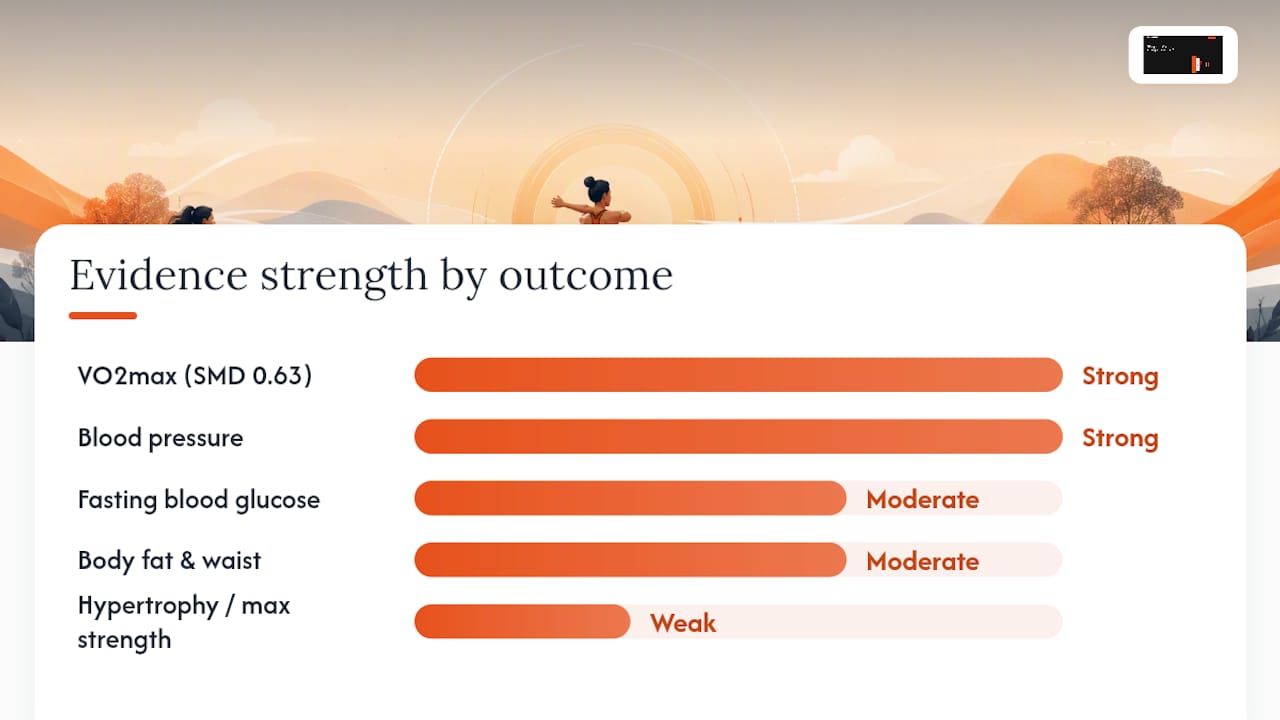
| Outcome | Short-bout evidence | Strength of evidence |
|---|---|---|
| VO2max / cardiorespiratory fitness | Significant improvement (SMD 0.63) | Strong (meta-analysis) |
| Blood pressure | Significant reduction | Strong (meta-analysis) |
| Fasting blood glucose | Significant improvement | Moderate |
| Body fat % / waist circumference | Significant improvement | Moderate |
| Hypertrophy / max strength | Limited improvement | Weak |
Adherence is another underrated advantage. Structured exercise snack RCTs report high adherence rates typically above 80% in inactive adults, which is far higher than typical gym programs. The reason, according to consensus research, is that perceived exertion, not time, is the primary barrier. Structured interval formats like the 10–20–30 method (30 seconds easy, 20 seconds moderate, 10 seconds hard) reduce that perceived difficulty and make high-intensity work feel manageable.
Five great quick workouts you can do today
These five routines cover the most common goals and constraints. Each one is equipment-free or close to it. Pick one and do it today.
Routine 1: 10-minute bodyweight HIIT
Goal: Conditioning, calorie burn, cardio fitness Equipment: None
Warm up with 90 seconds of marching in place and arm circles. Then cycle through this circuit twice:
- Jump squats: 30 seconds on, 15 seconds rest
- Push-ups: 30 seconds on, 15 seconds rest
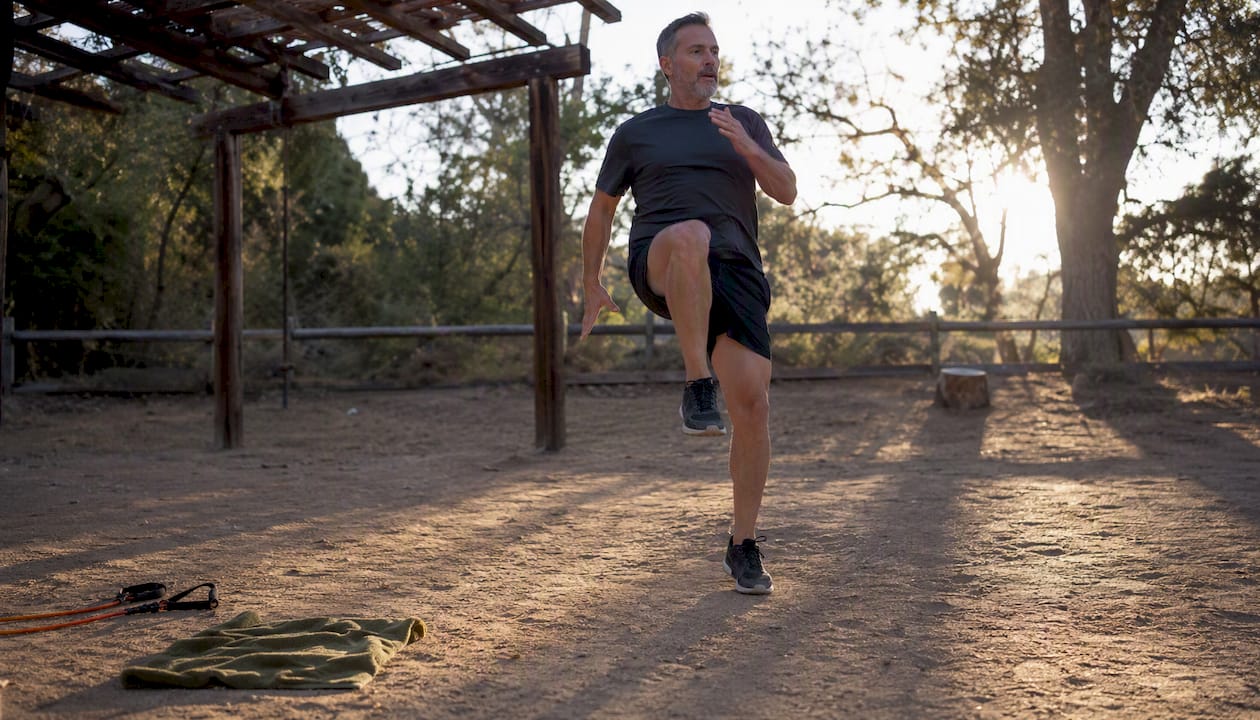
- High knees: 30 seconds on, 15 seconds rest
- Reverse lunges: 30 seconds on, 15 seconds rest
Beginner mod: Replace jump squats with bodyweight squats; step back into lunges instead of alternating. Advanced: Add a burpee at the end of each round. Week 1 → Week 4 progression: Start with one circuit. Add a third round by week 3. By week 4, reduce rest to 10 seconds.
Routine 2: 15-minute strength circuit
Goal: Strength maintenance, muscle retention Equipment: A pair of dumbbells or a resistance band (optional)
Two minutes of hip hinges and shoulder rolls to prime joints. Then:
- Goblet squat or bodyweight squat: 3 sets of 10 reps
- Push-up or dumbbell press: 3 sets of 8 reps
- Dumbbell row or band row: 3 sets of 10 reps per side
- Hip hinge / Romanian deadlift: 3 sets of 10 reps
Rest 30 seconds between sets. For a beginner strength primer, check out this step-by-step guide to basic strength training for form cues before loading up.
Week 1 → Week 4 progression: Begin with bodyweight only. Add light load in week 2. Increase reps to 12 by week 4.
Routine 3: 5-minute AMRAP exercise snack
Goal: Glycemic control, daily activity accumulation Equipment: Stairs or floor space
Do as many rounds as possible in 5 minutes:
- 10 stair climbs (or 10 step-ups on a chair)
- 5 push-ups
- 10 bodyweight squats
No warm-up needed for this intensity level. Space these snacks at least 30 minutes apart if you're doing multiple per day.
Routine 4: 4-minute Tabata blast
Goal: Metabolic conditioning, time-pressed days Equipment: None
Tabata is 20 seconds all-out, 10 seconds rest, repeated 8 rounds. Pick one exercise: burpees, squat jumps, or mountain climbers. That's it. Four minutes total.
Beginner mod: Use bodyweight squats instead of jumps. Aim for consistent pace, not maximum speed.
Pro Tip: Use a free Tabata timer app (Tabata Timer or Seconds Pro) so you're not watching a clock. Your only job is to move hard on the "go" signal. For intensity guidance, the CDC's physical activity guidelines suggest vigorous activity should bring you to 70–85% of your maximum heart rate.
Routine 5: 10-minute mobility and stress-relief flow
Goal: Recovery, stress relief, joint health Equipment: A mat
Move through each position for 60 seconds:
- Cat-cow spinal flow
- Hip flexor stretch (each side)
- Thread-the-needle thoracic rotation (each side)
- Seated forward fold
- Child's pose
No progression needed here. The goal is consistency, not intensity. This pairs well with an evening wind-down or the morning before a heavy lifting day.
For high-intensity sprint variations, including stair sprints and short sprint protocols, this guide to high-intensity sprints covers safety cues and performance applications worth reviewing before you push hard.
Are short workouts safe, and what should you modify?
Short doesn't mean low-risk, especially when the intensity is high. A proper warm-up is non-negotiable even for a 4-minute Tabata. Two to three minutes of low-intensity movement, joint circles, and movement primes (leg swings, arm circles, hip hinges) raises tissue temperature and reduces injury risk. For lifters who also do heavy sessions, Ironatforty's warm-up guide for over-40 lifters goes deeper on joint prep.
Common modifications for high-impact moves:
- Jump squats → bodyweight squats or slow tempo squats
- Burpees → squat-thrust without the jump, or step-back burpees
- Standard push-ups → incline push-ups on a bench or wall
- High knees → marching in place
- Stair sprints → slow stair climbs or step-ups
For lifters over 40 specifically:
- Space HIIT sessions away from heavy lower-body lifting by at least 6 hours, or use alternate days
- Monitor recovery: if sleep quality drops or joints feel persistently sore, reduce HIIT frequency before cutting strength work
- Protein intake at 0.8–1 gram per pound of bodyweight supports muscle retention when training frequency increases
- Prioritize sleep; it's where adaptation actually happens
Medical clearance: If you experience chest pain, shortness of breath disproportionate to effort, dizziness, or have uncontrolled hypertension, a recent cardiac event, or recent surgery, check with your clinician before starting high-intensity protocols. This is general information, not medical advice; confirm your specific situation with a qualified professional.
Where do you fit short workouts into a busy day?
Timing matters more than most people admit. Three placement strategies work consistently:
A. Micro-snacks between meetings Stack a 5-minute AMRAP between back-to-back calls. The glycemic control benefit is highest when short bouts are distributed across the day rather than clustered. The tradeoff: you need to be comfortable getting slightly sweaty at a desk. A change of shirt solves most of that.
B. Morning power burst A 10-minute HIIT session before breakfast works well for conditioning and mental clarity. It doesn't require a gym, and it's done before the day's friction builds up. The downside: if you lift heavy in the morning, keep the HIIT light or shift it to later.
C. Evening mobility or stress-relief session The 10-minute mobility flow is the best evening option. It doesn't spike cortisol before bed the way intense HIIT can, and it actively aids recovery. Pair it with a consistent sleep time and you've built a habit anchor.
Logistics that actually matter:
- Keep a mat rolled out in a visible spot; friction kills consistency
- Use a free interval timer app so you're not watching a clock
- A 2x2 meter floor space is enough for every routine above
- Stairs in your building replace any cardio machine for snacks and sprints
Habit triggers that work:
- Pair a snack with an existing cue: after your second coffee, before your lunch break, right after you close your laptop
- Block 10 minutes on your calendar as a meeting with yourself
- Tell one person your plan; public commitment increases follow-through
How do you make short workouts stick long-term?
Consistency is the variable that separates people who get results from people who have a good week and then disappear. A few tactics that actually hold up:
Habit stacking is the most reliable entry point. Attach the workout to something you already do without thinking, like making coffee or ending a work call. The new behavior rides the existing one.
Micro-challenges work better than vague goals. "I'll do a 5-minute AMRAP every weekday for two weeks" is a commitment you can track. "I'll work out more" is not.
Simple logging beats sophisticated apps for most people. A paper notebook with a date and a checkmark, or a basic note in your phone, is enough. The act of recording creates a streak you don't want to break.
When to scale up: After four weeks of consistent sessions, add one round, reduce rest, or increase load. If you're completing every session feeling like you could do more, that's the signal to progress.
When to back off: Persistent joint pain, two or more nights of poor sleep in a row, or a drop in motivation that feels physical rather than mental are all signs to reduce intensity or take a rest day. Ironatforty's free tools include a TDEE calculator that can help you align your calorie intake with your training load as you scale up, so recovery nutrition keeps pace with effort.
Key Takeaways
Short, well-structured workouts produce real cardiometabolic benefits when done consistently, and frequency plus intensity matter far more than total session length.
| Point | Details |
|---|---|
| Short workouts are evidence-backed | SBAE research across 135 studies shows improvements in VO2max, blood pressure, and glycemic control. |
| Intensity drives adaptation | Even 3 minutes of all-out sprint work per week produced a 12% improvement in peak VO2 and a 7% reduction in resting mean arterial pressure in a six-week trial. |
| Separate HIIT from heavy lifting | For lifters over 40, space high-intensity sessions at least 6 hours from heavy strength work to preserve gains. |
| Start with one routine today | Pick one of the five routines above and do it now; adherence rates in exercise snack trials reach 85–95%. |
| Ironatforty tools help you scale | Use the TDEE Calculator to align calorie targets with your training load as sessions increase. |
The case for short workouts is stronger than the fitness industry admits
The mainstream fitness world has a vested interest in making you believe that results require an hour-long session, a gym membership, and a complicated program. The research doesn't support that. What it supports is intensity, consistency, and frequency, none of which require a lot of time.
What I find most compelling about the SBAE and exercise snack literature is the adherence data. High dropout is the real epidemic in fitness, not lack of time. When people do short, structured bouts they stick with them. That's not a minor footnote; it's the whole game. A 10-minute session you actually do beats a 60-minute session you skip every time.
The nuance worth holding onto: short workouts are a floor, not a ceiling. If you're over 40 and lifting seriously, they complement your strength work. They don't replace it. The goal is to keep the metabolic engine running between heavy sessions, manage stress, and accumulate enough weekly activity to hit the thresholds where health outcomes actually shift. That's a realistic, sustainable target for most busy adults.
Ironatforty's free tools help you personalize your quick-workout plan
Short workouts produce results, but results compound faster when your nutrition and training load are calibrated. Ironatforty's free training and nutrition tools give you the numbers you need without a personal coach.
Start with the TDEE Calculator to find your daily calorie target based on your activity level. As you add more short sessions or increase intensity, your maintenance calories shift, and eating at the wrong number stalls fat loss or undercuts recovery. The calculator takes 60 seconds and gives you a concrete starting point. From there, Ironatforty's nutrition content covers protein targets, meal timing, and recovery strategies built specifically for lifters over 40. No guesswork, no recycled bro-science. Just the numbers and the reasoning behind them.
Useful sources
- Short bouts of accumulated exercise: Review and consensus statement on definition, efficacy, feasibility, practical applications, and future directions - PMC
- The effectiveness of exercise snacks as a time-efficient treatment for improving cardiometabolic health in adults: a systematic review and meta-analysis
- Three Minutes of All-Out Intermittent Exercise per Week Increases Skeletal Muscle Oxidative Capacity and Improves Cardiometabolic Health | PLOS One
- Perspective review on manipulating the F.I.T.T. components for interval training - PMC
- https://pmc.ncbi.nlm.nih.gov/articles/PMC11295100/
- Vigorous intermittent lifestyle physical activity (VILPA) and mortality risk among US adults: a wearables-based national cohort study | International Journal of Behavioral Nutrition and Physical Activity | Springer Nature Link
- Physical activity guidelines for adults - CDC
- Effect of exercise snacks on fitness and cardiometabolic health in physically inactive individuals: systematic review and meta-analysis
FAQ
What is the most effective quick workout?
For cardiorespiratory fitness, a 10-minute HIIT session using bodyweight exercises is the most evidence-backed option. For glycemic control specifically, multiple short bouts (5–10 minutes each) spread across the day outperform a single continuous session.
Does a 10-minute workout really work?
Yes. A 2025 meta-analysis found significant improvements in VO2max (SMD 0.63), blood pressure, and fasting blood glucose from exercise snack interventions, most of which used bouts of 10 minutes or less.
What is a good 10-minute workout routine?
A solid option: 90 seconds of warm-up movement, then two rounds of jump squats, push-ups, high knees, and reverse lunges, each 30 seconds on and 15 seconds rest. Beginners swap jumps for bodyweight squats and step back into lunges.
What is the 3-3-3 rule at the gym?
The 3-3-3 rule isn't a standardized training protocol with a single definition; different coaches use it differently. A common version refers to 3 sets of 3 reps at near-maximal load for strength development, but this isn't directly tied to short-workout or exercise snack research. If you're working with a specific program that uses this label, confirm the definition with that source.
How often should you do short workouts to see results?
Research supports 3x/week for structured HIIT sessions, or daily exercise snacks (multiple 5–10 minute bouts) for glycemic and cardiovascular benefits. CDC guidelines recommend at least moderate amounts of weekly activity; short workouts can accumulate toward that target.