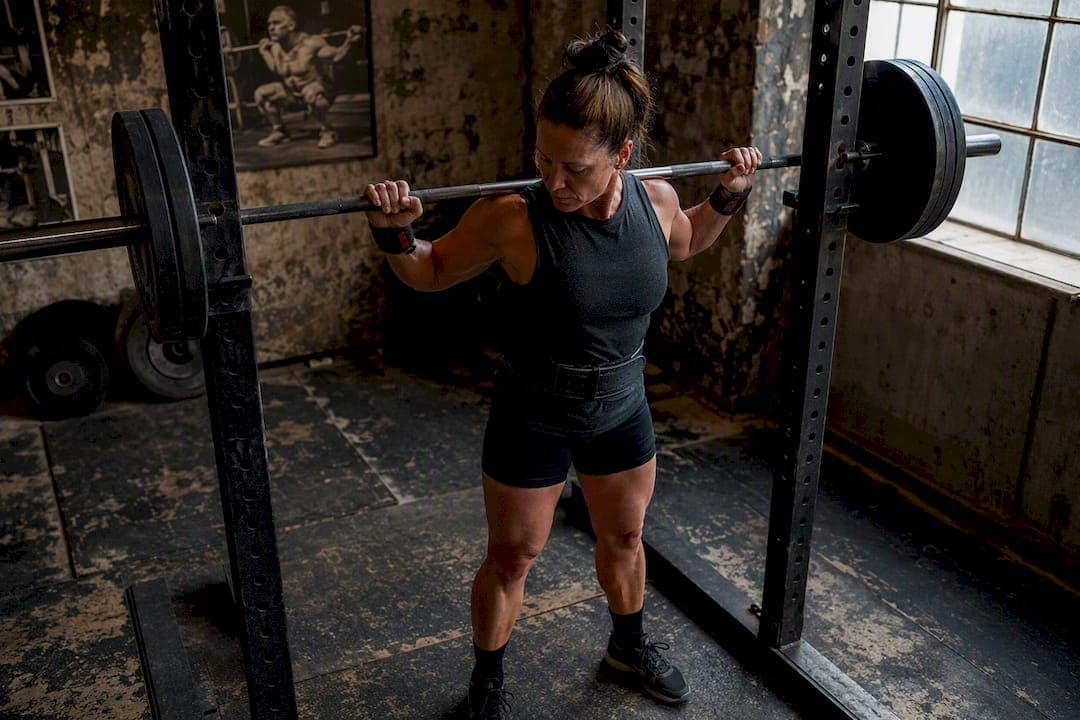
The fastest way to find your one-rep max: do a heavy set of 3 to 8 reps, then run the numbers through the Epley formula. Epley's equation is simple: 1RM = weight × (1 + reps ÷ 30). If you bench a certain weight for a moderate number of reps, you can estimate your 1RM using the Epley formula.
You don't need a chalkboard for this. Plug your set into the IronAtForty 1RM calculator and it'll run Epley, Brzycki, and a couple of other formulas at once, then average them so you're not betting your training week on a single equation's blind spot.
- Use a set you can complete with solid form, ideally 3 to 8 reps
- Plug weight and reps into Epley (or a full calculator)
- Treat the result as a working estimate, not gospel
Key Takeaways
Estimating your 1RM accurately requires a clean 3 to 8 rep test set, the Epley or Brzycki formula, and conservative rounding for older or novice lifters.
| Point | Details |
|---|---|
| Use 3 to 8 reps | This rep range gives the most reliable formula accuracy; past 10 reps, error widens. |
| Default to Epley | Epley works well for most lifts and lifters; use Brzycki for a more conservative bench number. |
| Average multiple formulas | Running Epley, Brzycki, and others together smooths individual formula bias. |
| Adjust by exercise | Deadlift estimates tend to run low due to grip fatigue; treat that number as a floor. |
| Retest every 8 to 12 weeks | Use the same rep range and formula each time so progress tracking stays consistent. |
Table of Contents
- What Are the Common 1RM Formulas and How Do Calculators Use Them?
- How Do You Test Your 1RM Step by Step?
- How Do You Safely Perform a Direct 1RM Test?
- How Accurate Are 1RM Estimates, and Which Formula Should You Trust?
- How Do You Turn Your 1RM Into Training Weights?
- How Should You Adjust 1RM Formulas for Bench, Squat, and Deadlift?
- Do Age, Gender, and Training Experience Change Your 1RM Estimate?
- What Mistakes Wreck a 1RM Calculation?
- How Should You Use Your 1RM for Programming and Tracking Progress?
- Get Your Training Numbers Dialed In
- What This Guide Gets Right That Gym-Bro Math Usually Misses
- Sources
- FAQ
What Are the Common 1RM Formulas and How Do Calculators Use Them?
Four formulas dominate strength training math, and each one treats the relationship between reps and load a little differently.
Epley: 1RM = weight × (1 + reps ÷ 30) Brzycki: 1RM = weight ÷ (1.0278 − 0.0278 × reps) Lombardi: 1RM = weight × reps^0.10 Mayhew et al. (sometimes labeled Wathan): 1RM = (100 × weight) ÷ (52.2 + 41.9 × e^(−0.055 × reps))
Epley and Brzycki produce nearly identical numbers at 10 reps, but they diverge below that, according to the Wikipedia entry on one-repetition maximum. Brzycki tends to run slightly more conservative at higher rep counts, which is why some coaches prefer it for bench press estimates. Lombardi's exponential curve handles low-rep, power-oriented sets a bit differently and is less commonly used for straight strength testing. Mayhew's formula was built from research on trained lifters and behaves well across a broader rep range.
Why do calculators show four numbers instead of one? Because no single formula fits every lifter, every lift, and every rep range perfectly. Averaging multiple formulas smooths out each one's individual bias, according to TrainCalc's guide to 1RM calculation, and calculators that report a spread (say, 210 to 220 pounds) are giving you a more honest picture than one that spits out a single suspiciously precise number.
- Epley: best general-purpose default, especially at 3 to 8 reps
- Brzycki: slightly conservative, good for bench-specific or higher-rep sets
- Lombardi: suited to low-rep, power-focused testing
- Mayhew/Wathan: validated across a wider range of trained lifters
How Do You Test Your 1RM Step by Step?
You don't need a max attempt to get a usable number. Here's the sequence that produces clean, repeatable data:
- Warm up progressively. Start light (40 to 50% of your estimated max) for 8 to 10 reps, then climb in jumps, resting 2 to 3 minutes between sets as the weight increases.
- Pick your test set. Land on a weight you can complete for 3 to 8 reps with good form. Anything past 10 reps starts degrading formula accuracy, according to the Calculators.
- Record weight and reps exactly. No half-reps counted, no rounding up your effort.
Worked example: You bench 135 pounds for 7 reps. Epley: 135 × (1 + 7 ÷ 30) = 135 × 1.233 = 166.5 pounds Brzycki: 135 ÷ (1.0278 − 0.0278 × 7) = 135 ÷ 0.833 = 162.1 pounds Average: about 164 pounds
Pro Tip: Keep your tempo, range of motion, and setup identical every time you test. A flared elbow or a high-bar squat swapped for low-bar changes the leverage enough to throw your number off by 10 pounds or more.
How Do You Safely Perform a Direct 1RM Test?
A direct test means loading the bar until you find the actual heaviest weight you can lift once. It's the most accurate method there is, but it demands more than a submaximal estimate does.
The protocol: warm up with progressively heavier singles, resting 2 to 5 minutes between attempts once weights get heavy. Add small incremental increases in load as you get closer to your maximum, and stop the moment your bar speed or technique breaks down. A spotter is non-negotiable on bench and squat.
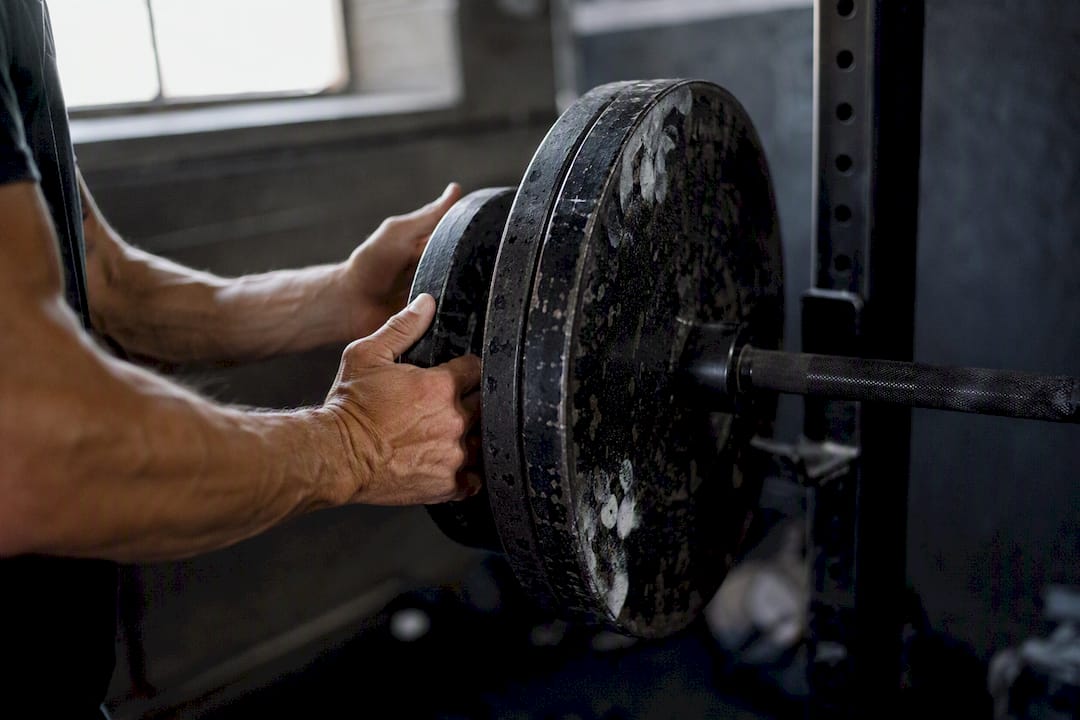
Direct maximal testing is generally not recommended for novice lifters, those without trained spotters, or individuals with specific health concerns or inadequate safety setup.
Safer alternatives exist. Submaximal estimation using a 3 to 8 rep set covers most training needs, and load-velocity profiling using a bar-speed sensor across several lighter loads can outperform classical formulas when the equipment is available. For most lifters over 40, testing directly once every 8 to 12 weeks is plenty. More frequent than that, and you're accumulating joint stress for a number you could estimate just as usefully.
How Accurate Are 1RM Estimates, and Which Formula Should You Trust?
Estimates are good, not perfect. Error tends to widen as rep count climbs past 8, and it widens further with less experienced lifters whose technique varies set to set. Validation research shows some prediction equations perform differently depending on the exercise, sex, and training background, according to a 2024 study in the IUSCA journal, which found certain formulas held up well for bench and squat in young trained adults but not universally across every population tested.
A newer weight-dependent approach shows conversion factors actually shift with absolute load and exercise type, according to a 2026 analysis on arXiv. That's worth knowing because it explains a common frustration: your Epley estimate might nail your bench but overshoot your deadlift.
Rules of thumb that hold up in practice, as explained in the Reactive Strength Index for Athletes: How to Test & Improve – htktrainingblog, include:
- Default to Epley for sets in the 3 to 8 rep range
- Use Brzycki for a more conservative bench estimate or when your set runs closer to 10 reps
- Use Lombardi for low-rep, power-focused testing
- Use load-velocity profiling if you have the equipment and want the tightest accuracy
- If you're over 40 or new to lifting, round down and treat your estimate as a ceiling, not a floor
How Do You Turn Your 1RM Into Training Weights?
Once you have a number, it's only useful if you know what to do with it. Training percentages translate your estimated max into the load you actually put on the bar for a given goal.
| Training Zone | % of 1RM | Typical Use |
|---|---|---|
| Max strength / singles | 90–100% | Peak testing, competition attempts |
| Heavy strength work | 85 to 90% | Low-rep strength blocks (3–5 reps) |
| Strength/hypertrophy | 65 to 80% | Most accessory and volume work |
| Endurance/technique | 50 to 65% | Warm-ups, deload weeks, skill work |
This chart draws from standard training-percentage ranges used across strength programming, per Calculators. Say your estimated squat 1RM comes out to 315 pounds. Round to the nearest 2.5 to 5 pounds depending on your gym's plates. Chasing the decimal is a waste of chalk.
Why Trust IronAtForty's Numbers
Ironatforty built its 1RM calculator and the broader tools collection specifically for lifters who train seriously but don't have a coach checking their math. Every formula on this page is a well-documented estimate, not a guarantee, and we cite the research behind each one rather than asking you to trust a black box.
- Run your own numbers against the calculator to sanity-check any hand math
- Formulas are approximations. Individual variation is real
- Author: Iron@40 Staff, editorial team focused on strength training for lifters over 40
How Should You Adjust 1RM Formulas for Bench, Squat, and Deadlift?
The formulas don't know which exercise you're testing, and that's exactly where they can mislead you. Upper-body lifts like bench press tend to fatigue faster per rep than lower-body compound lifts like squat and deadlift, which means a 5-rep bench set and a 5-rep squat set don't carry equivalent "distance from failure."
Deadlifts, in particular, are notorious for underestimating true 1RM when you plug in a submaximal set. Grip fatigue and lower back stabilization tend to cap your rep count before your prime movers actually hit their limit, so a 5-rep deadlift estimate often reads lower than what you could actually pull for one. Squat estimates tend to track closer to reality because the movement pattern stays more consistent across a rep range.
For bench press, Brzycki's slightly conservative curve tends to match real-world testing well. For squat, Epley works reliably across most rep ranges. For deadlift, treat any formula-derived number as a floor, and if you have access to a load-velocity device, this is the lift where it earns its keep. Isolation and accessory lifts (curls, lateral raises) don't respond to any of these formulas well at all. Skip formula-based 1RM math there entirely and just track working weights and rep progression instead.
Do Age, Gender, and Training Experience Change Your 1RM Estimate?
Yes, and this is where a lot of generic advice falls apart. The formulas were built from pooled data across mixed populations, which means they carry assumptions that don't apply evenly to everyone using them.
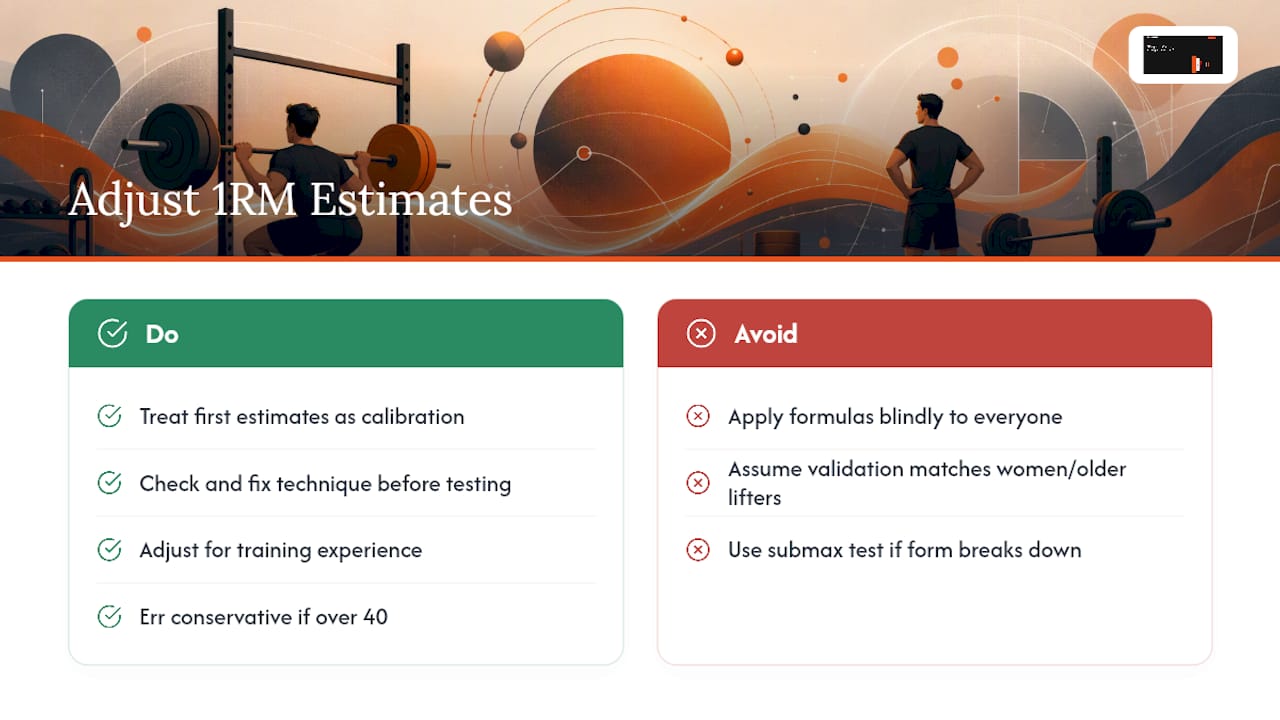
Training experience matters most. Novice lifters often have inconsistent bar speed and technique breakdown before true muscular failure, which skews submaximal tests. If your form falls apart at rep 6 because you've never trained that movement pattern before, the formula reads that as your ceiling when it's really a technique limit. Experienced lifters tend to produce more consistent, more accurate estimates because their form holds steady across a set.
Age changes the calculus in a different way. Recovery between warm-up sets slows, and connective tissue tolerates near-max loading differently than it did at 25. This isn't about capability. It's about the margin for error. If you're over 40, an estimate that reads a little low and conservative is a feature, not a bug.
Gender differences show up less in formula validity itself and more in how the underlying data was collected. Some prediction equations, including the ones examined in the IUSCA validation study, were tested primarily on specific populations, so accuracy for women or for older lifters isn't guaranteed to match the original validation cohort. Treat your first few estimates as calibration data, not fact, and adjust based on how your actual lifts compare over time.
What Mistakes Wreck a 1RM Calculation?
The single biggest mistake is testing too many reps and expecting formula-level accuracy. Once you're past 10 reps, the mathematical relationship between reps and max strength gets noisy, and every formula's error margin widens.
Bad reps are the second killer. If your "5-rep set" includes two grinders with a bounced bar path and a half-rep at the bottom, you haven't tested a true 5RM. You've tested something in between a 5RM and a 7RM, and the formula has no way to know that.
Inconsistent setup trips people up constantly. Changing your grip width, foot stance, or bar path between your test set and your next attempt to use that number means you're comparing two different exercises wearing the same name. Skipping a proper warm-up is another common one. Testing cold increases both injury risk and the odds your first working set undersells your real capacity.
Last, treating a single formula's output as an exact figure rather than an estimate causes people to load percentages too aggressively. Better to average two or three formulas, as covered above, and round conservatively rather than chase decimal precision.
How Should You Use Your 1RM for Programming and Tracking Progress?
Your 1RM estimate is a planning tool, not a scoreboard. Its real value shows up when you use it to set percentages for a training block and then track how that number moves over weeks and months.
Retest every 8 to 12 weeks, using the same rep range and formula each time so your comparisons are apples to apples. If you tested with a 5-rep Epley estimate in January, use the same method in March. Switching formulas between tests makes your "progress" partly a math artifact instead of real strength gained.
Watch the trend, not the single number. A number that stalls or dips slightly isn't necessarily bad news. It might mean you're recovering from a heavy block, or that your test-day fatigue was higher than usual. For a longer view on why chasing frequent max tests can backfire, see why you don't need a 1RM test every month.
Use your updated 1RM to recalculate training percentages at the start of each new block, not mid-cycle. Adjusting weights every session based on how you feel defeats the purpose of programming against a fixed number in the first place.
Get Your Training Numbers Dialed In
Estimating your 1RM is only half the equation. What you eat and how you recover determines whether that number goes up or stalls out. Ironatforty's nutrition guidance for lifters over 40 covers the eating side of the equation, and pairing that with the TDEE calculator gives you a full picture of calories in against training demand out. Run your next test set through the 1RM calculator and stop guessing at your working weights.
What This Guide Gets Right That Gym-Bro Math Usually Misses
Most gym advice on 1RM math treats formulas like they're precise. They're not, and pretending otherwise is where lifters get themselves into trouble, especially past 40 when a bad max attempt costs you more recovery time than it used to.
The conventional wisdom oversells direct testing as the "real" number and treats estimates as a lesser substitute. That's backwards for most lifters. A well-executed 5-rep test with consistent form gives you a number you can actually use, without the joint stress of grinding out a true single. Save direct testing for when you genuinely need it, like verifying a competition total, not as a monthly ritual.
What actually matters is consistency in how you test, not which formula you pick. Epley versus Brzycki produces a difference of a few pounds. Testing with sloppy form versus clean form produces a difference of 20 pounds or more. If you take one thing from this guide, prioritize the quality of your test set over the precision of your math, and lean conservative on your estimate if you're carrying old injuries or you're new to a lift. That's where the real risk lives, not in the third decimal place of a formula.
— Iron@40 Staff
Sources
- One-repetition maximum (Wikipedia)
- Weight-dependent generalization of 1RM prediction (arXiv, 2026)
- Calculators
- How to Calculate Your 1RM (TrainCalc guide)
- Accuracy of 1RM prediction equations before and after training (IUSCA journal, 2024)
FAQ
What is my max if I bench 135 for 7?
Using Epley, 135 × (1 + 7 ÷ 30) comes out to roughly 166.5 pounds. Brzycki gives about 162 pounds, so an averaged estimate lands near 164 pounds.
How do you calculate 1RM from 10 reps?
At 10 reps, Epley and Brzycki produce nearly identical results, per Wikipedia. Use either formula, but treat the output as a rougher estimate since accuracy declines above 8 reps.